

US & Global Reliance On Fossil Fuel Unchanged In 25 Years

Authored by Edward Ring via American Greatness,
So far this century, worldwide energy use is up nearly 60 percent, and, as anyone living in Western industrialized nations knows all too well, we have spent trillions of dollars to “decarbonize” our economy. And guess what? Our dependence on fossil fuels is unchanged.

To make this assertion, we may cite the world’s most authoritative source for comprehensive information on global fuel consumption, the Statistical Review of World Energy. For more than 75 years, an updated annual report has been released, and with the 2026 issue now available, we have the latest information on what forms of energy are most critical for maintaining human civilization. And in 2025, 86 percent of global energy came from fossil fuels: 33 percent from oil, 25 percent from natural gas, and 28 percent from coal. Nuclear power added 5 percent, hydroelectric power added 3 percent, and all renewables—biomass, biofuel, geothermal, wind, and solar combined—contributed 6 percent.
What’s most remarkable about these statistics is how little they have changed in 25 years. The Statistical Review reported that total fossil fuel consumption in 2000 represented, get ready, 87 percent of the total. Our global civilization’s reliance on fossil fuels has declined by 1 percent over the past 25 years. That’s not even a rounding error.
In the United States, the shift is greater, but not anywhere close to the trajectory demanded by the net-zero lobby. In 2000 we relied on fossil fuels for 89 percent of our total energy, and in 2025 that percentage was still 83 percent. More notable, perhaps, was that total energy consumption in the United States actually dropped slightly, from 95.8 exajoules in 2000 to 93.8 exajoules in 2025.
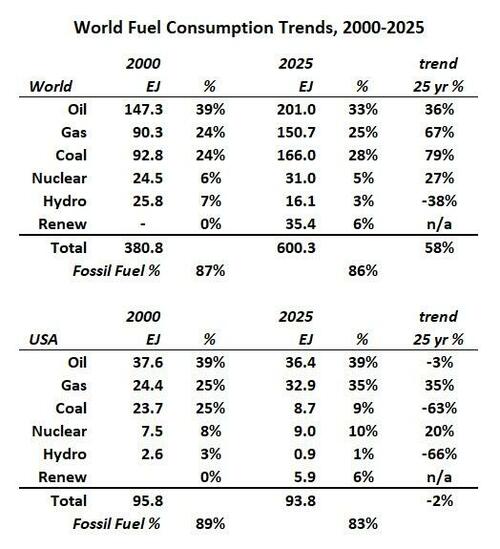
As the table shows, there are many additional, and very big, nuances to this story. Perhaps the biggest is the contrast between trends describing energy use in the United States compared to what happened in the world over the last quarter-century. To begin with, as noted, even though the U.S. population grew from 282 million to 343 million and U.S. GDP in inflation-adjusted dollars nearly doubled from $13.9 trillion to over $24.1 trillion, total energy consumption actually dropped.
Overall, total world GDP increased from an estimated $79 trillion in 2000 to roughly $180 trillion in 2025, more than doubling, while global population grew by 33 percent, from 6.2 billion to 8.2 billion. At the same time, global energy consumption is up 58 percent in the past 25 years, from 381 exajoules to just over 600 exajoules. But where is this energy coming from?
In the U.S., while total energy use declined slightly, the energy mix changed significantly. Consumption of oil stayed about the same, only dropping 3 percent from 37.6 to 36.4 exajoules. But use of natural gas jumped by 35 percent, while coal consumption dropped by a precipitous 63 percent. In 2000, coal and natural gas contributed almost equally to U.S. energy consumption, at 24.4 exajoules and 23.7 exajoules, respectively. By 2025, the contribution of natural gas to total U.S. energy jumped to 32.9 exajoules, while the use of coal plummeted to 8.7 exajoules. Also during the previous quarter century, nuclear energy in the U.S. actually grew a bit, from 7.5 to 9.0 exajoules, while hydroelectric power generation fell dramatically, from 2.6 exajoules in 2000 to only 0.9 in 2025. Hydroelectric power generation, however, is volatile because it depends on annual rainfall and snowpack.
Which brings us to renewables, which in the U.S. grew from virtually nothing in 2000 to supply 6 percent of the energy used in 2025.
For renewables to go from 0 to 6 percent is impressive, but the big story here is the persistence of fossil fuels. In the U.S., while we reduced our use of fossil fuels a bit, as noted, from 89 percent to 83 percent, for the most part we just flipped sources. We replaced coal with natural gas. But worldwide, the consumption of fossil fuels as a percentage of total energy didn’t change at all, barely dropping from 87 to 86 percent, while in absolute terms the use of fossil fuels exploded. And how the total world mix of fossil fuels changed tells a very different story from what happened in the U.S.
Worldwide consumption of oil dropped in percentage terms, from 39 to 33 percent, but the industry logged huge increases in actual production. In 2000, oil was the dominant source of energy in the world at 147.3 exajoules, and in 2025 it retained that distinction with ease, with consumption rising to 201 exajoules. In absolute terms, the use of gas and coal also grew sharply. Natural gas consumption jumped from 90.3 exajoules in 2000 to 150.7 in 2025, an increase of 67 percent. Coal experienced even greater growth, increasing 79 percent from 92.8 exajoules in 2000 to 166 in 2025.
These are a lot of numbers, but they tell an unequivocal story. If we regard the basic proportions that matter, fossil fuels power human civilization as much in 2025 as they did in 2000, despite trillions of dollars invested in renewables. Compared to fossil fuels, everything else combined is still relatively insignificant. Worldwide, as noted, nuclear power offers 5 percent of global energy; hydroelectricity offers 3 percent, and all renewables combined add another 6 percent.
It is pertinent to wonder how renewables, all of them, can possibly be poised to rapidly replace fossil fuels. Over the past 25 years, renewable sources of energy altogether went from zero to delivering to humanity 35.4 exajoules of energy. During that same 25 years, just the increase in fossil fuel consumption was 187 exajoules; that is, it went from delivering 331 exajoules in 2000 to delivering 518 exajoules. As human population moves toward its predicted peak of 10 billion people around 2050, we are going to need more energy to ensure a prosperous civilization, even if our capacity to efficiently convert energy into wealth improves even more than the U.S. was able to do over the past few decades.
These basic proportions are undeniable and lead to an inescapable conclusion. Fossil fuels are indispensable and are going to be with us for a very long time.
It’s important to recognize that the growth in renewable energy, particularly solar (photovoltaic) electricity, has been impressive. The gains have been exponential. Worldwide photovoltaic output—converting terawatt-hours to exajoules—increased from 1.76 exajoules in 2024 to 2.32 in 2025. Photovoltaic energy output is eleven times greater today than it was only ten years ago. But do we have the resources to accommodate another few decades of exponential growth?
Equally pertinent, total global battery storage capacity, despite 60 percent per year growth over the past ten years, is still, as of 2025, only equal to 1.2 terawatt-hours (ref. page 65 in the 2026 Statistical Review, “Grid-scale battery energy storage systems”). In the context of world energy, that’s nothing. It takes 278 terawatt-hours to equal one exajoule. It’s worth reflecting on this fact.
It means that even if we increased our photovoltaic output by another two orders of magnitude—roughly what would be required to even begin making a replacement-level contribution to global energy production—could we also increase our electricity storage capacity by four orders of magnitude from what it is today? Even multiplying today’s worldwide storage capacity by ten thousand would equal only 45 exajoules. Notice those battery farms going in all over? Imagine 10,000 of them where one of them now stands. That’s what it will take, at a minimum, if the world’s energy economy electrifies and does it while relying on intermittent energy sources. Does the earth have the resources to sustain such growth, and what would be the environmental impact?
These are questions everyone must ask who advocates for a net-zero future. There may be answers to these questions, but to date we don’t know what those answers are. Continuing to develop renewable energy has to take into account its own environmental impact. Biofuel cannot possibly grow much beyond current production unless we want to convert millions of square miles of farms and forests into monocultures of sugar cane and oil palm plantations. Wind energy as well is problematic; it’s a resource hog, a visual and auditory nuisance, and it wreaks havoc on the local environment. Hydroelectric power generation also has limited potential to add much more to our energy mix. Geothermal is a wild card. There are other paths, but they will take time—advanced nuclear fission, artificial photosynthesis, space-based power, fusion.
Meanwhile, policies designed to rapidly phase out fossil fuels are based on wishful thinking, and everyone familiar with basic energy statistics knows this. If proponents of net-zero cannot moderate their position against using fossil fuels, then we must justifiably question their motives.
Tyler Durden Wed, 07/29/2026 – 21:50
Source: https://freedombunker.com/2026/07/29/us-global-reliance-on-fossil-fuel-unchanged-in-25-years/
Anyone can join.
Anyone can contribute.
Anyone can become informed about their world.
"United We Stand" Click Here To Create Your Personal Citizen Journalist Account Today, Be Sure To Invite Your Friends.
Before It’s News® is a community of individuals who report on what’s going on around them, from all around the world. Anyone can join. Anyone can contribute. Anyone can become informed about their world. "United We Stand" Click Here To Create Your Personal Citizen Journalist Account Today, Be Sure To Invite Your Friends.
LION'S MANE PRODUCT
Try Our Lion’s Mane WHOLE MIND Nootropic Blend 60 Capsules
Mushrooms are having a moment. One fabulous fungus in particular, lion’s mane, may help improve memory, depression and anxiety symptoms. They are also an excellent source of nutrients that show promise as a therapy for dementia, and other neurodegenerative diseases. If you’re living with anxiety or depression, you may be curious about all the therapy options out there — including the natural ones.Our Lion’s Mane WHOLE MIND Nootropic Blend has been formulated to utilize the potency of Lion’s mane but also include the benefits of four other Highly Beneficial Mushrooms. Synergistically, they work together to Build your health through improving cognitive function and immunity regardless of your age. Our Nootropic not only improves your Cognitive Function and Activates your Immune System, but it benefits growth of Essential Gut Flora, further enhancing your Vitality.

Our Formula includes: Lion’s Mane Mushrooms which Increase Brain Power through nerve growth, lessen anxiety, reduce depression, and improve concentration. Its an excellent adaptogen, promotes sleep and improves immunity. Shiitake Mushrooms which Fight cancer cells and infectious disease, boost the immune system, promotes brain function, and serves as a source of B vitamins. Maitake Mushrooms which regulate blood sugar levels of diabetics, reduce hypertension and boosts the immune system. Reishi Mushrooms which Fight inflammation, liver disease, fatigue, tumor growth and cancer. They Improve skin disorders and soothes digestive problems, stomach ulcers and leaky gut syndrome. Chaga Mushrooms which have anti-aging effects, boost immune function, improve stamina and athletic performance, even act as a natural aphrodisiac, fighting diabetes and improving liver function. Try Our Lion’s Mane WHOLE MIND Nootropic Blend 60 Capsules Today. Be 100% Satisfied or Receive a Full Money Back Guarantee. Order Yours Today by Following This Link.


| Visits: | 1,829,906,869 |
| Stories: | 8,692,022 |
Whistler Blowers, Insiders

