

The Monumental Mistake Of Raising Rates In September

Three members of the Federal Open Market Committee voted to raise rates in July. However, the Committee held the federal funds target at 3.5%-3.75% by a 9-3 vote. Bank of America, Deutsche Bank, and J.P. Morgan all expect a September hike. Across the Atlantic, the European Central Bank raised rates by 25 basis points in June and is expected to raise them again in September.
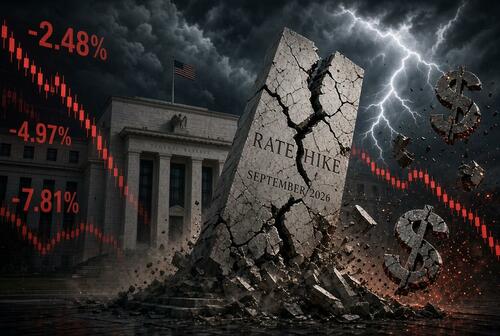
It would be a monumental mistake. The diagnosis is wrong on both sides of the Atlantic. There is no overheating, no private credit excess, and no runaway private money creation. In fact, what we have is imported temporary energy shock and a fiscal problem. Raising rates will not solve any of those issues and punish those who did not cause the persistent inflation problem.
The United States grew at an annual rate of 1.5% in the second quarter, slightly down from 2.1% in the first. Federal spending is flat. Nonfarm payrolls fell by 23,000 in July, and annual job creation is lower than the potential of the economy. This is not an overheated economy with a credit boom and a red-hot labor market that would justify a rate hike.
The European situation is not just worse. It is abysmal. Euro area GDP rose 0.4% in the second quarter, but Ireland’s 3.9% quarterly increase inflated that figure. Excluding Ireland, growth was just 0.3%. Using Irish modified domestic demand, the measure the ECB itself considers closer to real activity, euro area growth is barely 0.1% in the second quarter, estimated at 0.1% in the third, and 0.2% in the fourth, according to Eurosystem projections from June 2026. Germany, France, and Italy each grew 0.2% after a 0.2% contraction for the bloc in the first quarter. The Eurosystem projects a dreadful 0.8% for 2026, and the European Commission expects 0.9%, which was revised down. Unemployment stands at 6.3% with 11.1 million out of work, according to Eurostat.
The U.S. business lending boom has already moderated. Commercial and industrial loans grew at a 15.8% annualized pace in April, 10.8% in May, 4.0% in June, and minus 1.1% in July, according to the Federal Reserve. In the euro area, the ECB’s July survey on bank lending reports that credit standards tightened for firms on higher perceived risks, most severely in the car industry and energy-intensive manufacturing, while household loan demand fell. Tightening is already happening without central banks making it worse.
The ECB’s own monetary statistics, published this week, demolish the overheating thesis. Broad money M3 grew 3.4% annually in July, up from 3.3% in June, averaging 3.2% over three months, while M1 decelerated to 3.1% from 3.5%. With real GDP up 1.0% year on year and a deflator near 3%, money is growing at or below the pace of nominal GDP. Adjusted loans to households rose 3.1% and to non-financial corporations 4.4%. This increase is normalization after years of credit stagnation, not excess. Crucially, bank claims on euro area governments fell by 0.5%.
Admittedly, U.S. money growth looks faster, as M2 reached $23.22 trillion in July, up 5.4% year on year, according to FRED, but this figure is below the historic trend in growth periods. Furthermore, we must look at where it comes from. It is not a private lending boom, as the H.8 data show. It is the reflection of a reserve regime accommodating a massive level of Treasury issuance. The Fed’s balance sheet still holds about $6.7 trillion in Reserve Bank credit, bank reserves are $2.94 trillion, and the overnight reverse repo facility has been drained to under $1 billion. The Federal Reserve Committee explicitly states it is “continuing its policy of maintaining ample reserves in the banking system.” The only excess is in the public sector, not the private one. Consumer spending decelerated in July and flatlined against inflation.
US headline CPI eased to 3.4% in July while core inflation fell to 2.5%, with energy prices up 14.7% over twelve months. Euro area inflation was 2.9% in July, but the breakdown says everything: energy plus 10.0%; the index excluding energy, 2.2%; food, alcohol, and tobacco, 1.2%; and non-energy industrial goods, just 0.9%, according to Eurostat. Both central banks attribute the spike to the Middle East conflict.
Hiking rates would solve nothing in the energy complex and would arrive just as oil prices correct themselves, which has been happening for the past weeks.
No interest rate has ever created a barrel of oil or a cubic meter of gas. Higher rates do not make energy cheaper. They just destroy demand for everything else.
Mortgage holders and small businesses would be penalized to offset a temporary imported cost shock they did not create.
Here is the biggest problem. Monetary tightening is being loaded onto families and small firms while every mechanism that disguises sovereign solvency stays intact. The ECB keeps the Transmission Protection Instrument available to intervene in government bond markets, and Eurosystem excess liquidity still stands at €2.1 trillion, according to the ECB. The Fed maintains ample reserves and a balance sheet nearly triple its pre-2008 size versus GDP. Sovereign risk spreads remain artificially compressed, so no government faces market discipline. Governments ignore rate hikes; they just push the cost to taxpayers and continue spending. Thus, the entire burden of rate hikes falls on the shoulders of the private sector that keeps the economy afloat despite suffering persistent inflation.
That is why a hike will not produce the inflation improvements that some people imagine. No government cuts spending because rates rise. Higher debt service does not deliver budget control, only higher taxes on the private sector. Therefore, central banks would only create a double punishment, more expensive or no access to credit, and even heavier taxation, with zero effect on energy prices.
If the Fed and the ECB genuinely want to control inflation, they must stop subsidizing government borrowing; shrink the balance sheet faster; drain reserves and excess liquidity; and remove the sovereign backstops, instead of dumping the adjustment on the people who create jobs and wealth.
A September hike would be tightening for the productive economy and reckless spending for the state. A textbook monumental mistake.
We publish a variety of perspectives. Nothing written here is to be construed as representing the views of ZeroHedge.
Tyler Durden Sat, 08/29/2026 – 18:40
Source: https://freedombunker.com/2026/08/29/the-monumental-mistake-of-raising-rates-in-september/
Anyone can join.
Anyone can contribute.
Anyone can become informed about their world.
"United We Stand" Click Here To Create Your Personal Citizen Journalist Account Today, Be Sure To Invite Your Friends.
Before It’s News® is a community of individuals who report on what’s going on around them, from all around the world. Anyone can join. Anyone can contribute. Anyone can become informed about their world. "United We Stand" Click Here To Create Your Personal Citizen Journalist Account Today, Be Sure To Invite Your Friends.
LION'S MANE PRODUCT
Try Our Lion’s Mane WHOLE MIND Nootropic Blend 60 Capsules
Mushrooms are having a moment. One fabulous fungus in particular, lion’s mane, may help improve memory, depression and anxiety symptoms. They are also an excellent source of nutrients that show promise as a therapy for dementia, and other neurodegenerative diseases. If you’re living with anxiety or depression, you may be curious about all the therapy options out there — including the natural ones.Our Lion’s Mane WHOLE MIND Nootropic Blend has been formulated to utilize the potency of Lion’s mane but also include the benefits of four other Highly Beneficial Mushrooms. Synergistically, they work together to Build your health through improving cognitive function and immunity regardless of your age. Our Nootropic not only improves your Cognitive Function and Activates your Immune System, but it benefits growth of Essential Gut Flora, further enhancing your Vitality.

Our Formula includes: Lion’s Mane Mushrooms which Increase Brain Power through nerve growth, lessen anxiety, reduce depression, and improve concentration. Its an excellent adaptogen, promotes sleep and improves immunity. Shiitake Mushrooms which Fight cancer cells and infectious disease, boost the immune system, promotes brain function, and serves as a source of B vitamins. Maitake Mushrooms which regulate blood sugar levels of diabetics, reduce hypertension and boosts the immune system. Reishi Mushrooms which Fight inflammation, liver disease, fatigue, tumor growth and cancer. They Improve skin disorders and soothes digestive problems, stomach ulcers and leaky gut syndrome. Chaga Mushrooms which have anti-aging effects, boost immune function, improve stamina and athletic performance, even act as a natural aphrodisiac, fighting diabetes and improving liver function. Try Our Lion’s Mane WHOLE MIND Nootropic Blend 60 Capsules Today. Be 100% Satisfied or Receive a Full Money Back Guarantee. Order Yours Today by Following This Link.


| Visits: | 1,832,488,741 |
| Stories: | 8,707,603 |
Whistler Blowers, Insiders

