

Radiant Wins First-Ever DOE OK For Full-Power Microreactor As Nuclear Stocks Crash To Multi-Year Lows

For the first time ever, Washington has signed off on a commercial nuclear microreactor running at full power. On Wall Street, nobody seems to care.
On Thursday, the Department of Energy approved the Documented Safety Analysis (DSA) for LA-based Radiant’s Kaleidos, a 1-megawatt, truck-transportable reactor that is now sitting inside the DOME test bed at Idaho National Laboratory. According to the company, it is the only microreactor design to secure DOE safety approval covering operation at power, as opposed to the zero-power criticality tests that every other entrant in the DOE pilot program has run so far.
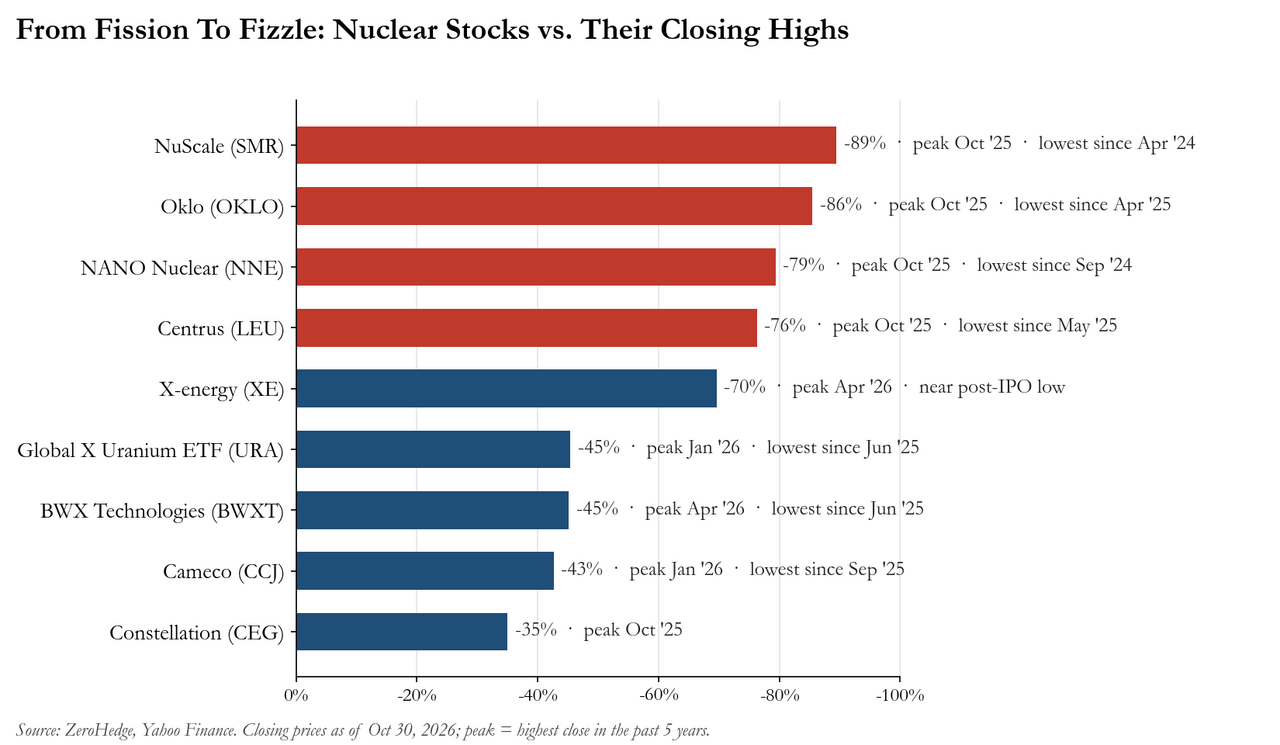
And yet the stocks most levered to the small modular reactor story are trading like the industry is going out of business: Oklo (OKLO) closed Friday at $25.25, down 86% from its October 2025 peak and at its lowest since April 2025, while NuScale (SMR) is down 89% and sitting at a price last seen in April 2024.
Regular readers know we have been tracking the microreactor buildout since well before it was a meme (and long before it stopped being one), so let’s take a closer look at what Radiant actually got, where the rest of the pack stands, and why the market has decided none of it matters, at least for now.
What Radiant Actually Won
The DSA approval is the step that comes after DOE signed off on Radiant’s preliminary safety analysis back in February. With it in hand, Radiant moves into DOE’s Readiness Review, which will check whether the reactor and the crew operating it are ready to go nuclear. Once that is done, Radiant fuels Kaleidos and kicks off a five-phase test campaign at the National Reactor Innovation Center’s DOME facility.
The campaign goes from first criticality through progressively higher power, and ends with at least 150 hours of continuous full-power operation with no operator intervention. Radiant also plans to run the same unit for 60 effective full-power days over several months, using essentially the same design and custom fuel that customers will get. DOE’s acting Deputy Assistant Secretary for Nuclear Reactors Chimi Zacot called it “another important step forward in President Trump’s vision for an American nuclear renaissance.”
Which, to be fair, is a meaningful upgrade from what we have seen so far. As we covered in “The Rebirth Of America’s Nuclear Industry” (Jun 5) and then in “Four By The Fourth“, Antares, Valar Atomics, Deployable Energy and Aalo all hit criticality at INL ahead of Trump’s July 4 deadline, and Oklo’s Groves test reactor in Texas followed on August 5. But those were zero-power demonstrations: proof the physics works, with nothing plugged into the other end. Kaleidos is being cleared to actually make power, for weeks at a time.
The commercial pipeline behind the box is also starting to look real:
- Army / DIU: a binding agreement worth up to $750 million for 15 Kaleidos units under the Army’s Janus program (Aug 26), one of the largest awards DIU has ever made.
- Air Force / DIU: selected in April to develop and operate a microreactor at Buckley Space Force Base in Colorado, with first commercial units to Buckley and Fort Benning in 2028.
- Navy: picked on October 20 to deploy Kaleidos at Naval Weapons Station Crane in Indiana, making Radiant the only nuclear company working with all three branches.
- Equinix: a commercial agreement for 20 units, the data center angle that matters most for the AI power trade.
Factory production is slated for Radiant’s 300,000-square-foot R-50 campus in Oak Ridge, Tennessee, which will also handle fueling, refueling and spent-fuel storage, so that customer sites never store spent fuel. Each unit runs up to five years between refuelings, needs no cooling water and has a 20-year design life. In other words, this is the closest thing yet to the plug-and-play “energy in a box” that the behind-the-meter crowd has been promising for years.
We have, of course, been on this story for a while: we flagged the Army’s plan to put nuclear microreactors on its bases by 2028 a year ago this week, declared that “The Microreactor Race Is On” in March, and noted in August that Kaleidos had locked up its fuel supply into the 2030s. And when the Pentagon first opened the microreactor door to the SMR names back in April 2025, we summed up the market’s mood in one word:
OKLO SELECTED BY THE US DOD AS ONE OF THE COMPANIES ELIGIBLE TO PROVIDE MICROREACTOR POWER SYSTEMS TO MILITARY BASES
jackpot
— zerohedge (@zerohedge) April 10, 2025
Oklo traded in the low $20s back then. It is at $25 now, after a round trip to $174. Some jackpot.
Meanwhile, In The Other Nuclear Market…
So with reactors going critical, the military writing checks and DOE finally approving full-power runs, the stocks must be ripping?
Well, no. October was brutal. From October 1 to October 30, Oklo lost 30%, NuScale 28%, NANO Nuclear (NNE) 26% and Centrus (LEU) 26%, while the S&P 500 slipped about 1%. The only name in the sector that held up was Constellation (CEG), which has the small advantage of owning reactors that already exist and sell power to Google.
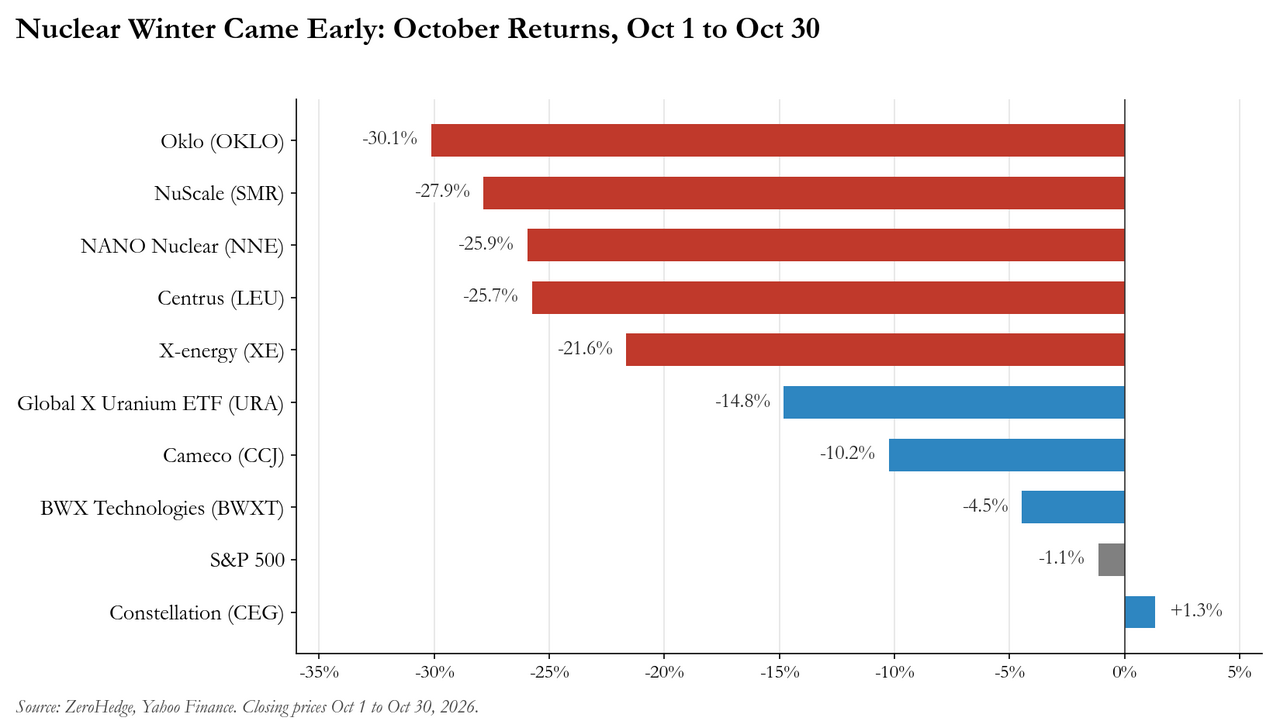
Even X-energy (XE), the “safe” SMR IPO of April, is down 70% from its post-debut high and trading near its lows. As for the multi-year lows: NuScale is at levels last seen in April 2024, NANO Nuclear in September 2024, Oklo in April 2025 and Centrus in May 2025. That’s 12 months of nuclear-renaissance headlines erased, and in NuScale’s case closer to 30.
What changed?
Mostly rates. The big break came on October 14, when the hotter-than-expected September CPI report pushed the 10-year Treasury yield to 5.26%; Oklo fell 8.6% that day and NuScale roughly 10%, per TIKR. For companies whose first meaningful revenue is years away, the math is brutal. UBS, which cut its Oklo target to $41 in late September, values the company on year-end 2034 EBITDA discounted back 6.5 years at Oklo’s cost of capital. BofA’s $80 price objective (still a Buy) is built on a DCF that assumes a 4.6% risk-free rate. The 10-year has spent most of October well above that (it’s a little lower now, but not by much).
Put differently, every 25bps on the long end takes a visible bite out of a valuation that lives almost entirely in the 2030s.
Then came the downgrade parade. Over the span of a few days around October 20-22, Piper Sandler cut Oklo to $49 from $55, Barclays to $59 from $76 (and moved NuScale to Underweight on the lack of binding contracts), Citi chopped Oklo to $33 from $57.50 while slapping a $4 target on NuScale with a Sell, and Truist slashed its target to $31 from $51. Citi pinned the weakness on higher rates, policy uncertainty and rising costs; for good measure, TD Cowen then initiated Oklo at Hold with a $26 target, which the stock promptly hit. Street targets now range from $26 to $80, which is either a screaming buy signal, or a reminder that price targets tend to follow price, and not the other way around.
The dilution math doesn’t help either: Oklo’s share count is up 26%, with about $3 billion in cash and marketable securities as of June 30 against an estimated $6.5 billion of cash burn through 2030, according to TIKR’s tally of consensus. NuScale, for its part, just launched a fresh $750 million at-the-market program.
Goldman: “Time To Reengage?” … One Week Too Early
Which brings us to the sell side, and a small case study in timing.
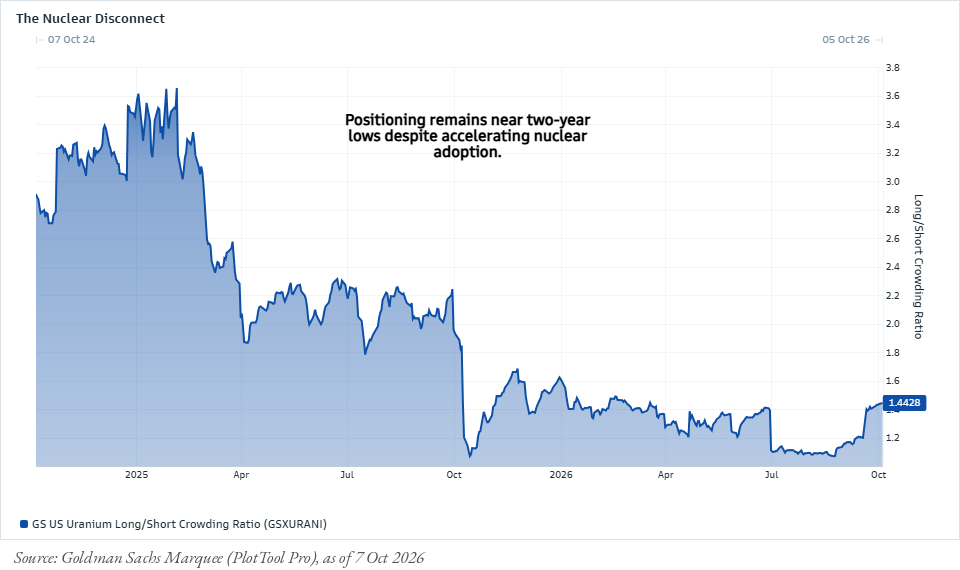
On October 6, the day nuclear stocks were enjoying a burst of good news (a $4 billion DOE loan for Vistra, $120 billion for reactors in the US-Korea investment package and Alphabet’s 20-year PPA with Constellation), Goldman’s Nelson Armbrust noted that positioning in the bank’s Uranium basket (GSXURANI) was “at the lows,” and asked whether it was “time to reengage?”
A day later, Goldman’s Marquee team doubled down in its Overlay note, “The Nuclear Disconnect” (available to pro subs), with equity derivatives salesman Cullen Morgan writing that while nuclear investment keeps accelerating, positioning in uranium-related equities remains near the low end of recent ranges. The chart was hard to argue with: the GS long/short crowding ratio for the uranium basket had collapsed from about 3.6 in early 2025 to around 1.4, near two-year lows.
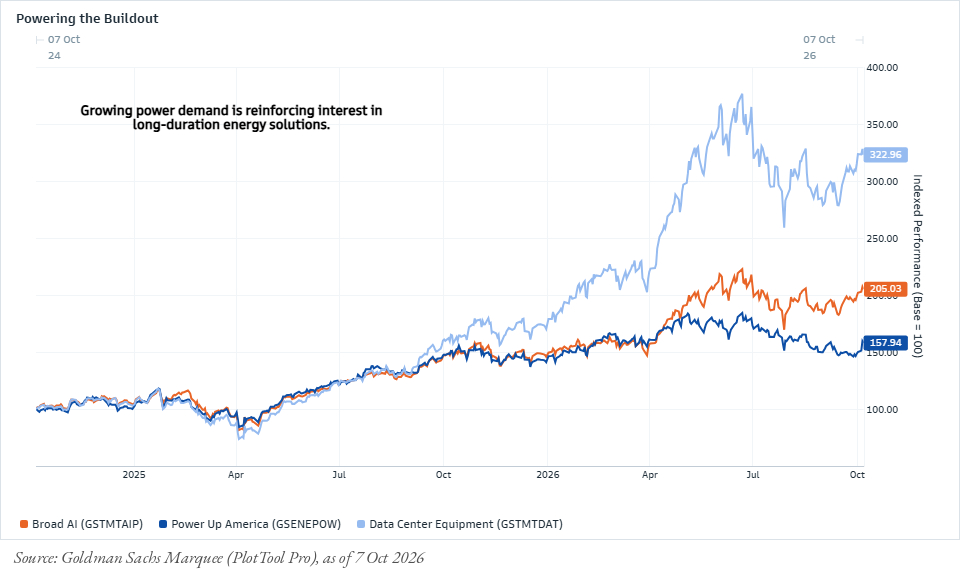
Goldman’s argument was that the market was ignoring the fundamental backdrop, which it illustrated by showing its Data Center Equipment basket up more than 3x since October 2024, and its broad AI basket roughly doubling, while the Power Up America basket lagged far behind.
The bank’s preferred expressions were a GSXURANI November 107.5%/125% call spread and a URA Nov-26 45/50 call spread (with URA at $40.19 at the time). URA closed Friday at $33.73, which leaves the lower strike roughly 33% out of the money with three weeks to go. Positioning, it turns out, can always get lower.
Goldman’s own fundamental analysts were more cautious. In his October 12 “Nuclear Nuggets” note (also available to pro subs), GS utilities and clean tech analyst Brian Lee showed that the bank’s nuclear coverage had underperformed the S&P 500 by 24% over the prior quarter, with short interest rising in both SMR and OKLO over the prior month; and by October 22, Lee’s team picked Oklo as Clean Tech’s weakest mid/large-cap performer of the month in Goldman’s Energy, Utilities & Mining Pulse.
We went through much of this in last week’s “Everyone Wants Nuclear Power, Nobody Wants Nuclear Stocks“, where the paradox was that utilities and hyperscalers are scrambling for every nuclear megawatt they can uprate or restart, while the equity market dumps anything that won’t generate power before the end of the decade.
Everyone Wants Nuclear Power, Nobody Wants Nuclear Stocks: Inside The Great Uprate Rush https://t.co/EVGf2mQPJl
— zerohedge (@zerohedge) October 26, 2026
Radiant’s approval sharpens that split. The tech is clearly moving: ironically, the most important microreactor milestone of the year belongs to a private company, and public investors can’t buy it.
Where The Listed Names Actually Stand
For the public names, the regulatory clock is still measured in years:
- Oklo: Groves went critical in August, and DOE approved the preliminary safety analysis for the first Aurora powerhouse at INL in June, but Aurora’s commercial debut is still targeted for 2028. As BofA put it after the company’s analyst day, Groves is a test reactor and a “useful execution reference point” rather than validation of the power business. Oklo also lost its PJM interconnection queue fight at FERC in late September.
- NANO Nuclear: the NRC accepted the KRONOS construction permit application in May, with the agency’s schedule pointing to a final safety evaluation around September 2027 and construction starting in the second half of 2027. NANO also just brought in Hyundai Engineering on the Illinois build.
- NuScale: still the only SMR with an NRC design certification, and still without the kind of binding commercial order that would let Barclays and Citi stop calling it a Sell.
Meanwhile, Radiant aims to start delivering reactors to the military in 2028 and to have 15 units in the Army’s hands by 2030. If the DOME campaign goes as planned, the first company to run a commercial microreactor at full power in the US may well be one that isn’t public, and won’t be swept up in whatever happens to the 10-year next.
Next up: Oklo and NuScale both report Q3 results this week, with consensus expecting Oklo to book roughly $99,000 in quarterly revenue. That’s not a typo.
The Physics Is Done Arguing; The Discount Rate Isn’t
So who’s right: the engineers, or the market?
Probably both, just on different clocks. The case for modular nuclear has never been stronger, and Radiant’s approval is the clearest sign yet that the regulatory machine Trump rebuilt last year is actually producing hardware on schedule. With the grid queue now measured in years, and data centers in PJM about to be told to bring their own power, small reactors sitting behind the meter are probably the long-term answer, as we have said many times before.
But the market isn’t paying for 2035 megawatts with a 10-year north of 5%, especially from companies that will need to raise several billion more before they get there. As long as long-end yields keep doing what they have been doing (and with Warsh’s Fed and the global bond rout, there is little reason to expect relief), the nuclear trade will remain a bet on the term premium as much as on fission. Goldman’s “time to reengage” call may well end up being right; it was just early by a few hundred basis points of drawdown.
Then again, there is something fitting about a reactor that needs 150 hours of uninterrupted full power to prove itself. The nuclear stocks will need about the same from the bond market.
Much more in the full Goldman “The Nuclear Disconnect” Overlay and the “Nuclear Nuggets” note, both available to pro subs.
Source: https://freedombunker.com/2026/11/01/radiant-wins-first-ever-doe-ok-for-full-power-microreactor-as-nuclear-stocks-crash-to-multi-year-lows/
Anyone can join.
Anyone can contribute.
Anyone can become informed about their world.
"United We Stand" Click Here To Create Your Personal Citizen Journalist Account Today, Be Sure To Invite Your Friends.
Before It’s News® is a community of individuals who report on what’s going on around them, from all around the world. Anyone can join. Anyone can contribute. Anyone can become informed about their world. "United We Stand" Click Here To Create Your Personal Citizen Journalist Account Today, Be Sure To Invite Your Friends.
LION'S MANE PRODUCT
Try Our Lion’s Mane WHOLE MIND Nootropic Blend 60 Capsules
Mushrooms are having a moment. One fabulous fungus in particular, lion’s mane, may help improve memory, depression and anxiety symptoms. They are also an excellent source of nutrients that show promise as a therapy for dementia, and other neurodegenerative diseases. If you’re living with anxiety or depression, you may be curious about all the therapy options out there — including the natural ones.Our Lion’s Mane WHOLE MIND Nootropic Blend has been formulated to utilize the potency of Lion’s mane but also include the benefits of four other Highly Beneficial Mushrooms. Synergistically, they work together to Build your health through improving cognitive function and immunity regardless of your age. Our Nootropic not only improves your Cognitive Function and Activates your Immune System, but it benefits growth of Essential Gut Flora, further enhancing your Vitality.

Our Formula includes: Lion’s Mane Mushrooms which Increase Brain Power through nerve growth, lessen anxiety, reduce depression, and improve concentration. Its an excellent adaptogen, promotes sleep and improves immunity. Shiitake Mushrooms which Fight cancer cells and infectious disease, boost the immune system, promotes brain function, and serves as a source of B vitamins. Maitake Mushrooms which regulate blood sugar levels of diabetics, reduce hypertension and boosts the immune system. Reishi Mushrooms which Fight inflammation, liver disease, fatigue, tumor growth and cancer. They Improve skin disorders and soothes digestive problems, stomach ulcers and leaky gut syndrome. Chaga Mushrooms which have anti-aging effects, boost immune function, improve stamina and athletic performance, even act as a natural aphrodisiac, fighting diabetes and improving liver function. Try Our Lion’s Mane WHOLE MIND Nootropic Blend 60 Capsules Today. Be 100% Satisfied or Receive a Full Money Back Guarantee. Order Yours Today by Following This Link.


| Visits: | 1,836,855,864 |
| Stories: | 8,730,385 |
Whistler Blowers, Insiders

