What if Election 2016 Fails to Give Either Presidential Candidate 270 Electoral Votes? The Twelfth Amendment Sets In…


By Michael T. Bucci / GlobalResearch.ca
The Twelfth Amendment of the U.S. Constitution stipulates the President is elected by the House of Representatives, and the Vice President is elected by the Senate.
What if the results of Election 2016 failed to give either major party presidential candidate 270 Electoral votes? In this event, the Twelfth Amendment of the U.S. Constitution stipulates the President is elected by the House of Representatives, and the Vice President is elected by the Senate. This process is referred to as “contingent election”.
What are the chances of this event occurring?
Which House and which Senate is stipulated: the sitting or the newly elected? What deadline dates are imposed? What occurs when either the upper house or lower house – or both houses – reach a stalemate? When does the Supreme Court decide the outcome?
In an election year when voters are asked to believe “Trump is a Russian agent” and Hillary “should be shot by a firing squad”, polling firms are facing inordinate numbers of respondents choosing “Other”, “Not Sure”, “Won’t Vote” categories; voters who mask their preference and voters altogether unhappy with both major party candidates. For these reasons and more, the 2016 election has been dubbed the “The Year of Neither”.
Reuters/Ipsos 5 Day Rolling poll released July 29 asked, “If the election were held today would you vote for Donald Trump or Hillary Clinton?” Clinton led Trump 40.5% to 34.6%; Refused 11.7%; Other 8.2%; Wouldn’t Vote 5.0%.
The methodology used in this poll differed from previous Reuters/Ipsos polls. The category “Neither/Other” was changed to “Other” eliminating the option “Neither”.
This change proved controversial especially to neoliberal and pro-Trump web sites like ZeroHedge.com and Breitbart.com.
To explain why Reuters/Ipsos results three days earlier (July 26) using prior methodology had Trump ahead of Clinton by one-point but after new methodology (July 29) had Clinton ahead of Trump by six points, Zero Hedge concluded, “Trump was soaring in the polls … the real reason for the (Reuters/Ipsos) ‘tweak’ was to push Hillary back in the lead simply due to a change in the question phrasing methodology.”
A PR release circulated to conservative and pro-Trump web sites read, “Breitbart News noted the 17-point swing for Trump, which seems to have set off alarm bells at Reuters.”
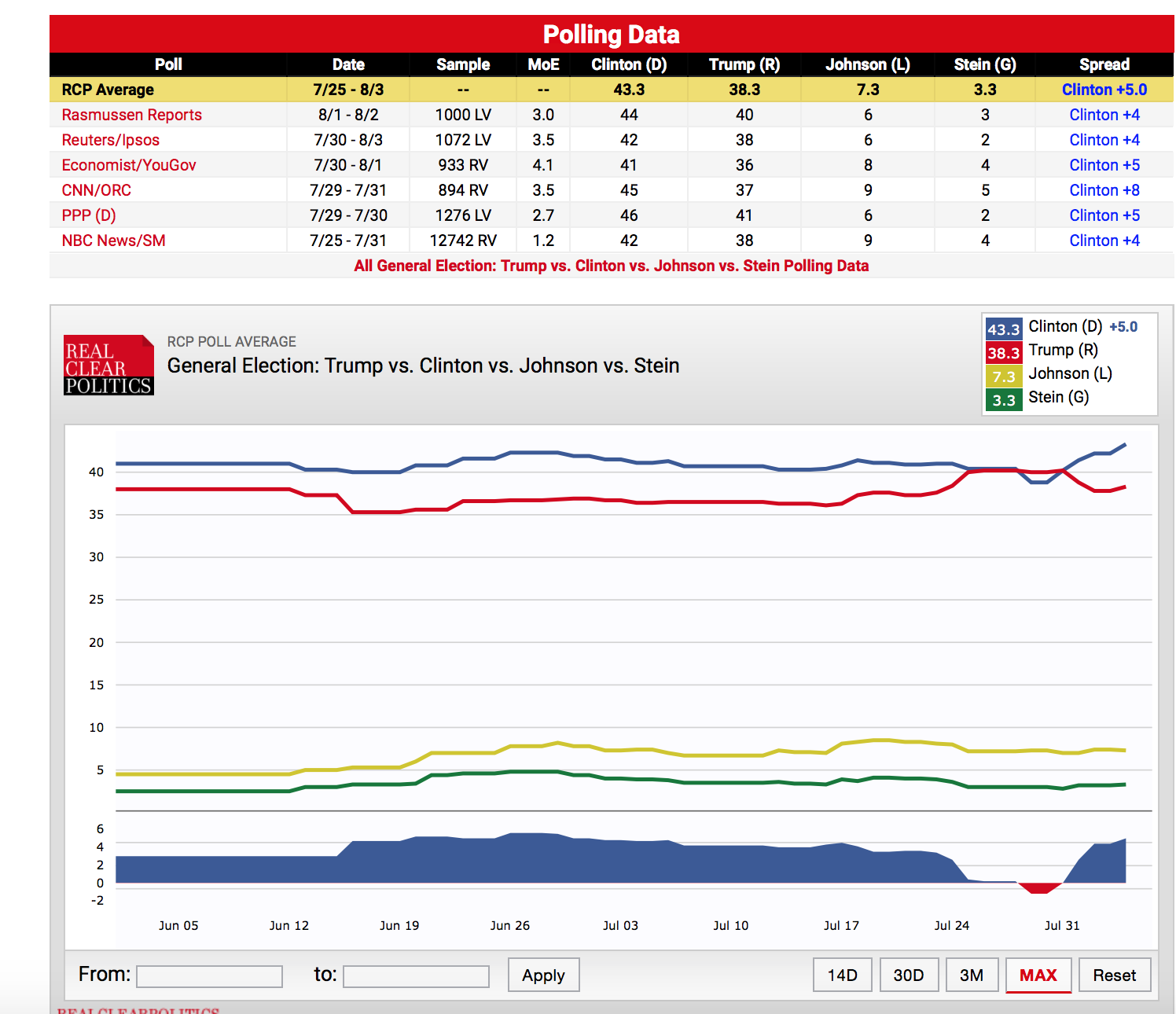
Conspiratorial explanations aside, polling compiled and aggregated by RealClearPolitics.com in the week of July 25 to August 1 showed Clinton ahead by one to nine points in seven out of eight polls conducted by eight different pollsters. If Reuters “tweaked” it, so must have seven others.
Furthermore, Real Clear Politics RCP Poll Average (compiled poll averages) of the last three months shows Trump led only during two three-day periods from May 22-25 (+ .2%) and from July 25- 28 (+1.1%).
While Reuters/Ipsos polls are widely followed, so too are polls from Gallup, Pew, Rasmussen, NBC News/SM, CBS News, CNN/ORC, Economist/YouGov and others.
It hasn’t been a bad year for pollsters, according to Nate Silver at FiveThirtyEight.com. In the 2016 primaries “the polling averages had a good track record of calling winners, with the polling front-runner winning the vast majority of the time.”
Silver rated pollsters based both on past accuracy and on two measurable methodologies.
How did they do? ABC/WaPo (A+); Monmouth (A+); Ipsos (A-); NBC (A-); CBS (A-); CNN (A-); Pew (B+); YouGov (B); Gallop (B-); Rasmussen (C+).
With Trump and Clinton vying for the highest negativity ratings, the system does allow for “third party” candidates.
Although third parties haven’t had an impact since Teddy Roosevelt won 27-percent of the popular vote in 1912, Green and Libertarian parties are on most state ballots. As of August 3, the Green Party (gp.org) has ballot access in 24 states and D.C., and the Libertarian party (lp.org) in 36 states.
In the 2012 presidential election, Jill Stein and the Green Party secured 0.36% of the popular vote and Gary Johnson of the Libertarian party secured 0.99% of the popular vote. Neither secured one electoral vote. This election year promises to yield significantly higher percentages for each candidate across the country, though.
Comparing 2012 and 2016 polling data averages compiled by RealClearPolitics shows as much.
Percentage share of popular vote by major party candidates:
RCP Average Polling Data for July 9-31, 2012 showed the two major party contenders (Obama and Romney) together secured 92% of the popular vote:
2012: Obama (47%), Romney (45%) = 92% combined
RCP Average Polling Data for August 1, 2016 showed a significant drop by the two major party contenders (Clinton and Trump) who together secured only 80% of the popular vote –– a decline in the combined share of the popular vote of 12-percent.
2016: Clinton (42.2%), Trump (37.8%) = 80% combined
Percentage share of popular vote by third parties and “other”:
Taking up 10.6% of the popular vote this year (as of August 1) are Gary Johnson/Libertarian (7.4%) and Jill Stein/Green (3.2%). The remaining 9.4% are “Other” voters.
2012: Green and Libertarian share of popular vote = 1.35% combined (2012 Final)
2016: Green and Libertarian share of popular vote = 10.6% combined (July 31, 2016)
It is rare for a third party and independent candidate to earn electoral votes; none have since 1968 when George Wallace carried five Southern states earning 46. Ross Perot became the most successful independent candidate in 1992. He drew 19-percent of the total vote but not one electoral vote.
As Michael Medved at The Daily Beast pointed out in 2011, “No candidate without major party backing can be president if we don’t get rid of the Electoral College.”
Due to vagaries of the “winner-take-all” Electoral College system, a strong third party candidate or the sum of two or more “third parties” winning electoral votes could keep Trump or Clinton from reaching the 270 electors needed. It only happened once – in 1824 – when John Quincy Adams won despite Andrew Jackson having gained popular and electoral pluralities.
In such an event, the top three leaders in electoral votes are sent to the newly elected U.S. House (taking office January 3) where each state’s delegation gets one vote. Two-thirds of the House must be present and the winner needs a simple majority vote.
Because each state casts one vote, Vermont with its three electoral votes or New Hampshire with its four yield as much clout as California with its 55. Pundits predict that if thrown to the House, Republicans would control the outcome because they dominate more, smaller states.
The Vice President is elected separately by the newly elected Senate, which is limited to choosing from the top two, not three VP candidates. So if on January 3, 2017 Republicans control the House and Democrats the Senate we feasibly could have Donald Trump as President and Tim Kaine as Vice President.
What if either house or both houses reach a stalemate?
If the House is unable to elect a President by January 20, the Vice President-elect serves as Acting President until the impasse is resolved. If the Senate is unable to elect a Vice President by January 20, then the newly elected Speaker of the House serves as Acting President.
Further permutations exist and party strategists are already building “what-if” models.
For example, Ilya Shapiro of the Cato Institute, a Libertarian think-tank, explained in USA Today (June 1, 2016) how Gary Johnson could give us President Paul Ryan.
Let’s assume Gary Johnson campaigned strategically and won enough electoral votes to deny Hillary and Trump the 270 needed.
So what happens if the election goes to the House? … If even five of those red states refuse to vote for Trump, there’s no majority and no president … If the Democrats take the upper chamber, House Republicans will have to reach a presidential agreement to prevent Hillary’s vice presidential nominee from becoming acting president. And if the Republicans keep the Senate, it could be that they prefer Trump’s vice president to The Donald himself … Oh, and there’s one more possibility: If the Senate is tied — or enough senators abstain to again prevent a majority of the whole body — then we’ll have four years of President Paul Ryan, who as House speaker is next in line. Wouldn’t that be huge?
But Washington Post’s Amanda Skuldt will tell you why it is unlikely for a third party candidate to win the presidency (August 2). She maintains, “Political science says no … The answer lies in what is known among political scientists as Duverger’s Law.”
In the essay “Duverger’s Law: Why American Third Parties Are Hopeless Fantasies”, Brian Underwood explains “the number of major political parties in any given republican/democratic country is determined by the electoral structure of that country. States with proportional representation – those that award seats to political parties based on the total portion of the popular vote they receive – tend to develop a multi-party system. Single-district plurality voting systems in which seats are allocated district-by-district based on which candidate wins the most votes in that single district – such as the United States – produce a two-party system.”
So how could a third party succeed? Amanda Skuldt explains:
A critical mass of people would have to defect from one party to the new party, essentially causing the old party to crumble and the new (formerly third) party to take its place … That’s what happened the last time a third party won the U.S. presidency in 1860, putting Abraham Lincoln in the seat. The insurgent Republican Party replaced its predecessor, the Whig Party, after the Whigs unraveled over slavery during the 1850s.
Other than this, to encourage more third parties our voting systems would require dramatic revision, she concluded.
Generally, political pundits like to group voters into either the practical/pragmatic category or the idealist/pure one. Mrs. Clinton is all of the former and Bernie Sanders all the latter; leaving Donald J. Trump in the “yet to be classified” category.
But it is fair to say that 2016 is a “none of the above”, “neither”, “won’t vote”, “don’t know”, rowdy, tumultuous period that pundits might be humbled to learn the political science rulebook isn’t the guidebook to follow or apply in this political year.
Imagine if Bernie Sanders joined Jill Stein and pulled enough Millennial votes to win several electoral ones and Gary Johnson won several electors from a number of libertarian-leaning states, a “contingent election” would occur activating the Twelfth Amendment.
But if an “October Surprise” occurred – a large terrorist act on American soil that would benefit Donald Trump, or a hot war with Russia that would benefit Hillary – all bets are off!
* * * *
Scoreboard
As of August 1: RealClearPolitics’ RCP Average polling data on a 4-way race was Clinton (42.2%); Trump (37.8%); Gary Johnson/Libertarian (7.4%); Jill Stein/Green 3.2%).
Michael T. Bucci is a retired public relations executive who currently resides in New England. He has written nine books on practical spirituality collectively titled The Cerithous Material.
www.globalresearch.ca contains copyrighted material the use of which has not always been specifically authorized by the copyright owner. We are making such material available to our readers under the provisions of “fair use” in an effort to advance a better understanding of political, economic and social issues. The material on this site is distributed without profit to those who have expressed a prior interest in receiving it for research and educational purposes. If you wish to use copyrighted material for purposes other than “fair use” you must request permission from the copyright owner.
For media inquiries: [email protected]
Anyone can join.
Anyone can contribute.
Anyone can become informed about their world.
"United We Stand" Click Here To Create Your Personal Citizen Journalist Account Today, Be Sure To Invite Your Friends.
Before It’s News® is a community of individuals who report on what’s going on around them, from all around the world. Anyone can join. Anyone can contribute. Anyone can become informed about their world. "United We Stand" Click Here To Create Your Personal Citizen Journalist Account Today, Be Sure To Invite Your Friends.
LION'S MANE PRODUCT
Try Our Lion’s Mane WHOLE MIND Nootropic Blend 60 Capsules
Mushrooms are having a moment. One fabulous fungus in particular, lion’s mane, may help improve memory, depression and anxiety symptoms. They are also an excellent source of nutrients that show promise as a therapy for dementia, and other neurodegenerative diseases. If you’re living with anxiety or depression, you may be curious about all the therapy options out there — including the natural ones.Our Lion’s Mane WHOLE MIND Nootropic Blend has been formulated to utilize the potency of Lion’s mane but also include the benefits of four other Highly Beneficial Mushrooms. Synergistically, they work together to Build your health through improving cognitive function and immunity regardless of your age. Our Nootropic not only improves your Cognitive Function and Activates your Immune System, but it benefits growth of Essential Gut Flora, further enhancing your Vitality.

Our Formula includes: Lion’s Mane Mushrooms which Increase Brain Power through nerve growth, lessen anxiety, reduce depression, and improve concentration. Its an excellent adaptogen, promotes sleep and improves immunity. Shiitake Mushrooms which Fight cancer cells and infectious disease, boost the immune system, promotes brain function, and serves as a source of B vitamins. Maitake Mushrooms which regulate blood sugar levels of diabetics, reduce hypertension and boosts the immune system. Reishi Mushrooms which Fight inflammation, liver disease, fatigue, tumor growth and cancer. They Improve skin disorders and soothes digestive problems, stomach ulcers and leaky gut syndrome. Chaga Mushrooms which have anti-aging effects, boost immune function, improve stamina and athletic performance, even act as a natural aphrodisiac, fighting diabetes and improving liver function. Try Our Lion’s Mane WHOLE MIND Nootropic Blend 60 Capsules Today. Be 100% Satisfied or Receive a Full Money Back Guarantee. Order Yours Today by Following This Link.


| Visits: | 1,822,147,856 |
| Stories: | 8,673,725 |
Whistler Blowers, Insiders