

THE CEUTA CROSSING: Anatomy of a Manufactured Crisis


Freddie Ponton
21st Century Wire
On the African side of the Strait of Gibraltar, a narrow border separates Morocco from a piece of Spain. On the night of July 29, that border gave way. Tens of thousands of young men surged into Ceuta by land and sea, following online claims that the crossing had been opened. By morning, bodies were being pulled from the water and collected from the fence.
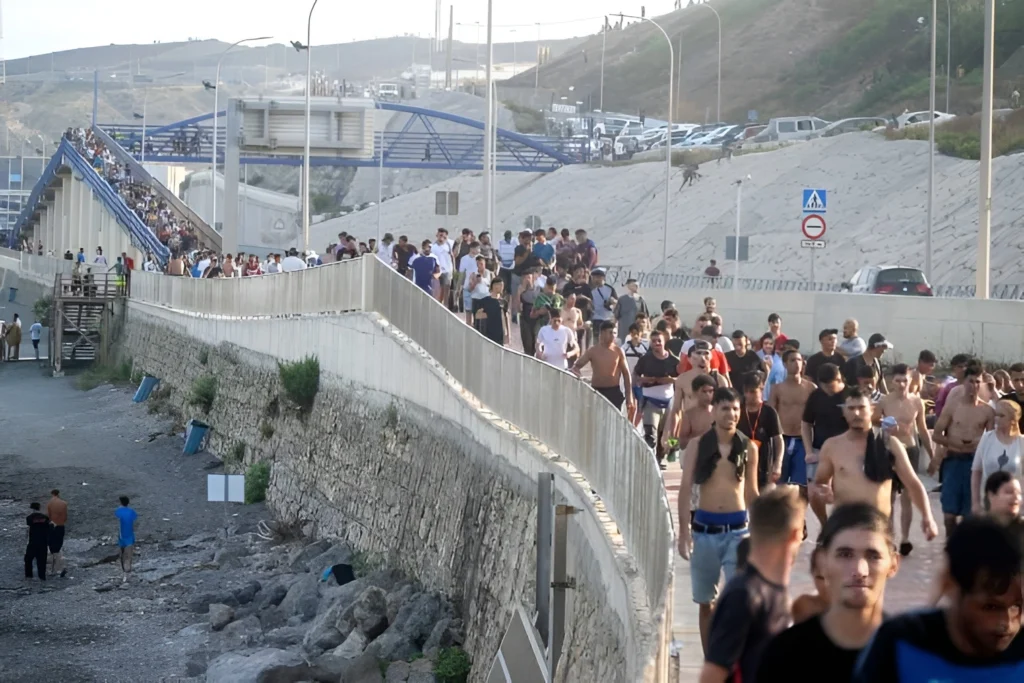
IMAGE: Thousands move along Ceuta’s coast after crossing from Morocco by land and sea, July 2026 (Source: NBC News)
It looked like chaos, but it did not come without warning. For years, Israeli and American political figures had threatened Spain over Gaza, questioned its sovereignty in North Africa and presented Ceuta as a pressure point. Months before the crossing, a former Pentagon adviser published the method almost exactly as it later unfolded, calling on Morocco to send an unarmed mass march into the city while NATO stood aside.
This investigation follows the trail that preceded the crowd, through Israeli threats, Washington pressure, Moroccan lobbying, military agreements and a digital mobilisation that delivered tens of thousands of people to one of Spain’s most exposed borders. The fence gave way only after powerful interests had spent years explaining exactly what Spain’s loss of control over Ceuta could achieve.
On the night of July 29, 2026, an estimated 70,000 people, mostly young men, crossed from Morocco into the Spanish city of Ceuta in under forty-eight hours. At least 88 people died at the border fence, and in the water; a toll Spanish authorities and news organisations repeatedly revised upwards in the days that followed. Morocco’s Interior Ministry put the figure at 11, while the Moroccan Association for Human Rights (AMDH) estimated that nearly 130 people had died. More than a thousand required medical treatment, yet days later there was still no agreed account of how many lives the crossing had taken.
Moroccan police were present along the route in visible numbers. Videos circulating within hours showed officers watching the crowds pass and, in some cases, appearing to direct people towards crossing points rather than stopping them. By the weekend, testimony published by international news organisations had made those images harder to dismiss. Several people who reached Ceuta said Moroccan officers had told them, “Go that way” or “Come to Spain.” The force capable of stopping the movement was not absent. It was there, along the route, as tens of thousands advanced towards the border. That shifts the investigation away from how Morocco lost control of the crossing and towards the evidence that, for the crucial hours in which it gathered momentum, control was deliberately withheld.
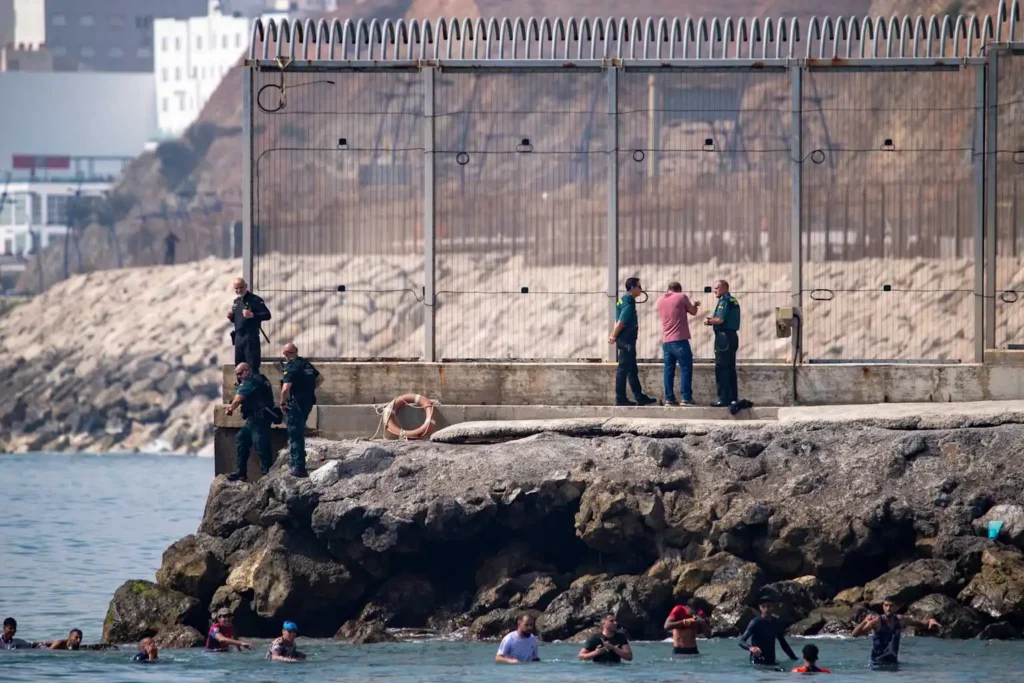
IMAGE: People cross into Ceuta by land and sea, July 2026. (Source: OPB)
Within a day, Spain’s government said the situation had almost entirely reversed, with most of the crowd returning voluntarily to Morocco. According to Spanish Government Delegate in Ceuta Miguel Ángel Pérez Triano on 3 August 2026, approximately 2,500 irregular migrants remained in the city, a number that, based on Interior Ministry data, exceeded Ceuta’s capacity to care for them.
The Spanish Interior Ministry credited Moroccan authorities with cooperating “faithfully and permanently” and with preventing the arrival of even larger numbers. Morocco’s embassy in Madrid called the cooperation “exemplary.” Unnamed Moroccan diplomatic sources told Euronews the same week that the assistance on the ground had actually been “limited and insufficient to contain the pressure.” Both accounts referred to the same forty-eight hours, but they point in different directions.
Washington did not direct its criticism at Rabat. Statements from American officials and allied commentators in the days that followed focused instead on Madrid, particularly Pedro Sánchez’s positions on Gaza, Spain’s refusal to allow the United States to use its air bases during the Iran campaign, and the government’s broader posture towards Israel. The US State Department raised its travel advisory for Ceuta, while American commentary presented the crisis as the consequence of Spain’s failure to secure its borders. Morocco, whose government controlled the frontier through which the crowds passed, faced no equivalent public criticism from Washington. Nor did it face any from Jerusalem. Israel’s ambassador to the United Nations, Danny Danon, used the crisis to describe Ceuta and Melilla as “colonial enclaves” that Spain should explain before lecturing anyone else. Spain’s transport minister, Óscar Puente, replied: “Well, things are starting to get pretty clear.”
The response did more than spare Morocco scrutiny. It redirected responsibility towards Spain and placed the crisis inside arguments Washington and Jerusalem had already been making against Sánchez for months. The crossing had lasted less than forty-eight hours, but the political case used to explain it had been assembled long before the first crowds reached Ceuta.
A border settled by treaty, not by conquest
Ceuta’s status is not ambiguous. Portugal took the city in 1415, and Spain acquired sovereignty under the Treaty of Lisbon in 1668. In 1860, the Moroccan Sultanate signed the Treaty of Wad-Ras, fixing Ceuta’s modern boundaries and formally recognising Spanish sovereignty over the territory. The independent Kingdom of Morocco did not emerge until 1956, nearly a century after the Sultanate had signed that recognition and more than five hundred years after Ceuta first passed into European hands.
The present Moroccan claim therefore does not arise from an unresolved act of decolonisation. It asks that a sovereignty recognised by Morocco’s own predecessor state be treated as though that recognition never occurred. Calling Ceuta a “colonial enclave” therefore does not resolve that contradiction. In fact, it conceals it
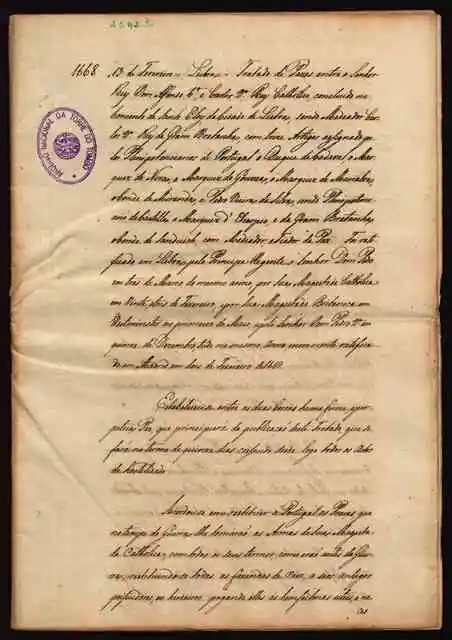
IMAGE: The 1668 Treaty of Lisbon transferred Ceuta to Spain (Source: Wikimedia Commons)
A threat made seven years in advance
On May 25, 2019, Yair Netanyahu, the Israeli prime minister’s son, posted a map of Spain’s North African holdings, Ceuta, Melilla, and the Alborán Sea islands, captioned: “Dear Arabs and Muslims. Want to free occupied Arab Islamic lands? Here’s a good start.”
Dear Arabs and Muslims. Want to free occupied Arab Islamic lands? Here’s a good start! pic.twitter.com/Ci5R0dOXN7
— Yair Netanyahu (@YairNetanyahu) May 25, 2019
When Spanish users responded, he made the trade explicit, suggesting that Israel would stop funding NGOs calling for Spain to relinquish Ceuta and Melilla if Spain stopped funding NGOs calling for Israel to relinquish Judea and Samaria. The Times of Israel later described the exchange as a direct linkage between Palestinian advocacy, NGO funding and the transfer of Ceuta and Melilla to Morocco. That exchange took place seven years before Moroccans crossed into Ceuta by the tens of thousands.
The same argument later came from someone who did hold office. In September 2025, after Spain barred Itamar Ben Gvir and Bezalel Smotrich from entering the country over their positions on Gaza, Ben Gvir publicly told Spain to “give the people from Gaza free entry.” Ten months later, as tens of thousands were crossing into Ceuta, he posted in Spanish to congratulate Sánchez on his “deep commitment to welcoming immigration and human diversity.” He then made the demand explicit: “As someone who shows great concern for Hamas and the residents of Gaza, I call on you to translate words into actions: open the doors of Spain and grant refuge to the residents of Gaza.”
By then, migration was no longer being invoked as a hypothetical answer to Spanish policy. Ben Gvir was using a real mass crossing into Spanish territory to repeat a punishment he had prescribed ten months earlier. Ceuta had become the setting in which years of Israeli rhetoric linking Spain’s territorial integrity, its support for Palestine and the movement of displaced people were brought together in a single political message.
Mis felicitaciones al Presidente del Gobierno de España, Pedro Sánchez, por su profundo compromiso con la acogida de la inmigración y la “diversidad humana”.
Como alguien que demuestra una gran preocupación por Hamás y los residentes de Gaza, le llamo a traducir las palabras en…— איתמר בן גביר (@itamarbengvir) July 31, 2026
Nine days after Rubin’s second op-ed, a Moroccan journalist writing in the Israeli outlet Ynet, Amine Ayoub, argued that Israel should reward Morocco for the Abraham Accords and punish Spain for its position on Palestine, using Ceuta and Melilla as the mechanism. The piece leaned directly on Rubin’s framing.
The campaign that came before the crowd
On March 12, 2026, Michael Rubin, a senior fellow at the American Enterprise Institute (AEI) and the Middle East Forum, published an op-ed arguing that Ceuta and Melilla were occupied Moroccan territory and that Spain, as a colonial power, had no standing to criticise Israel. Four days later, on March 16, Rubin published a second piece proposing that Morocco organise a new Green March, invoking the name of its 1975 mass civilian crossing into Western Sahara. This time, the proposal was specific. Unarmed Moroccan civilians would advance on Ceuta and Melilla with bulldozers, breach the border fences and raise the Moroccan flag. Rubin argued that NATO’s mutual-defence clause would not apply because the enclaves lie outside Europe and North America.
In four days, the argument had moved from stripping Spain of legitimacy to setting out a method for breaking its border. The proposed instrument was not the Moroccan military, but a mass civilian movement directed at the fences under the assumption that Spain would be left to confront it alone. Four months later, tens of thousands of civilians moved towards Ceuta, Moroccan security controls gave way, and Spain faced precisely the dilemma Rubin’s proposal had anticipated.
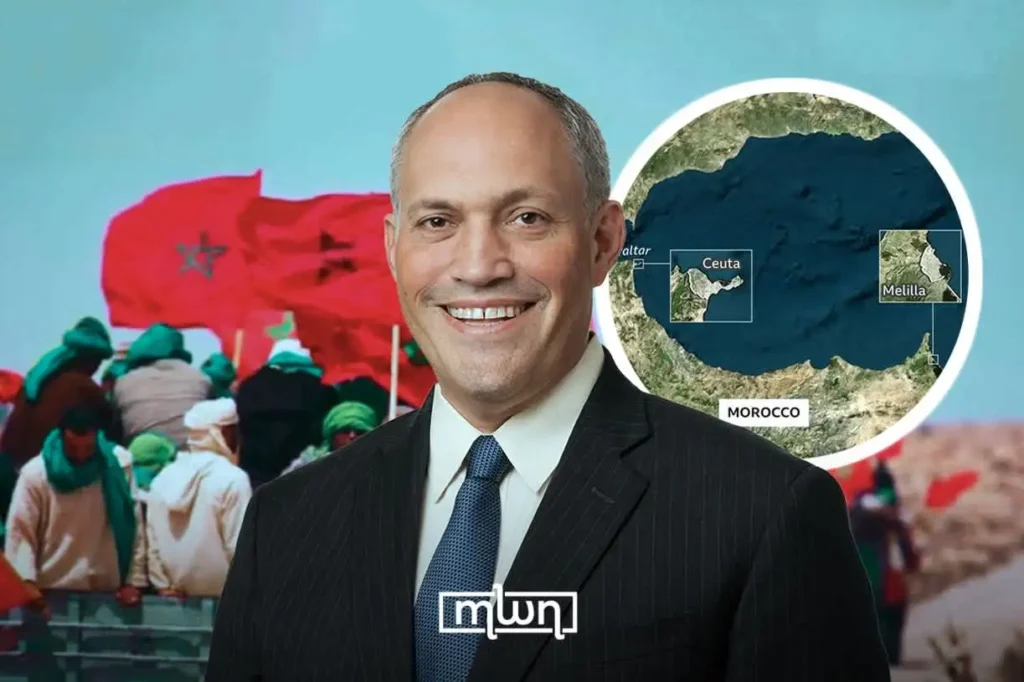
IMAGE: Michael Rubin called for a new Green March into Ceuta and Melilla (Source: MoroccoWorld)
Spanish newspapers picked up the articles within days and placed them within a broader Washington current favourable to Morocco, identifying the Middle East Forum, the American Enterprise Institute, the Hudson Institute and the Moroccan American Center for Policy. The latter is funded by the Kingdom of Morocco, and Spanish reporting described it as financing reports, events and opinion pieces that reinforced Rabat’s case against Spain.
On April 3, three weeks after Rubin’s second article, Representative Mario Díaz-Balart, then chairman of the House Appropriations subcommittee overseeing State Department funding, told El Español that Ceuta and Melilla “are not in the geographic territory of Spain” but “in the territory of Morocco,” and that their status should be negotiated between allies. On April 30, his subcommittee filed its formal report on the 2027 State Department appropriations bill. Under the heading “Morocco,” it states that “the Spanish-administered cities of Ceuta and Melilla are located in Moroccan territory” and encourages the Secretary of State to promote diplomatic engagement between Morocco and Spain over their future status. The language does not appear in H.R. 8595, the bill passed by the House, and the committee report carries no legal force. Its significance lies elsewhere.
Within seven weeks of Rubin calling Ceuta and Melilla occupied Moroccan territory, the same territorial premise had travelled from Washington commentary into an official congressional document. Morocco’s claim had not become US law, but it had acquired a foothold inside the machinery that shapes US foreign policy.
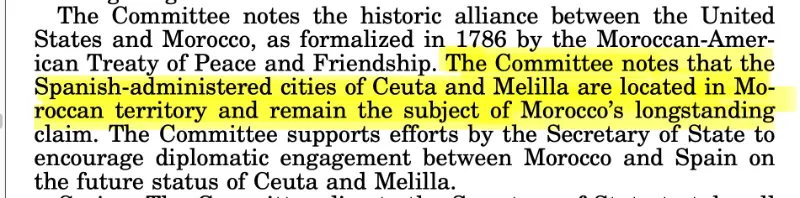
IMAGE: House Report 119-631 places Ceuta and Melilla in Moroccan territory (Source: US Congress)
Díaz-Balart’s connection to this machinery extended into his own family. His brother, former congressman Lincoln Díaz-Balart, ran Western Hemisphere Strategies (WHS), which received roughly $1.2 million between 2012 and 2017 from the Moroccan American Centre for Policy (MACP) to “positively affect relations between Morocco and the United States.” The firm was retained at $20,000 a month to advise and advocate before Congress and the executive branch in support of stronger US–Moroccan relations. Its contract expressly prohibited WHS from lobbying Representative Mario Díaz-Balart or his staff, acknowledging in writing the conflict that the restriction was intended to contain.
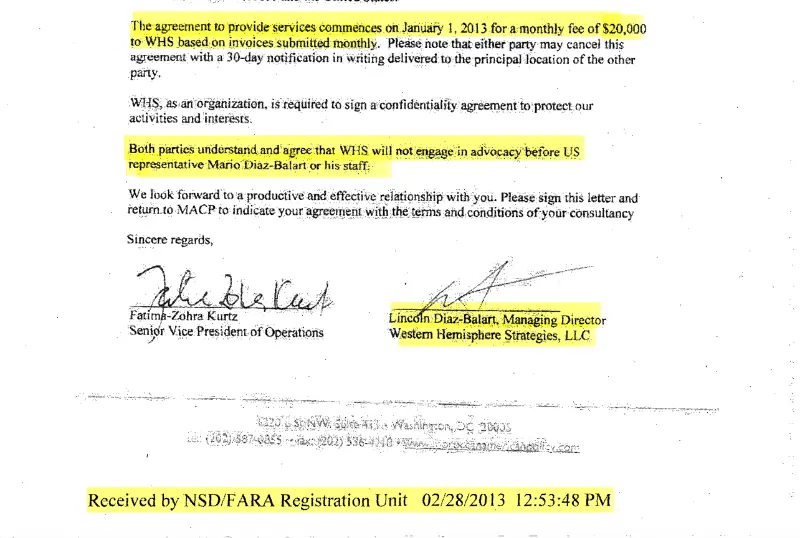
IMAGE The MACP contract excluded lobbying Díaz-Balart’s office. (Source: US Department of Justice FARA filing)
Mario Díaz-Balart’s office has denied that any lobbying contact with his brother took place, and his support for Morocco’s territorial positions dates back to at least 2011, before the contract. What the filing establishes is that a Moroccan-funded advocacy organisation paid his brother’s firm to influence US policy while formally placing Díaz-Balart’s congressional office behind a contractual firewall. Years later, it was Díaz-Balart’s subcommittee that inserted Morocco’s claim over Ceuta and Melilla into an official congressional report.
The House passed the broader appropriations bill on July 15, eleven weeks after the report language was filed. The mass crossing into Ceuta began fifteen days later. On July 31, Al Jazeera’s opinion desk asked whether Spain was being punished, noting that pro-Israel voices had “conspicuously raised the issue of the enclave” in the months before the crossing and citing Rubin’s articles directly. Spanish, English and Arabic-language outlets subsequently reconstructed the same chronology, from Yair Netanyahu’s 2019 map and Ben Gvir’s migration rhetoric to Rubin’s March 2026 articles, Díaz-Balart’s report language and the Israel–Morocco defence relationship already in place.
None of this emerged after the crossing. Before the first crowds reached Ceuta, Spain’s sovereignty had been challenged, a civilian march against its border had been proposed and Morocco’s territorial claim had entered an official congressional report. When the crossing came, Washington and Jerusalem turned their criticism on Madrid while leaving Rabat largely untouched. The pressure was already there. The crossing gave it force.
The pressure campaign was never just two men
The proposal to replace Spain with Morocco as Washington’s military partner was already in circulation. In June 2025, retired General Robert Greenway, a former Trump national security adviser and head of the Heritage Foundation’s Allison Center, wrote on X that it was “time to relocate NAS Rota and Morón Air Base… to Morocco.” By April 2026, the argument had moved closer to government. After Spain refused to support the Iran campaign, the late Senator Lindsey Graham called for the removal of American bases from Spain to a country willing to permit their use. José Lev Álvarez, a Middle East Forum writer and former Israeli army officer, argued that the Israel–Morocco security relationship had created “a new reality” that the White House could use as leverage against Madrid. On April 24, Reuters reported that an internal Pentagon email had listed possible measures against allies that resisted the Iran campaign, including suspending Spain from NATO.
This was no longer pressure on Sánchez alone. Spain was being told that its bases could be moved, its place in NATO reconsidered and its strategic role handed to Morocco. At the same time that Washington figures were giving Rabat’s claim over Ceuta a foothold in Congress, they were laying out how Spain itself could be displaced on the other side of the Strait.
Time to relocate NAS Rota and Moron Air Base…to Morocco. https://t.co/8pKIUStLN4
— Robert Greenway (@RC_Greenway) June 27, 2025
No direct Moroccan payment to Rubin, the Middle East Forum or the American Enterprise Institute appears in the public records examined for this investigation. Their available tax filings do not identify the Moroccan government or the Moroccan American Center for Policy among their disclosed sources of funding. Rubin’s articles cannot therefore be traced to a commission from Rabat. They emerged from a pro-Israel political platform that had already found its own reason to advance Morocco’s claim against Spain.
Morocco was, however, paying for representation elsewhere in Washington. Its previous arrangement with Brownstein Hyatt had gone dormant in October 2025, and a new $780,000 contract took effect on March 13, 2026, within days of Rubin’s articles. Brownstein was retained at $65,000 a month to provide government-relations and public-affairs services connecting the Moroccan embassy with the US government. The next filing covering its work during the months leading to the crossing had not been published when this investigation was completed. Rubin, meanwhile, continued writing after the crossing, again calling on Washington to recognise Moroccan sovereignty over Ceuta and Melilla and punish Spain for its positions on Gaza and Iran.
The political use of Morocco’s claim was already being proposed openly in Israeli media. Citing an analysis published by Ynet, Diario Socialista reported in late April that Israel could use its influence in Washington to help Morocco press its claims over Ceuta and Melilla. The proposed return was explicit. Morocco would be rewarded for its alignment with Israel, while Spain would be punished for its positions on Iran, Palestine and NATO. The argument relied in part on Article 6 of the North Atlantic Treaty, whose geographical language does not expressly place Ceuta and Melilla under the alliance’s collective-defence guarantee.
This was the same bargain taking shape elsewhere. Díaz-Balart was introducing Morocco’s territorial premise into Congress, Israel and Morocco had signed a joint military work plan, and Washington commentators were presenting Rabat as the partner through which Spain could be pressured or replaced. In each case, Ceuta offered the same thing—a way to put pressure on Spain without confronting it directly.
Five years since the Abraham Accords: Israel and Morocco continue to deepen security cooperation.
This week in Tel Aviv, the IDF and the Moroccan Armed Forces held the 3rd Joint Military Committee meeting, concluding with the signing of the joint work plan for 2026.
The…
— Israel Defense Forces (@IDF) January 5, 2026
Nine days after Díaz-Balart’s April 3 interview with El Espanõl, on April 9, Netanyahu’s government expelled Spain’s access to the Kiryat Gat facility, in the U.S.-led Civil-Military Coordination Center (CMCC), and said Spain would “pay an immediate price” for its Gaza positions. But Sánchez did not retreat one inch, and in May, he called for the European Union to terminate its Association Agreement with Israel entirely.
The architecture that already existed
Morocco entered 2026 with an established military relationship with Israel. In 2021, Israeli defence minister Benny Gantz and his Moroccan counterpart, Abdellatif Loudiyi, signed a memorandum of understanding covering intelligence cooperation, military procurement, training and joint exercises. In January 2026, the two countries held the third meeting of their Joint Military Committee in Tel Aviv and signed an annual work plan.
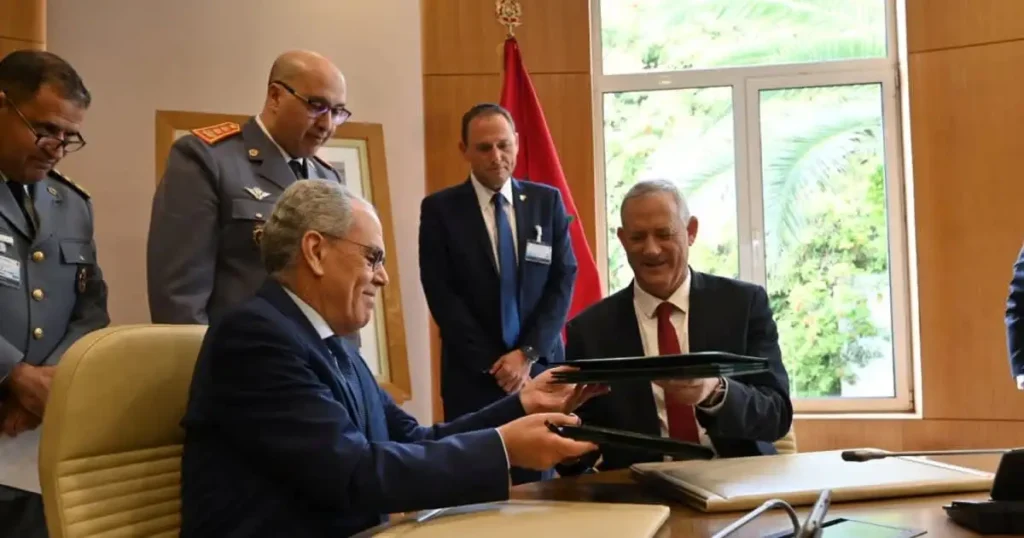
IMAGE: Israel and Morocco formalised defence cooperation in 2021. In Rabat, Israeli Defense Minister Benny Gantz signed the document along with Abdellatif Loudiyi, Morocco’s defence administration minister. November 2021 (Source: Israel Defence Ministry via Al Jazeera)
By early 2026, that relationship had produced operational military infrastructure on Moroccan soil. Israel Aerospace Industries’ Barak MX air-defence system, acquired under a deal worth approximately $500 million, had entered service. Defence reporting based on satellite imagery, including Raksha Anirveda and Infodefensa, placed the system at a newly constructed base near Sidi Yahya el Gharb in northwestern Morocco. Deliveries had begun in 2023, and by 2026 the system formed part of a layered Moroccan air-defence network.

IMAGE: Satellite-image panel showing Barak MX components at Sidi Yahya el Gharb, Morocco. (Source: Militarnyi)
Morocco was equally embedded in Washington’s regional security system. The United States designated it a major non-NATO ally in 2004, provides military financing and maintains extensive arms and training programmes with Rabat. Morocco also hosts the annual US-led African Lion, the largest military exercise in Africa.
When Moroccan controls on the route to Ceuta gave way on July 29, the military and intelligence channels linking Rabat with Tel Aviv and Washington were already active. The next part of the investigation is whether those channels carried anything beyond routine defence cooperation in the days before the crossing.
The ruling that opened a door, and the campaign that walked through it
Spain’s Supreme Court gave the crossing its mechanism. In Judgment 814/2026, published July 8, it ruled that summary “hot returns” could not be used against migrants intercepted swimming toward Ceuta or Melilla, only against those caught scaling the fence. Spain’s Interior Ministry said smugglers and rumor networks exploited that sea-land distinction directly, and most coverage has treated the ruling as the proximate trigger.
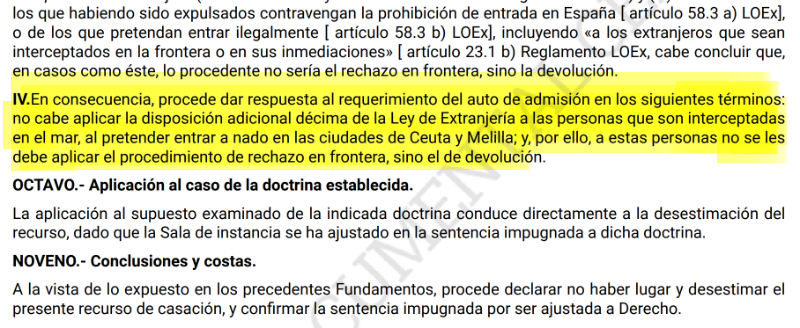
IMAGE: The Supreme Court required formal returns for interceptions at sea. (Source: CENDOJ)
Translation from Spanish to English: “IV. Accordingly, the question raised in the order admitting the appeal must be answered as follows: the Tenth Additional Provision of the Immigration Law cannot be applied to persons intercepted at sea while attempting to swim into the cities of Ceuta and Melilla; consequently, such persons must not be subjected to the border-rejection procedure, but rather to the return procedure.”
The ruling explains how a crossing on this scale became possible, but not why the border was opened at that particular moment. By then, a coordinated social media campaign was already in place, Morocco had recalled its ambassador, and six months of pressure had drawn Ceuta’s sovereignty into Spain’s positions on Iran, Gaza and NATO.
The crowd that gathered online
The people who crossed were overwhelmingly young men, rather than the mixed population of families typically associated with migration crises. Many had responded to false social-media and WhatsApp claims that Spain had opened the border, amplified through public Facebook groups including Hraga Ceuta and Haraga_ceuta. The mobilisation began online, not at the border. Meta subsequently shut down five Facebook groups with more than 230,000 members between them, where users exchanged routes, equipment information, telephone numbers and other logistical details. Before the mass crossing, CeutaTV documented Hraga Ceuta, then numbering more than 20,000 members, sharing Google Maps measurements around the Tarajal breakwater, advertisements for diving fins, information about sea conditions and requests for companions with whom to attempt the crossing. Brussels Signal independently documented the same material, including swimming distances, wetsuits, diving fins, taxi routes to the frontier and the false claim that the border had opened.
By the time the first swimmers reached the water, the rumour had already done its work. Thousands had been given the same message, shown the same routes and told what equipment they would need. What followed at the border had been gathering for days in plain sight online. The question is no longer simply how the crossing spread, but why the conditions described online coincided so closely with those encountered at the border.

IMAGE: A Google Maps image circulated in the Hraga Ceuta Facebook group measures a roughly 432-metre swimming route around the Tarajal border breakwater—an example of the maps and logistical guidance shared before the mass Ceuta crossing. (Source: CeutaTv)
At least 2 viral videos showing crowds at the border were confirmed to predate the actual crossing by several weeks, with two separate detection tools rating it 81 to 87 percent likely AI-generated; Yahoo and Firstpost both reported that verification.
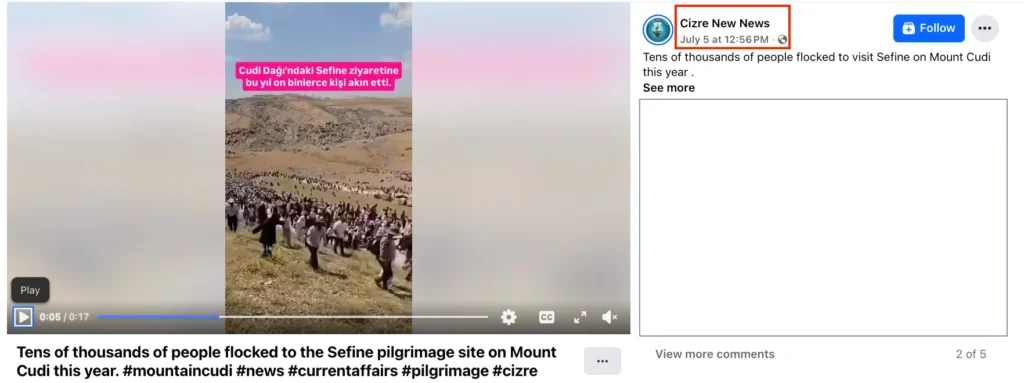
IMAGE: A viral border video was flagged as likely AI-generated.(Source: Leadstories)
Independent observers moved in the same direction. Riccardo Fabiani of the International Crisis Group said the evidence pointed to some form of Moroccan official role meant to send a message, and did not exclude an effort to curry favor with the United States after weeks of pressure from pro-Israel and American right-wing voices over Ceuta. That is not proof of outside operational control, but it is an external judgment that the crossing looked political, not merely chaotic.
This was not the first time Rabat had used migration pressure as diplomatic leverage. During a May 2021 dispute triggered by Spain’s decision to admit Polisario Front leader Brahim Ghali for medical treatment, Moroccan authorities appeared to relax border controls, allowing roughly 8,000 people to enter Ceuta over two days. After the crossing began and Madrid summoned Morocco’s ambassador to protest, Rabat recalled Ambassador Karima Benyaich for consultations. Al Jazeera’s 2026 analysis invoked that episode as the precedent for interpreting the July 2026 crossing as another possible attempt to pressure Spain. That episode echoed May 2021, when Reuters and others reported that Moroccan authorities had previously eased controls during a diplomatic rupture, widely read as retaliation over Spain’s decision to let the Western Sahara independence movement’s ailing leader receive hospital treatment on Spanish soil.
Both Le Monde and The Guardian raised the possibility that Rabat loosened its controls to register displeasure at Sánchez’s visit to Algeria, Morocco’s principal regional rival. The visit restored high-level political ties and sought additional Algerian gas through Medgaz, the direct undersea pipeline to Spain that bypasses Morocco. The grievance, then, was not lost transit revenue but Madrid’s renewed strategic partnership with Algiers
VIDEO: RTVE documented the May 2021 crossing at Tarajal.(Source: RTVE Noticias)
.
Moroccan lawmaker Lahcen Haddad denied that Rabat had engineered the Ceuta crossing, but she is totally missing the point. Direct orchestration was not necessary, as Morocco could exert pressure simply by suspending the border controls it normally enforced. Spain’s renewed ties with Algeria certainly added to the political grievances behind that pressure, even though Algerian gas reached Spain through a pipeline that totally bypassed Morocco, making her argument very narrow.
To resume, we have identified two border openings, five years apart, followed by Spanish decisions Rabat opposed, and in both cases, Morocco withheld the enforcement it routinely used to stop departures, turning migration into an instrument of state pressure against Madrid.
Israel publicly maintained its distance from Morocco’s territorial claims. In late April, its ambassador in Madrid, Dana Erlich, said that her government was “not thinking about” supporting Rabat’s claims to Ceuta and Melilla, calling the issue irrelevant to Israel’s immediate priorities. The denial was narrowly framed around the government’s position at that moment and did not address the wider political and military alignment between Israel and Morocco. When Danny Danon subsequently described the cities as “colonial enclaves,” Israel could portray his intervention as the personal position of a politician with a long record of challenging Netanyahu. Netanyahu fired Danon as deputy defence minister in 2014 after he publicly criticized the government’s Gaza strategy, and Danon challenged Netanyahu for the Likud leadership in 2007 and 2014.
Spain, which never misses an opportunity to lecture Israel, has declared a state of emergency in Ceuta following the crisis over its immigration policy.
Maybe before it continues lecturing us, it’s time it explained to the world why it still maintains colonial enclaves in…
— Danny Danon דני דנון (@dannydanon) July 30, 2026
Yet distancing the government from Danon’s wording does not answer the central issue raised by this investigation. His intervention amplified a campaign already being advanced by Morocco’s advocates in Washington and unfolded alongside deepening Israeli–Moroccan military cooperation, allowing Israel to deny a formal policy while one of its most prominent diplomats reinforced the same pressure on Spain
The strait nobody wanted to talk about
Ceuta sits beside the Strait of Gibraltar, a corridor Washington has treated as a strategic artery for decades. A declassified State Department record called Gibraltar “the most important strait in the world” and warned that Spanish resistance to free transit threatened the strategic mobility underpinning Western defence. A Justice Department-filed account of US–Gibraltar relations documents Gibraltar’s use by American ships during Desert Shield and Desert Storm, by reserve vessels refuelling en route to the Middle East, and by US attack submarines during the 2011 intervention in Libya.
American strategic writing has likewise identified Gibraltar as a vital Mediterranean port for US nuclear-powered submarines, arguing that British control protects Washington’s access from the political restrictions Spanish sovereignty could impose. Ceuta lies on the opposite shore of that same passage.
Its sovereignty is therefore not a peripheral dispute at Europe’s southern edge, but part of the political geography surrounding a corridor central to American military movement between the Atlantic, the Mediterranean and the Middle East. Pressure on Ceuta cannot be separated from the strategic waterway beside it, or from the interests of the powers that depend on keeping it open.
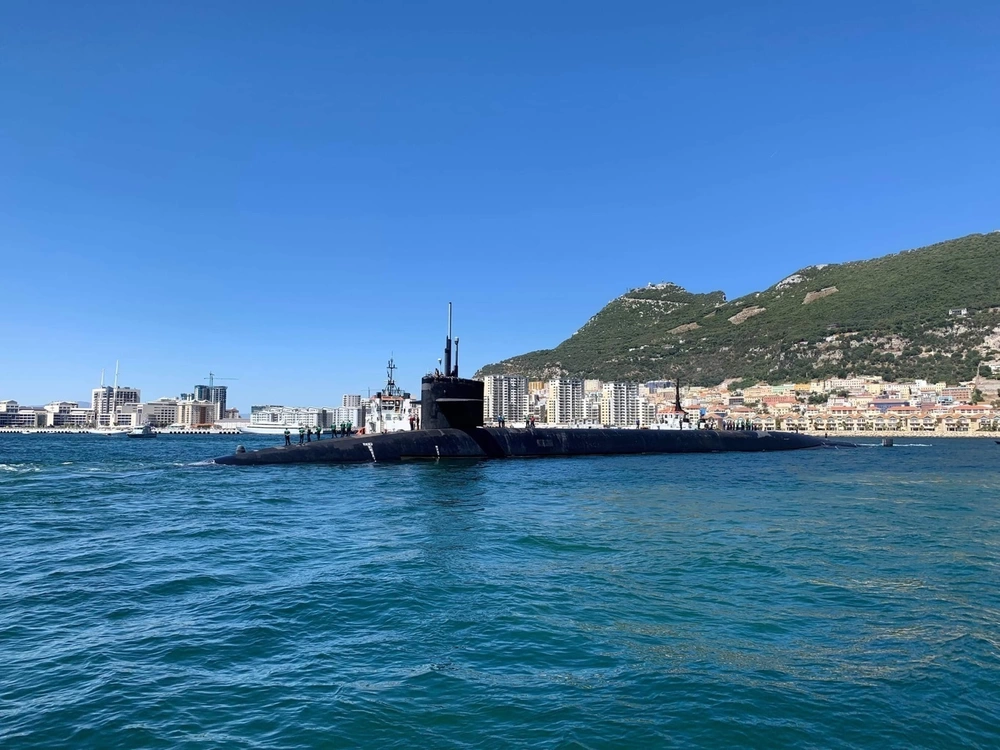
IMAGE: USS Alaska at Gibraltar, June 2021 (Source: DVIDS)
That warning became reality in March 2026, when Spain denied Washington the use of Rota and Morón for operations against Iran and later closed its airspace to participating US aircraft, forcing them to bypass Spanish territory. On April 16, more than three months before the Ceuta crossing, US ambassador Mike Waltz told the United Nations that Gibraltar, Hormuz, the Bering Strait and Malacca were international waterways “too vital to be choked, to be mined, to be weaponized and held hostage.” By mid-July, Iran had asked the Houthis to prepare to close Bab el-Mandeb, where missiles and drones had already been deployed, while traffic through Hormuz remained severely restricted. Gibraltar had therefore become more valuable at precisely the moment Madrid demonstrated that American access through Spain could no longer be taken for granted.
A border that belongs to more than Spain
If Ceuta were threatened militarily, Spain would defend it as sovereign territory. The legal and strategic reality, however, is more complicated. NATO’s founding treaty limits Article 5’s geographical scope to member territories in Europe and North America, Turkey and qualifying North Atlantic islands, leaving Ceuta and Melilla outside its explicit collective-defence guarantee. Any allied response would therefore depend on a political decision reached by consensus rather than an unambiguous treaty obligation. Rubin, Díaz-Balart, Ayoub and others built their arguments around that vulnerability opportunistically.

IMAGE: Spanish forces deployed in Ceuta amid uncertainty over NATO’s explicit coverage (Source: The Globe and Mail)
Consequently, Ceuta offered a way to challenge Spanish sovereignty, strain Madrid’s military resources and expose divisions inside NATO without directly confronting continental Spain, whose collective defence was clearly guaranteed.
What the record shows
By July 30, the conditions for pressuring Spain over Gaza and Iran had been assembled for years, in public and by name. Yair Netanyahu proposed the trade in 2019. Ben Gvir rehearsed the use of migration as punishment in 2025 and repeated it during the crossing itself. Rubin then described the method that appeared on the ground, calling for an unarmed mass movement into Ceuta under the protection of NATO’s territorial ambiguity. Six weeks later, Díaz-Balart placed Morocco’s claim inside an official congressional report, while Lindsey Graham, Robert Greenway and a leaked Pentagon planning document carried the campaign from the think-tank circuit into the machinery of American power. Netanyahu’s government warned that Spain would pay an “immediate price,” as Israel and Morocco entered 2026 with a signed military work plan and an Israeli Barak MX air-defence battery deployed at Sidi Yahya, roughly 200 kilometres southwest of Ceuta.
Then the border opened, and Morocco controlled the gate, while Washington and Jerusalem had the surveillance capacity to see the crowd gathering, the strategic relationships to understand what Rabat was doing and every reason to recognise the pressure it placed on Madrid. Yet neither condemned Morocco. Their anger remained fixed on Spain, while Israeli officials used the crossing to repeat the same arguments about migration, Gaza and Moroccan sovereignty that had preceded it. The event followed the script too closely to be dismissed as an unrelated border failure. Spain had been threatened, the method published, and Morocco already possessed the lever and security architecture when the promised pressure arrived at the precise point where Spanish territory was most exposed.
Coordination does not always leave behind a signed order; in fact, States working through convergent interests rarely need one. What they need is a shared target, compatible motives, an available instrument and confidence that the others will not interfere. By July 2026, Washington, Jerusalem and Rabat had all four.
What crossed into Ceuta was not merely a crowd. It was the physical expression of a pressure campaign that had already been written, promoted and carried into official policy before the first person reached the fence.
READ MORE EU NEWS AT: 21st CENTURY WIRE EU FILES
SUPPORT OUR INDEPENDENT MEDIA PLATFORM – BECOME A MEMBER @21WIRE.TV
VISIT OUR TELEGRAM CHANNEL
21st Century Wire is an alternative news agency designed to enlighten, inform and educate readers about world events which are not always covered in the mainstream media.
Source: https://21stcenturywire.com/2026/08/04/the-ceuta-crossing-anatomy-of-a-manufactured-crisis/
Anyone can join.
Anyone can contribute.
Anyone can become informed about their world.
"United We Stand" Click Here To Create Your Personal Citizen Journalist Account Today, Be Sure To Invite Your Friends.
Before It’s News® is a community of individuals who report on what’s going on around them, from all around the world. Anyone can join. Anyone can contribute. Anyone can become informed about their world. "United We Stand" Click Here To Create Your Personal Citizen Journalist Account Today, Be Sure To Invite Your Friends.
LION'S MANE PRODUCT
Try Our Lion’s Mane WHOLE MIND Nootropic Blend 60 Capsules
Mushrooms are having a moment. One fabulous fungus in particular, lion’s mane, may help improve memory, depression and anxiety symptoms. They are also an excellent source of nutrients that show promise as a therapy for dementia, and other neurodegenerative diseases. If you’re living with anxiety or depression, you may be curious about all the therapy options out there — including the natural ones.Our Lion’s Mane WHOLE MIND Nootropic Blend has been formulated to utilize the potency of Lion’s mane but also include the benefits of four other Highly Beneficial Mushrooms. Synergistically, they work together to Build your health through improving cognitive function and immunity regardless of your age. Our Nootropic not only improves your Cognitive Function and Activates your Immune System, but it benefits growth of Essential Gut Flora, further enhancing your Vitality.

Our Formula includes: Lion’s Mane Mushrooms which Increase Brain Power through nerve growth, lessen anxiety, reduce depression, and improve concentration. Its an excellent adaptogen, promotes sleep and improves immunity. Shiitake Mushrooms which Fight cancer cells and infectious disease, boost the immune system, promotes brain function, and serves as a source of B vitamins. Maitake Mushrooms which regulate blood sugar levels of diabetics, reduce hypertension and boosts the immune system. Reishi Mushrooms which Fight inflammation, liver disease, fatigue, tumor growth and cancer. They Improve skin disorders and soothes digestive problems, stomach ulcers and leaky gut syndrome. Chaga Mushrooms which have anti-aging effects, boost immune function, improve stamina and athletic performance, even act as a natural aphrodisiac, fighting diabetes and improving liver function. Try Our Lion’s Mane WHOLE MIND Nootropic Blend 60 Capsules Today. Be 100% Satisfied or Receive a Full Money Back Guarantee. Order Yours Today by Following This Link.


| Visits: | 1,830,061,735 |
| Stories: | 8,693,106 |
Whistler Blowers, Insiders

