

What Your Dog's Food Label Isn't Telling You

Most dog owners read the label. Very few understand what it actually means.
Pet food is one of the least regulated food industries in the United States. While human food labeling is governed by strict FDA standards, the rules for what goes on a bag of dog food are far more flexible, and manufacturers know exactly how to use that flexibility to their advantage. The result is a label that looks informative but is carefully designed to tell you as little as possible.
Here’s what’s actually hiding in plain sight.
“Natural” Doesn’t Mean What You Think
The word “natural” on a pet food label has no legal definition that requires meaningful standards. Under AAFCO guidelines, the term simply means the ingredients weren’t chemically synthesized, but it says nothing about quality, sourcing, or processing methods. A bag of highly processed kibble made from low-grade rendered ingredients can legally call itself natural, and thousands of products do exactly that.
The same applies to “holistic,” “premium,” and “gourmet.” None of these words carry any regulatory weight whatsoever. They exist entirely as marketing language, and they work, because most consumers assume someone is verifying the claim.
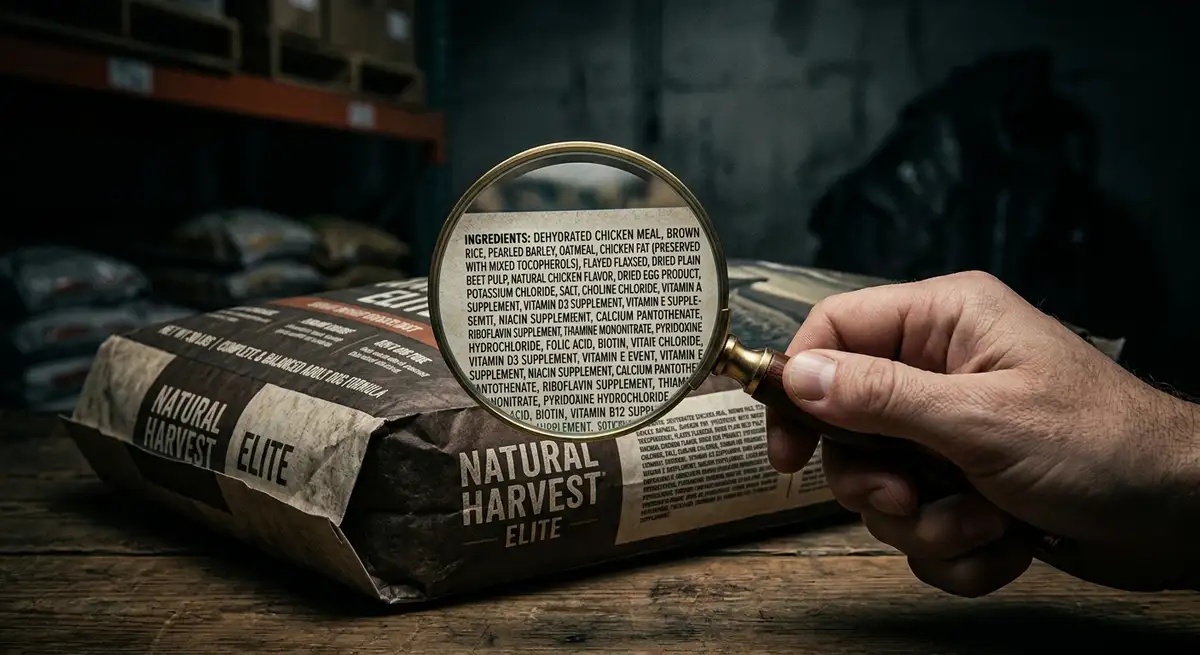
The Ingredient List Is Ordered by Weight Before Cooking
This one catches almost everyone. Ingredients are listed by their pre-cooking weight, which means a label that leads with “chicken” may contain far less actual chicken protein than it appears. Raw chicken is roughly 80 percent water. Once that moisture is removed during processing, chicken can drop several positions down the list. What looked like a chicken-first formula may actually be grain or filler-dominant once you account for what cooking does to the weight.
Manufacturers are fully aware of this. “Ingredient splitting” is a common practice where a single ingredient like corn is broken into multiple forms, corn flour, corn gluten, corn meal, so that each appears separately lower on the list, while chicken stays at the top.
Byproducts Aren’t Always the Problem. The Sourcing Is.
“Byproduct” has become a dirty word in pet food marketing, and competitors use it accordingly. But the truth is more complicated. Organ meat, for example, is technically a byproduct and is nutritionally dense. The real issue isn’t the word byproduct. It’s that the label won’t tell you where the byproducts came from, what quality standard they met, or whether they came from a single source or a rotating blend of unnamed suppliers.
“Meat meal” and “animal meal” are even more opaque. These rendered ingredients can come from multiple species and sources, and the label is not required to specify which. For dog owners who care about what their animal is actually eating, this is a significant gap that the label simply doesn’t fill.
For owners trying to cut through the confusion, detailed breakdowns of what these terms actually mean and which brands hold themselves to higher transparency standards are increasingly available through independent pet lifestyle resources like prettyfluffy.com, which covers ingredient research and product comparisons outside the influence of pet food advertising.
Preservatives Are Often Unlisted When Added at the Supplier Level
Here’s one most people never hear about. Preservatives that are added to ingredients before they reach the manufacturer don’t have to appear on the final product label. If a fat or meal arrives at the facility already preserved with BHA or ethoxyquin, that preservative is not required to show up in the ingredient list you read. This is known in the industry as a “carry-in” additive, and it means a bag labeled “no artificial preservatives” may still contain them, technically without lying.
Feeding Trials vs. Formulation: Two Very Different Things
When a label says “complete and balanced,” it can mean one of two things. Either the product was tested in an actual feeding trial with real dogs over time, or it was simply formulated to meet a nutrient profile on paper. Both products can carry the same claim. The label will tell you which standard was used if you read it carefully, but most consumers don’t know the difference exists, let alone which one to look for.
Feeding trial validation is significantly more rigorous. Formulation-only products may meet the numbers on paper while still falling short in real-world digestibility and absorption. The distinction matters enormously for long-term health, and it’s buried in fine print most buyers skip entirely.
What You Can Actually Do
Reading dog food labels more critically starts with a few basics: look past the front of the bag entirely, check whether named animal proteins or their meals appear in the first three ingredients, research any brand that relies heavily on marketing language without substantive transparency, and look for products that specify their feeding trial validation rather than formulation-only compliance.
The pet food industry spends heavily on packaging and positioning. The label is a sales tool first. Understanding what it’s designed to obscure is the first step toward making a genuinely informed choice for your dog.
Anyone can join.
Anyone can contribute.
Anyone can become informed about their world.
"United We Stand" Click Here To Create Your Personal Citizen Journalist Account Today, Be Sure To Invite Your Friends.
Before It’s News® is a community of individuals who report on what’s going on around them, from all around the world. Anyone can join. Anyone can contribute. Anyone can become informed about their world. "United We Stand" Click Here To Create Your Personal Citizen Journalist Account Today, Be Sure To Invite Your Friends.
LION'S MANE PRODUCT
Try Our Lion’s Mane WHOLE MIND Nootropic Blend 60 Capsules
Mushrooms are having a moment. One fabulous fungus in particular, lion’s mane, may help improve memory, depression and anxiety symptoms. They are also an excellent source of nutrients that show promise as a therapy for dementia, and other neurodegenerative diseases. If you’re living with anxiety or depression, you may be curious about all the therapy options out there — including the natural ones.Our Lion’s Mane WHOLE MIND Nootropic Blend has been formulated to utilize the potency of Lion’s mane but also include the benefits of four other Highly Beneficial Mushrooms. Synergistically, they work together to Build your health through improving cognitive function and immunity regardless of your age. Our Nootropic not only improves your Cognitive Function and Activates your Immune System, but it benefits growth of Essential Gut Flora, further enhancing your Vitality.

Our Formula includes: Lion’s Mane Mushrooms which Increase Brain Power through nerve growth, lessen anxiety, reduce depression, and improve concentration. Its an excellent adaptogen, promotes sleep and improves immunity. Shiitake Mushrooms which Fight cancer cells and infectious disease, boost the immune system, promotes brain function, and serves as a source of B vitamins. Maitake Mushrooms which regulate blood sugar levels of diabetics, reduce hypertension and boosts the immune system. Reishi Mushrooms which Fight inflammation, liver disease, fatigue, tumor growth and cancer. They Improve skin disorders and soothes digestive problems, stomach ulcers and leaky gut syndrome. Chaga Mushrooms which have anti-aging effects, boost immune function, improve stamina and athletic performance, even act as a natural aphrodisiac, fighting diabetes and improving liver function. Try Our Lion’s Mane WHOLE MIND Nootropic Blend 60 Capsules Today. Be 100% Satisfied or Receive a Full Money Back Guarantee. Order Yours Today by Following This Link.


| Visits: | 1,830,044,209 |
| Stories: | 8,692,976 |
Whistler Blowers, Insiders

