

What a Marketing Budget of $500 a Month Buys a Small Business

- A marketing budget of $500 a month covers everything a small business needs to get and keep customers, as long as every dollar runs through one repeating 4-week process.
- Only 9.5% of new business owners plan to spend more than $200 a month on marketing, so $500 already puts you ahead of most of your competition.
- You get the exact dollar split, what each dollar realistically produces, and the monthly loop showing you what to keep and what to kill.
A marketing budget of $500 a month buys one focused channel for finding new customers, a simple follow-up system, and a small fund for keeping the customers you already have. At average Google Ads prices, $500 buys about 92 clicks and roughly seven leads, so the money works best when a process decides where each dollar goes. Scattered across random tactics, $500 disappears in a week.
I built DIYMarketers around a promise to market a business on less than $17 a day, which works out to about $510 a month. For years I assumed $500 sat right in the middle of what small businesses spend. The numbers tell a different story. When UENI asked 7,413 new business owners about their monthly marketing plans, 26.1% said zero, 39.4% said $1 to $50, and only 3.8% planned to spend $500 or more. If you have $500 a month to work with, you already have more firepower than most of the businesses you compete against.

Is a marketing budget of $500 a month enough for a small business?
Yes. For solopreneurs and small businesses with fewer than 10 employees, a marketing budget of $500 a month covers the essentials: a few core tools, one channel to find new buyers, and a small fund to thank the buyers you already have.
The big averages you read about come from bigger businesses. UpFlip found the average American business spends $14,575 a year on marketing, while 66.3% of small business owners spend less than $1,000 a year. A small group of heavy spenders drags the average up and makes everyone else feel behind.
Owners plan to push harder this year. Constant Contact surveyed 1,500 small business owners and found 68% expect their marketing budgets to rise in 2026, while 74% expect to spend more time on marketing. Extra money and extra hours only pay off when you know where they go, and knowing where they go comes from a process.
Why does a $500 budget disappear so fast?
Most owners spend marketing money the way they spend their day, on whatever feels urgent. A $49 scheduling tool here, a $99 directory listing there, a $150 boosted post before the weekend. Each purchase makes sense on its own. Together they add up to $500 with nothing connecting them, and you never learn which one brought in a customer.
Tactics are individual moves. A process gives those moves an order, one number to watch, and a decision at the end of every month. I break down the difference in marketing strategy vs. tactics, and the gap matters twice as much when your budget is small.
How should you split a marketing budget of $500 a month?
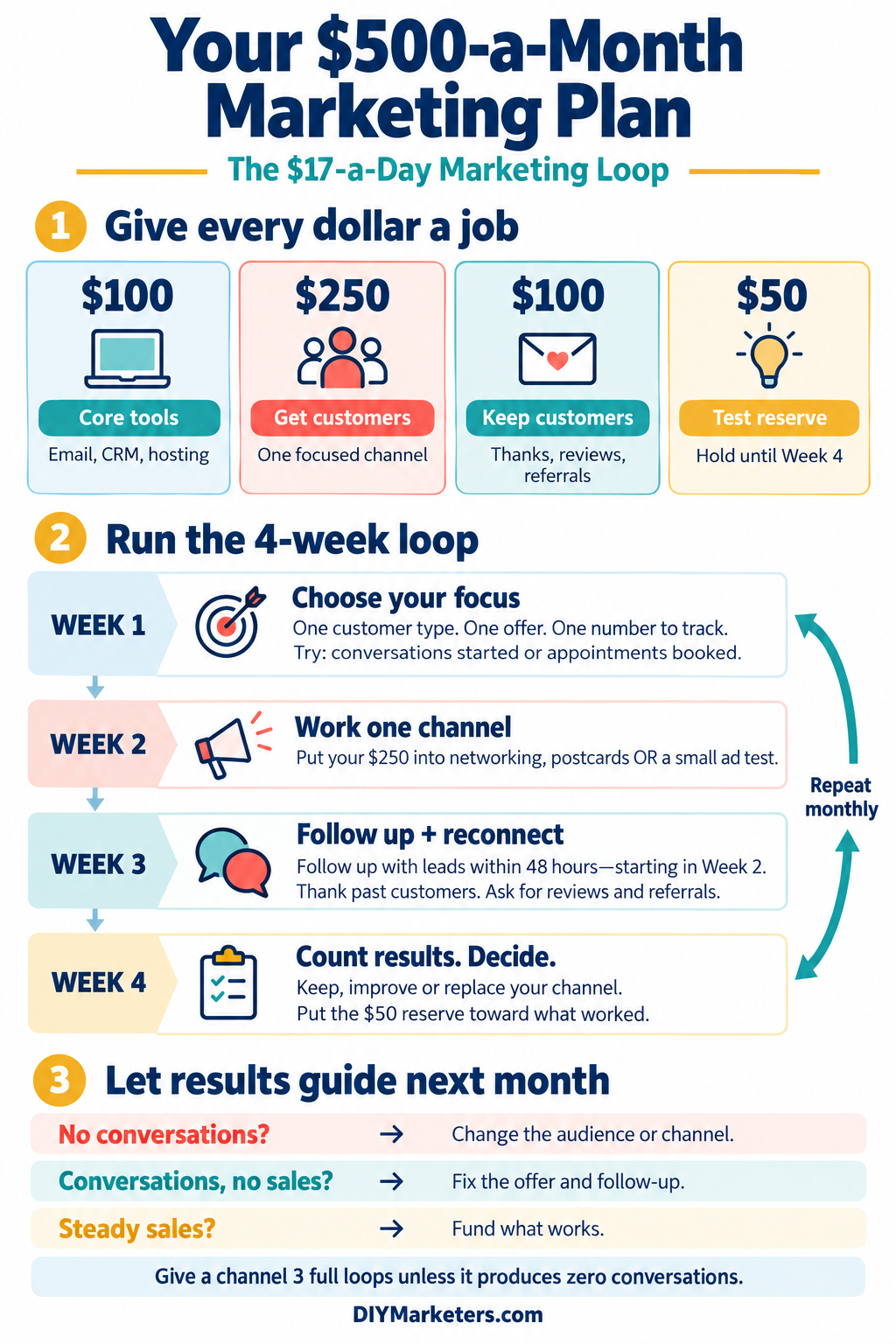
Split your money by job. Everything at DIYMarketers comes back to three jobs: get customers, keep customers, and make money. Your budget should mirror those jobs, with a small reserve held for whatever wins.
| Bucket | Monthly amount | What it covers | What it should produce |
|---|---|---|---|
| Core tools | $100 | Email platform, simple CRM, website hosting, booking tool | A place to capture every lead and reach every customer |
| Get customers | $250 | One channel: a local ad test, a networking group, an event sponsorship, or a postcard mailing | New conversations you count each week |
| Keep customers | $100 | Thank-you cards, referral rewards, a small customer event, review requests | Repeat purchases, reviews, and referrals |
| Test reserve | $50 | Held until Week 4 | Extra fuel for whichever bucket won the month |
Two notes on this split. Your core tools should cost the least of any bucket. If software eats more than $150 a month, run the money audit in where is all your marketing money going and cut the overlap.
Your keep-customers bucket gets real money on purpose. Past buyers already trust you, so a dollar spent on them goes further than a dollar spent chasing strangers. Email sits at the center of both the tools bucket and the keep bucket, and the email marketing ROI numbers for small business show why it earns a permanent spot.
What does the $17-a-Day Marketing Loop look like week by week?
The loop stops you from starting over every month. Each week gets one job, so you always know your next move. I built it on top of the simple marketing process I teach, sized for a marketing budget of $500 a month and about 17 minutes of marketing time a day.
Week 1 is for picking one customer, one offer, and one number
Write down the single customer type you want more of this month, the one offer you will put in front of them, and the number you will judge the month by. Choose a number you control, such as conversations started, quotes sent, or appointments booked. Revenue matters, and it trails the work by weeks.
Week 2 is for pushing one channel
Spend your $250 get-customers money on one channel and give it your full attention for seven days. Go to the networking breakfast, mail the postcards, or launch the tightly targeted ad test. Skip the second channel. Two half-run channels teach you nothing about either one.
Week 3 is for following up with everyone
In my Fix-It Sessions, this is the week where I see the most money leak out. Contact every lead from Week 2 within 48 hours. Then turn to past customers: send the thank-you notes, ask for reviews, and make one referral request. My guide on how to ask for referrals without feeling pushy gives you the exact words.
Week 4 is for measuring and deciding
Count your number from Week 1 and look at what each bucket produced. Then make one of three calls for next month: keep the channel, fix one thing about it, or drop it and move the $250 somewhere new. Your $50 test reserve goes to whichever bucket earned it. Give a channel three full loops before you drop it, unless it produced zero conversations, and read how long to stick with a marketing strategy before you pull the plug.
What results should you expect from $500 a month in marketing?
Expect clarity in month one and customers by month three. The first loop shows you which channel produces conversations. The second loop fixes the weak spots. By the third loop, a marketing budget of $500 a month should give you a predictable number of leads and a cost per customer you understand.
Use this table at the end of every Week 4.
| If You See This… | It Means… | Your Next Move |
|---|---|---|
| Zero conversations from your get-customers channel | Wrong channel or wrong audience | Move the $250 to a place where your buyers already gather |
| Conversations and no sales | The offer or the follow-up breaks down | Keep the channel, rewrite the offer, and tighten Week 3 |
| Sales from past customers and none from new ones | Your keep bucket outworks your get bucket | Shift $50 from get to keep and ask for more referrals |
| Steady sales from one channel for three loops | You found a winner | Move the test reserve into it and raise the budget as profit allows |
| Software costs creeping past $150 | Tools are crowding out customer money | Run a money audit and cancel overlapping tools |
A marketing budget of $500 a month puts you ahead of most small businesses before you spend a dime. Run it through the loop, watch one number, and let each month decide where the next month’s money goes.
Five hundred dollars a month is enough to test Google Ads and too little to rely on them as your only channel. WordStream reports an average cost per click of $5.42 and an average cost per lead of $66.69 in 2026, so $500 buys roughly 92 clicks and about seven leads if your campaign performs at the average. Restaurants and entertainment businesses pay closer to $2 per click, which stretches the budget further, while professional services pay much more. WordStream also notes most small businesses start Google Ads at $1,000 to $2,500 a month. If you test ads on a smaller budget, pick a handful of high-intent keywords, target a tight local radius, and track every call and form fill. Judge the test after one full 4-week loop, and put the rest of your budget into following up with leads and past customers.
Most small businesses spend far less than the popular guideline of 7% to 8% of revenue. In UENI’s 2026 data from 7,413 new business owners, 90.5% planned to spend under $200 a month on marketing, and 26.1% planned to spend nothing at all. UpFlip’s survey found 66.3% of small business owners spend less than $1,000 a year. A practical target for a solopreneur or small service business is $17 a day, about $500 a month, split between core tools, one channel for finding new customers, a fund for keeping current customers, and a small test reserve. Start there, run the money through a monthly process, and raise the budget only after one channel proves it returns more than it costs. The right number is the one you measure, since an unmeasured budget of any size turns into guesswork within a few months.
The best way to spend a $500 marketing budget is to split it by job and run it through a 4-week loop. Put about $100 into core tools such as email, a simple CRM, and booking software. Put $250 into one channel for finding new customers, like a networking group, a postcard mailing, or a small ad test. Put $100 into keeping customers through thank-you notes, referral rewards, and review requests. Hold $50 as a test reserve. Week 1, pick one customer type, one offer, and one number to track. Week 2, push your single channel. Week 3, follow up with every lead and past customer. Week 4, measure results and move the reserve toward whatever worked. This approach, which I call the $17-a-Day Marketing Loop, keeps your money tied to results you see every month.
Plan on about 90 days, or three full 4-week loops, before judging a $500 monthly marketing budget. The first month gives you leading indicators such as conversations started, quotes sent, and appointments booked. The second month shows whether fixing your offer or follow-up improves those numbers. By the third month, a working channel should produce a steady number of leads and a cost per customer you understand. Referrals and past customers respond faster, often within the first few weeks, because those people already trust you. New channels such as networking groups or local ads take longer, since strangers need several touches before they buy. The exception is a channel producing zero conversations after a full month, which usually means the wrong audience or the wrong place, and you should move the money right away without waiting for loop three.
A full-service agency on a $500 monthly budget usually leaves nothing for the marketing itself. In my experience, most agency retainers start well above $500, which means the fee eats the money you meant to spend on reaching customers. Some agencies sell starter packages priced to match small budgets, and those packages often spread thin work across too many channels to produce measurable results. A better setup for this budget is to run the marketing yourself with affordable tools and a simple monthly process, then bring in an expert for a focused review when you get stuck. A one-time audit costs a fraction of a retainer and tells you exactly which part of your system needs fixing. Once one channel proves it pays for itself and your budget grows past $1,500 or $2,000 a month, outside help makes more sense.
Additional reading
- Small business marketing budget risk and how to reduce it
- How to get your first 100 customers without paid ads
Low budget marketing strategies for CEOs with no marketing department. Join DIYMarketers.com for free marketing tips.
Source: https://diymarketers.com/marketing-budget-of-500-a-month/
Anyone can join.
Anyone can contribute.
Anyone can become informed about their world.
"United We Stand" Click Here To Create Your Personal Citizen Journalist Account Today, Be Sure To Invite Your Friends.
Before It’s News® is a community of individuals who report on what’s going on around them, from all around the world. Anyone can join. Anyone can contribute. Anyone can become informed about their world. "United We Stand" Click Here To Create Your Personal Citizen Journalist Account Today, Be Sure To Invite Your Friends.
LION'S MANE PRODUCT
Try Our Lion’s Mane WHOLE MIND Nootropic Blend 60 Capsules
Mushrooms are having a moment. One fabulous fungus in particular, lion’s mane, may help improve memory, depression and anxiety symptoms. They are also an excellent source of nutrients that show promise as a therapy for dementia, and other neurodegenerative diseases. If you’re living with anxiety or depression, you may be curious about all the therapy options out there — including the natural ones.Our Lion’s Mane WHOLE MIND Nootropic Blend has been formulated to utilize the potency of Lion’s mane but also include the benefits of four other Highly Beneficial Mushrooms. Synergistically, they work together to Build your health through improving cognitive function and immunity regardless of your age. Our Nootropic not only improves your Cognitive Function and Activates your Immune System, but it benefits growth of Essential Gut Flora, further enhancing your Vitality.

Our Formula includes: Lion’s Mane Mushrooms which Increase Brain Power through nerve growth, lessen anxiety, reduce depression, and improve concentration. Its an excellent adaptogen, promotes sleep and improves immunity. Shiitake Mushrooms which Fight cancer cells and infectious disease, boost the immune system, promotes brain function, and serves as a source of B vitamins. Maitake Mushrooms which regulate blood sugar levels of diabetics, reduce hypertension and boosts the immune system. Reishi Mushrooms which Fight inflammation, liver disease, fatigue, tumor growth and cancer. They Improve skin disorders and soothes digestive problems, stomach ulcers and leaky gut syndrome. Chaga Mushrooms which have anti-aging effects, boost immune function, improve stamina and athletic performance, even act as a natural aphrodisiac, fighting diabetes and improving liver function. Try Our Lion’s Mane WHOLE MIND Nootropic Blend 60 Capsules Today. Be 100% Satisfied or Receive a Full Money Back Guarantee. Order Yours Today by Following This Link.


| Visits: | 1,835,330,795 |
| Stories: | 8,722,616 |
Whistler Blowers, Insiders

