

Why You Keep Attracting the Wrong Customers

- If your marketing isn’t attracting the right customers, it’s because your message is too vague for the right person to recognize themselves in it.
- Research across 143 studies and 53,000+ consumers shows that people buy from brands that reflect who they are. A generic message gives them nothing to reflect themselves in. they scroll past you and buy from someone more specific.
- By the end of this article, you’ll have a five-part framework for tightening your message — plus seven guerrilla-style tests you can run this week without touching your website or spending a dollar on ads.
You already know you’re supposed to niche down. Every marketing person with a podcast and a LinkedIn newsletter has told you to get specific — to call out your exact customer so precisely they feel seen. “Marketing consultant for women-owned product businesses in their first three years.” That level of specific.
The problem isn’t that you don’t believe it. The problem is that it still feels terrifying to say out loud. What if you push people away? What if someone outside your niche wants to hire you and you need the revenue?
Here’s what I know after 35 years of watching small business owners market their businesses: the broad message doesn’t protect your revenue. It protects your anxiety. And it costs you the customers you want most — the ones who pay on time, refer their friends, and never haggle over your rate — because those people need to see themselves in your message before they’ll reach out.
So why is your about page still saying “I help small businesses grow”?
Being loud and specific about who you serve, what you believe, and what you stand for is no longer a branding exercise. In today’s market, it’s the cheapest, fastest customer filter you have. The wrong customers find you when your message is broad enough to include everyone. The right ones scroll past when nothing in it says “this is specifically for you.”
You don’t need to rebuild your website or overhaul your entire business to fix this. You need to change one thing. Here’s what that looks like.
Why a broad marketing message repels the customers you want
Here’s what nobody tells you about trying to appeal to everyone: it doesn’t work. It doesn’t feel risky, it feels safe. But the data tells a different story.
A meta-analysis of 143 consumer studies covering more than 53,000 participants found that the strongest predictor of purchase decisions isn’t price or quality scores. It’s self-congruity, the degree to which a brand reflects who the buyer is, or who they want to be. When your message is specific enough for the right person to see themselves in it, they lean in. When it’s generic, they have nothing to connect to, and they move on.
Think about the last time you found something, a product, a newsletter, a service, and immediately thought “this was made for me.” That feeling didn’t happen because the message tried to speak to everyone. It happened because it was specific enough to describe your exact situation.
Research on concrete language backs this up further. A study analyzing more than 1,000 real customer interactions found that specific, concrete language increased satisfaction by approximately 9% and subsequent spending by at least 13%. The reason: specific language signals that you understand the person in front of you. Vague language signals that you wrote it for anyone, which means you wrote it for no one in particular.
What “your message is too vague” looks like
Most small business owners know their message isn’t landing. They don’t know why. Here are the patterns I see most often:
You describe what you do, not who you do it for. “I help small businesses with their marketing” is a job description, not a brand message. It tells someone what category you’re in. It doesn’t tell them whether you’re the right fit for their specific situation.
Your message uses industry language your customer doesn’t use. You say “I provide holistic wellness solutions.” Your ideal customer types “I need help sleeping” into Google at midnight. The gap between those two phrases is where customers get lost.
You avoid saying what you don’t do. This feels inclusive. It’s confusing. When you tell a prospect what you won’t help them with, you do two things: you build trust with the ones who need exactly what you offer, and you save time for everyone by letting the wrong fit walk away before they book a discovery call.
Your testimonials are about the outcome, not the person. “She increased my revenue by 40%” is impressive. “She’s the only person I’ve found who gets what it’s like to run a business solo with no team” is magnetic to the right customer. One proves you’re good. The other proves you’re for them.
The five-part brand message framework that helps you attract the right customers
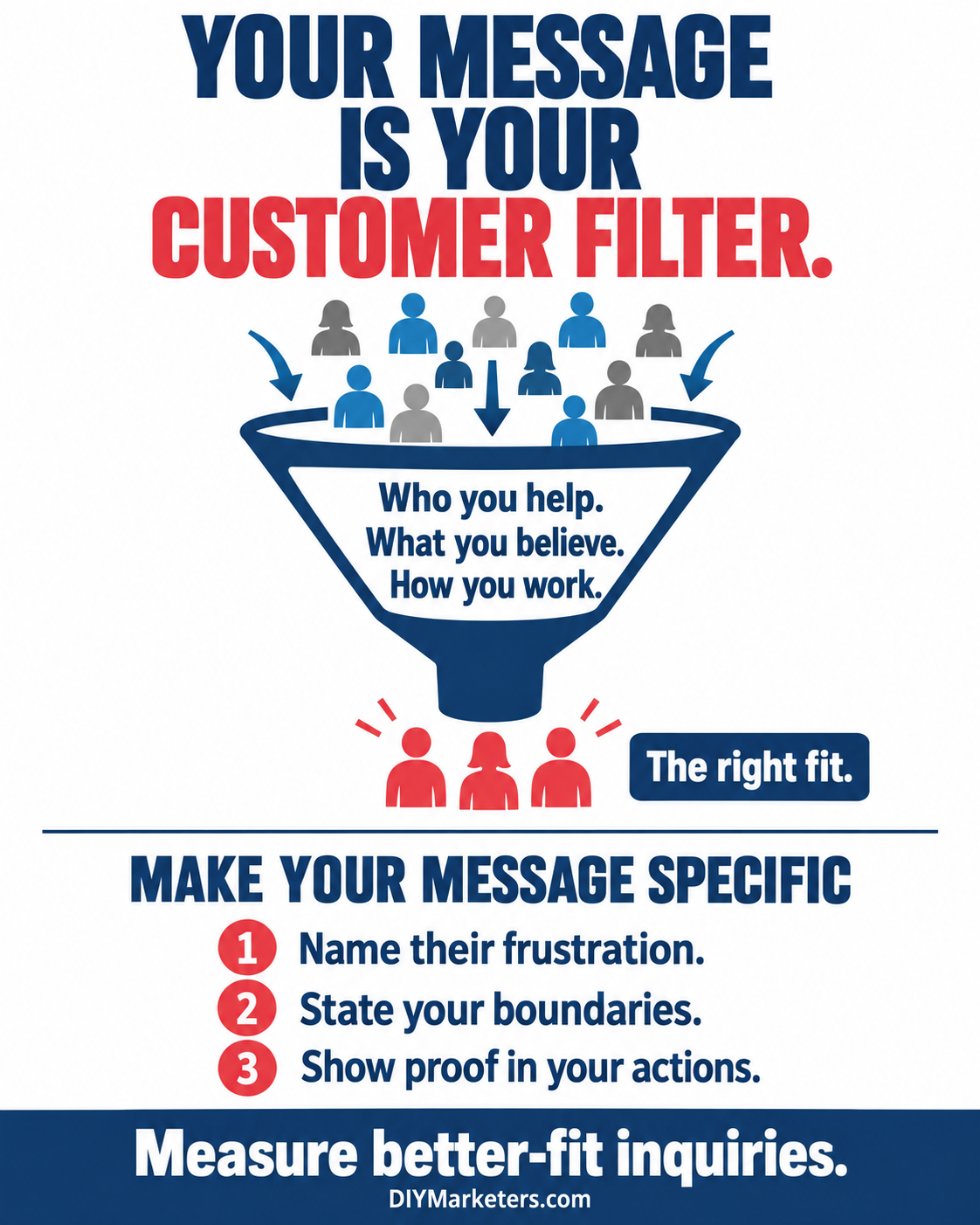
This isn’t a tagline exercise. It’s a qualification framework. Each piece does a specific job. Together, they create a message that pulls the right people in and lets the wrong ones self-select out before they waste your time.
1. Name the person by mindset, not demographics. “Women over 40” is a demographic. “Women over 40 who’ve spent a decade building someone else’s company and are done waiting for permission to build their own” is a mindset. Mindset descriptions create recognition. Demographics create lists.
2. Name the frustration in their words, not yours. Your customer doesn’t say “I’m experiencing a strategic marketing misalignment.” They say “I keep posting and nothing happens.” Use their words. When your message mirrors their internal experience, they feel understood before they’ve even reached out.
3. State what you believe about how the work should be done. This is the piece most business owners skip because it feels presumptuous. It’s what makes you credible. “Marketing should be simple enough for the business owner to understand and run” is a belief that qualifies on working style, budget tolerance, and philosophy. A prospect who wants to hand everything off to an agency reads that sentence and keeps scrolling. Good. They were never your customer.
4. Say what you refuse to do. This is the hardest part for most people because it sounds like leaving money on the table. It’s the opposite direction. When research study across 1,443 consumers looked at what drives loyalty and word-of-mouth most strongly, brand identification, the sense that a brand stands for what you stand for, ranked higher than satisfaction scores. The customers who become your loudest advocates are the ones who agree with your refusals, not just your promises.
5. Show the proof in your behavior, not your copy. A philosophy stated is marketing. A philosophy demonstrated is positioning. If you believe marketing should be affordable, your pricing shows it. If you believe clients should understand what they’re paying for, your proposals show it. When your words and your actions match, trust is almost automatic.
Here’s how that template looks in practice for DIYMarketers: “DIYMarketers helps experienced small-business owners who are overwhelmed by random tactics build a simple customer-acquisition system they understand and run themselves. Marketing should reduce your workload, not create another full-time job. That’s why every recommendation has to fit a budget of roughly $17 a day, and why bloated tool stacks and trendy tactics with no measurable job don’t make the plan.”
Read that and ask yourself: does the right customer recognize themselves? Does the wrong one know to keep looking? Both answers are correct. Both serve you.
Seven guerrilla-style tests to try this week — no website redesign required
This is where most marketing advice loses me. It tells you what to change but not how to test it without tearing everything down. You don’t need to rebuild your website, rewrite all your content, or hire a brand consultant. You need to run cheap, fast experiments that tell you whether specificity is working before you commit to it everywhere.
Here are seven you can do starting today:
1. Rewrite your LinkedIn headline for 30 days. Change “Marketing Consultant | Small Business Specialist” to something that names the person and the frustration: “I help service business owners stop attracting the wrong clients, and start getting paid what they’re worth.” Run it for a month. Count the inbound messages. Note whether they’re better fit than what you were getting before.
2. Add one sentence to your email signature. Under your name and title, add the belief sentence from the template above. Nothing else. See how many people comment on it, ask about it, or reference it when they reach out.
3. Change the first sentence of your next social post. Instead of starting with what you do, start with who you do it for and what they’re frustrated by. “If you’ve been posting consistently for six months and nothing is happening, this is for you.” Track engagement. Compare it to your usual opening.
4. Add a “who this is not for” note to your contact page. One paragraph. Three sentences. Name the customer who isn’t right for you. Watch what happens to the quality of the inquiries you receive. This is the highest-leverage, lowest-cost conversion improvement I know of.
5. Send one email to your list that takes a clear position. Pick one belief from your framework and write 200 words defending it. Not a tip. Not a tool review. An opinion. Watch your reply rate. The replies you get, agree or disagree, are the most qualified people on your list.
6. Swap one testimonial on your website. Find a testimonial that describes the transformation in emotional, identity-specific terms, not only the result, and put it above the fold. “She’s the only person who gets what it’s like to run this alone” outperforms “She increased my traffic by 60%” for the right customer every time.
7. Test two versions of your bio in the same week. Use the generic version in one networking context and the specific version in another. Count the follow-up conversations. Specific bios start more specific conversations, which is exactly what you want if you’re trying to figure out how to attract the right customers without wasting time on the wrong ones.
What to measure so you know it’s working
Most business owners measure brand message experiments by reach, impressions, likes, follower count. Those are the wrong numbers for this experiment. The filter is working when you see:
- Prospects who mention your philosophy or your specific language when they reach out (“I saw you said you only work with people who…” or “I loved that you said you won’t…”)
- Discovery calls where the prospect already agrees with your approach before you explain it
- Proposals that close faster because the fit was established before the call
- Existing clients who describe you accurately to someone else — and that person shows up already aligned
- Fewer conversations about price, because the right customer came in already valuing what you do
That last one is the real tell. Price resistance is almost always a message problem. When someone haggles over every invoice or asks you to justify your rate before they’ve seen your work, it means your message attracted someone who didn’t understand your value in the first place. A more specific message fixes that upstream, before the sales conversation happens.
For more on building a message that makes you stand out, see 10 Strategies to Differentiate Your Business and How to Write a Unique Selling Proposition With These 5 Questions. If you want to understand why broad tactics keep failing even when you execute them well, Why Marketing Strategies Fail for Small Businesses is worth reading next. And if you’re at the point where you’re questioning everything, Why Your Marketing Isn’t Working and How to Fix It will give you a diagnostic starting point.
Frequently asked questions about how to attract the right customers
Attracting the right customers starts with making your message specific enough for the right person to recognize themselves in it, and that costs nothing to change. The guerrilla tactics in this article (LinkedIn headline, email signature, contact page “who this is not for” note, one opinion-based email) are all free. The research is clear: specificity in language is associated with higher satisfaction and more spending from customers who fit. Advertising amplifies your message, it doesn’t fix it. Fix the message first, then consider amplifying it. Start with one specific sentence about who you serve and what frustration you solve, and test it in three different places this week before you consider spending anything on promotion.
The most common reason small business owners keep attracting the wrong clients is a brand message designed to avoid rejection rather than create recognition. Generic language, “I help small businesses grow,” “full-service marketing agency,” “solutions for every need”, doesn’t disqualify anyone. That sounds like a feature. It’s the problem. The right clients self-select in when your message reflects their specific situation, philosophy, and way of working. The wrong ones self-select in when your message is broad enough to seem like it includes them. Tightening your message to name the specific mindset, frustration, and belief that governs your work solves this faster than any platform or tactic change.
A target audience is a demographic, industry, age range, company size, location. Attracting the right customers is about mindset fit, value alignment, and philosophy match. Two business owners in the exact same demographic can be completely different fits for your work. One wants to hand everything off and never think about it again. The other wants to understand every decision and run the system themselves. A message built around demographics attracts both. A message built around the mindset, frustration, and philosophy of one specific type of owner attracts the right one, and lets the other keep scrolling. The five-part framework in this article helps you move from demographic targeting to mindset targeting, which is where the real qualification happens.
The fastest results come from the guerrilla tests described in this article. A LinkedIn headline change can produce different inbound messages within days. An email to your list that takes a clear position will show you reply quality within 24 hours of sending. The website-level changes take longer, expect three to six months before the filter effect shows up in your inquiry quality, because that depends on new prospects discovering you with your updated message. The referral effect takes the longest, because it requires current clients to experience your philosophy in action and then describe it accurately to someone else. Start with the fast tests, validate the direction, then update your permanent assets.
You will lose some prospects when you get specific. Those are prospects who were unlikely to become good clients. Research on brand identification shows that the customers who become your most loyal advocates and strongest referral sources are the ones who agree with your philosophy, not just the ones who need what you do. A prospect who needs your service but disagrees with how you work will become a difficult client, a price negotiator, or a one-time buyer who doesn’t refer anyone. Specificity scares them away before they cost you time, energy, and reputation. The risk of being too vague is much larger: you attract everyone weakly instead of attracting the right people strongly. For a solopreneur or small business owner, client quality matters more than client volume every time.
Additional reading
- 10 Fun Ways to Find Your Ideal Customer
- Effective Brand Building for Small Business: Stop Competing on Price
- Commodity vs Brand: 3 Easy Ways to Tell the Difference
- Why Your Marketing Keeps Failing When You Keep Trying Different Tactics
- 15 Brand Story Formula Templates That Narrate to Captivate
Low budget marketing strategies for CEOs with no marketing department. Join DIYMarketers.com for free marketing tips.
Source: https://diymarketers.com/how-to-attract-the-right-customers/
Anyone can join.
Anyone can contribute.
Anyone can become informed about their world.
"United We Stand" Click Here To Create Your Personal Citizen Journalist Account Today, Be Sure To Invite Your Friends.
Before It’s News® is a community of individuals who report on what’s going on around them, from all around the world. Anyone can join. Anyone can contribute. Anyone can become informed about their world. "United We Stand" Click Here To Create Your Personal Citizen Journalist Account Today, Be Sure To Invite Your Friends.
LION'S MANE PRODUCT
Try Our Lion’s Mane WHOLE MIND Nootropic Blend 60 Capsules
Mushrooms are having a moment. One fabulous fungus in particular, lion’s mane, may help improve memory, depression and anxiety symptoms. They are also an excellent source of nutrients that show promise as a therapy for dementia, and other neurodegenerative diseases. If you’re living with anxiety or depression, you may be curious about all the therapy options out there — including the natural ones.Our Lion’s Mane WHOLE MIND Nootropic Blend has been formulated to utilize the potency of Lion’s mane but also include the benefits of four other Highly Beneficial Mushrooms. Synergistically, they work together to Build your health through improving cognitive function and immunity regardless of your age. Our Nootropic not only improves your Cognitive Function and Activates your Immune System, but it benefits growth of Essential Gut Flora, further enhancing your Vitality.

Our Formula includes: Lion’s Mane Mushrooms which Increase Brain Power through nerve growth, lessen anxiety, reduce depression, and improve concentration. Its an excellent adaptogen, promotes sleep and improves immunity. Shiitake Mushrooms which Fight cancer cells and infectious disease, boost the immune system, promotes brain function, and serves as a source of B vitamins. Maitake Mushrooms which regulate blood sugar levels of diabetics, reduce hypertension and boosts the immune system. Reishi Mushrooms which Fight inflammation, liver disease, fatigue, tumor growth and cancer. They Improve skin disorders and soothes digestive problems, stomach ulcers and leaky gut syndrome. Chaga Mushrooms which have anti-aging effects, boost immune function, improve stamina and athletic performance, even act as a natural aphrodisiac, fighting diabetes and improving liver function. Try Our Lion’s Mane WHOLE MIND Nootropic Blend 60 Capsules Today. Be 100% Satisfied or Receive a Full Money Back Guarantee. Order Yours Today by Following This Link.


| Visits: | 1,834,674,339 |
| Stories: | 8,719,292 |
Whistler Blowers, Insiders

