

Pests Weren’t the Biggest Problem in 1,126 Bad Pest-Control Reviews

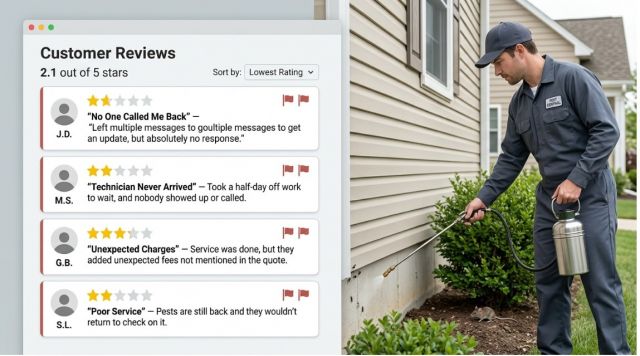
One customer called twice and said nobody responded. Another waited for a technician who never arrived. A third complained that their credit card had been charged without their knowledge.
These customers reported different experiences, but they had something in common: the pest itself was no longer the only problem.
A study of 1,126 one- and two-star Google reviews connected to pest-control businesses with New Jersey addresses found that complaints about customer service appeared more frequently than complaints about pests remaining after treatment.
Poor communication led the list, appearing in 553 reviews, or 49.1% of the sample. Prices, bills and payment problems followed closely at 47.2%. Late, missed or poorly scheduled appointments appeared in 36.4%.
By comparison, 25.8% of the reviews said pests remained or returned after treatment.
The study was commissioned by Agile Pest Control, a New Jersey (Monmouth County) pest-control company. Researchers examined reviews from more than 110 business profiles and classified the problems customers described.
The findings offer a look at what happens when a pest-control complaint expands beyond ants, rodents or insects and becomes a larger dispute about communication, money or trust.
The silence after a problem
A treatment may require another visit. A technician may run late. A customer may need to ask whether a product is safe around a pet.
None of those situations automatically leads to a bad review. The experience can change, however, when the customer cannot reach anyone for an answer.
One reviewer wrote, “I recently place two calls requesting addition service and did not receive a return call to schedule the visit.”
The quotation contains grammatical errors because it is reproduced from the original review, but the complaint is clear. The customer wanted additional service and said two calls went unanswered.
Other reviewers described difficulty receiving updates, arranging another appointment or getting help after something went wrong.
Communication problems were also closely tied to scheduling. Of the 410 reviews that mentioned late, missed or poorly managed appointments, 302 also contained a communication complaint. In other words, nearly three out of every four scheduling complaints included a problem reaching the company or receiving information.
This overlap helps explain why a missed appointment can become more than a scheduling inconvenience. The customer may have taken time off work, prepared the property or arranged for someone to provide access. When no technician arrives, the customer then has to determine whether the appointment was delayed, canceled or entered incorrectly.
One reviewer summarized that experience in six words: “They never showed up for the appointment.”
Problems rarely stayed in one category
The research identified 10 recurring complaint categories. More than 80% of the reviews fell into at least two of them, and the average review mentioned approximately 2.8 issues.
That means many customers were not describing a single failure.
A scheduling mistake could be followed by an unanswered call. A treatment problem could lead to a promised return visit that never happened. A cancellation request could be followed by another payment the customer did not expect.
The fourth-most-common complaint involved rushed, incomplete or incorrect work. It appeared in 390 reviews, or 34.6% of the sample. Missing follow-up or unkept promises appeared in another 325 reviews, representing 28.9%.
One customer said a technician “never came in to spray the inside,” although the reviewer believed that work was part of the service. Another said the company “never returned for a make up visit after a rain.”
The study cannot establish exactly what occurred in any individual case. It records the experience as described by the reviewer. Taken together, however, the reviews show how customers’ frustration can grow when an initial service problem is not resolved.
Billing was almost as common as poor communication
Billing and payment concerns appeared in 531 reviews, only 22 fewer than the number mentioning communication problems.
The complaints included disputed bills, prices customers considered excessive and charges they said they did not understand. One reviewer wrote, “Charged my card for the service without my knowledge.”
The researchers did not examine customer contracts or company billing records, so the study does not determine whether a charge was valid. What it captures is the customer’s belief that the payment was unexpected.
That distinction matters because pest control may be sold as a one-time treatment, a seasonal program or a recurring service agreement. The advertised or initial price may not tell a customer how many payments will be collected, whether follow-up visits are included or what happens when the service renews.
Contract and cancellation complaints appeared in 195 reviews, or 17.3%. Another 204 reviews mentioned sales practices customers described as misleading or overly aggressive.
These categories often touched different parts of the same customer relationship: what was promised during the sale, what appeared in the agreement and what happened when the customer tried to stop the service.
Treatment results were still a serious concern
The fact that customer-service complaints ranked higher does not mean treatment effectiveness was unimportant.
A total of 291 reviews said pests remained or returned. Customers reported continued problems despite treatments or ongoing service plans.
These complaints also tended to overlap with other frustrations. Some customers questioned why they were still being charged when they believed the treatment had not worked. Others described difficulties arranging another visit.
That pattern complicates the idea of “treatment failure.” Some pest problems require multiple visits, monitoring or changes around the property. A customer may accept that process when the expectations are explained clearly and follow-up occurs as promised.
The same situation may be viewed very differently when the customer cannot reach the office, does not know when another technician will arrive or receives a bill they did not anticipate.
What the numbers do not show
The study examined a selected sample of negative reviews. It did not analyze every review posted about New Jersey pest-control businesses, and it was not designed to measure the experience of the average customer.
A finding that 49.1% of the sampled reviews mentioned poor communication does not mean 49.1% of all pest-control customers experience that problem. It means communication appeared in almost half of the one- and two-star reviews included in this analysis.
The customer accounts were also not independently verified. Individual reviews could be assigned to multiple categories, so the percentages should not be added together as though each group contained different customers.
What the research does reveal is the language people used when they were unhappy enough to leave a low rating.
They wrote about pests, but they wrote more often about unanswered calls, confusing bills, missed appointments and promises that were not kept.
For the customers represented in these 1,126 reviews, the pest problem may have started the relationship with a company. What happened around the treatment often determined how that relationship ended.
Anyone can join.
Anyone can contribute.
Anyone can become informed about their world.
"United We Stand" Click Here To Create Your Personal Citizen Journalist Account Today, Be Sure To Invite Your Friends.
Before It’s News® is a community of individuals who report on what’s going on around them, from all around the world. Anyone can join. Anyone can contribute. Anyone can become informed about their world. "United We Stand" Click Here To Create Your Personal Citizen Journalist Account Today, Be Sure To Invite Your Friends.
LION'S MANE PRODUCT
Try Our Lion’s Mane WHOLE MIND Nootropic Blend 60 Capsules
Mushrooms are having a moment. One fabulous fungus in particular, lion’s mane, may help improve memory, depression and anxiety symptoms. They are also an excellent source of nutrients that show promise as a therapy for dementia, and other neurodegenerative diseases. If you’re living with anxiety or depression, you may be curious about all the therapy options out there — including the natural ones.Our Lion’s Mane WHOLE MIND Nootropic Blend has been formulated to utilize the potency of Lion’s mane but also include the benefits of four other Highly Beneficial Mushrooms. Synergistically, they work together to Build your health through improving cognitive function and immunity regardless of your age. Our Nootropic not only improves your Cognitive Function and Activates your Immune System, but it benefits growth of Essential Gut Flora, further enhancing your Vitality.

Our Formula includes: Lion’s Mane Mushrooms which Increase Brain Power through nerve growth, lessen anxiety, reduce depression, and improve concentration. Its an excellent adaptogen, promotes sleep and improves immunity. Shiitake Mushrooms which Fight cancer cells and infectious disease, boost the immune system, promotes brain function, and serves as a source of B vitamins. Maitake Mushrooms which regulate blood sugar levels of diabetics, reduce hypertension and boosts the immune system. Reishi Mushrooms which Fight inflammation, liver disease, fatigue, tumor growth and cancer. They Improve skin disorders and soothes digestive problems, stomach ulcers and leaky gut syndrome. Chaga Mushrooms which have anti-aging effects, boost immune function, improve stamina and athletic performance, even act as a natural aphrodisiac, fighting diabetes and improving liver function. Try Our Lion’s Mane WHOLE MIND Nootropic Blend 60 Capsules Today. Be 100% Satisfied or Receive a Full Money Back Guarantee. Order Yours Today by Following This Link.


| Visits: | 1,834,585,459 |
| Stories: | 8,718,841 |
Whistler Blowers, Insiders

