
While We Focused on Fripperies, the Foundations Have Rotted Away

While the Everything Bubble has soared to new heights, consumer confidence has fallen to new lows.
For your consideration, four charts that tell a single story: while those Americans who have benefited so immensely from the Everything Bubble in stocks, housing, crypto, bat guano, etc.–every asset under the sun–have spent lavishly on fripperies, the foundations of everyday life for the bottom 90% have rotted away.
Yes, I know: stocks are up, and AI will enrich us all, so since everything’s great for me, it’s great for everyone. Nice, but not true. The reality is the foundations of an affordable quality of life for the bottom 90% who haven’t been enriched by the Everything Bubble have rotted away while the top 10% jetted around the world immiserating the everyday lives of the locals.
If everything’s great, then how do we explain this? A shocking 92 percent of US adults are not going to the doctor because it’s too expensive. (yahoo.com)
An overwhelming number of Americans are delaying medical care because of fears they can’t afford it, a new study has found. “The findings highlight a growing gap between having health insurance and feeling financially protected, with medical costs forcing many Americans to delay treatment, cut essential spending and take on debt,” the study said.
Or this? ‘There’s no joy in living this way.’ Families struggling to make ends meet. (yahoo.com)
Americans surveyed in a new study by Omnisend, an e-commerce marketing platform company, are expressing similar struggles. More are borrowing money to pay for groceries. Consumers also said higher prices have changed how they feel about brands they once liked, and a majority of respondents also said they believe brands are using inflation as an excuse to raise prices more than necessary.
In a survey of 1,075 consumers in June, 30% of respondents said they used a credit card to pay for essentials, such as groceries, gas, utilities or medical bills, in the past three months, knowing they may not pay off their bill.
An additional 20% said they borrowed from friends or family, 18% used buy now, pay later products, and 17% said they had to use savings meant for something else.
Shrinkflation: 89% of respondents said they regularly notice when companies shrink packages while prices stay the same. Twenty-nine percent of respondents consider this type of price increase to be the most unfair, and 59% said they noticed it regularly.
Trust in brands is at a low point: 85% said they believe brands often use inflation to justify larger-than-necessary price increases. Among respondents, 67% said higher prices have changed how they feel about brands they once liked.
Those who dismiss all of the above as “not true” or “it’s their fault” are terrified of admitting the truth: the foundations of life in America have rotted away while the wealthiest 10% are enjoying the wealth generated by history’s greatest credit-asset bubble.
The Rise of the Unstoppable American Tourist A supercharged U.S. economy has helped transform a nation of homebodies into zealous international travelers; ‘Travel isn’t optional’ (wsj.com)
Behind the shift is a supercharged U.S. economy that in the course of a generation has created a larger and wealthier class of Americans that views travel as an essential rather than a luxury. Older Americans, who are driving this new era of travel, hold about $110 trillion in wealth. They’re also living longer, and looking to make the most of those years.
Europe is often the gateway drug. Portugal and Greece have seen the biggest percentage increases in U.S. visitors of any country over the past decade, according to U.S. government data. The U.K. and Italy have seen the largest increases in the total number of tourists, getting millions of additional Americans a year arriving by air.
Only about 6% of U.S. travelers to Europe in 2025 said it was their first time flying abroad. Many of these tourists are visiting multiple times a year. U.S. travelers to the region skew female, with women 55 and over making up 24%. More than 15% of Americans visiting Europe reported a household income of $300,000 or more.
In 1990, fewer than 5% of Americans had a passport. Now, more than 50% do.
A growing share of consumer spending is going toward foreign travel, as habits change and prices rise. Lenza, who does tech work for the travel industry, estimates that he and his wife spend between $100,000 and $200,000 on travel each year, even as they try to be cautious with other kinds of spending.
“One of the reasons I joke that I’m still working is that I like my business-class sleeper seats,” said Robbins, who estimates they spend about $60,000 to $70,000 a year on travel abroad.
And it’s not just freewheeling baby boomers. Younger generations, who place a high value on experiences, are spending on travel instead of buying houses and having kids.
The magic is often lost on locals. The influx of tourists has brought in new wealth in many places but it’s also straining infrastructure, raising the cost of living and disrupting local life. Housing has become scarce and unaffordable in some cities, with more apartments being used as pricey short-term vacation rentals.
Tens of thousands protested against overtourism on the Spanish island of Mallorca last month, demanding fewer visitors and more affordable housing. The march turned violent as protesters clashed with police, who fired rubber bullets after being pelted with plastic bottles.
It wasn’t just “working hard” or “smart investing” that generated $70 trillion in new “wealth” since 2020, it was luck: being in one’s peak earning years when assets such as houses were still affordable, and then owning those assets during history’s greatest credit-asset bubble, arguably from Q1 2009 to the present, or from either Q1 2020 or Q3 2022. Take your pick, the results are the same: tens of trillions of “free money” wealth for those older, wealthier Americans who bought assets before the Everything Bubble inflated.
The Great $110 Trillion Wealth Transfer Won’t Happen Any Time Soon Americans 55 and up control most wealth, and many of them have decades of living left. (wsj.com)
A staggering 97% of that increase was due to wealth gains in households where the head of household was 55 or older. About 75% of the total increase was from gains by the wealthiest 10% of households age 55 and older, the analysis found.

This chart of Composite Consumer Confidence is well worth studying. Look at the 1990s dot-com era and the current Everything Bubble. Since the 1990s Internet boom actually raised all boats–real wages actually increased, prosperity by any commonsense measure was broad-based rather than concentrated in the top 10%–consumer confidence rose throughout the 1990s.
Compare that to the present: while the Everything Bubble has soared to new heights, consumer confidence has fallen to new lows. The Everything Bubble only benefited the older, wealthier Americans, while the rot accelerated the decay of the foundations of life for the bottom 90%.

Consider the S&P 500 stock market index. The stock market has more than doubled in a mere four years, along with housing in many markets. As a result, household net worth rose a staggering $71 billion, a 70% increase, “97% of that increase was due to wealth gains in households where the head of household was 55 or older, and 75% of the total increase was from gains by the wealthiest 10% of households age 55 and older.”

That’s an incredible concentration of the gains in two overlapping cohorts: the top 10% of households and those 55 and older.
Actually, for the bottom 90% of American households, overseas travel is at best optional. Nobody seems to be asking questions such as: what kind of society do we end up with if young people no longer have an interest in raising families or buying homes while devoting their earnings to visiting the Stans? What kind of society celebrates luxury travel while 92% of households forego medical care because they can’t afford it?
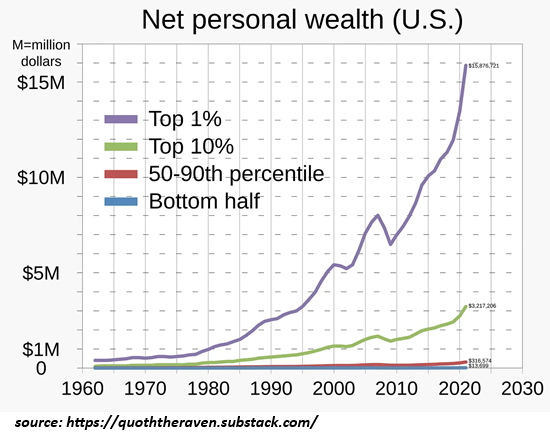
The obvious answer is a society whose foundations have completely rotted away while we focused on fripperies funded by asset bubbles. If you want to argue, argue with the data. Sorry, the data won.
My book Investing In Revolution is available at a 10% discount ($18 for the paperback, $24 for the hardcover and $8.95 for the ebook edition). Introduction (free)
Subscribe to my Substack for free
NOTE: Contributions/subscriptions are acknowledged in the order received. Your name and email remain confidential and will not be given to any other individual, company or agency.
|
Thank you, Sam F. ($200), for your outrageously generous subscription to this site — I am greatly honored by your steadfast support and readership. |
Thank you, Stuart L. ($75), for your marvelously generous subscription to this site — I am greatly honored by your steadfast support and readership. |
|
|
Thank you, Michael T. ($70), for your massively generous subscription to this site — I am greatly honored by your steadfast support and readership. |
Thank you, Gunnar ($7/month), for your splendidly generous subscription to this site — I am greatly honored by your support and readership. |
Source: http://charleshughsmith.blogspot.com/2026/08/while-we-focused-on-fripperies.html
Anyone can join.
Anyone can contribute.
Anyone can become informed about their world.
"United We Stand" Click Here To Create Your Personal Citizen Journalist Account Today, Be Sure To Invite Your Friends.
Before It’s News® is a community of individuals who report on what’s going on around them, from all around the world. Anyone can join. Anyone can contribute. Anyone can become informed about their world. "United We Stand" Click Here To Create Your Personal Citizen Journalist Account Today, Be Sure To Invite Your Friends.
LION'S MANE PRODUCT
Try Our Lion’s Mane WHOLE MIND Nootropic Blend 60 Capsules
Mushrooms are having a moment. One fabulous fungus in particular, lion’s mane, may help improve memory, depression and anxiety symptoms. They are also an excellent source of nutrients that show promise as a therapy for dementia, and other neurodegenerative diseases. If you’re living with anxiety or depression, you may be curious about all the therapy options out there — including the natural ones.Our Lion’s Mane WHOLE MIND Nootropic Blend has been formulated to utilize the potency of Lion’s mane but also include the benefits of four other Highly Beneficial Mushrooms. Synergistically, they work together to Build your health through improving cognitive function and immunity regardless of your age. Our Nootropic not only improves your Cognitive Function and Activates your Immune System, but it benefits growth of Essential Gut Flora, further enhancing your Vitality.

Our Formula includes: Lion’s Mane Mushrooms which Increase Brain Power through nerve growth, lessen anxiety, reduce depression, and improve concentration. Its an excellent adaptogen, promotes sleep and improves immunity. Shiitake Mushrooms which Fight cancer cells and infectious disease, boost the immune system, promotes brain function, and serves as a source of B vitamins. Maitake Mushrooms which regulate blood sugar levels of diabetics, reduce hypertension and boosts the immune system. Reishi Mushrooms which Fight inflammation, liver disease, fatigue, tumor growth and cancer. They Improve skin disorders and soothes digestive problems, stomach ulcers and leaky gut syndrome. Chaga Mushrooms which have anti-aging effects, boost immune function, improve stamina and athletic performance, even act as a natural aphrodisiac, fighting diabetes and improving liver function. Try Our Lion’s Mane WHOLE MIND Nootropic Blend 60 Capsules Today. Be 100% Satisfied or Receive a Full Money Back Guarantee. Order Yours Today by Following This Link.


| Visits: | 1,828,432,268 |
| Stories: | 8,686,306 |
Whistler Blowers, Insiders