

Selkirk Copper Mines

EXECUTIVE SUMMARY—BIG NEWS DUE THIS WEEK ON SCMI
There’s a fully built copper-gold-silver mine sitting in the Yukon that cost over $300 million to construct. It ran for 16 years. It produced half a billion pounds of copper. The last owner went bankrupt in 2023 — not because the rock was bad, but because they ran out of money and couldn’t manage their water. A First Nation bought it out of bankruptcy, teamed up with a Vancouver finance group and a 33-year Teck veteran, and now owns 100% of it — with the old streaming deal and offtake contract wiped clean off the books. They’ve drilled 52,000 metres, they’re drilling 50,000 more, and the first real economic study on the restart is due this month.
That study is the trade. Let me walk you through why.
PART 1: WHAT HAPPENED AT MINTO — AND WHY IT MATTERS
Minto sits 250 km north of Whitehorse, right off the Klondike Highway. Year-round access by road, barge, and air. Grid power. It’s on Selkirk First Nation Category A Settlement Land — meaning the Nation owns both the surface and what’s underneath.
The deposit was found in the early 1970s. Sherwood Copper built the mine and poured first concentrate in 2007. Capstone took over, ran it hard, and put it on care and maintenance in 2018. Pembridge Resources bought it in 2019 and restarted it under a subsidiary called Minto Metals.
Over 16 years the mine produced more than 500 million pounds of copper plus gold and silver credits. Peak year was 2016: about 31,000 tonnes of copper, 40,000 oz gold, 355,000 oz silver.
The concentrate was excellent — 36-40% copper, 12-18 g/t gold, 100-150 g/t silver, and low in the nasty deleterious elements smelters hate. Copper recovery ran 90-92%. Smelters lined up for this stuff.
So why did it die?
Three reasons, and none of them are the orebody.
1. Water. Minto restarted in 2019 without functioning water treatment. Contaminated water piled up year after year. Storage capacity shrank. Eventually they fell below the minimums their water licence required. Every spring melt made it worse.
2. The bond. In 2022 the Yukon government — largely because of the water mess — asked for roughly $18 million more in reclamation security. Minto Metals couldn’t pay. Regulators imposed restricted operating conditions in April 2022. Once you’re operating on a leash, you can’t fix anything.
3. The capital structure was a noose. Pembridge’s original purchase fell apart when they couldn’t raise enough money. They ended up borrowing from US hedge funds and giving away most of the mine’s economics. On top of that:
• Wheaton Precious Metals held a gold and silver stream that took the precious metal revenue. Over the life of the mine that stream paid Wheaton more than US$250 million.
• Sumitomo held the concentrate offtake, so the copper sales were spoken for too.
A mine with high-grade gold and silver by-products where you don’t get to keep the gold and silver is a mine with a much thinner margin than the drill results suggest.
In May 2023 the board resigned and the company walked. Two dozen lawsuits followed. The Yukon government took over the site. PwC was appointed receiver. The mine went dark.
The reset
In June 2025, Selkirk First Nation became the first Indigenous government in Canadian history to take full legal ownership of a mine. They then partnered with Venerable Ventures (a Fiore Group vehicle), which reverse-took-over into what is now Selkirk Copper Mines.
Here’s the part that matters most to a shareholder:

That means 100% of any future gold and silver revenue flows to Selkirk Copper shareholders. The only royalty left on the property is a 1.5% NSR payable to Selkirk First Nation — their own controlling shareholder.
And the offtake being free means it’s now a source of capital. Trading houses will pay real money up front for the right to market that clean concentrate. That’s non-dilutive financing that didn’t exist before.
The company acquired the whole thing — mill, camp, pits, underground, water treatment plant, mobile fleet, 26,850 hectares of claims — at roughly a C$30 million enterprise value. Against $300M+ of infrastructure replacement cost.
PART 2: THE CEO — COLIN JOUDRIE
This is not a promoter running a shell.
M. Colin Joudrie is a geologist by training — BSc.H from Queen’s, MBA from Ivey. He started as a project geologist in Manitoba, Chile, Argentina, and Namibia.
He then spent 33 years at Teck Resources, the last 13 of them (2011–2024) as Vice President of Business Development. That job is exactly the job you’d want on your résumé if you were going to do this: he spent over a decade advancing copper, zinc, nickel and precious metals projects across the Americas through PEA, prefeasibility and feasibility. He built and managed joint ventures. He negotiated with communities, First Nations and regulators for a Tier 1 copper producer.
Earlier he ran Teck’s CESL hydrometallurgical group — so he understands copper processing at a technical level, not a PowerPoint level.
He joined August 1, 2025. And critically: he put his own money in. $1.5 million at $0.28/share in the initial private placement, with reported total personal investment around $2.3 million. He owns about 6.4% of the company.
I pay attention to that. A guy leaving a senior Teck role to run a Yukon single-asset junior and writing a seven-figure personal cheque at 28 cents is not doing it for the salary.
The rest of the bench is credible too: Josh Kierce as CFO, Stacie Jones as VP Exploration, Chuck Hennessey as SVP Operations (joined Nov 2025), plus Selkirk First Nation citizens Kevin McGinty (VP Lands & Environment) and Morris Morrison (Manager, Community Relations). Two SFN-nominated directors on the board.
PART 3: WHAT THEY’VE ACTUALLY DONE SO FAR
Talk is cheap. Here’s the receipts.
The Phase 1 drill program — 52,288 metres in 175 holes. Four rigs, started August 2025, finished March 2026. That’s one of the largest drill programs in the Yukon in a decade. Zero medical aid or lost-time injuries. 105% of planned metres. 94 m/day per rig average.
Roughly 87% of Phase 1 holes hit notable mineralization. That’s an absurd hit rate — it tells you this is a well-understood system, not a fishing expedition.
The standouts:
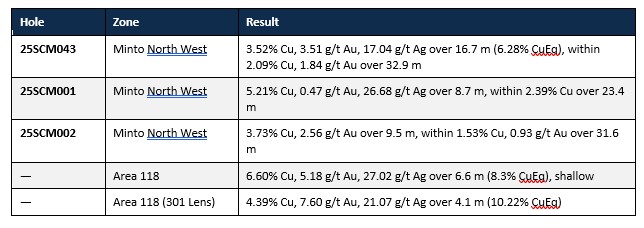
That 25SCM043 intercept sits in the top 1% of grade-thickness for the entire Minto database — a database spanning six decades, 1,773 holes and 390,000+ metres.
What they grew:
• Minto North West zone expanded roughly 90% (about double the modelled volume from the Aug 2025 resource)
• Discovered a brand new 117 Lens underneath a previously mined open pit — 1.02% Cu, 0.35 g/t Au over 22.7 m
• Extended Minto East with multiple stacked lenses
• Pushed Ridgetop and Area 118 mineralization beyond the current pit shells
And here’s the kicker: only 3 km of a 7 km mineralized trend inside the licensed mine area has been explored. Minto North — the highest grade zone — has seen the least drilling, and nothing north of the boundary.
Other boxes ticked:
• Trade-off study and engineering awarded to Hatch (mining, processing, infrastructure) and SRK (water, tailings, waste rock). Both have prior Minto site experience. These are grown-up firms.
• Phase 2 drill program launched May 2026 — another 50,000 m, focused on infill and geotechnical/metallurgical data for the Feasibility Study
• Geotechnical drilling, test pitting, geomet testwork and structural mapping all underway for the FS
• LiDAR flown over ~2,000 km² of the belt
• Assumed site care and maintenance from the Yukon Government on April 1, 2026
• Listed on OTCQB and Frankfurt; got DTC eligibility for US investors
PART 4: THE RESOURCE
From the August 2025 MRE (Moose Mountain Technical Services, effective April 7, 2025) — this is the pre-Phase-1 number, and it’s about to be replaced:

Call it 881 million pounds of copper at an average grade above 1%. In a world where new copper mines average 0.4-0.5%, that’s a fat grade.
But the number I want you to burn into your brain isn’t the grade. It’s the NSR — the net smelter return per tonne. That’s what a tonne of rock is actually worth after recovery and smelter charges:
• Indicated underground: US$235/tonne
• Indicated overall: US$183/tonne
• Inferred overall: US$159/tonne
(company’s “spot” column is September 2025 LME: US$5.30/lb Cu, US$4,300/oz Au, US$60/oz Ag)
Now re-run those at today’s prices. Copper is up about 21% from that deck. Gold is down about 7%. Silver is flat. Because copper carries roughly three-quarters of the revenue at these grades, the copper gain more than offsets the gold pullback — NSR comes out roughly 13% higher than the company’s published spot column:
• Indicated underground: ~US$265/tonne (my calculation at US$6.40 Cu / US$4,000 Au / US$60 Ag)
• Indicated overall: ~US$207/tonne
• Inferred overall: ~US$180/tonne
Rock worth $180-265 a tonne is not a marginal copper deposit. And note the revenue split at these prices: copper about 75%, gold about 21%, silver about 3%. The precious metals are a genuine margin enhancer — but this is a copper story first, and it should be underwritten as one.
PART 5: THE OLD PEA vs. THE NEW ONE
The old PEA (JDS Energy & Mining, effective March 31, 2021)
Prepared for Pembridge, filed on SEDAR June 2021. Here’s what it said:
• 8-year mine life (out to 2028)
• 277 million lb copper, 129,000 oz gold, 930,000 oz silver total
• First five years averaging 38 Mlb Cu / 17,600 oz Au / 129,000 oz Ag per year
• AISC of US$2.65/lb copper net of by-product credits (excluding closure)
• Built on 11.09 Mt M&I at 1.46% Cu plus 13.03 Mt Inferred at 1.29% Cu
• After-tax NPV8% of C$313 million at US$4.50/lb copper and 0.82 FX
• Copper price assumptions in the base case: US$3.40/lb in 2021, $3.25 in 2022, $3.10 thereafter
That study was a short-life, grade-led plan run by a company that was already financially stretched. It assumed permits would get sorted in production. And every dollar of it was calculated with the Wheaton stream and the Sumitomo offtake in place.
What’s changed since 2021
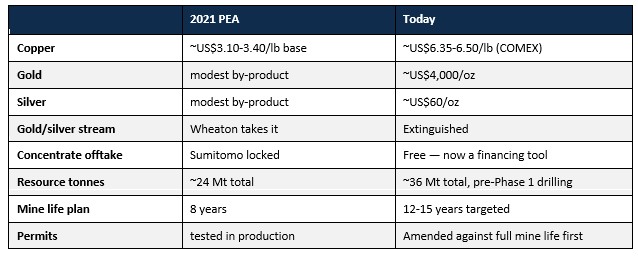
Selkirk publishes a chart benchmarking metal prices against Jan 1, 2023 (copper US$3.75/lb, gold US$1,846/oz, silver US$24.23/oz, Whitehorse diesel C$1.347/litre). Recalculated at today’s prices, copper is up about 71%, gold about 117%, and silver about 148% — while diesel is up roughly 45%. Costs went up. Revenue went up a lot more. That gap is the entire thesis.
What the new PEA is designed to deliver
Management has publicly laid out the design basis:
• 12-15 year mine life — explicitly long enough “to attract low-cost restart financing”
• 4,100 tpd (1.5 Mtpa) integrated open pit + underground, with an ore blending strategy so mining stays ahead of the mill
• ~30,000 tonnes per year copper-equivalent production
• Updated operating cost estimate on current power, labour, fuel and consumables
• Updated restart and sustaining capital based on vendor quotes, not scaling factors
• Updated scoping-level closure plan, crediting reclamation already done since the bankruptcy
• Full incorporation of the 52,288 m Phase 1 drilling
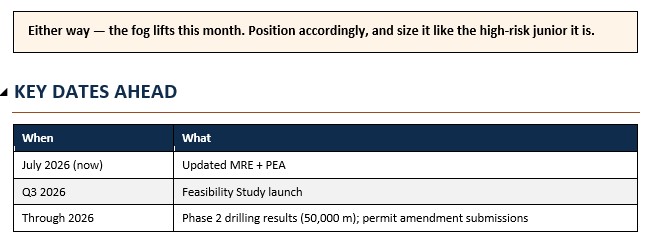
Timing: the company said the updated MRE and the PEA are “on target for completion in the second half of July.” We are in the second half of July.
PART 6: PRO-FORMA ECONOMICS — MY BACK-OF-THE-ENVELOPE

Capital
The mill exists. The camp exists. The power line, the roads, the water treatment plant, the pits, the underground portals — they all exist. That’s the $300M+ nobody has to spend again.
What does need spending:
• Dewatering the underground (the Yukon Government stored water down there as part of closure — moving it is an active engineering and permitting workstream)
• Water treatment capacity expansion — this is non-negotiable, it’s what killed the last guy
• Mill refurbishment and crusher work after 3+ years idle
• Pre-strip and underground development to get ore in front of the mill
• Mobile fleet refresh
• Tailings and waste rock storage for a 12-15 year life inside the existing QML boundary
• Reclamation security posted with the Yukon Government — the wildcard
My working range for initial restart capital: C$175M to C$325M. Anything under C$250M and the market will cheer. Over C$350M and the financing math gets ugly against a ~C$290M market cap.
Operating cost
Here’s where it gets interesting. Take indicated grade — 1.20% Cu, 0.46 g/t Au, 4.27 g/t Ag — and apply Minto’s historical 90-92% copper recovery:
• ~23 lb of payable copper per tonne (26.5 lb contained, ~91% recovery, ~96.5% payable)
• ~0.010 oz payable gold per tonne — at US$4,000/oz that’s about US$40/tonne
• ~0.099 oz payable silver per tonne — at US$60/oz that’s about US$6/tonne
So gold and silver together are worth roughly US$42-50 per tonne of ore. Divide that by the payable copper and you get a by-product credit of roughly US$1.80-2.15 per pound of copper.
If site operating costs land at US$70-95/tonne milled (reasonable for a mixed OP/UG operation at 1.5 Mtpa in the Yukon with grid power), gross cost per pound is roughly US$3.00-4.10 — and after those precious metal credits you’re plausibly looking at a net cash cost in the US$1.00-2.10/lb range.
Against US$6.40 copper, that is still an enormous margin. At 1.5 Mtpa and a blended NSR around US$185-195/tonne, gross revenue is roughly US$265-300 million a year. Take off US$105-143 million of site operating cost and you get EBITDA in the US$140-180 million range annually, before sustaining capital, the 1.5% NSR royalty and tax.
Against an enterprise value that’s been sitting around C$230 million.
That’s the bull case in one line: if the PEA confirms even half of that, this is trading at a fraction of its own cash flow.
PART 7: SHARE STRUCTURE AND MONEY IN THE TILL
As of the May 2026 corporate presentation (plus the May 25 SFN top-up):
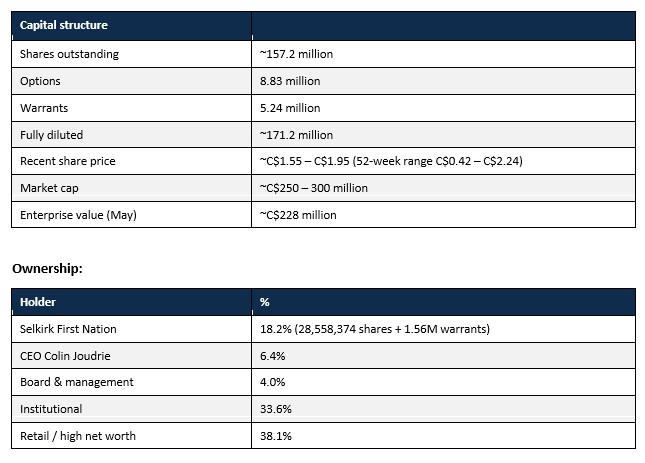
That’s a tight, clean structure. 171 million fully diluted shares for a company with a built mine is unusually disciplined for the TSXV. No 400-million-share rollup here.
Money in the till:
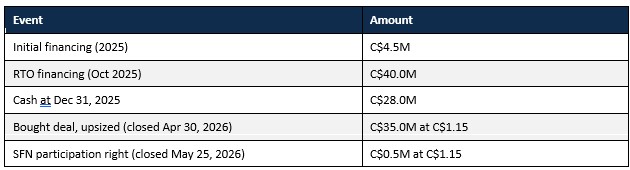
Roughly C$63.5 million was available going into the summer. Since then they’ve been running a 50,000 m Phase 2 drill program, paying for Hatch and SRK, and — since April 1 — carrying site care and maintenance themselves.
My estimate of current cash: somewhere in the C$40-55 million range. No debt. They’ll confirm it in the Q2 financials. That’s enough to finish the PEA, run Phase 2 drilling and get well into feasibility work without a raise. It is not enough to build. That comes later, and it comes big.
Note also: the Canaccord-led bought deal was upsized from $20M to $30M to $35M on demand. Institutions want in. Selkirk First Nation exercised its participation right to defend its position. Both are good signals.
PART 8: THE COPPER MARKET RIGHT NOW
Copper has been on an absolute tear.
• COMEX copper is trading around US$6.35-6.50/lb — near multi-week highs
• LME cash copper is around US$13,300-13,400/tonne, versus a July 2025 monthly average near US$9,778/t. That’s a ~36% year-over-year move.
• LME warehouse stocks have been drawing down hard — roughly 306,500 t in mid-July, down from ~389,000 t at end-May
• The Yangshan premium (China’s import demand gauge) hit a multi-year high around US$115/tonne
Why it’s tight:
• Chile is the bottleneck. El Teniente is capped near 301,000 t/year for years following the July 2025 accident. Cochilco cut its 2026 Chilean estimate to 5.75 Mt.
• Mine disruptions, slow project delivery, concentrate shortages and squeezed smelter margins across the board
• Scrap availability tightened in China after a VAT fraud crackdown
• Structural demand from grid buildout, AI data centres, defence and electrification
The tariff overlay: The US Section 232 action put a 50% tariff on semi-finished copper products effective August 2025. The follow-up report delivered June 30, 2026 temporarily exempted refined copper but scheduled a phased duty — 15% from January 1, 2027, rising to 30% in 2028. That’s kept a persistent COMEX-over-LME premium and kept metal flowing toward US warehouses.
Be honest about the disagreement. The analysts are not aligned:
• UBS sees a ~520,000 t refined deficit in 2026 (demand +2.8% vs supply +1.7%) and has called for US$14,000/t by September 2026
• Goldman Sachs has been more cautious, arguing a US$10,000-11,000/t range on continued surplus
• Macquarie goes further and models a 262,000 t surplus in 2026 with bigger surpluses after
• ICSG (April) pegged a modest 96,000 t surplus for 2026 and 377,000 t for 2027
So the “structural deficit” story is real but contested. What’s not contested is that the price is historically high right now, and that there is nowhere near enough new copper supply coming.
Which is the whole point of Selkirk. In a market screaming for near-term pounds, a built mine that can be back in production in 2028 is worth vastly more than a greenfield discovery that needs a decade and $2 billion. Compare Selkirk’s total copper resource of 881 Mlb at 1.10% against peers like Western Copper’s Casino (10.7 billion lb, but at 0.12%) — different animals entirely. Selkirk’s advantage isn’t size. It’s grade, infrastructure, and timing.
And don’t forget the co-products. Gold near US$4,000 and silver near US$60 are worth roughly US$46 per tonne of ore at Minto’s grades — about a quarter of gross revenue, and enough to knock nearly US$2.00/lb off the copper cash cost. That’s not the headline, but it’s the difference between a decent margin and a great one. And this time, shareholders keep every ounce.
One caution worth stating plainly: gold has come off its highs. It touched a two-week peak above US$4,165 in late July before sliding back toward US$4,050 as oil rallied and the market moved to price roughly 80% odds of a Fed hike by September. If gold keeps retreating, the by-product credit shrinks and the cash cost rises. At US$3,500 gold the credit drops by about US$0.22/lb. Not fatal — but it’s the second-order price risk in this story, behind copper itself.
PART 9: WHAT THE MARKET IS HOPING FOR IN THIS PEA
Here’s my scorecard. When it hits the wire, check these seven boxes:
1. Mine life — needs to be 12+ years. Company has guided 12-15. Anything under 10 and the “not another short-life squeeze job” thesis takes damage.
2. Restart capital — THE number. Under C$250M is a green light. C$250-325M is workable. Over C$350M and you have to ask hard questions about dilution against a ~C$290M market cap.
3. Cash cost / AISC net of by-products. The 2021 PEA said US$2.65/lb with a stream taking the precious metals. With the stream gone and gold at US$4,000, I want to see something starting with a 1. If they print sub-US$1.50/lb, this thing re-rates immediately.
4. After-tax NPV and IRR — and read the price deck carefully. Companies typically run base case at consensus prices well below spot (Selkirk’s own consensus deck has been US$4.25/lb Cu, US$2,500/oz Au, US$30/oz Ag). At those prices the headline NPV will look modest. Go straight to the sensitivity table and find the spot-price row.
5. Payback period. Under two years and the debt/offtake financing conversation gets very easy.
6. Production profile. They’ve flagged ~30,000 tpa CuEq. The historical peak was 31 kt Cu in 2016, so it’s achievable — but I want to see the grade profile front-loaded.
7. Closure and security. The updated scoping-level closure plan is in the PEA scope. This is the least glamorous item and possibly the most important.
Also watch the updated MRE that drops alongside it. Phase 1 nearly doubled the Minto North West zone and found a whole new lens. If the resource jumps meaningfully — and if a good chunk of that inferred material moves to indicated — the PEA is being built on a bigger, more confident base than the August 2025 numbers.
PART 10: THE RISKS — READ THIS PART TWICE
1. Reclamation security is the big unknown. The Yukon Government holds and is spending Minto Metals’ old financial security on the site (it allocated C$21.5M in one budget year alone). When Selkirk moves to restart, it will have to post its own security for both the remaining legacy liability and any new operations. That number has not been disclosed and could be very large. This is the exact issue that put the last operator on a leash. Watch for it in the PEA closure section.
2. Water. Water. Water. Contaminated water killed Minto Metals. There’s water stored in the underground workings from the government’s closure work that has to be dealt with physically and from a permitting standpoint. SRK is on it. But this is the single biggest technical risk on the property.
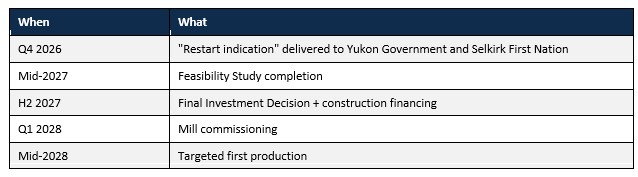
3. Permitting timeline. The strategy is to amend existing licences (QML, exploration, water) rather than start from scratch — that’s the whole reason a 2028 restart is even conceivable. If regulators require a broader new assessment, the timeline slips a year or more and so does the stock.
4. Financing dilution. They’ll need a couple hundred million dollars to build. Options include debt, a free concentrate offtake prepayment (their best card), equipment financing, and equity. If copper cracks while they’re financing, retail gets diluted hard.
5. A lot of inferred material. A PEA is allowed to use inferred resources. A Feasibility Study is not. Phase 2’s infill drilling has to convert enough tonnes to indicated for the FS to carry the mine plan. Conversion risk is real.
6. Single asset, remote, seasonal. Concentrate moves by road and barge across the Yukon River to Skagway, Alaska. Shoulder seasons (freeze-up and break-up) constrain access — the company is actively evaluating options to eliminate that constraint, which tells you it’s a genuine issue.
7. The stock has already moved. SCMI has run from around C$0.42 to a high of C$2.24 in under a year. Expectations are elevated. A good PEA that isn’t a spectacular PEA can still knock 20-30% off this stock. That’s how “sell the news” works on the Venture.
8. Copper price. Every number above is leveraged to it. If Macquarie’s surplus call is right instead of UBS’s deficit call, everything gets harder.
THE BOTTOM LINE
I like the setup here more than almost any restart story I’ve looked at, and it comes down to four things:
One — they’re not buying a dream, they’re buying steel in the ground. $300M+ of infrastructure for a $30M enterprise value. The mill is there. The camp is there. The metallurgy is proven over 16 years, not modelled.
Two — the balance sheet reset is genuinely rare. Bankruptcy extinguished a stream that had paid out over US$250 million and a locked-in offtake.
Both of those were structural drags on every prior owner. They’re gone forever. That is a permanent, non-repeatable improvement to the economics of every future tonne.
Three — the ownership structure solves the problem that kills Canadian mines. The First Nation on whose Category A land the mine sits isn’t a stakeholder to be consulted. They’re the largest shareholder at 18.2%, with two board seats and two of their citizens in management. Social licence isn’t a risk line item here — it’s the foundation of the company. Add a majority pro-mining Yukon government elected in November 2025 and the political risk drops a lot.
Four — management is doing it in the right order. Drill first. Trade-off studies with Hatch and SRK. Then PEA. Then Feasibility. Then permit amendments against the full mine life. Then, and only then, a restart decision. That is precisely the opposite of what Pembridge did, and Joudrie — who spent 13 years at Teck watching projects succeed and fail — clearly knows it.
The catalyst is imminent. The updated MRE and the PEA were guided for the second half of July 2026. That’s now. This is the moment the market stops guessing about capex and opex and gets actual numbers from actual engineers.
If the PEA prints a 12-15 year life, restart capital under C$250 million, and net cash costs with a “1” in front of them, this stock is materially undervalued at a C$230M enterprise value.
If capex comes in heavy or the closure security number is a monster, it’s a very different conversation.
This report is for information and education only. It is not investment advice, and I am not a licensed investment advisor. Junior mining stocks are speculative and you can lose your entire investment. All figures are drawn from public company disclosure, regulatory filings and news reports as of July 26, 2026. All economic calculations use a price deck of US$6.40/lb copper, US$4,000/oz gold and US$60/oz silver; the NSR adjustments in Part 4 and the capex, opex and EBITDA estimates in Part 6 are my own back-of-the-envelope work and are NOT company guidance. Metal prices, share prices and cash balances move — verify current figures before acting. Do your own due diligence.
Source: https://oilandgas-investments.com/2026/latest-reports/selkirk-copper-mines/
Anyone can join.
Anyone can contribute.
Anyone can become informed about their world.
"United We Stand" Click Here To Create Your Personal Citizen Journalist Account Today, Be Sure To Invite Your Friends.
Before It’s News® is a community of individuals who report on what’s going on around them, from all around the world. Anyone can join. Anyone can contribute. Anyone can become informed about their world. "United We Stand" Click Here To Create Your Personal Citizen Journalist Account Today, Be Sure To Invite Your Friends.
LION'S MANE PRODUCT
Try Our Lion’s Mane WHOLE MIND Nootropic Blend 60 Capsules
Mushrooms are having a moment. One fabulous fungus in particular, lion’s mane, may help improve memory, depression and anxiety symptoms. They are also an excellent source of nutrients that show promise as a therapy for dementia, and other neurodegenerative diseases. If you’re living with anxiety or depression, you may be curious about all the therapy options out there — including the natural ones.Our Lion’s Mane WHOLE MIND Nootropic Blend has been formulated to utilize the potency of Lion’s mane but also include the benefits of four other Highly Beneficial Mushrooms. Synergistically, they work together to Build your health through improving cognitive function and immunity regardless of your age. Our Nootropic not only improves your Cognitive Function and Activates your Immune System, but it benefits growth of Essential Gut Flora, further enhancing your Vitality.

Our Formula includes: Lion’s Mane Mushrooms which Increase Brain Power through nerve growth, lessen anxiety, reduce depression, and improve concentration. Its an excellent adaptogen, promotes sleep and improves immunity. Shiitake Mushrooms which Fight cancer cells and infectious disease, boost the immune system, promotes brain function, and serves as a source of B vitamins. Maitake Mushrooms which regulate blood sugar levels of diabetics, reduce hypertension and boosts the immune system. Reishi Mushrooms which Fight inflammation, liver disease, fatigue, tumor growth and cancer. They Improve skin disorders and soothes digestive problems, stomach ulcers and leaky gut syndrome. Chaga Mushrooms which have anti-aging effects, boost immune function, improve stamina and athletic performance, even act as a natural aphrodisiac, fighting diabetes and improving liver function. Try Our Lion’s Mane WHOLE MIND Nootropic Blend 60 Capsules Today. Be 100% Satisfied or Receive a Full Money Back Guarantee. Order Yours Today by Following This Link.


| Visits: | 1,830,155,011 |
| Stories: | 8,693,704 |
Whistler Blowers, Insiders

