

How Gold Is Mined from Ore to Bar: From Rock to Bullion 2026

Understanding how gold is mined from ore to bar means following rock through a chain of stages: it is found, blasted out of the ground, crushed and ground to a powder, chemically separated from the surrounding waste, smelted into a rough bar called doré, then refined and cast into a stamped bar. Almost no finished bar is ever made at the mine itself.
Here is the whole chain in ten steps.
- Exploration: geologists map veins, drill core, assay samples and size the deposit before any digging begins.
- Feasibility: engineers model the mine, mill and cost base, then test whether the ore earns more than it costs.
- Extraction: ore is drilled, blasted, loaded and hauled out, either from an open pit or from underground.
- Crushing: run-of-mine rock is broken down in jaw and gyratory crushers until the pieces are small enough to mill.
- Grinding: mills grind the crushed rock to a fine powder, using steel balls and water to keep it suspended.
- Concentration: gravity separators and froth flotation pull gold-bearing particles away from the surrounding waste.
- Cyanidation: a dilute sodium cyanide solution dissolves the fine gold, which is then adsorbed onto activated carbon.
- Smelting: the loaded carbon is burned off and the remaining gold and silver melt together into a doré bar.
- Refining: Miller and Wohlwill processes strip out the remaining silver, copper and lead, leaving 99.99% pure gold.
- Casting and hallmarking: the metal is poured into moulds, weighed, numbered, assayed and hallmarked for sale.
Figures below reflect published mining practice and reference sources, and they were last checked in October 2026. Costs, grades and recoveries vary widely between deposits, so treat every number as a range rather than a rule.
How Gold Is Mined from Ore to Bar: The Process
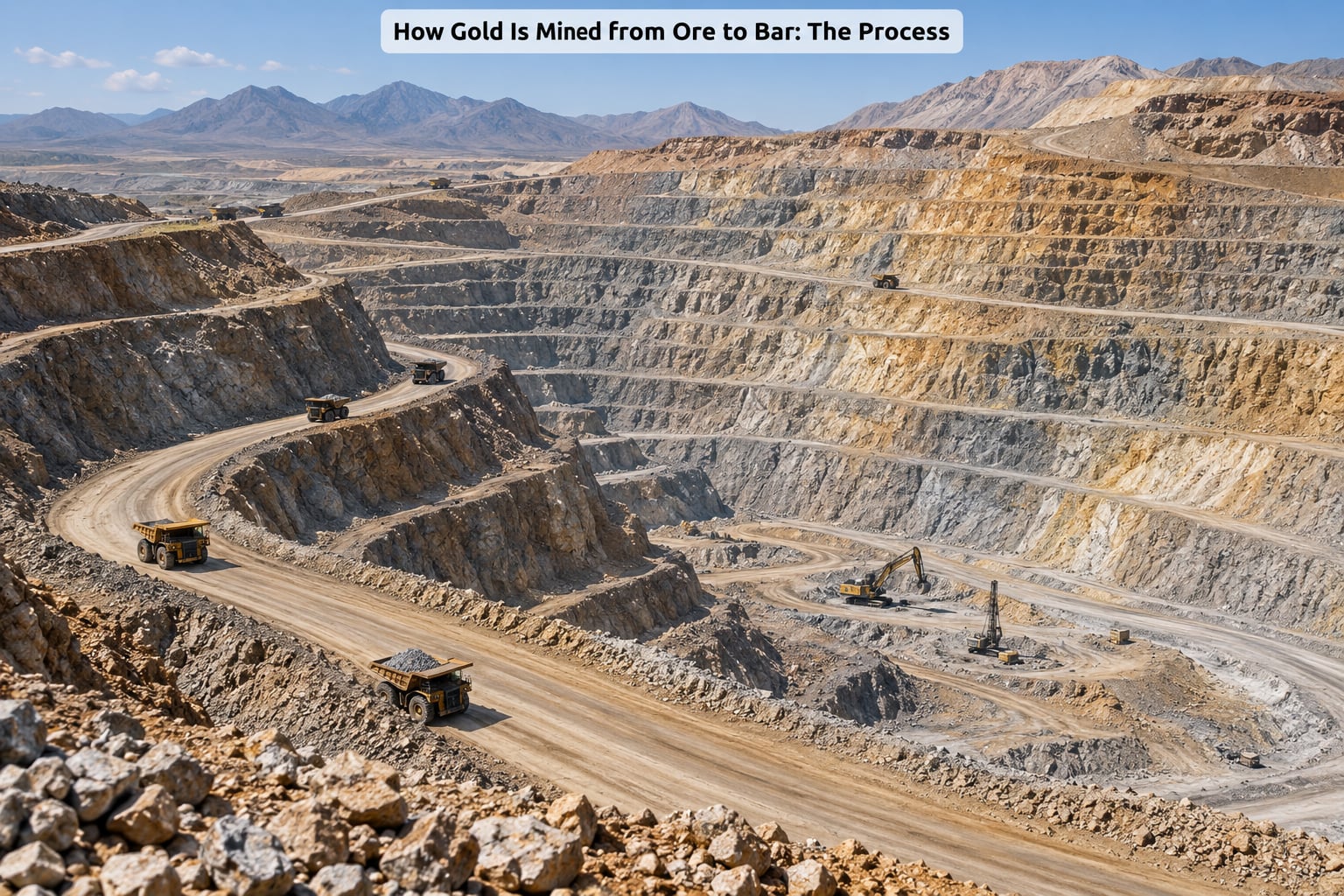
The route rock takes is rarely a straight line. A heap leach operation skips crushing and flotation entirely, an underground mine may run gravity and flotation only, and a refractory deposit adds a roasting step before anything can be leached. What every route shares is the same logic: remove gold from a very large mass of rock, then concentrate that gold into a small, pure, saleable form.
How gold is mined from ore to bar, stage by stage
Metallurgists call the sequence comminution, recovery, smelting and refining, but the useful way to read it is as a series of separations. Each stage strips away one more layer of unwanted material.
| Stage | What happens | What comes out | Typical duration |
|---|---|---|---|
| Exploration and drilling | Core drilling and mapping test the deposit | A resource estimate with a grade range | 3 to 10 years |
| Feasibility and permitting | Mine plan, mill flowsheet and cost model are tested | A financed construction decision | 1 to 3 years |
| Extraction | Drilling, blasting, loading and hauling | Run-of-mine ore plus waste rock | Hours per shift, decades of mine life |
| Crushing | Jaw and gyratory crushers reduce rock size | Semi-crushed ore, often 10 to 30 mm | Seconds to minutes per tonne |
| Grinding | SAG and ball mills grind with steel balls and water | Ore pulp, typically 70 to 150 micrometres | Minutes per tonne |
| Gravity and flotation | Dense particles settle; sulphides float in froth | Gold concentrate and a tailings stream | Hours to a few days per batch |
| Cyanidation and carbon capture | Leach solution dissolves gold; carbon adsorbs it | Pregnant solution and loaded carbon | 12 to 48 hours of leaching |
| Smelting | Carbon is burned off in a furnace | A doré bar, roughly 85 to 90 percent gold | 1 to 3 days |
| Refining | Chlorination and electrolysis strip out impurities | Refinery fine gold, 99.99 percent | Several days |
| Casting and hallmarking | Metal is poured, cooled, weighed, numbered, assayed | A serialised, hallmarked bullion bar | Hours, plus transport to a buyer |
That table describes a hard rock operation. Placer and heap leach projects skip most of the middle rows, which is why two mines reporting the same metal price can have completely different cost structures.
What Is Gold Ore and How Much Gold Does It Contain?
Ore is any rock carrying enough gold to be worth processing. Waste rock, or gangue, is everything else blasted out of the pit that goes straight to a dump. The difference between them is decided on the spot by a geologist or a grade-control technician sampling the face before it is loaded.
Five terms get confused constantly, so it is worth separating them cleanly.
- Ore grade is the amount of gold in the rock, usually quoted in grams per tonne.
- Concentrate is a processed intermediate where the gold has been upgraded from grams per tonne to a fraction of a percent or more.
- Tailings are the residue that leaves the plant after the recoverable gold has been taken out.
- Doré is a rough bar of gold mixed with silver and a little base metal, produced at the mine or at a smelter.
- Refined bullion is metal refined to a stated fineness such as 999.9, cast and stamped by a refinery.
As broad examples rather than hard rules, large low-grade open pit and heap leach operations commonly work between 0.4 and 1.5 grams per tonne, conventional open pit mines run nearer 1 to 2 grams per tonne, and underground operations that chase narrower veins can see 3 to 8 grams per tonne. For context, one open pit project studied publicly in recent years reported an average ore grade of about 1.04 grams per tonne. Placer deposits are described differently again, in grams per cubic metre of gravel, because the volume is not rock at all.
Grade is only one number in the economics, and frequently the least important one on its own. Recovery rate, operating cost, the mineralogy of the ore, how much byproduct silver or copper is credited against costs, and whether the deposit can be mined safely all move the answer. A 1.2 gram per tonne deposit that recovers 94 percent of its gold and sits next to existing road and power infrastructure can beat a 3 gram per tonne deposit that is hard to leach and 400 kilometres from a port.
A worked example: how much rock for one ounce?
Here is the calculation that most public explainers skip. A troy ounce of gold weighs 31.1035 grams. Take an ore averaging 1.5 grams per tonne with a 90 percent recovery, which sits comfortably inside normal practice for a large open pit operation.
Each tonne of ore therefore yields 1.5 grams of contained gold, and 90 percent of that reaches the doré stage: 1.35 grams of recovered gold per tonne of ore. Dividing 31.1035 by 1.35 gives about 23 tonnes. So it takes roughly 23 tonnes of ore to produce one recovered ounce of gold.
That is the ore figure only. Add the waste rock that has to be moved to reach it, and the totals climb sharply. Reference works commonly quote a figure near 79 tonnes of mine waste per ounce of gold once overburden and barren rock are counted. Anyone who has seen a pit that looks enormous for its output is looking at exactly this arithmetic.
How Is Gold Found Before Mining Begins?
Gold is found by looking for the conditions that concentrate it, not by looking for gold itself. It is too scarce to see in most rock, and the visible speckles in a stream are the leftovers of an erosion process, not a guide to the source.
Geologists build a model of the geology first, using mapping, aerial photography, geochemical sampling of soil and stream sediments, and geophysical surveys that sense differences in rock density, conductivity and magnetism. Drilling then tests the model. A core drill cuts a narrow cylinder of rock, which is split, logged and sent to an assay laboratory.
Assaying is where the number comes from. A laboratory fires a small, precisely weighed sample and measures the gold content, with results returned in grams per tonne. Thousands of those results are modelled into a resource estimate, and an independent geologist signs it off before any of it becomes a number investors can trade on.
After that comes the feasibility stage, where the resource meets engineering. The study asks two questions: can the ore be processed at a recovery rate that makes the grade pay, and can the mine be built and run within a cost structure that survives a lower metal price than today? Only after that does a shovel normally appear.
How Is Gold Extracted from the Ground?
Extraction is the part everyone pictures, and it is the most straightforward stage in the chain. Ore is drilled with rigs that punch or blast holes, loaded with explosives, and then broken. Front shovels or loaders fill haul trucks, which take the rock to a primary crusher at the pit or underground at the portal.
Underground mining does the same job with a different shape. Rather than stripping everything above the ore, miners drive declines and levels into the rock, fill stopes and draw the broken ore up through shafts. It suits steep, narrow, high-grade veins that would be uneconomic to chase from the surface, and it carries far more ground-control risk.
Between the blast and the mill sits grade control. Crews sample the face, mark high and low zones on the haul route, and direct material to different destinations. Sending low-grade rock to the mill at all is the most expensive decision an operation makes, so that sorting is a continuous, unglamorous discipline.
| Method | What it suits | Typical grade | Typical recovery | Main limitation |
|---|---|---|---|---|
| Placer | Alluvial gravel in streams and terraces | Grams per cubic metre | Often well below 90 percent | Shallow and limited in volume |
| Heap leach | Oxidised, low-grade, large-tonnage ore | 0.4 to 0.8 g/t | 60 to 75 percent | Long leach cycles, slow to pay back |
| Open pit | Large, shallow or gently dipping orebodies | 0.8 to 2 g/t | 85 to 95 percent | Huge waste rock volumes |
| Underground | Narrow, steep, high-grade veins | 3 to 8 g/t | 85 to 95 percent | Ground control and development cost |
| By-product | Copper, lead or zinc operations carrying gold | Varies widely | Varies widely | Gold output is not the business driver |
Recovery figures in that table come from published developer studies and pilot campaigns rather than marketing material. Recent base-case studies commonly assume about 95 percent recovery, while heap leach pilots have targeted nearer 70 percent at pilot scale.
How Is Gold Separated from Ore?
Separation is where the volume of rock becomes a volume of gold. Nothing clever happens in a single step; each method takes advantage of a different physical property that the gold or its host minerals happen to have. It is also the longest stretch of how gold is mined from ore to bar, and where most of the operating cost sits.
Comminution: why gold is never mined straight from rock
Crushing breaks the rock, but grinding is what actually sets the processing route. In a SAG mill, large steel balls tumble with the ore, and a second stage of ball mills fine-grinds it until gold grains are freed from the surrounding mineral. The practical target is a grind where roughly 80 percent of the pulp passes 150 micrometres or finer. Grind any coarser and locked gold stays buried in the particles; grind finer and the mill burns power it does not need to.
Crushers usually sit right at the mine mouth, which cuts the haul distance and lets the pit run at a steadier rate. Grinding happens at the mill, next to the concentrator.
Gravity, flotation and amalgamation before cyanide
Because gold is dense, it responds to water. Jigs, shaking tables and spiral ramps separate heavy particles from light ones, recovering coarse free gold cheaply and with no chemicals at all. That is how most placer gold is found: panning is just this idea done by hand.
Froth flotation takes the opposite approach. In a tank of slurry, air bubbles float up through water and carry only the water-repellent mineral particles with them. Gold is not usually the target, but many gold deposits are hosted in sulphide minerals such as pyrite, so the plant floats the sulphide concentrate and recovers the gold from it later. The froth overflows into a thickener, the concentrate goes to a smelter or a roaster, and the underflow becomes tailings.
Amalgamation, where gold is trapped in liquid mercury, is a third older method. It is fast and works on very small operations, and it is the single most damaging practice in the sector, because mercury vapour is toxic to the people doing the work. International programmes have pushed artisanal and small-scale mining off it over two decades, but it persists in parts of the world where formal processing is unavailable.
Cyanidation and carbon capture: CIL, CIC and heap leach
Most of the world production now runs on cyanidation. Gold dissolves in a dilute sodium cyanide solution, typically a few hundredths of a percent, when the ore is fine enough, the solution is alkaline enough to keep the cyanide stable, and enough oxygen is present. Leaching can take 12 to 48 hours.
Rather than recovering the dissolved gold from solution, modern plants attach it to activated carbon, which is essentially charcoal engineered to grab molecules. The loaded carbon is stripped with a hot caustic solution, the gold is precipitated out of that, and the now-empty solution goes back to leaching. Sodium hypochlorite or ozone destroys any remaining cyanide before water is discharged, and cyanide-bearing solution is never released untreated.
Two circuit layouts dominate. In carbon-in-pulp, the slurry is leached and adsorbed in the same tanks. In carbon-in-column, the slurry is leached first, the clear solution passes through columns packed with carbon, and the carbon is stripped separately. Heap leaching is the third variant, quite different in character: crushed ore is stacked on a lined pad, a weak cyanide solution is dripped through it for weeks or months, and pregnant solution is collected from the bottom.
Not every ore will give up its gold to cyanide. Refractory ore traps gold inside sulphide crystals where the solution cannot reach it, so it is roasted to burn off the sulphides, pressure-oxidised, or biologically oxidised first. That adds a plant, time and cost, and it is often the difference between a deposit that works and one that does not.
What Happens to Gold Concentrate and Doré?
Concentrate and doré are both intermediates, and confusing them with a finished bar is the most common misunderstanding in this whole chain.
Flotation concentrate may be roasted on site to drive off sulphides and carbon, or it may leave by truck or rail to a smelter if the mine is far from a refinery. Either way, the concentrate arrives as a fine powder carrying a small percentage of gold rather than grams per tonne.
At the smelter, the concentrate is smelted and the gold and silver it carries melt together into an unrefined bar, typically around 85 to 90 percent gold with the balance mostly silver plus copper, lead or zinc. That bar is doré, and it is a tradeable intermediate that no serious buyer treats as investment metal. It still has to be refined before it means anything as bullion.
Modern smelters also capture the sulphur dioxide, arsenic and mercury released from the charge, which is a large part of why modern facilities are expensive to build and tightly permitted.
| Product | Typical fineness | Where it is made | Who buys it |
|---|---|---|---|
| Concentrate | Often a few percent gold, variable | Concentrator at the mine | Roaster or smelter |
| Doré bar | About 85 to 90 percent | Mine smelter or custom smelter | Refinery or trader |
| Refinery fine gold | 99.99 percent | Specialist refinery | Mints, bullion dealers, banks |
| Minted bullion bar | 999.9 fineness or better | Mint or refiner | Retail investors and banks |
How Is Refined Gold Turned into a Bar?
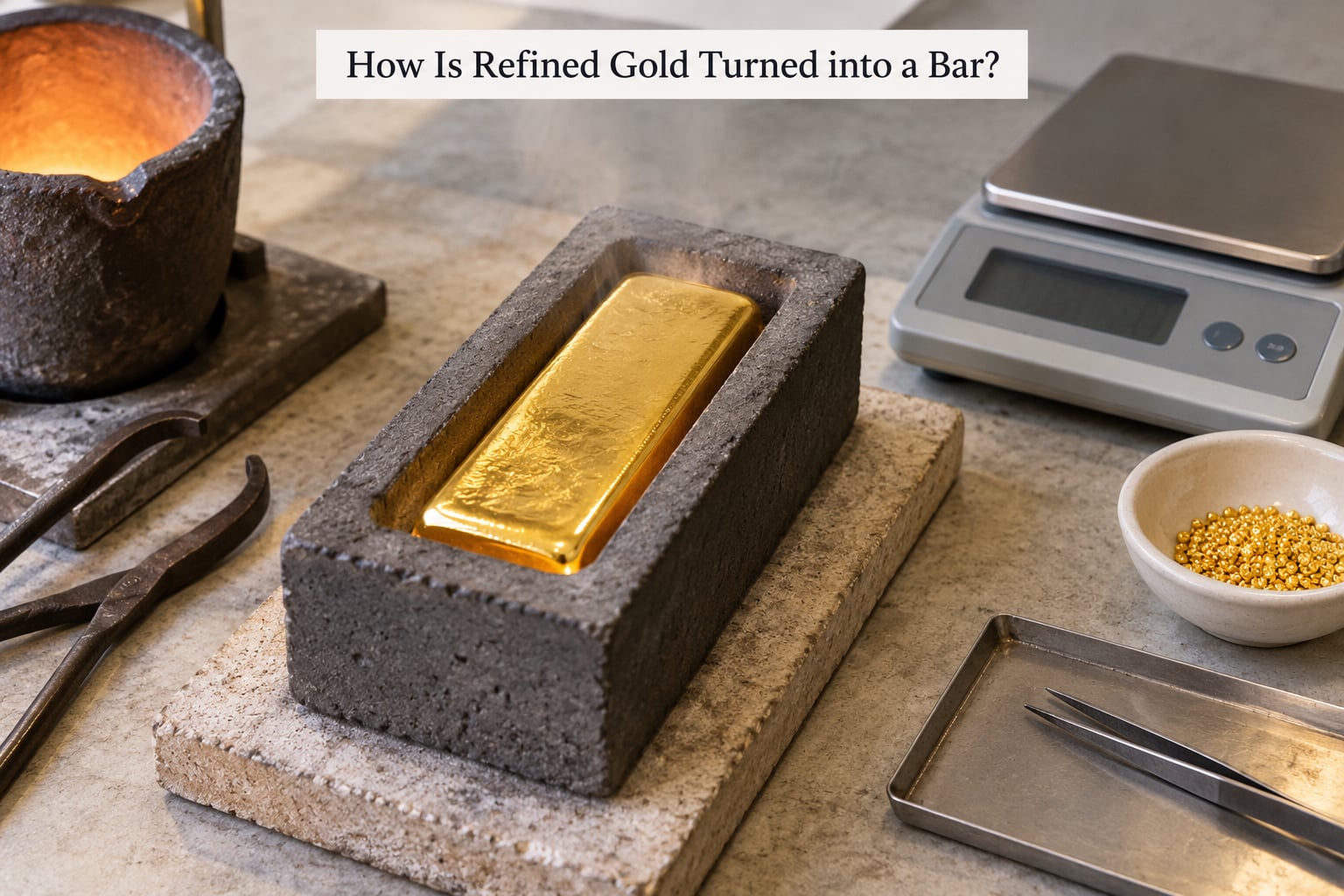
Refining is the step that turns a mixed metal into a defined product, and it is the last, least mine-side part of how gold is mined from ore to bar. The doré arrives, gets remelted, and then goes through two refining processes that have barely changed in principle since the nineteenth century.
The Miller process, patented in 1867, blows chlorine through the molten metal. Gold reacts with chlorine and dissolves as gold chloride while most base metals either volatilise or stay behind, and the gold is then precipitated out of solution. It is fast and inexpensive, and it typically takes the metal to about 99.5 percent.
The Wohlwill process, patented in 1878, then takes it the rest of the way. An impure gold anode is dissolved in an electrolyte and the gold plates out onto a cathode in a controlled electrolytic cell, while silver and copper stay in solution or fall as sludge. The result is the 99.99 percent that investment-grade bullion requires. Every modern refinery runs both, and the electrolysis step is what makes the claim on a bar defensible.
From there the metal is cast. Molten gold is poured into moulds, often under vacuum or inert gas to keep oxides out, and it is allowed to cool under controlled conditions. Bars are then trimmed, weighed, given a serial number, and hallmarked with the refiner’s mark, the fineness and the weight. A sample goes to an independent assay office, which issues a certificate for the batch. London Good Delivery bars, the international trading standard, weigh 400 troy ounces and require three good refiners, each holding a minimum stock of refined metal, to certify the metal.
Provenance is the part buyers should care about most. The serial number, hallmark and assay certificate let anyone trace a bar back to a refiner and check its weight and fineness, and reputable dealers will show you the certificate before the bar leaves the counter. A bar that arrives without any of that is just metal in a shape.
What Is the Difference Between a Gold Bar and a Gold Coin?
A bar and a coin usually contain the same purity, and the difference is mostly in how they are made, shaped and sold. Both are bullion, but they behave differently in the market.
A bar is cast from refined metal, so it carries no minting premium beyond the cost of casting and stamping. It usually comes in a heavier weight, and heavier bars are typically priced closer to the underlying metal. A coin is struck, not cast, which adds a manufacturing step, and popular designs such as American Eagles, Krugerrands or Maple Leafs can also carry a collector premium that moves independently of the metal.
That premium cuts both ways. Coins are easier to resell in small, convenient amounts and are widely accepted, but you may pay above the metal value and give some of it back when you sell. Bars usually trade at a tighter spread, which makes them the simpler choice for holding metal and the worse choice for the moment you want to sell a small amount. A 400 ounce bar is a different product from a 1 ounce bar in more than weight: the smaller one is what most individual buyers actually want.
For anyone checking value, the useful habit is to read the fineness stamp and the assay before the shape. 999.9 means 99.99 percent pure, which is the same number whether it is struck into a coin or cast into an ingot.
Frequently Asked Questions
Gold is extracted in four broad moves. The ore is crushed and ground to a fine powder so the gold grains break free. Gravity separators and froth flotation then upgrade the gold-bearing particles into a concentrate. A dilute cyanide solution dissolves the remaining fine gold, which is captured on activated carbon. Finally the carbon is stripped and smelted into a doré bar, which is refined to 99.99 percent.
It depends entirely on the deposit. Large open pit and heap leach operations often work between 0.4 and 1.5 grams per tonne, while underground mines chasing narrow veins can see 3 to 8 grams per tonne. At a representative 1.5 grams per tonne and a 90 percent recovery, one tonne of ore yields about 1.35 grams of recovered gold.
Multiply the ore grade by the recovery rate. At 1.5 grams per tonne and 90 percent recovery, you get 1.35 grams of recovered gold per tonne of ore. Converted to a troy ounce of 31.1035 grams, that works out to roughly 23 tonnes of ore for every recovered ounce. Higher grades and higher recoveries cut that figure sharply.
The main methods are placer mining for alluvial gravel, heap leaching for low-grade oxidised ore, open pit mining for large shallow orebodies, underground mining for steep narrow veins, and by-product mining where gold comes out of a copper, lead or zinc operation. Each differs in typical grade, recovery, capital cost and how long it takes to produce a first ounce.
Cyanide is used because it dissolves gold quickly and cheaply at low concentration, which no other reagent matches. It is genuinely toxic, so plants manage it under strict controls: solutions are kept alkaline and ventilated, cyanide-bearing water is treated to destroy residual cyanide before discharge, and workers use protective systems. Artisanal miners working without those controls are the ones most at risk.
Nevada’s Carlin trend in the United States is generally treated as the largest gold-producing complex in the world, with several adjacent operations running on the same geological belt. Grasberg in Indonesia is often cited separately for the largest gold endowment in a single operation. Both are hard rock mines using conventional blasting, milling and cyanide processing.
Conclusion
The chain runs from a mapped deposit, through blasting, crushing, grinding, concentration, cyanidation and carbon capture, to a doré bar at the smelter and a 99.99 percent bar at the refinery. Grade, recovery and cost are the three numbers that decide whether that chain is worth running, and they explain why two mines producing the same metal can have very different economics.
If you want one practical starting point, learn to tell the four material types apart: ore, concentrate, doré and refined bullion. A product’s fineness stamp, serial number and assay certificate tell you which stage it came from, and that is a far better basis for judging a gold product than its shape, weight or finish.
Source: https://www.pgm-blog.com/how-gold-is-mined-from-ore-to-bar/
Anyone can join.
Anyone can contribute.
Anyone can become informed about their world.
"United We Stand" Click Here To Create Your Personal Citizen Journalist Account Today, Be Sure To Invite Your Friends.
Before It’s News® is a community of individuals who report on what’s going on around them, from all around the world. Anyone can join. Anyone can contribute. Anyone can become informed about their world. "United We Stand" Click Here To Create Your Personal Citizen Journalist Account Today, Be Sure To Invite Your Friends.
LION'S MANE PRODUCT
Try Our Lion’s Mane WHOLE MIND Nootropic Blend 60 Capsules
Mushrooms are having a moment. One fabulous fungus in particular, lion’s mane, may help improve memory, depression and anxiety symptoms. They are also an excellent source of nutrients that show promise as a therapy for dementia, and other neurodegenerative diseases. If you’re living with anxiety or depression, you may be curious about all the therapy options out there — including the natural ones.Our Lion’s Mane WHOLE MIND Nootropic Blend has been formulated to utilize the potency of Lion’s mane but also include the benefits of four other Highly Beneficial Mushrooms. Synergistically, they work together to Build your health through improving cognitive function and immunity regardless of your age. Our Nootropic not only improves your Cognitive Function and Activates your Immune System, but it benefits growth of Essential Gut Flora, further enhancing your Vitality.

Our Formula includes: Lion’s Mane Mushrooms which Increase Brain Power through nerve growth, lessen anxiety, reduce depression, and improve concentration. Its an excellent adaptogen, promotes sleep and improves immunity. Shiitake Mushrooms which Fight cancer cells and infectious disease, boost the immune system, promotes brain function, and serves as a source of B vitamins. Maitake Mushrooms which regulate blood sugar levels of diabetics, reduce hypertension and boosts the immune system. Reishi Mushrooms which Fight inflammation, liver disease, fatigue, tumor growth and cancer. They Improve skin disorders and soothes digestive problems, stomach ulcers and leaky gut syndrome. Chaga Mushrooms which have anti-aging effects, boost immune function, improve stamina and athletic performance, even act as a natural aphrodisiac, fighting diabetes and improving liver function. Try Our Lion’s Mane WHOLE MIND Nootropic Blend 60 Capsules Today. Be 100% Satisfied or Receive a Full Money Back Guarantee. Order Yours Today by Following This Link.


| Visits: | 1,833,794,133 |
| Stories: | 8,714,586 |
Whistler Blowers, Insiders

