

Why Warehouse Stocks Matter for Metals: A Guide (2026)

Warehouse stocks matter because metals prices are set at the margin, by the last unit a buyer can actually get hold of, and exchange warehouse inventory is the closest public measure of that. When stocks fall, the visible pool of deliverable metal shrinks and nearby prices tend to firm; when they build, prices tend to soften. The catch, and the reason most beginners get this backwards, is that a visible stock number is not the same as available supply. Metal sitting in the wrong region, or booked to leave the warehouse, will not help a buyer in the wrong place at the wrong time. Getting why warehouse stocks matter for metals means reading that number properly rather than reacting to the headline.
The rest of this guide works through what warehouse stocks are, how they move prices, which exchange to watch for which metal, and a repeatable checklist for reading a stock headline without fooling yourself.
What Are Warehouse Stocks?
LME stocks are the tonnage of metal stored in approved warehouses that is registered against exchange warrants, which makes it deliverable against futures contracts. The London Metal Exchange publishes these figures daily for its base metals, and CME Group and the Shanghai Futures Exchange publish equivalents for their own contracts.
The warrant is the piece most readers miss. When a truck delivers copper cathode to an approved delivery point, the metal is weighed and quality-checked, and the holder is issued a warehouse warrant, a document proving title to that specific tonnage. The warrant is what makes the metal deliverable against an exchange contract. Without one, the metal is physically present but legally outside the futures system.
A metal inside or near a warehouse can sit in one of four states, and the difference between them is the whole ballgame:
| Stock state | What it means | Available to a futures buyer? |
|---|---|---|
| Registered or on-warrant | Title is documented by a live warehouse warrant | Yes, against a contract |
| Cancelled warrants | Warrant cancelled against a load-out, so the metal is booked to leave | Not any more, it is already spoken for |
| Off-warrant | Delivered but no warrant issued, or warrant cancelled without a load-out | No |
| Eligible or non-warranted | Not yet warranted, or outside the exchange system entirely | No, not until it is warranted |
Two things follow immediately. First, exchange reports cover registered and off-warrant stock at exchange-approved locations. They do not cover metal held by producers, traders, refiners or governments, metal in bonded or private storage, or metal still sitting as concentrate waiting to be smelted. Visible inventory is a sample of the market, not a census of it. Second, a headline total can rise while the deliverable portion falls, because cancellations and load-outs are counted differently from new warrant registrations.
Why Warehouse Stocks Matter for Metals
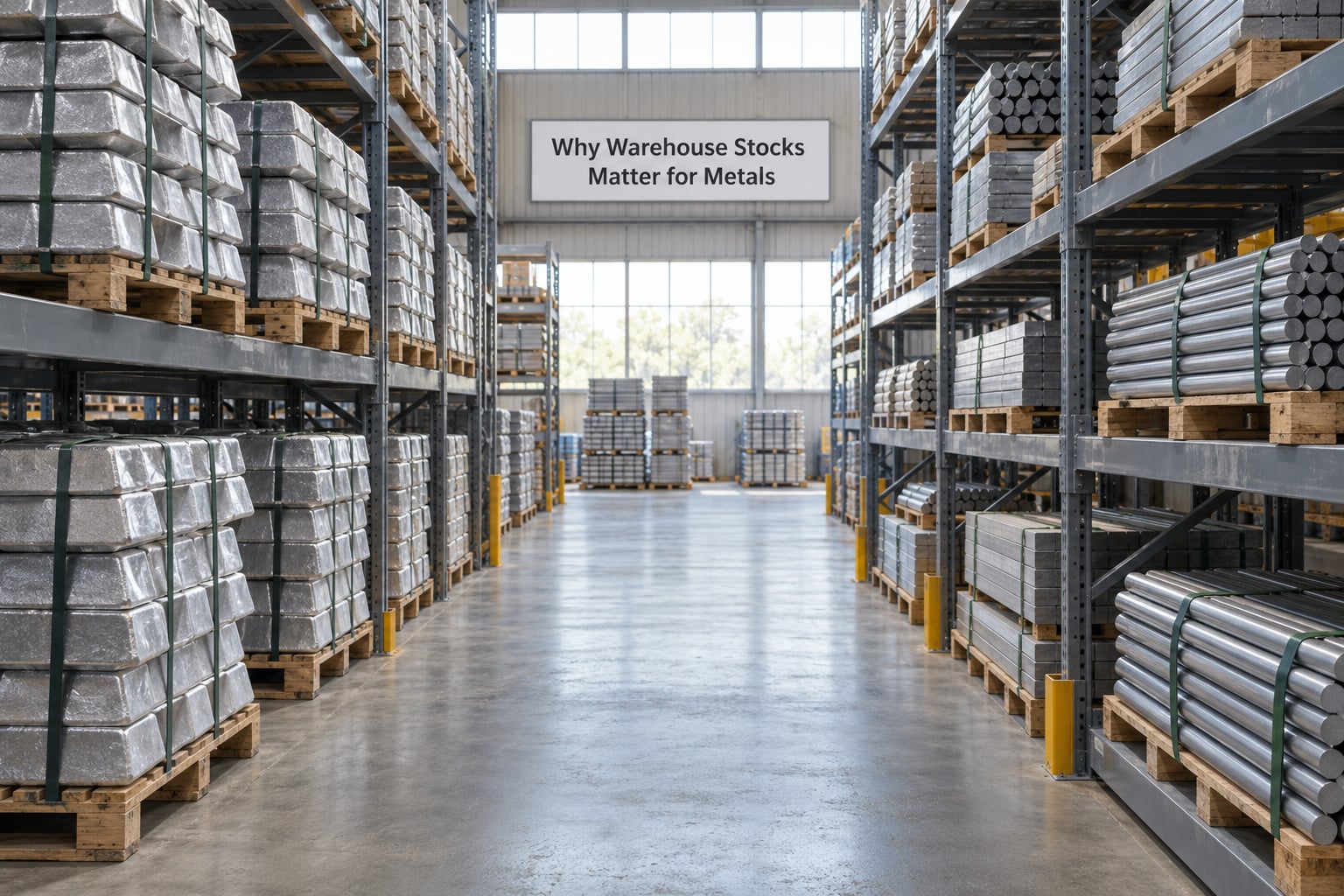
Warehouse stocks matter for metals because they are the supply side of a market whose price is decided at the tightest point, not the average point. A buyer does not care about the average availability of metal across the planet. A buyer cares whether a specific tonne can be delivered into a specific location inside a specific month, and exchange warehouse stocks are the number that tracks that.
Why warehouse stocks matter for metals more than the tonnage headline
Producer behaviour is the second reason. Mine output is largely fixed by geology and by how long a pit or underground panel takes to develop, so a smelter, fabricator or trader who expects metal to be tight has an incentive to secure tonnage early rather than rely on buying later. Warehousing is how that securing happens. The metal sits, the warrant is issued, and the holder owns a claim on the deliverable pool.
Third, delivery constraints make location decisive. Freight, port capacity and insurance all determine which metal a real buyer can actually reach. Ten thousand tonnes in a warehouse serving a smelter region and ten thousand tonnes in a warehouse two continents away are different products, even at the same headline grade.
Fourth, inventories absorb the gap between real demand and real production. Smelters run at fixed feed rates, fabricators order against production schedules, and traders carry stock to bridge the timing difference. Warehouse stocks are where that bridging happens, so a drawdown says as much about how confident buyers are about near-term supply as it does about how much metal exists.
None of this is new, by the way. The LME warrant system was built in the nineteenth century precisely because warehouse-based physical delivery made it possible to run a futures market on top of a real commodity. Understanding why warehouse stocks matter for metals is really understanding how that inheritance still sets the price.
How Warehouse Inventories Affect Metal Prices
Stock levels influence price through scarcity, but the transmission runs through the spread structure rather than the tonnage itself.
When stocks fall steadily and cancelled warrants rise, the prompt date tightens. Buyers competing for near-dated metal push the cash price above the three-month price, and that state is called backwardation. It is a market telling you that supply right now is worth more than supply later, which is what you would expect from genuine physical scarcity.
When stocks build and cancelled warrants fall, the market usually moves into contango, where the three-month price sits above the cash price. Buyers are being paid to defer, which is the market telling you that metal today is less valuable than the convenience of having it later. Persistent contango alongside rising stocks is one of the clearer signs of comfortable supply.
That is why the cash-to-three-month spread often reacts faster than the headline stock number. Traders watch the spread because it prices scarcity immediately, whereas the stock report confirms it a day later.
Why raw tonnage comparisons across metals mislead
Comparing 400,000 tonnes of one metal with 200,000 tonnes of another tells you nothing about which market is tighter. The useful normalisation is days of consumption:
Days of consumption = exchange stocks ÷ average daily consumption
Run that calculation for the same metal across different dates and it becomes genuinely informative, because the denominator moves with industrial demand while the numerator tells you what is available to meet it. Consumption estimates come from the industry study groups, the International Copper Study Group and the International Lead and Zinc Study Group among them. The habit worth building is checking whether a stock level is high relative to that metal’s own recent history and its own consumption rate, not whether it looks big in absolute terms.
There is a second normalisation people forget: direction of flow versus net change. In 2026 reporting on lead, over a million tonnes moved in and out of LME warehouses while the net stock rose by only 16,425 tonnes. A headline that says stocks rose hides the fact that the market was turning metal over at enormous speed.
Rising or Falling Warehouse Stocks: What Investors Should Read
Copper. The clearest example of why location beats quantity. Reporting in September 2026 put visible exchange copper at roughly 252,500 tonnes on the LME against about 696,000 tonnes in COMEX warehouses and 43,900 tonnes in Shanghai, with COMEX holding around 69% of the visible pool. Read as a single number, that looks abundant. Read as a location map, it says the deliverable metal was in the wrong region while buying interest sat elsewhere, which is a much tighter market than the total implies.
Zinc. Stocks fell below 50,000 tonnes in the year before 2026, before recovering to about 131,000 tonnes by the end of the year as Chinese exports surged. The recovery is a reminder that a low stock level is not automatically permanent: exports, arbitrage and tariff-driven redirection can refill a warehouse quickly. Zinc also ran a cash-to-three-month backwardation wide enough to make physical holders eager to sell into the prompt date, which is the confirming signal that the tightness was real rather than a reporting artefact.
Lead. Combined registered and off-warrant lead stocks rose from roughly 21,500 tonnes to over 440,000 tonnes across the same period. That is the metal where secondary supply and recycling economics matter most, and where a large headline stock is less alarming than it looks for a metal with an exceptionally high recycling rate.
Aluminium. Regional delivery premia have run at records over LME levels, which is a location signal in the opposite direction: the binding constraint is where the metal sits relative to the buyer, not the global total.
Gold and silver. The same logic applies to vault holdings, though the mechanics differ. Large reported ETF and vault holdings function as inventory buffers: when holders stand still, less metal is available to satisfy new demand, and when they sell, availability rises. Precious metals investors often treat holdings as a sentiment indicator for exactly this reason.
Exchange Reports, Visible Inventories, and the Global Supply Picture
Three exchanges publish the numbers most readers actually see, and they cover different regions, contracts and reporting conventions:
| Exchange | What its stock report covers | Why it differs from the others |
|---|---|---|
| London Metal Exchange | Registered and off-warrant base metal tonnage at approved delivery points worldwide | The global reference contract for most base metals, so its stocks set the international benchmark |
| CME Group (COMEX) | Metal at CME-approved delivery points, primarily in North America | A North American delivery location, so its stocks can build while LME availability thins |
| Shanghai Futures Exchange | Warehouse stocks reported in the domestic market | The centre of industrial demand for several of these metals, so its drawdowns are often read as consumption |
None of these is the whole picture. Between them sit bonded stocks held outside the exchange system, producer and trader inventories, metal in fabrication, metal still in concentrate form, and metal held by central banks and governments that is deliberately not for sale. Community discussion of LME and Shanghai drawdowns treats the two as a pair for a good reason: a fall on one exchange alongside a build on another often means relocation rather than consumption.
Where the exchanges overlap on the same metal, arbitrage normally keeps the price gap bounded. That mechanism is also why a widening gap is informative: it is the market telling you transport and financing costs, or trade policy, are now large enough to block metal from moving to where it is wanted.
What Does Not Show Up in Warehouse Stock Data?
Warehouse stock reports are honest about tonnage and silent about several things that change what that tonnage means.
Location risk does not appear in a global number. Ten thousand tonnes in the wrong basin does not relieve a smelter with no rail access.
Ownership is invisible. The same warrant system that records tonnage says nothing about whether a holder is a hedge fund, a producer, a consumer or a trader, and those groups respond to a stock drawdown in opposite ways.
Double counting is a real risk when figures from different reports are added together, because metal can be counted as eligible, as off-warrant and as bonded at different moments in its life.
Futures positioning sits entirely outside the data. A large open interest build or unwind in the futures market will move prices hard with no change in warehouse tonnage whatsoever.
Physical premia are reported separately, and a rising premium in one region against flat global stocks is the clearest possible statement that availability, not abundance, is the constraint.
Finally, not every stored tonne is uniformly available to every buyer. Grade, brand, location and delivery timing all narrow the pool, and the effective available figure is usually smaller than the headline. One documented error that runs through retail commentary is treating a headline decline as proof of shortage without ever checking consumption rates or asking where the metal went.
How to Use Warehouse Stocks in Metals Investing
Here is the repeatable process. Six steps, in order, before you react to any stock headline.
1. Identify the exchange, the metal and the date. A number without those three is not a fact. Most confused commentary comes from comparing a London figure with a Shanghai figure and treating the difference as a change in supply.
2. Separate the headline total from cancelled warrants. Cancelled warrants are metal already booked out. Rising cancellations alongside falling totals is a much stronger tightness signal than the total alone.
3. Normalise it into days of consumption. Compare the level against that metal’s own recent history and its consumption rate, not against another metal or against an arbitrary round number.
4. Check the cash-to-three-month spread. Backwardation confirms that the tightness is being priced. Contango with rising stocks says the opposite. The spread is the tie-breaker when the stock report is ambiguous.
5. Ask where the metal went. A drawdown that is mirrored by a build on another exchange or a jump in bonded stocks is relocation. Only unmatched drawdowns alongside firm spreads tell you something about real availability.
6. Check whether supply from the mine side agrees. Treatment and refining charges are the complementary signal for concentrate markets, and they can show smelter feed tightening long before refined stocks move. If the concentrate market and the refined market disagree, refined stocks are describing the refined market, not the mine.
For mining equities, add one more layer. Inventory tightness tends to support metal prices, and metal prices drive miner margins, but a tight concentrate market with comfortable refined stocks is a very different earnings picture from the reverse. Equities can rally on tight feed while exchange inventories sit at multi-decade highs in the wrong location, which is confusing until you notice the location is the whole story.
Key Takeaways for Metals Investors
Warehouse stocks are a genuine supply signal, but they are a signal about deliverable metal in specific places, not a measure of how much metal the planet holds.
Cancelled warrants matter more than the headline total, because they show what has already been claimed.
Gross flows can dwarf net changes, so a stock that barely moved may still reflect enormous warehouse activity.
Spreads confirm what stocks imply. Backwardation means the market is paying for metal now; contango means it is not.
Normalise into days of consumption before comparing anything across time or across metals.
Data quality has limits. Location, ownership, positioning and premia all sit outside the tonnage figure, and an analyst who ignores them will reach the wrong conclusion more often than not.
None of this is investment advice. Exchange inventory data describes physical availability; it does not tell you whether any security is worth owning, and markets can move against a correct reading of the data for a long time.
Frequently Asked Questions
LME stocks are the tonnage of metal stored in approved warehouses and registered against exchange warrants, which makes it deliverable against futures contracts. The London Metal Exchange publishes these figures daily for its base metals. They matter because they show how much deliverable metal exists right now, in a specific place, rather than how much metal exists in general.
Metal arrives at an approved delivery point, gets weighed and quality-checked, and the holder is issued a warehouse warrant proving title. That warrant makes the tonnage deliverable against a futures contract. The exchange publishes daily warrant and cancellation data. Futures price the possibility of taking delivery, so traders watch those reports and the cash-to-three-month spread, and prices tend to react to the direction of change rather than the absolute level.
Usually because metal is leaving the exchange system faster than it is arriving, often booked out through cancelled warrants and load-outs. But a fall is not automatically a shortage. The metal may simply have moved to another exchange, into bonded storage outside the exchange system. Check whether the drawdown is matched by a build elsewhere, and whether the cash-to-three-month spread has moved into backwardation, before drawing conclusions.
The question mixes two different things. Global geological and recyclable supply is not close to exhausted for most industrial metals. Availability in a specific place at a specific time is a much tighter constraint, and that is what warehouse stocks measure. Markets run on deliverable metal in the right location, so a market can experience a genuine shortage of available metal while total global supply remains comfortable.
Inventory data can tell you how tight a physical market is, but it is not a valuation for any security. Reading it properly means checking the exchange, the date, cancelled warrants, days of consumption and the spread structure before drawing any conclusion, and then weighing that separately against costs, currency and equity factors. This guide explains the signal; it is not investment advice, and no storage figure on its own justifies buying or selling anything.
Conclusion: Start with the Supply Signal
Warehouse stocks matter for metals because they are the most direct public read on deliverable supply, and supply at the margin is what sets the price. Watch three things first: the direction of inventories, the reason they are changing, and whether price and demand data confirm the signal. Get those three right and most of the rest of the warehouse stock noise sorts itself out.
Source: https://www.pgm-blog.com/why-warehouse-stocks-matter-for-metals/
Anyone can join.
Anyone can contribute.
Anyone can become informed about their world.
"United We Stand" Click Here To Create Your Personal Citizen Journalist Account Today, Be Sure To Invite Your Friends.
Before It’s News® is a community of individuals who report on what’s going on around them, from all around the world. Anyone can join. Anyone can contribute. Anyone can become informed about their world. "United We Stand" Click Here To Create Your Personal Citizen Journalist Account Today, Be Sure To Invite Your Friends.
LION'S MANE PRODUCT
Try Our Lion’s Mane WHOLE MIND Nootropic Blend 60 Capsules
Mushrooms are having a moment. One fabulous fungus in particular, lion’s mane, may help improve memory, depression and anxiety symptoms. They are also an excellent source of nutrients that show promise as a therapy for dementia, and other neurodegenerative diseases. If you’re living with anxiety or depression, you may be curious about all the therapy options out there — including the natural ones.Our Lion’s Mane WHOLE MIND Nootropic Blend has been formulated to utilize the potency of Lion’s mane but also include the benefits of four other Highly Beneficial Mushrooms. Synergistically, they work together to Build your health through improving cognitive function and immunity regardless of your age. Our Nootropic not only improves your Cognitive Function and Activates your Immune System, but it benefits growth of Essential Gut Flora, further enhancing your Vitality.

Our Formula includes: Lion’s Mane Mushrooms which Increase Brain Power through nerve growth, lessen anxiety, reduce depression, and improve concentration. Its an excellent adaptogen, promotes sleep and improves immunity. Shiitake Mushrooms which Fight cancer cells and infectious disease, boost the immune system, promotes brain function, and serves as a source of B vitamins. Maitake Mushrooms which regulate blood sugar levels of diabetics, reduce hypertension and boosts the immune system. Reishi Mushrooms which Fight inflammation, liver disease, fatigue, tumor growth and cancer. They Improve skin disorders and soothes digestive problems, stomach ulcers and leaky gut syndrome. Chaga Mushrooms which have anti-aging effects, boost immune function, improve stamina and athletic performance, even act as a natural aphrodisiac, fighting diabetes and improving liver function. Try Our Lion’s Mane WHOLE MIND Nootropic Blend 60 Capsules Today. Be 100% Satisfied or Receive a Full Money Back Guarantee. Order Yours Today by Following This Link.


| Visits: | 1,833,886,241 |
| Stories: | 8,714,920 |
Whistler Blowers, Insiders

