

What Is a Gold Lease Rate? A Simple Guide (October 2026)

A gold lease rate is the annualized interest a borrower pays to rent physical gold for a set period, on the same logic as paying interest on a dollar loan. It has nothing to do with the price of gold itself, and it is quoted by private agreement between two counterparties rather than published by an exchange.
Gold sitting in a vault earns nothing, which is why jewellers, mints, refiners and bullion banks borrow metal instead of tying up cash in it. This guide walks through how the calculation worked, why the number stopped being public in 2015, and what the rate can and cannot tell you.
What Is a Gold Lease Rate?
Three things define it. What it is, how it was calculated, and whether you can look it up.
- Definition: the annualized interest rate a borrower pays a lender for borrowing gold over a set tenor, typically one, three, six or twelve months. Interest is normally settled in more gold ounces rather than in cash.
- Historical calculation: the dollar funding rate minus the gold forward offered rate. In practice that meant US dollar LIBOR minus GOFO, where GOFO was the forward rate at which the market priced gold for future delivery.
- Public availability: not published. The London Bullion Market Association stopped disseminating GOFO in January 2015, and most leases since then are private bilateral quotes between a handful of bullion banks.
That last point matters more than people expect. There is no single official gold lease rate you can look up to check an advertised quote against, which is exactly why forum threads full of screenshots showing “lease your gold at 3% or more” offers get so much suspicion.
How a gold lease rate is calculated and where it is published
Think of it as a spread between two forward curves. Borrowers of gold need metal now and owe metal later; investors selling gold today need to be compensated for giving up the metal until a future date. The gap between what the dollar market charges for borrowing money and what the gold forward market pays for deferred gold delivery is the lease rate.
Take a simple one-month example. Suppose the dollar funding rate is 4.00% annualized and the one-month gold forward rate is 2.00%. Borrowing gold is then cheaper than borrowing dollars, so a gold lease costs about 2.00% a year. Under the London mid-rate construction, the published figure adjusted the forward leg upward by roughly 19 basis points to cover swap and currency-deposit costs, giving about 1.81%. The direction of that arithmetic is the useful part: high gold forward rates and low dollar rates both push the lease rate down.
How Does a Gold Lease Rate Work?
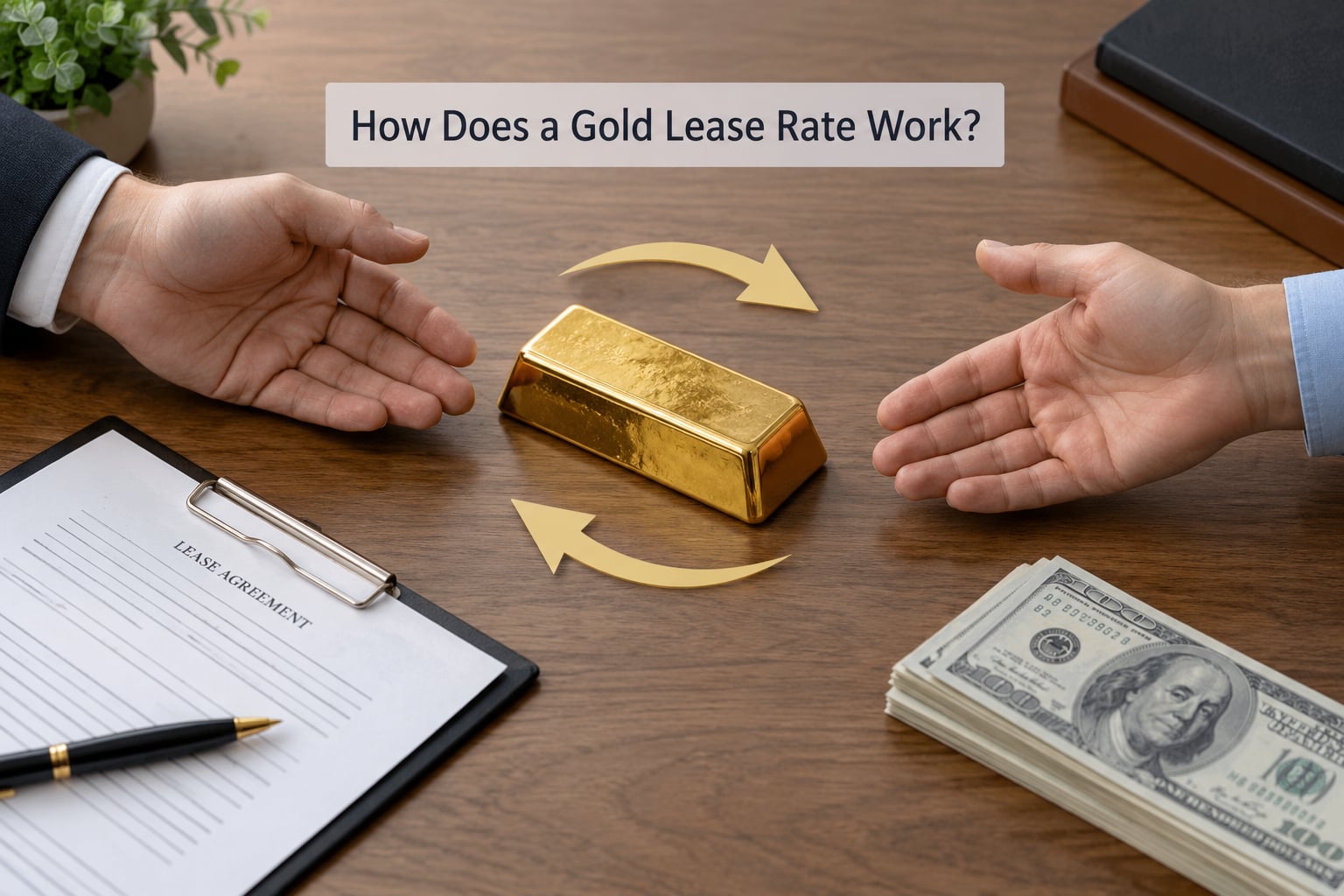
Gold lending runs on four steps, and the step people get wrong is the last one.
- The borrower identifies a use for the metal. A jewellery manufacturer needs gold to fill next quarter’s orders, a refinery needs a working buffer of feedstock, or a bullion bank needs dollars without selling metal it has already sold forward.
- Terms are agreed bilaterally. Notional ounces, tenor, the quoted rate and the credit terms are all negotiated between two counterparties. No exchange sets them.
- Metal moves, and a lease return is booked. The borrower receives ounces and owes the same quantity back at the end of the term, plus interest in ounces. The lender receives cash today and takes the small risk that gold might rise sharply over those months.
- At maturity, the lease is closed or rolled. The borrower returns the metal plus interest, or rolls the position into a new tenor at whatever rate the market then offers. That repricing is the risk, and it is why lease rates are treated as a variable cost rather than a fixed one.
A true lease keeps title with the lender and is unsecured, which is why it trades close to a dollar rate minus a small spread. Plenty of what gets called gold leasing is not that at all: bullion banks often sell gold outright and promise to buy it back later, which lifts dollars without a lease ever appearing on the books. Retail lease programmes usually promise something similar, an agreed return in ounces on metal you still own. Whether the metal is segregated, how long a lockup applies, and what happens to your claim if the counterparty fails are the questions worth asking before you hand over anything.
What Determines the Gold Lease Rate?
Six forces move it, and the first two do most of the work.
- Dollar funding rates. The lease rate leans on the dollar rate because a lease is a dollar loan dressed in metal. When dollar rates fall, lease rates usually follow.
- Scarcity of loanable gold. Lease rates sit below dollar rates only when gold is plentiful enough to lend. Tight metal availability pushes the gold forward rate down and the lease rate up, sometimes past the dollar rate.
- Tenor. Short leases price closer to overnight dollar funding; a one-year lease carries more of the counterparty’s credit risk and the cost of replacing metal later.
- Counterparty credit. A lease to a first-tier bullion bank prices differently from a lease to a small refinery. Published mid-rates historically ignored credit spreads entirely.
- Currency and central bank expectations. A falling dollar often lifts gold, and higher gold makes the forward curve richer, which compresses lease rates. Central bank buying adds metal to vaults and can work the other way.
- Physical supply conditions. Exchange withdrawals, refining bottlenecks and delivery tightness at the London fix all change how much metal is genuinely lendable.
History shows the pattern better than theory does. In 1999, after the Washington Agreement on Gold capped official sector sales, central bank lending dried up and lease rates spiked toward 10% while the gold price barely moved. From 2009 to 2011, central bank lending was plentiful and dollar rates sat near zero, so lease rates went negative, and borrowers were paid to hold the metal. That negative-lease dynamic is worth watching for, because it tells you lendable metal is abundant and funding is cheap at the same time. Silver is the comparison case: with tight supply, silver lease rates have been running in the 6% to 7% and above range on shorter tenors as of early 2026, well above gold.
How Is a Gold Lease Rate Different From Interest or a Gold Forward?
These five terms get used interchangeably, and they describe different things. Here is the cleanest way to separate them.
| Term | What it represents | Who is involved | What it calculates |
|---|---|---|---|
| Gold lease rate (GLR) | The annualised cost of borrowing gold | Borrower and bullion bank | The implied yield a lease pays to the lender of metal |
| GOFO | Gold forward offered rate, published 1989 to January 2015 by the LBMA | Contributing market makers | The forward rate embedded in a gold forward contract |
| Gold swap | Exchange of gold for dollars over a short period | Two financial counterparties | A funding cost or a position, depending on direction |
| Gold deposit rate | The rate earned by an investor who places metal with a bank | Investor and bank | The return on metal that has been handed over |
| Gold forward | An agreement to buy or sell gold at a future date and price | Two financial counterparties | Forward price from spot, spot dates and the gold lease rate |
Read that table bottom-up. The gold forward price is built from the spot price plus the forward points, and the lease rate is the piece that reconciles that forward market with the dollar rate. A negative lease rate simply means the forward market was offering more than the dollar market charged, so holding borrowed metal paid the borrower.
Why Do Gold Lease Rates Matter to Investors?
For most people the rate is background noise until they see it attached to a product. Then it becomes the whole pitch.
It is not a price predictor. Over decades the relationship between lease rates and the gold spot price has been unreliable, because the rate responds to metal availability and dollar policy rather than to sentiment about gold. A 1999 spike happened during a flat price year; negative rates in 2009 to 2011 happened during a powerful bull market. Treat the rate as a liquidity and stress gauge, not a directional call.
Where it does earn its place is in three practical areas. Borrowing against gold is how miners, refineries and bullion funds raise working capital without selling metal into a falling market, and the lease rate is the line item on that financing. Hedging works the same way: a miner who leases gold today and returns it at a fixed forward price locks in revenue without carrying price risk. And for bullion investors, a retail lease programme offers a yield in ounces, which is worth interrogating carefully. How is the rate set, is the metal segregated, what is the lockup, and does your claim survive the counterparty’s bankruptcy.
Gold versus silver is a good sanity check on any offer. Silver lease rates have run persistently above gold rates because the market for industrial and photographic demand leaves less slack in the lending pool. If someone quotes you a gold lease rate materially above what the market supports while a cheaper metal leases at 6% to 7%, the offer deserves a second look. Rates and terms vary by country and by provider, and nothing here is individual financial advice.
Frequently Asked Questions
At the time of writing, wholesale gold lease rates have generally been quoted in the 1.0% to 2.0% annualised range depending on tenor, while retail physical-gold lease programmes have historically advertised between 2% and 4%. There is no official published rate you can check against, because GOFO dissemination stopped in January 2015. Ask the provider for the tenor, the rate basis and the fee schedule in writing.
A borrower takes gold from a lender for a fixed term, typically one to twelve months, and agrees to return the same number of ounces at the end plus interest settled in metal. Title usually stays with the lender, which is why the deal is unsecured and priced close to a dollar loan rate. At maturity the lease is closed out or rolled at the rate then prevailing, which is where repricing risk sits.
Retail lease programmes do exist, usually offered by dealers or specialist precious-metals platforms. Ask who holds title, whether the metal is allocated and segregated in a third-party vault, how long you are locked in, and what happens to your claim if the counterparty is liquidated. Promotional offers far above market rates deserve scepticism, because a legitimate lease rate has a market benchmark and an advertised yield well above it usually signals something else.
Gold is an asset, not a currency, so lenders will only accept a return below their normal lending rate when the metal is plentiful and easy to replace. When loanable metal tightens, the gold forward rate falls and the lease rate rises toward or past the dollar rate. So the discount is a supply signal about lendable metal, not a sign that gold is a cheaper form of collateral in every market condition.
A negative lease rate means the borrower was paid to hold the gold, because the gold forward market offered more than the dollar market charged for funding. It is a symptom of abundant loanable metal combined with very low dollar rates, as seen from 2009 to 2011. Elevated or negative readings in both directions are best read as signals of physical liquidity conditions rather than as a forecast for the gold price.
GOFO publication ended in January 2015 and nothing has replaced it as an official series. Dealers and data vendors estimate an implied lease rate from the gold forward curve and current dollar funding benchmarks such as SOFR, while actual leases are struck as private bilateral quotes between counterparties. That is why most published lease rate figures you see are modelled estimates rather than transacted prints.
What to Do With a Lease Rate Quote
First, ask for the tenor. A one-month rate and a one-year rate are different instruments, and plenty of advertising quotes the shortest one. Second, compare against the recent wholesale range rather than against a round number. Third, and most important, establish who holds title to the metal and what survives if that company fails, because that single answer carries more weight than the advertised rate.
Source: https://www.pgm-blog.com/what-is-a-gold-lease-rate/
Anyone can join.
Anyone can contribute.
Anyone can become informed about their world.
"United We Stand" Click Here To Create Your Personal Citizen Journalist Account Today, Be Sure To Invite Your Friends.
Before It’s News® is a community of individuals who report on what’s going on around them, from all around the world. Anyone can join. Anyone can contribute. Anyone can become informed about their world. "United We Stand" Click Here To Create Your Personal Citizen Journalist Account Today, Be Sure To Invite Your Friends.
LION'S MANE PRODUCT
Try Our Lion’s Mane WHOLE MIND Nootropic Blend 60 Capsules
Mushrooms are having a moment. One fabulous fungus in particular, lion’s mane, may help improve memory, depression and anxiety symptoms. They are also an excellent source of nutrients that show promise as a therapy for dementia, and other neurodegenerative diseases. If you’re living with anxiety or depression, you may be curious about all the therapy options out there — including the natural ones.Our Lion’s Mane WHOLE MIND Nootropic Blend has been formulated to utilize the potency of Lion’s mane but also include the benefits of four other Highly Beneficial Mushrooms. Synergistically, they work together to Build your health through improving cognitive function and immunity regardless of your age. Our Nootropic not only improves your Cognitive Function and Activates your Immune System, but it benefits growth of Essential Gut Flora, further enhancing your Vitality.

Our Formula includes: Lion’s Mane Mushrooms which Increase Brain Power through nerve growth, lessen anxiety, reduce depression, and improve concentration. Its an excellent adaptogen, promotes sleep and improves immunity. Shiitake Mushrooms which Fight cancer cells and infectious disease, boost the immune system, promotes brain function, and serves as a source of B vitamins. Maitake Mushrooms which regulate blood sugar levels of diabetics, reduce hypertension and boosts the immune system. Reishi Mushrooms which Fight inflammation, liver disease, fatigue, tumor growth and cancer. They Improve skin disorders and soothes digestive problems, stomach ulcers and leaky gut syndrome. Chaga Mushrooms which have anti-aging effects, boost immune function, improve stamina and athletic performance, even act as a natural aphrodisiac, fighting diabetes and improving liver function. Try Our Lion’s Mane WHOLE MIND Nootropic Blend 60 Capsules Today. Be 100% Satisfied or Receive a Full Money Back Guarantee. Order Yours Today by Following This Link.


| Visits: | 1,833,886,241 |
| Stories: | 8,714,920 |
Whistler Blowers, Insiders

