

Why Gold and Interest Rates Move Opposite: Simple Guide 2026

Gold and interest rates tend to move in opposite directions because gold pays no interest. Its opportunity cost is whatever a risk-free deposit pays, so when real interest rates rise, holding a bar that produces nothing looks expensive, and gold usually falls. When real rates fall, the reverse tends to happen.
That is the whole textbook rule, and it is usually right. The trouble starts when people apply it to the headline rate on the news instead of the real rate underneath it, because those two have pointed in different directions for much of the past few years.
Getting why gold and interest rates move opposite right comes down to the mechanism, the exceptions, and a short list of things worth watching if you are timing a precious-metals purchase around a Federal Reserve decision. Nothing here is investment advice; treat it as a framework for reading the market rather than a forecast.
Why Gold and Interest Rates Move Opposite
The core of the answer is one word: yield. A Treasury bond pays you interest. A savings account pays you interest. A share of most companies pays you a dividend or buys you a share of future earnings. A gold bar pays you exactly nothing, forever.
Gold is a zero-yield asset: no coupon, no dividend, no cash flow. So an investor comparing gold to anything interest-bearing has to ask a simple question. Is the interest I earn elsewhere worth more than what gold gives me in return, which is the value of holding a scarce, durable, universally accepted store of value?
When risk-free yields are high, the answer is usually no, and capital moves out of gold. When yields are low or negative after inflation, the answer is often yes. That is the inverse relationship, and it exists for a mechanical reason rather than a sentimental one.
The chain from a central bank decision to a gold price runs through about five steps:
- The Fed moves the federal funds rate, or signals where it expects to move.
- That shifts yields across the Treasury curve, including the 10-year yield most investors watch.
- Inflation expectations do not always move with the nominal rate, so the real yield changes by a different amount than the headline rate.
- The real yield changes what a zero-yield asset is worth relative to a yielding one.
- Money reallocates, and the gold price responds, usually within days rather than months.
Three qualifications sit on top of that chain, and they are the reason the rule fails as often as it works. Inflation expectations decide how much of a rate move is real. The dollar decides how the move translates for everyone not trading in US dollars. And safe-haven demand can swamp everything else when markets break.
The inverse relationship between gold and interest rates is therefore a tendency with a large error bar, not a physical law. Forum discussions on this question tend to circle the same trap: someone posts a chart where gold rose while yields rose, and the thread argues about whether the rule is broken or the poster is reading the chart wrong. Usually both camps are partly right, because they are using nominal yields rather than real ones.
How Higher Interest Rates Put Downward Pressure on Gold
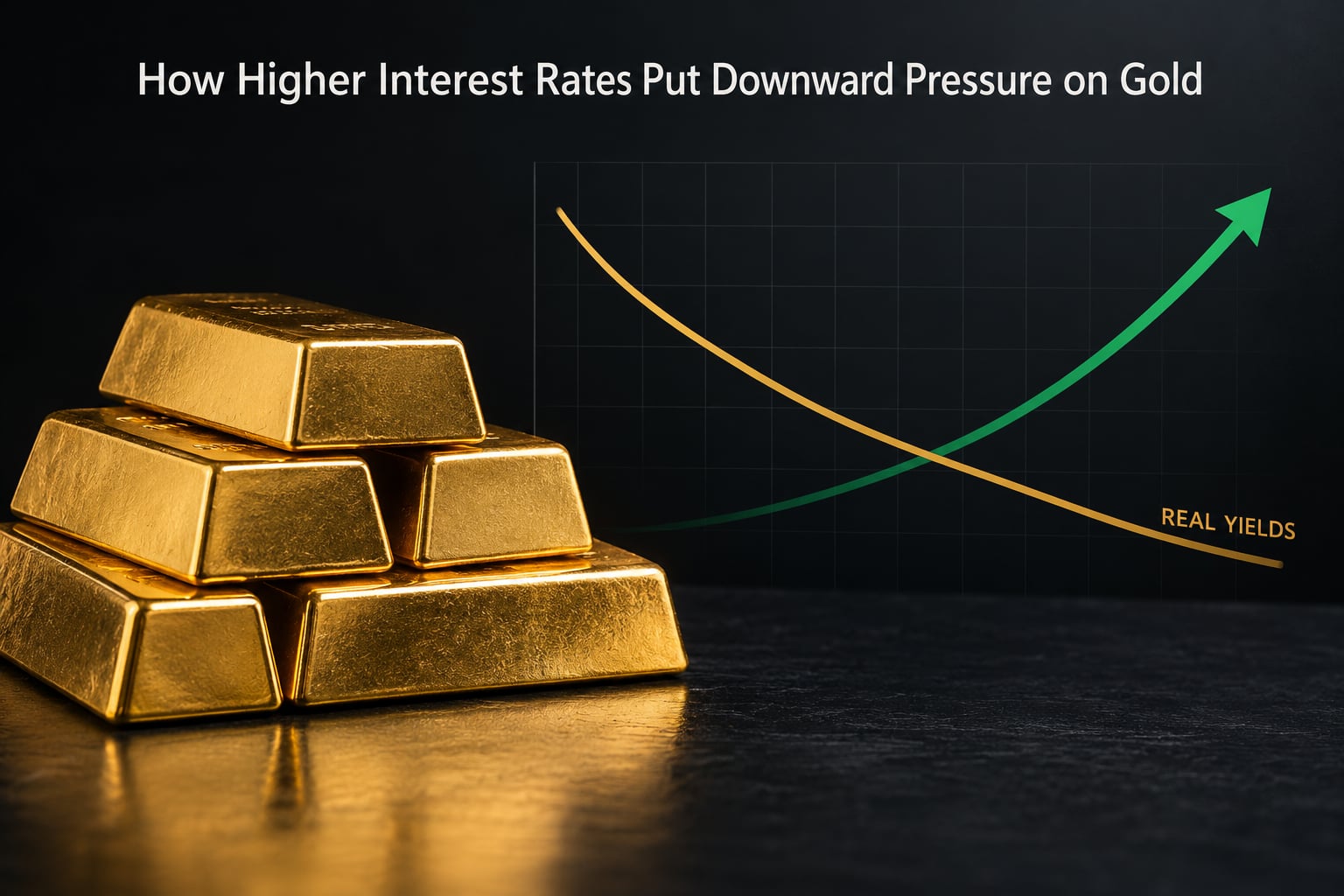
Start with the opportunity cost. If a ten-year government bond pays a meaningful yield and gold pays nothing, then holding gold costs you that yield every year. Gold is not free to own either. Storage, insurance and spreads come out of the return, so the real comparison is a negative number on the gold side.
There is a second effect underneath that one. Higher rates raise the discount rate applied to future cash flows everywhere in the economy, which pushes up the return investors demand before they will buy any asset, gold included. Higher yields also tend to strengthen the dollar, and since gold is priced in dollars, a stronger dollar makes the metal more expensive for European and Asian buyers and usually damps the dollar price.
Here is the part most retail commentary gets wrong. The rate that matters is not the nominal one. It is the real rate, which is the nominal rate minus expected inflation. A central bank can raise the nominal rate while inflation expectations fall faster than the rate rises, and in that case real yields drop even as headline yields climb.
| What the central bank does | What real yields usually do | Typical pressure on gold |
|---|---|---|
| Raises the nominal rate | Real yields rise | Downward |
| Raises the nominal rate | Real yields fall, because inflation expectations drop faster | Neutral to upward |
| Holds rates steady | Real yields drift with inflation | Depends on other drivers |
| Cuts the nominal rate | Real yields fall | Upward |
One of the most widely cited checks on the rule comes from LBMA, which back-tested Fed rate-hike cycles and reported that gold rose in five of seven hiking cycles, an average gain of about 133%, against a decline of roughly 7% in the others. That study is dated, based on cycles running to 2008, so read it as a historical observation rather than a current forecast. Even so, it is a useful corrective to the assumption that every hike kills gold.
How Lower Interest Rates Can Support Gold
The mirror image is straightforward. When the Fed cuts, yields fall, and the income available on safe assets shrinks. A portfolio holding bonds and cash starts producing less, which raises the relative appeal of an asset whose return comes entirely from price appreciation and scarcity.
Two things usually follow. The dollar tends to weaken as interest-rate differentials narrow, which mechanically lifts the dollar gold price for non-dollar buyers. And when real yields fall far enough to go negative, holding something that pays nothing starts to look rational: you are not losing purchasing power by sitting on the metal.
A practical example: suppose markets start pricing a series of cuts because growth is slowing, but the central bank has not announced anything yet. Expectations move first. Bond yields fall, the dollar softens against major currencies, and gold usually begins its run before the first cut actually arrives. People watching for the decision itself are often a little late.
The distinction that matters for the answer to does gold go up when interest rates go up is timing and cause, not direction alone. Gold responds to where real yields are expected to settle, and that often happens months before a policy decision lands.
Why Gold and Rates Do Not Always Move in Opposite Directions
Start with the numbers. One commonly cited long-run estimate puts the correlation between gold and interest rates at around 28% over fifty years, which is weak by any standard. A relationship with a correlation that low will contradict itself regularly, and readers who expect a clean rule are setting themselves up to be confused every few months.
The larger break came after the pandemic-era tightening cycle. Through that period gold rallied while yields were not falling in the textbook way, because demand came from somewhere the rate story does not cover. Central banks, particularly in emerging markets, have been adding to reserves as a way of diversifying away from a single reserve currency. Add concerns about government debt and fiscal deficits, plus geopolitical stress, and you get a bid for gold that is largely independent of what the Fed does.
What inflation expectations do to the relationship
Gold’s inflation-hedge reputation sits right in the middle of the contradiction that confuses people. When a central bank hikes to fight inflation, the nominal rate goes up, the usual rule says gold should fall, and it often does in the short run. That looks like the hedge failing.
It is not failing, it is just working on a different horizon. A rate hike that credibly lowers future inflation can push gold down through higher real yields, while the same environment erodes the purchasing power that gold is meant to protect. Watch the breakeven inflation rate, which you can read off TIPS yields, to see whether expectations are actually falling or rising alongside the policy rate.
Crises, supply and investor demand
Safe-haven flows do not care about yields. When equities gap lower, credit freezes or a bank fails, buyers pile into gold regardless of what yields are doing, and they often do it while Treasury yields fall at the same time. Gold and bonds rising together is not a paradox; it is what a genuine liquidity shock looks like.
Supply barely moves in the short run. Mining output responds to prices with a multi-year lag and recycling responds to prices with a few months, so neither can explain a week of gold moving. What can is investor demand: exchange-traded fund flows, futures positioning and central bank purchases, all of which can swamp a rate-based signal in days.
None of this makes rates irrelevant. It makes them one input among several, and usually the dominant one only when markets are calm.
What Should Retail Investors Watch?
Here is a short routine I would run before and after any Federal Open Market Committee decision. It is not a system, and no single line on it predicts gold prices.
- The 10-year TIPS yield. This is the closest thing to a direct real rate you can trade, and it is the variable the opportunity-cost argument actually cares about.
- Breakeven inflation rates. They tell you whether a rate move is driven by inflation or by growth, which are two very different things for gold.
- The dollar index. Gold is priced in dollars, so a sustained dollar move often matters more over a quarter than a single rate decision.
- The reason behind the move. This is the piece most commentary skips.
- ETF flows and central bank purchases. These are the structural bid that has made the old rule unreliable.
- Physical demand signals. Premiums in Asian markets and coin demand show where physical buyers are absorbing metal.
The reason behind the move is the part that resolves most of the confusion, because the same rate change means different things depending on what caused it.
| Why rates are moving | What it signals about the economy | Likely gold response | Confidence |
|---|---|---|---|
| Hikes because growth is strong | Expansion, real yields rising | Pressure lower | Higher |
| Hikes to push down inflation | Disinflation, real yields ambiguous | Falls first, can recover later | Low |
| Hikes as pre-emptive normalisation | Policy catching up to growth | Limited reaction | Low |
| Cuts because of a recession | Real yields falling fast | Supported, unless the shock is systemic | Medium to higher |
| Cuts to fight inflation | Weak demand, credibility question | Supported, dollar also weaker | Medium |
Two pitfalls are worth naming. First, trading the headline rate move rather than the real-rate move means being early or, more often, simply wrong. Second, treating gold as a rate trade rather than a diversifier is how people end up holding a position that only makes sense in one macro scenario. Gold and interest rates move opposite on average; the average is not the plan.
Rates and rates alone will also miss the currency angle. If you hold gold in pounds, euros or yen, what you experience is the dollar gold price multiplied by your currency’s move against the dollar, and those two components frequently disagree.
Frequently Asked Questions
No. The relationship is a tendency, not a rule. Over long periods the correlation between gold and interest rates has been weak, and gold has risen during several Fed rate-hike cycles. The reason behind a rate move, plus safe-haven demand, central bank buying and dollar strength, often outweighs the rate itself.
Falling real yields generally improve the case for gold, because the income forgone by holding a zero-yield asset shrinks. But markets usually price the expected path before the central bank acts, so by the time cuts are confirmed the move may already have happened. A falling rate is one argument for gold, not a timing signal on its own.
A real interest rate is the nominal rate minus expected inflation. It matters because it measures what a safe asset actually earns after prices are accounted for. Gold pays nothing, so when real yields are high, holding it is expensive by comparison. When real yields fall toward zero or below, zero beats a negative real return.
Because the nominal rate is not the variable that matters. If inflation expectations fall faster than the policy rate rises, real yields still drop, and the opportunity cost of holding gold falls with them. Heavy central bank reserve buying, fiscal-debt concerns and safe-haven demand can also overpower the rate signal entirely.
Usually yes, and there is a mechanical reason: gold is priced in dollars, so a stronger dollar makes it more expensive for buyers using other currencies. The dollar and gold often move inversely for that reason alongside rate expectations. Non-dollar investors also see this directly, since their gold return depends on both the metal price and their currency.
Watch the 10-year TIPS yield for the real rate, breakeven inflation rates to see what is driving the policy move, the dollar index for the currency channel, and ETF flows plus central bank purchases for the structural demand picture. No single indicator predicts gold prices, so treat any of them as one input rather than a trigger.
Conclusion
Gold pays no interest, so its price is set against what a safe asset actually pays after inflation. That is why gold and interest rates tend to move opposite, and why the relationship gets confusing whenever nominal and real rates point in different directions.
Start with two numbers rather than a headline: the 10-year TIPS yield and the dollar index. Then ask what is driving the rate move, because a hike driven by strong growth and a hike driven by an inflation scare do opposite things for gold. Treat the inverse relationship as a probabilistic tilt rather than a trading rule, and keep gold sized as a diversifier instead of a bet on the next Fed decision.
Source: https://www.pgm-blog.com/why-gold-and-interest-rates-move-opposite/
Anyone can join.
Anyone can contribute.
Anyone can become informed about their world.
"United We Stand" Click Here To Create Your Personal Citizen Journalist Account Today, Be Sure To Invite Your Friends.
Before It’s News® is a community of individuals who report on what’s going on around them, from all around the world. Anyone can join. Anyone can contribute. Anyone can become informed about their world. "United We Stand" Click Here To Create Your Personal Citizen Journalist Account Today, Be Sure To Invite Your Friends.
LION'S MANE PRODUCT
Try Our Lion’s Mane WHOLE MIND Nootropic Blend 60 Capsules
Mushrooms are having a moment. One fabulous fungus in particular, lion’s mane, may help improve memory, depression and anxiety symptoms. They are also an excellent source of nutrients that show promise as a therapy for dementia, and other neurodegenerative diseases. If you’re living with anxiety or depression, you may be curious about all the therapy options out there — including the natural ones.Our Lion’s Mane WHOLE MIND Nootropic Blend has been formulated to utilize the potency of Lion’s mane but also include the benefits of four other Highly Beneficial Mushrooms. Synergistically, they work together to Build your health through improving cognitive function and immunity regardless of your age. Our Nootropic not only improves your Cognitive Function and Activates your Immune System, but it benefits growth of Essential Gut Flora, further enhancing your Vitality.

Our Formula includes: Lion’s Mane Mushrooms which Increase Brain Power through nerve growth, lessen anxiety, reduce depression, and improve concentration. Its an excellent adaptogen, promotes sleep and improves immunity. Shiitake Mushrooms which Fight cancer cells and infectious disease, boost the immune system, promotes brain function, and serves as a source of B vitamins. Maitake Mushrooms which regulate blood sugar levels of diabetics, reduce hypertension and boosts the immune system. Reishi Mushrooms which Fight inflammation, liver disease, fatigue, tumor growth and cancer. They Improve skin disorders and soothes digestive problems, stomach ulcers and leaky gut syndrome. Chaga Mushrooms which have anti-aging effects, boost immune function, improve stamina and athletic performance, even act as a natural aphrodisiac, fighting diabetes and improving liver function. Try Our Lion’s Mane WHOLE MIND Nootropic Blend 60 Capsules Today. Be 100% Satisfied or Receive a Full Money Back Guarantee. Order Yours Today by Following This Link.


| Visits: | 1,833,824,436 |
| Stories: | 8,714,683 |
Whistler Blowers, Insiders

