

What Makes a Coin Numismatic vs Bullion? Simple Guide (2026)

What makes a coin numismatic vs bullion comes down to one question: is the price being set by the metal inside it, or by what collectors will pay for it? A bullion coin tracks the metal. A numismatic coin carries a collector premium on top, set by rarity, condition, history and demand. Most people hear both terms used loosely by the same dealer in the same afternoon, so the distinction is worth settling before you spend anything.
Dealers blur the two on purpose. A buyer who walks in wanting plain metal exposure can be steered toward a collectible piece at four times the melt value, and the sale still looks legitimate because somebody in the shop called it rare.
This is a general explainer on how coin markets are put together. Rules, tax treatment and eligibility conditions differ by country and change over time, so nothing here is personal financial advice.
What Makes a Coin Numismatic vs Bullion? at a Glance
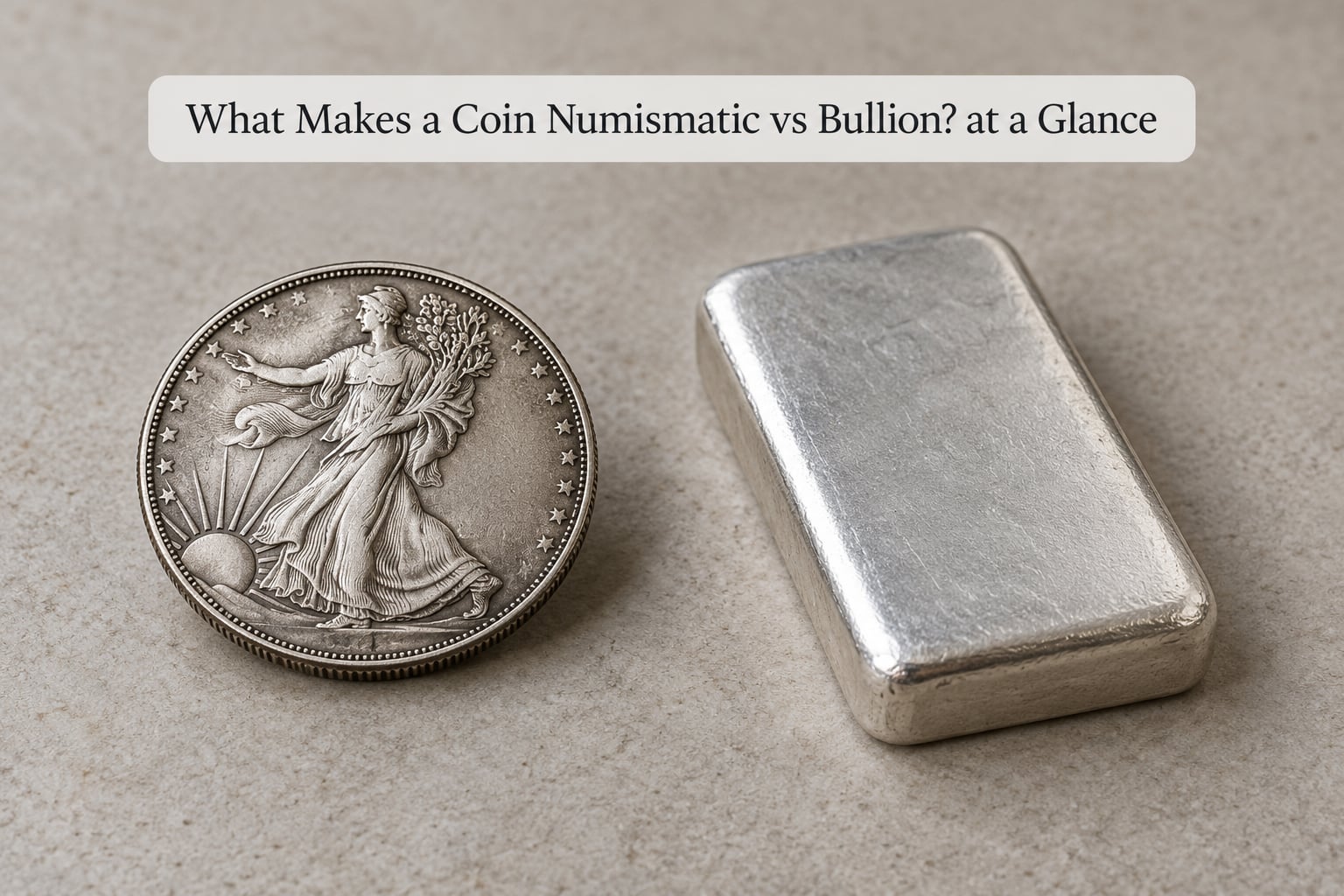
Here is the short answer, and it is worth reading twice before you look at any coin. A bullion coin is priced almost entirely by its metal content, meaning weight, purity and the current spot price. A numismatic coin is priced by scarcity, condition, authenticity and collector demand, usually on top of whatever metal it contains. That single split explains nearly every difference that follows.
| Criterion | Bullion coin | Numismatic coin |
|---|---|---|
| What sets the price | Weight, purity and spot price | Rarity, grade, originality and collector demand |
| Source of value | Intrinsic metal value (melt value) | Collector premium above melt value |
| Typical premium over spot | A few percent to roughly 10 percent | Zero to many times the melt value |
| Liquidity | High; sold over the counter to any dealer | Low; needs the right buyer at the right time |
| Predictability | Tracks the metal price closely | Decoupled from short-term gold moves |
| Who buys it on the way out | Any bullion dealer, bank or refinery | Collectors, dealers and auction houses |
| Resale pathway | Dealer buyback at a stated spread | Private sale, dealer consignment or auction |
| Transaction costs | Spread, delivery and storage | Spread, commission, fees, grading and insurance |
| Storage needs | Safe deposit box or insured home safe | Archival flips or holders, stable humidity, insurance |
| Common failure mode | Paying too large a premium to a dealer | Cleaning the coin, or buying fakes |
One column is not entirely clean, and pretending otherwise is how people get confused. Plenty of coins sit in between: bullion coins that sold out before anyone could grade them, low-mintage coins bought as a cheaper way to hold metal, and collector-grade modern issues. That middle is usually called semi-numismatic, and it is discussed further below.
What Is a Numismatic Coin?
A numismatic coin is one whose price is set by collectors rather than by the metal market. The word comes from the same root as numismatics, the study and collecting of coins, but in investing use it simply means the collectible side of the market.
Several things can make a coin numismatic:
- Rarity. Not the mintage figure alone, but the number known to survive. A million-piece mintage with two percent still in existence is rarer in practice than a fifty-thousand-piece run that nobody touched.
- Condition. Grade matters enormously, and originality within that grade matters even more. Honest wear beats a shiny cleaned surface every time.
- Variety and rarity within the type. Mint marks, plant varieties and die varieties can matter more than the date itself.
- Historical significance. Some coins are tied to an event, an error or a short-lived issue that collectors deliberately saved.
- Collector demand. This is the wildcard. A beautiful, genuinely scarce coin with no theme behind it can sit unsold for years.
- Provenance. A documented ownership history, especially from a famous collection or a major auction, can add credibility and value.
Named examples help. A Morgan silver dollar, pre-1933 United States gold coins, ancient Greek and Roman issues, and the 1913 Liberty Head nickel all sit clearly on the numismatic side.
The 1913 Liberty Head nickel is the extreme case collectors quote. It is often described as the holy grail of American numismatics, and the finest known example, recovered from a Long Island estate collection, drew a record bid at auction in 2019. The point is not that every rare coin multiplies like that. The point is that no amount of arithmetic on silver content gets you there.
One numismatic coin that is illegal to own
The 1933 Double Eagle is the famous exception to private ownership in the United States. Gold coinage was recalled and melted shortly after issuance, and roughly a dozen to two dozen pieces survived in government hands. A handful were later released into commerce and seized, which is why authentic examples are now effectively off the legal market for private collectors. If a seller offers you one, that is a serious warning sign on the whole dealer.
What Is a Bullion Coin?
A bullion coin is minted primarily to hold precious metal, and its price is anchored to that metal. You can price almost any bullion coin yourself if you know three numbers: the weight, the purity and the spot price.
The math is straightforward. Weight in troy ounces multiplied by fineness gives the fine metal content. Multiply that by the spot price for the metal and you get the melt value, the floor beneath the coin. A one-ounce .999 fine gold coin contains 0.999 troy ounces of pure gold. A one-ounce .999 fine silver coin contains 0.999 troy ounces of pure silver, which is why the silver version trades at a small fraction of the gold one despite the identical stated weight.
Named examples: the American Gold Eagle and American Silver Eagle, the Canadian Maple Leaf, the Australian Kangaroo and the South African Krugerrand. All of them are struck to a recognisable design and legal tender specification, and most carry a face value that is largely symbolic. That face value is not what you are buying.
What you are buying is metal plus a small premium, usually somewhere between a few percent and roughly ten percent, covering the dealer’s margin, minting cost and assay. That is the whole commercial structure. There is no expectation that an American Gold Eagle will ever be scarce, because the mint will happily strike more of them the moment demand appears.
Bullion coins also have one practical advantage that gets overlooked. In the United States, coins meeting certain purity thresholds, commonly quoted as .995 fine gold or .999 fine silver in original mint packaging, can qualify as assets in a self-directed IRA. Numismatic coins generally do not, because the collector premium pushes them above bullion value. Rules differ outside the US and change over time, so confirm current thresholds with a tax professional before acting.
How Coin Value Is Determined
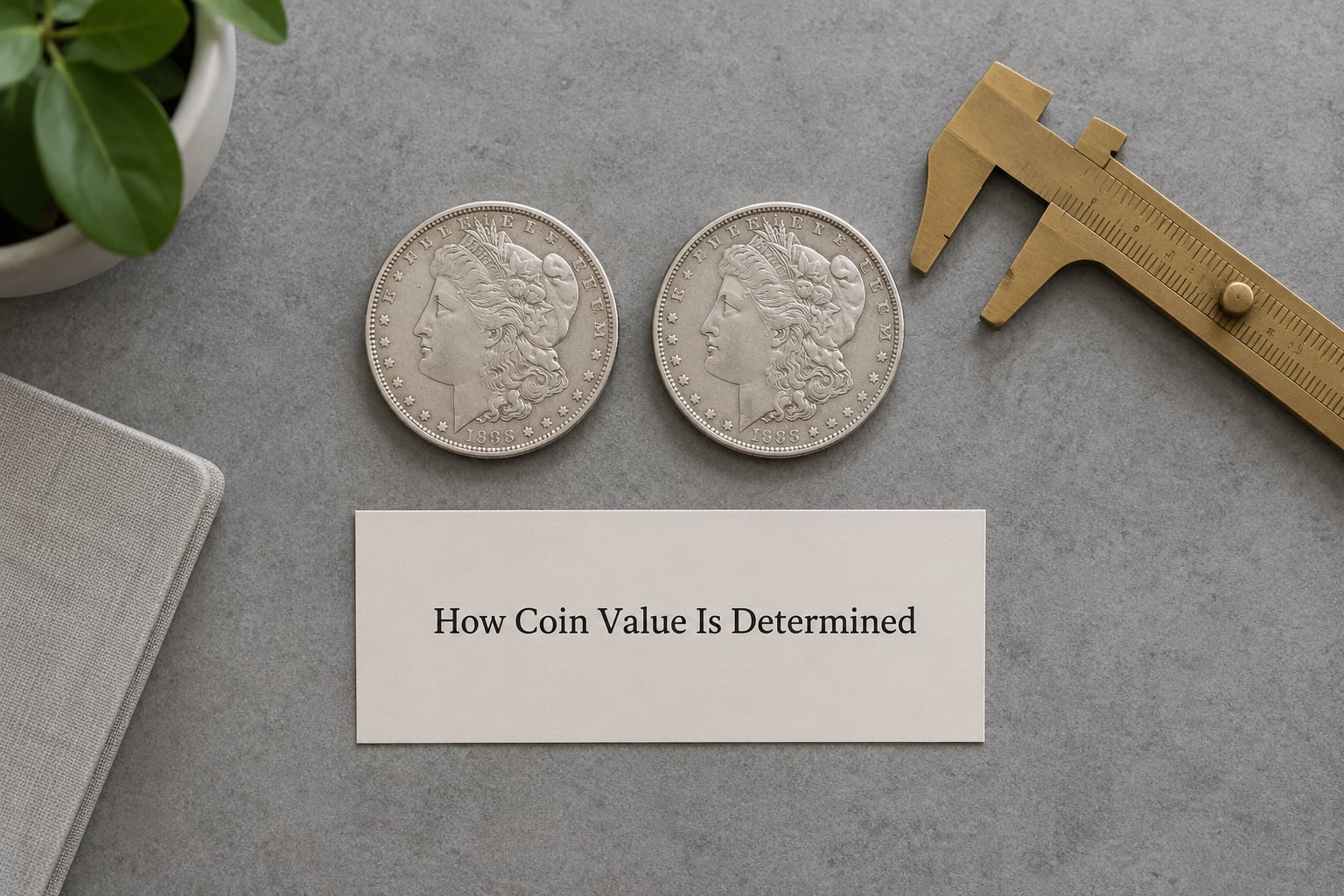
Every precious metal coin has the same three layers, whether the seller describes all of them or not. Knowing the names makes dealer conversations much shorter.
Melt value: the floor under every precious metal coin
Melt value is what the metal alone is worth if you melted the coin down. It moves every day with the spot price and nothing else. It is the number that stops a bullion coin from ever being worth less than its contents in normal conditions, and it is the number a dealer will quietly fall back on if they cannot sell you the collectible story.
Collector premium: what sits above the floor
The premium over spot is everything between the melt value and the asking price. On bullion it is thin and predictable, covering margin and minting cost. On a numismatic coin it can be 100 percent, 1,000 percent or far more, and it is priced by demand rather than by anything physical. A 1933 Double Eagle has a melt value calculated like any other gold coin and a market price with nothing to do with gold at all.
Three drivers decide a numismatic vs bullion price
- For bullion: fine metal content first, mint and brand second, condition and packaging a distant third.
- For numismatics: rarity within the surviving population, then grade and originality, then eye appeal, provenance and demand.
- For both: who you buy from. The same coin can differ by a wide margin between a dealer with a retail counter and one working on thin margins.
Worked example: the same metal, two very different prices
Take a 1916 Morgan silver dollar and a freshly struck American Silver Eagle. Both weigh roughly 26.7 grams and both are .999 fine silver, so their melt values are calculated the same way and move together all day, every day.
The Morgan in a problem grade might be worth its melt value plus a small cushion, because collectors are not competing for it. The same Morgan in a top grade at a major auction can bring many multiples of that figure, because surviving high-grade examples number in the hundreds rather than the tens of thousands. Same metal, same spot price, wildly different market. That gap is the collector premium, and it is the entire answer to numismatic vs bullion pricing.
A semi-numismatic coin shows the gap in miniature. A low-mintage bullion issue bought as metal can trade for a modest premium over melt and carry almost no collectable value, which is exactly what a disciplined buyer wants to hear before paying for the story.
Numismatic vs Bullion: Rarity and Collectability
Collectability is the biggest structural difference between the two, because bullion coins are designed to defeat it. Mints produce on demand, and a coin that can always be made again is never scarce no matter how many people want it.
Numismatic coins also accumulate history in a way bullion coins do not. Gold coins get melted down, exported and worn as jewellery. Many old dates were never saved, so the surviving population can be a tiny fraction of the original mintage, and that surviving pool is fixed forever.
Condition is where beginners get hurt. Coins scratched, cleaned or polished lose value permanently, and a cleaned coin is worth far less than an honest one in the same grade. Experienced collectors consistently describe the coins they want as original and unaltered rather than cosmetically perfect, and the price gap between the two is enormous.
The practical upshot for a numismatic vs bullion decision: bullion pricing stays consistent because the inputs never change, while numismatic pricing can move years in either direction on a single collector trend. One can absolutely appreciate when gold falls; the other can sit dead for a decade and then triple.
Numismatic vs Bullion: Liquidity and Selling
Liquidity is where the two categories diverge most sharply, and it is the factor buyers underestimate. A bullion coin can be sold to almost any dealer on any afternoon, usually at a spread the dealer states openly. A numismatic coin needs one specific buyer, at one specific grade, on one specific date.
Selling routes differ accordingly:
- Bullion: dealer buyback, private sale to another buyer, or sale to a refinery for melt. All three are quick. The dealer spread is the cost of convenience.
- Numismatic: private sale, consignment through a dealer, or auction house. Auction commission, listing fees, photography and postage can eat a meaningful slice of a modest coin. Most experienced collectors sell privately rather than through an auction for exactly that reason.
A recurring point from experienced bullion buyers on r/Gold is worth repeating here, because it is the most common costly misunderstanding in this market: buy the coin, not the slab. Grading modern bullion does not usually add anything, because it almost always comes back graded 69 or 70 anyway. You have paid a submission fee, postage and insurance, and now you hold a modern bullion coin plus a piece of plastic.
Two further wrinkles with holders: grading services carry their own grading scale, so a holder graded by one service does not translate one-to-one into the other. And guarantee coverage on a holder expires after a set period, which matters if you are buying with an eye on eventual resale.
Numismatic vs Bullion: Risks and Storage
The risks are not the same on each side, and knowing which you are carrying makes it easier to manage.
Counterfeiting sits almost entirely on the numismatic side. A bullion coin can be checked for weight, diameter and edge reeding on a scale and calipers. An ancient or foreign coin requires genuine expertise, which is precisely why the catalogue of reputable shows and the third-party grading services exist.
Cleaning is the other one, and it is self-inflicted. A coin that has been polished loses a large part of its collector value, and beginners frequently do this at home before ever selling. Never clean a coin, and never handle the surfaces with bare fingers.
Volatility cuts both ways. Bullion moves with the metal price and can drop sharply in a short window. Numismatic value is less correlated with gold in the short term, which protects it during a metals selloff and makes it just as unhelpful when you need cash next week. Different risk, not smaller risk.
Storage requirements scale with the category too. Bullion needs little beyond an insured, secure location. Numismatic coins need archival flips or inert holders, stable humidity, careful handling and a home inventory, and they carry a higher insurance value per coin, so your policy needs to reflect it.
Which side of the line is this coin on? Three questions settle it. How many are known to survive compared with the mintage? Does it carry a genuine collector premium, or just a small dealer margin over melt? Would you still want it if the metal price collapsed? If the first two answers are weak, you are holding bullion, whatever the listing says.
Which Should You Choose?
Match the category to the goal, and be honest about which goal you actually have.
My own rule is that a coin has to be interesting before it has to be valuable. That ordering stops me paying a big premium for a date I have no reason to care about, and it is the single most useful habit I have picked up from watching other people buy at shows.
Choose bullion if you want metal exposure, a hedge against currency weakness, something you can sell in a week, or an asset that fits cleanly inside a retirement account. The expectation is modest and clear: you are paying a small premium to hold a physical version of the metal price.
Choose numismatic coins if you are building a collection, you enjoy the research, and you can accept that the sale may take longer than you would like. Treat it as a hobby with a possible financial upside, not as a savings vehicle. Do the authentication homework yourself or pay a specialist, and buy the coin rather than the story about the coin.
Choose a mix if you want both. Many buyers hold a core bullion position and spend a separate, smaller budget on collecting. The split keeps the illiquid portion from being the part they depend on for liquidity.
On the honest question of whether numismatic coins are a good investment: they can be, and the record includes genuine winners, but the return depends entirely on buying the right coin, in the right grade, at a sensible price, and holding it while a specific collector market exists. Illiquidity and counterparty risk are real and hard to price in advance. For most first-time buyers, bullion with a small premium is the more reliable starting point, and collectible coins are the more rewarding hobby.
Frequently Asked Questions
Yes, and the overlap confuses both sides of the market. A coin can be minted as bullion and still become collectible if the mintage was low, the issue was short-lived, or it belongs to a popular series. Bullion coins struck to meet demand almost never become numismatic. Terms like semi-numismatic exist for coins carrying both metal value and a modest collector premium in meaningful proportion.
No. A rare coin is usually more valuable than any bullion coin, but rarity alone does not create value. Condition, originality, eye appeal, provenance and the number of collectors chasing the issue decide the outcome. Plenty of genuinely scarce coins trade near their melt value simply because collectors are not looking for them. Scarcity with no demand is still just scarcity.
Condition matters far more for numismatic coins. Bullion pricing is driven by metal content, so a scratch barely moves the value. On a collectible coin, grade and originality can multiply or divide the price several times over. Cleaning and polishing are the main risk here, because the damage is permanent. Handle coins by the edges with clean gloves and never clean them.
They can diversify a portfolio, but they do not diversify in the way bullion does. A numismatic coin tied to a popular series can correlate strongly with other collectibles and stay flat for years. Bullion spreads exposure across the metal itself and has a clear exit. If diversification is the goal, bullion is the tool. If enjoyment is part of the goal, a small, separate collecting budget works better.
Check the price against melt value. Multiply the weight in troy ounces by fineness and by the spot price. If the asking price sits within roughly ten percent of that figure, it is being valued as bullion. If it is a multiple of it, a collector premium is being charged. Then confirm you are buying the coin and not just a grading holder, since modern bullion usually grades 69 or 70 anyway.
Yes, considerably. Any bullion dealer will buy a standard coin over the counter at a stated spread, usually the same afternoon. Collectible coins usually need the right specialist buyer, so the sale can take weeks, months or never. That difference in exit time is the most important practical gap between the two categories, and it is worth more to your finances than a small premium difference.
The next move is small and cheap: pick any coin you are considering, work out its melt value on paper, and compare it with the asking price. That one exercise tells you whether you are being offered metal with a thin margin or a story with a multiplier attached.
Source: https://www.pgm-blog.com/what-makes-a-coin-numismatic-vs-bullion/
Anyone can join.
Anyone can contribute.
Anyone can become informed about their world.
"United We Stand" Click Here To Create Your Personal Citizen Journalist Account Today, Be Sure To Invite Your Friends.
Before It’s News® is a community of individuals who report on what’s going on around them, from all around the world. Anyone can join. Anyone can contribute. Anyone can become informed about their world. "United We Stand" Click Here To Create Your Personal Citizen Journalist Account Today, Be Sure To Invite Your Friends.
LION'S MANE PRODUCT
Try Our Lion’s Mane WHOLE MIND Nootropic Blend 60 Capsules
Mushrooms are having a moment. One fabulous fungus in particular, lion’s mane, may help improve memory, depression and anxiety symptoms. They are also an excellent source of nutrients that show promise as a therapy for dementia, and other neurodegenerative diseases. If you’re living with anxiety or depression, you may be curious about all the therapy options out there — including the natural ones.Our Lion’s Mane WHOLE MIND Nootropic Blend has been formulated to utilize the potency of Lion’s mane but also include the benefits of four other Highly Beneficial Mushrooms. Synergistically, they work together to Build your health through improving cognitive function and immunity regardless of your age. Our Nootropic not only improves your Cognitive Function and Activates your Immune System, but it benefits growth of Essential Gut Flora, further enhancing your Vitality.

Our Formula includes: Lion’s Mane Mushrooms which Increase Brain Power through nerve growth, lessen anxiety, reduce depression, and improve concentration. Its an excellent adaptogen, promotes sleep and improves immunity. Shiitake Mushrooms which Fight cancer cells and infectious disease, boost the immune system, promotes brain function, and serves as a source of B vitamins. Maitake Mushrooms which regulate blood sugar levels of diabetics, reduce hypertension and boosts the immune system. Reishi Mushrooms which Fight inflammation, liver disease, fatigue, tumor growth and cancer. They Improve skin disorders and soothes digestive problems, stomach ulcers and leaky gut syndrome. Chaga Mushrooms which have anti-aging effects, boost immune function, improve stamina and athletic performance, even act as a natural aphrodisiac, fighting diabetes and improving liver function. Try Our Lion’s Mane WHOLE MIND Nootropic Blend 60 Capsules Today. Be 100% Satisfied or Receive a Full Money Back Guarantee. Order Yours Today by Following This Link.


| Visits: | 1,833,808,941 |
| Stories: | 8,714,641 |
Whistler Blowers, Insiders

