

Why Gold Coin Premiums Rise and Fall: A Buyer’s Guide 2026

Gold coin premiums rise and fall because the amount you pay above the coin’s metal value is set by supply, demand and dealer competition, not by the mint. When buyers chase a scarce coin faster than dealers can replace it, the premium widens. When coins flood back into the market or the gold price climbs faster than the extra charge, the premium shrinks as a percentage. Understanding that single mechanic is the difference between paying a normal cost and paying a gouge.
Most of the confusion comes from one word doing two jobs. On the buy side a premium is what you pay above melt value. On the sell side, dealers bid below melt value, so there is no premium at all in your favour. This guide covers both directions, with the numbers you need to price any coin yourself.
Figures here are indicative and move with the market; premium levels vary by region and by dealer. Nothing in this guide predicts where gold goes next.
What Is a Gold Coin Premium?
A gold coin premium is the amount a buyer pays above the coin’s melt value, which is the value of the gold the coin contains at the current spot price. It exists because the coin is not raw metal: someone refined the gold, minted a disc, shipped it, insured it and stocked it, and each of those steps has a cost that lands in the asking price.
Three terms get tangled, so it helps to keep them apart. Spot price is the wholesale price of one troy ounce of fine gold, roughly 31.1 grams. Melt value is that spot price multiplied by the coin’s pure gold content. Premium is everything the dealer charges on top of melt value.
The formula is straightforward, and you can run it in your head:
Melt value = gold content in troy ounces × spot price
Premium percentage = (coin price − melt value) ÷ melt value × 100
Worked example. A one-ounce Canadian Maple Leaf contains 0.9999 fine gold, so its melt value sits a hair under one full troy ounce. If spot is near 4,700 and a dealer asks 4,960, the premium is about 160, which works out to roughly 3.4 percent. Now check the same arithmetic when spot moves: the dollar premium barely changes, but the percentage does, because the percentage is measured against a bigger melt value every time metal gets more expensive.
A premium is not the same as a markup, a spread or collector value. The markup is what the dealer adds to its own cost of goods. The bid/ask spread is the gap between what a dealer pays you and what it charges you on the same coin. The numismatic premium is what a coin commands because of age, condition and collector demand, and it is a completely separate animal from the metal premium. A 1920s Double Eagle is mostly a collector market; a freshly struck Eagle is mostly a metal market.
How to calculate the premium on any gold coin
Three steps, no app required. Look up the coin’s gold weight in troy ounces and its purity. Multiply that by the live spot price to get melt value. Subtract melt value from the asking price and divide by melt value to get the percentage.
There is a good reason to learn this by hand. A thread on The Gold Forum kept circling the same question from readers who could read a chart but had never priced a physical coin, and the answer that helped them most was not an opinion about fairness. It was the arithmetic.
Why Gold Coin Premiums Rise and Fall
Premiums rise when demand outpaces the supply a dealer can actually get, and they fall when coins become easier to get or when buyers stop competing with each other. That is the whole answer. Everything below it is a specific version of those two forces, and they act on the retail price with different time lags.
Here is how the pressures pair up.
| Pressure | What pushes the premium up | What pushes it down |
|---|---|---|
| Demand | Retail investors bidding up a popular coin, safe-haven buying during market stress, dealer restocking after inventory runs down | New buyers stepping back, collectors releasing coins from storage, jewellers selling scrap back into the market |
| Supply | Mint allocation limits, refinery bottlenecks, slow delivery from wholesalers, low mintage on a dated or fractional issue | A fresh release landing at every dealer, normalising of supply, an IRA contribution window opening up old inventory |
| Market | Volatility that makes people want coins now, a falling gold price that makes existing inventory scarce | A sharp spot rally that inflates melt value faster than asking prices, so the same dollar premium becomes a smaller percentage |
| Dealer | Thin inventory, higher freight or assay costs, dealers competing hard for a coin buyers want | Margin compression, dealers running promotions, arbitrage between dealers keeping prices close |
Two behaviours surprise people most. First, a dealer running out of a popular coin will widen the premium or simply stop selling it, which turns pricing into rationing. Second, a dealer who cannot find anything worth buying from customers may stop bidding altogether, a situation dealers sometimes call a no-bid market. Both push retail premiums higher simply because inventory is the scarce item, not because the metal got more valuable.
How Supply, Demand and Investor Interest Affect the Premium
Investment demand is the most obvious driver, and the least interesting one to watch, because it tracks everything else gold-related. When confidence in equities or government debt wobbles, money moves toward metal, and the same week the premium on a popular coin tends to widen. Safe-haven buying rarely disappears, but it changes the urgency of the bid, and urgency is what a dealer prices in.
Central bank buying matters for gold’s price but only indirectly for the retail premium. A central bank does not bid for a one-ounce Maple Leaf, so its purchases push the metal price rather than the premium. This is the source of a common mistake: assuming a strong gold market means a fat premium on the counter.
On the supply side, the chain runs mint to refinery to authorised purchaser to wholesaler to retailer, and a delay at any step shows up in the asking price. The United States Mint sells one-ounce gold coins to authorised purchasers at a fixed markup of roughly three percent over spot. That charge sits at the bottom of every retail price, so it functions as a floor. With spot near 4,700, three percent works out to about 140 an ounce. Nobody can buy below that number and sell at a loss, which is why you never see a retail premium under three percent on a bullion coin.
Mintage, the number of coins a mint authorised, changes the arithmetic when supply is limited. A dated bullion series with a small published mintage competes for the same buyer attention as the standard issue, so it can carry an extra five or ten points. The extra is not a fee. It is a bet that a handful of buyers want that specific year.
Dealer inventory is the pressure most buyers feel directly. When a shop sells through its stock of a popular coin faster than the wholesaler can restock, the wholesale market sets the price and the dealer passes it through. Delivery that used to take days can take weeks, and users on bullion forums describe exactly that, watching the premium behave like a supply problem rather than a pricing decision.
Seasonality is real but small. Physical demand tends to firm up in the last quarter as accounts and retirement contributions are funded, and it softens in the middle of the year. Expect a steady market rather than a dramatic seasonal swing.
How Coin Type, Mint and Collectibility Change the Price
Not all one-ounce coins cost the same premium over melt. The metal is identical, so the difference comes from recognition, eligibility rules, purity and how easily a dealer can resell the coin on the back side of the sheet.
Brand recognition is the biggest factor. A widely recognised sovereign mint coin has a deep secondary market, which means a dealer can always sell it to another dealer near melt. That liquidity is worth several percentage points of premium, because the dealer is not stuck holding it. Coins with a thin following in your country can sit at the same premium with worse exit options, which is a worse deal than it looks.
Purity makes a smaller difference than most buyers expect. A one-ounce coin at .9999 fine carries 99.99 percent of an ounce of gold, so its melt value is fractionally higher than a .999 coin. Nobody pays a premium for four ten-thousandths of purity. Where purity genuinely matters is eligibility rules for retirement accounts, where minimum fineness requirements decide which coins you are allowed to hold at all.
Design changes matter mostly for collectors. The American Eagle has walked through several obverse and reverse designs, and the Canadian Maple Leaf has refreshed its security features more than once. Annual redesigns create a natural break between the current issue and older dates, and that break is where numismatic value attaches.
Here is a reasonable benchmark set. Treat it as a reference range, not a quote.
| Coin type | Typical size | Typical premium over melt | Main driver |
|---|---|---|---|
| Major sovereign bullion coin | 1 troy oz | 3 to 5 percent | Fixed mint charge plus a thin dealer margin |
| Same, during a shortage | 1 troy oz | 5 to 10 percent | Thin inventory and competition between dealers |
| Fractional bullion coin | 1/10 oz | 8 to 15 percent | Minting and handling cost spread over a small amount of metal |
| Fractional bullion coin | 1/20 or 1/25 oz | 12 to 20 percent | The same fixed cost over even less metal |
| Minted bar, 1 oz | 1 troy oz | 3 to 6 percent | Simple design, strong liquidity, no collector demand |
| Dated or limited-mintage bullion | 1 troy oz | 5 to 15 percent above standard | Collector interest layered on top of the metal premium |
| Proof or graded coin | 1 troy oz | Well above the bullion range | Grading fee, holder and certification cost, not scarcity of gold |
Fractional gold is the case buyers ask about most, and the economics are simple enough to explain in one line. A mint charges roughly similar fixed costs to strike a tenth of an ounce as it does for a full ounce, so the same cost gets divided by ten times less metal. That is why a tenth-ounce coin can cost well over twice the per-ounce price of a one-ounce coin, and why experienced stackers treat anything under half an ounce as a collector purchase rather than a metal purchase.
The flip side of small sizes is that their per-ounce premium does not behave the same way. Long-time participants on r/Gold report that fractional premiums hold steady or even widen as metal prices rise, instead of compressing the way a one-ounce premium does. The fixed cost stays fixed, so it never becomes a smaller share of anything.
Why Gold Coin Premiums Fall
Premium compression happens when spot rises faster than the asking price. The dollar premium a dealer charges stays roughly where it was, but melt value grows underneath it, so the percentage shrinks. The reverse also shows up constantly: when spot falls, the same dollar premium becomes a larger percentage, and dealers widen their bid to protect margin.
Take a one-ounce coin quoted at a fixed premium of about 160 above melt. At a spot near 4,700, that is roughly 3.4 percent. If spot later runs to 6,600 and the dealer holds that dollar premium, the same coin is quoted at 2.4 percent over melt. Nothing about the coin or the dealer changed. Only the denominator moved.
This is why long-running discussions on the NGC boards carry titles like gold and silver premium erosion as prices go higher. Buyers notice the same thing from the other side, worrying about paying a premium only to watch it shrink as metal rallies.
Other things that pull premiums down:
- Fresh mint releases. A new dated series arriving at dealers gives the market something to compare against, and asking prices usually follow the fresh stock down.
- Destocking. When retail interest cools, dealers work down inventory rather than reorder, and the pressure to move coins shows up as a thinner premium or a promotion.
- Newcomer supply. Coins returning from storage, safe deposit boxes and old jewelry sales add coins that were never part of the current flow.
- Competition between dealers. Shops in the same city watch each other’s shelves. When two dealers are close, the premium compresses without either wanting to.
- Fading novelty. A special release that carried ten percent over melt can drift back toward the bullion range once the launch buyers have filled their bags.
- Loss of urgency. Safe-haven buying is the most volatile component of demand. When the fear recedes, the extra points go first.
Some of those are forces, not prices, and they are what push premiums up. Here is what sits inside the number you are quoted.
| Cost component | Rough share of the premium | Who ultimately pays |
|---|---|---|
| Refining and minting charge | Largest single piece, around 3 percent on a one-ounce bullion coin | Every buyer, permanently |
| Assay and verification | Small, a few tenths of a percent | Every buyer |
| Freight, insurance and secure storage | Varies sharply with volume and distance | Buyers, heavier on small sizes |
| Dealer margin | The part that moves most | Whoever buys in a tight market |
| Grading and holder, if applied | A flat fee unrelated to the metal | The buyer who wants a certified coin |
Read that table before you complain about a five percent premium. Roughly three points of it are a structural charge you cannot negotiate away, and the dealer margin is the only portion in play. Graded and slabbed coins deserve separate treatment, because a large part of what looks like a premium is a certification fee, not a scarcity premium.
How to Judge Whether a Premium Is Fair
A premium is fair when it covers the fixed costs you cannot avoid, matches what other reputable dealers charge for the identical coin, and reflects real scarcity rather than one shop having a slow week. Use this order.
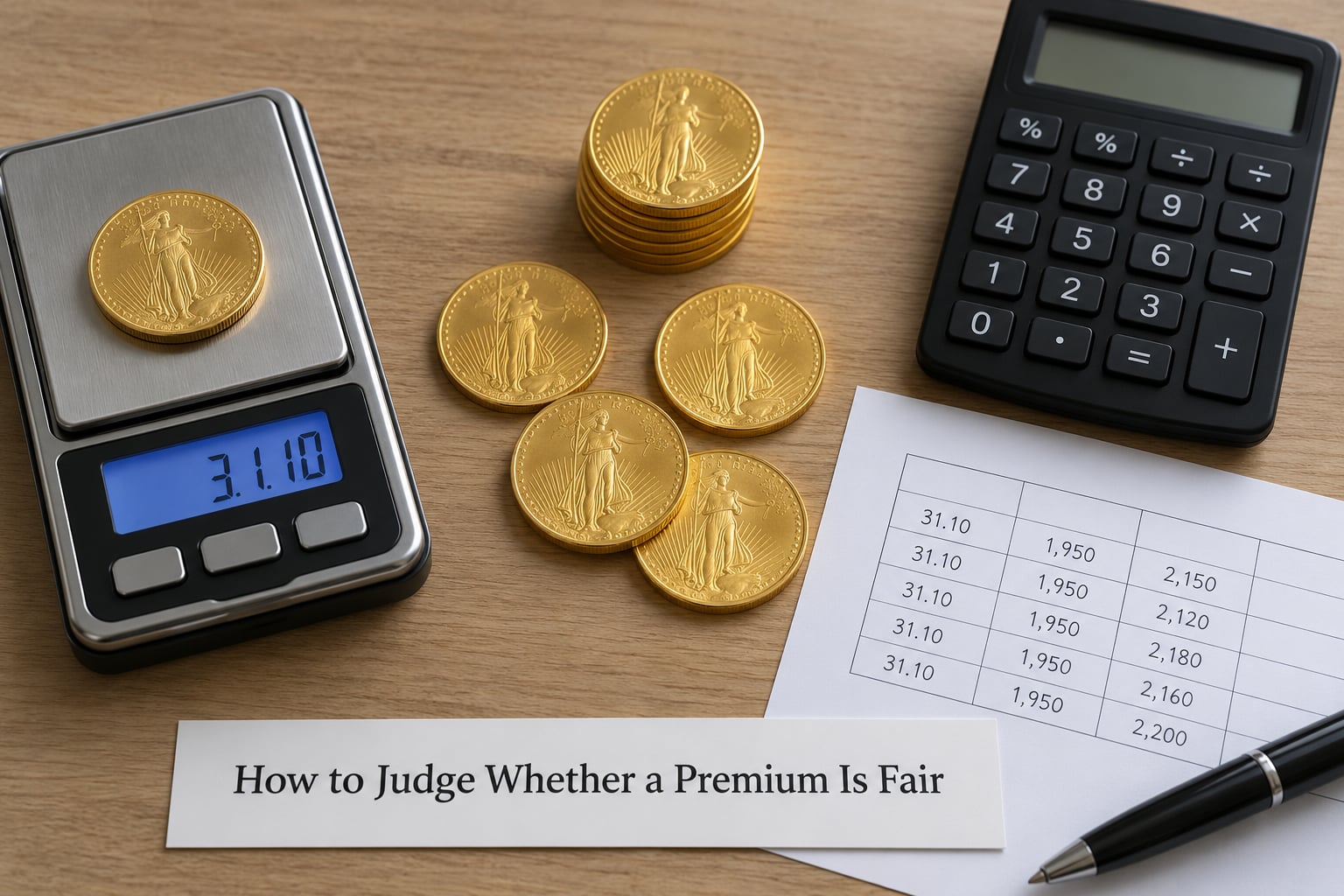
- Pull the live spot price. Use the current per-ounce quote, not a figure from an article written last week. Premiums are measured against metal as it is trading now.
- Compute melt value yourself. Gold content in troy ounces times spot. Do this before you look at the asking price so the number anchors you.
- Compare the identical coin across dealers. Same coin, same year, same grade, same quantity. Dealers will not quote premiums over the phone, so plan to check several shops or dealer sites before you travel.
- Place the percentage against the range table. Three to five percent on a one-ounce bullion coin is ordinary. Ten percent on a one-ounce coin needs a reason. Fifteen percent on a tenth-ounce coin is closer to normal than it sounds.
- Add the friction you will pay later. Shipping, insured storage and your own resale bid all belong in the decision. A dealer who buys below melt can turn a modest premium into a real cost on exit.
When is a bigger premium worth paying? A dated or low-mintage bullion series with a real secondary market, a coin you specifically want, or a fractional piece you need for a retirement account minimum. In each case the premium buys scarcity or access rather than metal.
When is it pure cost? A standard one-ounce bullion coin at ten percent over melt with no collectible story behind it. That is a dealer margin, and you have better options.
One rule of thumb gets repeated by experienced buyers and holds up most of the time: stay at or above one troy ounce if your goal is metal, and treat anything smaller as a collecting decision.
What Changes a Premium Over Time
Premiums move on very different clocks, and knowing which one you are watching prevents most of the confusion.
Within hours. Spot price changes reprice the whole sheet. This is the fastest-moving input and the one that most often makes a quoted premium look wrong by the time you reach the shop. Users report dealers declining to hold quotes for long during sharp moves for exactly this reason.
Within weeks. A new mint release lands, wholesaler deliveries arrive or stall, and the inventory pressure resolves one way or the other. If a series is genuinely constrained, the premium firms up here and holds for a few months.
Within a season. New demand from retirement account funding or a renewed safe-haven wave lifts every premium at once, then fades. These cycles repeat and they are the reason the same coin can be five percent over melt in one quarter and eight percent in another.
Over years. A mint discontinuing a series, or a change in eligible coin design for retirement accounts, can permanently reprice what was an ordinary bullion coin. Long-minted bullion coins also tend to trade at thinner premiums over time because the market learns them better and liquidity deepens.
Put together, the pattern repeats: fresh inventory competes down against older stock, then shortages or renewed demand lift the premium until the next release cycle absorbs it.
Frequently Asked Questions
For a one-ounce sovereign mint bullion coin, three to five percent over melt value is ordinary, because roughly three points of that is a fixed minting charge the buyer cannot negotiate away. Ten percent on a one-ounce coin signals a shortage or a thin dealer margin. Smaller coins carry higher premiums for the same reason: a one-tenth ounce piece often runs eight to fifteen percent because the minting cost is spread over far less metal.
Yes, and it happens constantly. Premium compression occurs when spot rises faster than the asking price, so the same dollar premium becomes a smaller percentage. This is a well-documented pattern among bullion dealers, who describe watching their percentage margins shrink every time metal rallies sharply. It is also why a buyer who paid a fat premium right before a spike can end up closer to melt value than when they started.
A dealer has to cover freight, storage, insurance, refining and their own margin, and they cannot resell your coin at the exact price they just paid. Their bid therefore sits below melt value while their asking price sits above it. That gap is the spread, and it is the real cost of liquidity. Many new buyers find this the most confusing part of the market, expecting dealers to bid at or above the price they pay.
No. A premium above roughly three percent reflects fixed minting, refining and handling costs that every buyer pays. Higher premiums are defensible on dated or limited-mintage bullion with an active secondary market, on coins you specifically want to collect, and during genuine supply shortages. A ten percent premium on a standard one-ounce bullion coin with no collectible angle is usually dealer margin rather than scarcity.
Find the coin’s gold weight in troy ounces, multiply by the live spot price to get melt value, then subtract melt value from the asking price and divide by melt value. The result is your premium percentage. Do the melt calculation before you look at the asking price so the metal value anchors you. Comparing the same coin at several dealers is the fastest way to spot an outlier.
Dealers give you a verified coin, a receipt and someone to buy it back from, at the cost of the premium and spread described above. Private sales can cost less, but you carry the authentication risk and may pay more in shipping and insurance than you save. Buying from a dealer also means you can resell at a predictable discount. For most first-time buyers, the predictability is worth the few percentage points.
Conclusion
Premiums rise when buyers compete for coins that are hard to get and fall when coins are plentiful or when metal rallies faster than the asking price. That is the mechanic behind every premium you will ever be quoted.
Start with three things. Pull the live spot price and calculate melt value before anyone quotes you. Compare the identical coin across several reputable dealers, because premiums differ more between shops than most buyers expect. Then separate the two kinds of premium clearly: the fixed metal premium you cannot avoid, and the collector premium you only pay when you actually want that coin.
Premium figures move daily, so treat any number you see, including the ranges in this guide, as a starting point rather than a quote.
Source: https://www.pgm-blog.com/why-gold-coin-premiums-rise-and-fall/
Anyone can join.
Anyone can contribute.
Anyone can become informed about their world.
"United We Stand" Click Here To Create Your Personal Citizen Journalist Account Today, Be Sure To Invite Your Friends.
Before It’s News® is a community of individuals who report on what’s going on around them, from all around the world. Anyone can join. Anyone can contribute. Anyone can become informed about their world. "United We Stand" Click Here To Create Your Personal Citizen Journalist Account Today, Be Sure To Invite Your Friends.
LION'S MANE PRODUCT
Try Our Lion’s Mane WHOLE MIND Nootropic Blend 60 Capsules
Mushrooms are having a moment. One fabulous fungus in particular, lion’s mane, may help improve memory, depression and anxiety symptoms. They are also an excellent source of nutrients that show promise as a therapy for dementia, and other neurodegenerative diseases. If you’re living with anxiety or depression, you may be curious about all the therapy options out there — including the natural ones.Our Lion’s Mane WHOLE MIND Nootropic Blend has been formulated to utilize the potency of Lion’s mane but also include the benefits of four other Highly Beneficial Mushrooms. Synergistically, they work together to Build your health through improving cognitive function and immunity regardless of your age. Our Nootropic not only improves your Cognitive Function and Activates your Immune System, but it benefits growth of Essential Gut Flora, further enhancing your Vitality.

Our Formula includes: Lion’s Mane Mushrooms which Increase Brain Power through nerve growth, lessen anxiety, reduce depression, and improve concentration. Its an excellent adaptogen, promotes sleep and improves immunity. Shiitake Mushrooms which Fight cancer cells and infectious disease, boost the immune system, promotes brain function, and serves as a source of B vitamins. Maitake Mushrooms which regulate blood sugar levels of diabetics, reduce hypertension and boosts the immune system. Reishi Mushrooms which Fight inflammation, liver disease, fatigue, tumor growth and cancer. They Improve skin disorders and soothes digestive problems, stomach ulcers and leaky gut syndrome. Chaga Mushrooms which have anti-aging effects, boost immune function, improve stamina and athletic performance, even act as a natural aphrodisiac, fighting diabetes and improving liver function. Try Our Lion’s Mane WHOLE MIND Nootropic Blend 60 Capsules Today. Be 100% Satisfied or Receive a Full Money Back Guarantee. Order Yours Today by Following This Link.


| Visits: | 1,833,808,941 |
| Stories: | 8,714,641 |
Whistler Blowers, Insiders

