

How Silver Is Refined and Purified: From Ore to Metal 2026

Silver refining strips a mixed, often disappointing material down to metal pure enough to trade: the ore concentrate, dore bar or scrap pile goes in, and bars, granules or cathodes of .999 fine silver come out. Most of that work is done in two families of process — heat-based methods that oxidise base metals away, and electrolytic methods that dissolve a crude anode and plate pure crystals onto a cathode. Chemistry does the separating; the assay office decides whether the job actually succeeded.
Understanding the route matters if you buy, hold or recycle silver, because the purity standard, the recovery rate and the cost of processing all show up in what a dealer will pay you and what an industrial buyer will accept.
What Does Silver Refining and Purifying Mean?
Refining and purifying are usually used loosely for the same thing, but it helps to split them. Extraction gets the silver out of the ground at all. Refining takes a material that already contains silver in a usable proportion and drives it toward chemical purity. Purifying is the finishing language — the last push from roughly 98% up to .999 or better.
Silver purity is expressed in millesimal fineness, where .999 means 999 parts per thousand are silver. That is the standard for traded bullion, and .9999 is used where the buyer needs tighter tolerances.
Three feed materials drive almost all refining work:
- Mined concentrate from silver mines and from the copper, lead and zinc mines where silver rides along as a by-product.
- Dore metal — a mixed gold-silver bar produced at a smelter, which is later parted so each metal is recovered separately.
- Scrap and recycled material — jewellery, flatware, photographic and electronic waste, industrial contacts, plating solutions and silver-bearing residues.
Why bother? Because raw silver is rarely close to the standard the market trades in. Mined silver commonly arrives at a concentrate worth a few percent to a few tens of percent, and it is common for silver to arrive as a by-product of a mine whose primary metal is something else entirely. Refining is the step that converts low-grade concentrate and old jewellery into .999 fine metal.
No single route suits everything. A copper smelter’s anode slime behaves nothing like a bag of broken rings, and a refinery’s job list changes with the feed composition and the specification the customer ordered. For an investor-minded reader, though, the destination is always the same: a weighed, assayed, market-ready product.
How Silver Is Refined and Purified From Ore
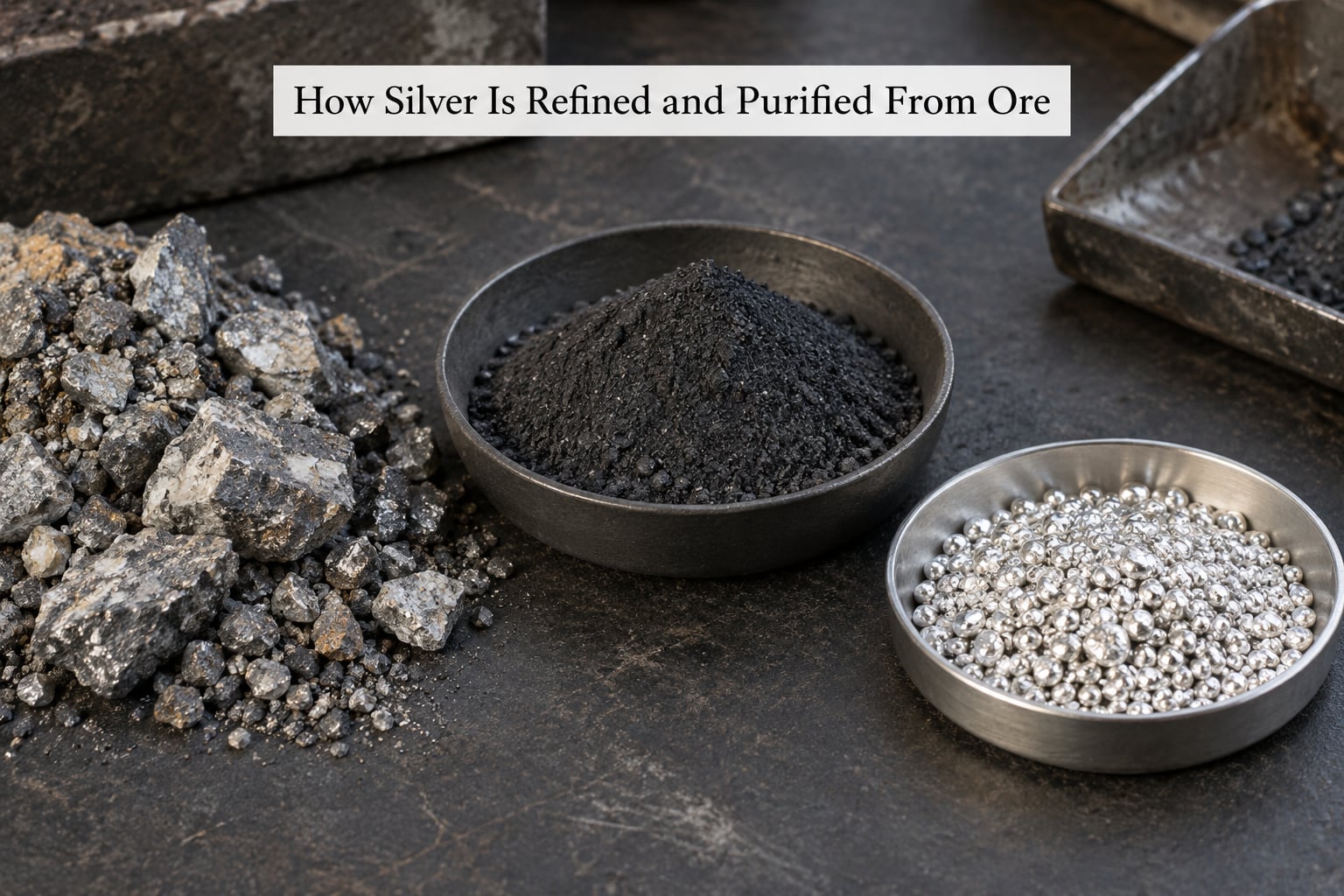
The ore route runs through seven stages, and each one strips away something different. The order matters because later steps are expensive and none of them can recover metal that an earlier step threw away.
1. Exploration and mining. Drill results and assay work identify how much silver is actually in the rock. Most silver today is not mined from a dedicated silver deposit at all — it comes out of the copper, lead and zinc ores listed above, which is why silver supply tracks those metals as much as it tracks the silver price.
2. Crushing and grinding. The run-of-mine rock is broken down and milled until the silver-bearing mineral grains are freed from the surrounding gangue. The finer the grind, the better the separation, and the more energy the operation burns doing it.
3. Concentration. Flotation cells or gravity tables separate the silver-bearing mineral from waste rock. The waste goes to the tailings pile; the concentrate carries perhaps a few percent to a few tens of percent silver into the smelter.
4. Smelting. The concentrate is fused with a flux at high temperature. Sulfur and carbon burn off as gases, volatile impurities leave as fumes, and the silver collects in a molten pool beneath the slag.
5. Fire refining. Cupellation is the classic step here: air is blown across the molten metal, and the oxidising blast converts lead and other base metals into litharge that floats off as dross, leaving the less oxidisable silver and gold behind.
6. Electrorefining. The intermediate is cast as an anode and dissolved in an electrolyte. Pure silver ions migrate and plate onto a cathode, while base metals stay in solution and some impurities drop out as an anode sludge.
7. Melting, casting and assay. The harvested cathodes are washed, dried, melted and cast into bars, granules or mint blanks. An assay office then checks a sample against the contract fineness before the metal is released to the buyer.
The Main Industrial Steps How Is Silver Ore Mined and Prepared for Refining?
Hard-rock silver mining follows the same basic recipe as any other metal: drill, blast, load, haul, crush, mill, float. The distinctive part is the by-product question. Where silver is the primary ore, the mining plan targets silver. Where it is a by-product, the plan targets the host metal, and silver simply rides out with it in whatever quantity the geology provides.
Concentration is where the economic line gets drawn. Material that does not concentrate cleanly is usually too dilute to refine economically, which is why the grade of the concentrate matters as much as the grade of the ore. A mine can be a large silver producer and still send a concentrate that a smelter treats mainly as a lead or copper feed.
How Are Silver Concentrates and Doré Smelted?
Smelting is where the concentrate route splits into three families, and the split follows the concentrate type: copper, lead or zinc.
In copper smelting, the silver and gold travel with the copper into an anode and end up in the electrolytic slime left behind when the copper is refined. From lead concentrates, the classic route is the Parkes process — molten lead is treated with zinc, which collects the precious metals, and the zinc layer is skimmed and vacuum-retorted to drive off the zinc and leave a precious metal dore. Zinc concentrates are roasted and leached, and the silver residue is processed onward.
Dore is deliberately impure. It is a gold-and-silver alloy that is easier to transport and handle than two separate metals, and it is parted later — usually with nitric acid for the silver, or with electrolysis — to recover each one cleanly.
Cupellation is still part of the sequence. Heating the melt with an air blast oxidises lead, copper and other base metals, and their oxides are skimmed as dross until only the noble metals remain.
How Silver Is Refined Electrolytically: Anodes, Cathodes and Electrolyte
Electrolytic refining exploits the fact that silver dissolves cleanly while most impurities do not, or dissolve but never plate.
The intermediate metal is melted and cast into anodes. Anodes sit in a tank of silver-bearing electrolyte, cathodes in the same tank carry the current, and the charge is applied. Silver leaves the anode as ions, travels through the solution, and deposits as crystals on the cathode. Base metals stay dissolved or fall away as sludge, and the cathode grows heavier and purer as the run continues.
Two cell designs dominate. The Moebius system uses vertical electrodes, which suits purer feed and gives good cathode control. The Balbach-Thum system uses horizontal electrodes in a series of flat cells and handles cruder, higher-anode-sludge material. Both achieve the same idea — plate pure, leave the rest behind — and both generate no anode waste to dispose of, because the sludge often carries recoverable platinum group metals.
The endpoint of a good run is a cathode that has grown to the thickness where the base metal contamination of the deposit starts climbing again. Electrorefining routinely delivers .999 to .9999 purity.
What Happens When Silver Comes From Recycling?
Scrap follows the same logic with a different front end. Sorting comes first — jewellery and flatware, photographic and electronic material, industrial contacts and residues are all treated differently because each carries different contaminants.
After shredding and non-metallic removal, the material is usually smelted with a flux. The melt either goes straight to electrorefining, or it goes to cupellation first when the material is lead-heavy, which strips a lot of impurity cheaply before the electrolysis step.
Low-melting-point routes exist too: vacuum distillation and chloride-based chemical refining, which can pull silver out of residues at a smaller scale than a tankhouse can justify. Vacuum distillation is also the classic way to separate silver from a gold-silver alloy by boiling off the lower-melting metal.
One practical warning from people who actually do this. Sterling is not reliably .925 in the marketplace, and hobbyists report recovering considerably less than the stamp implies — .900 is common, .925 is a pleasant surprise. Assaying the lot before you plan anything around it is the difference between a good day and a wasted one.
Refining Methods Compared: Pyrometallurgical, Electrolytic and Chemical
| Method | What it removes | Purity reached | Scale | Watch out for |
|---|---|---|---|---|
| Roasting and calcination | Sulfur, carbon, volatile impurities | Not a purity step on its own | Industrial | Gas handling and furnace dust |
| Cupellation | Lead, copper and other base metals as litharge | Roughly 97 to 99 percent | Industrial and small foundry | Very hot dross, heavy fume |
| Fusion melting with flux | Gangue, oxidised impurities | Roughly 98 to 99 percent | Industrial | Metal loss to dross and splash |
| Electrolytic refining (Moebius, Balbach-Thum) | Base metals and trace impurities | .999 to .9999 | Industrial tankhouse | Acid electrolyte, sludge handling |
| Chemical refining and affination | Base metals dissolved out by acid | High, if the wash is thorough | Lab to small workshop | Nitric acid, nitrogen dioxide, chlorine gas |
| Vacuum distillation | Lower-melting metals boiled off | High on the residue | Small to mid workshop | Equipment cost, slow throughput |
Read it as a chain rather than a menu. The smelter’s job is to make a material good enough to feed the cell, and the cell’s job is to finish the job. Chemical refining is fast and precise at small scale but hard to scale safely, and vacuum distillation is the opposite.
How Is Refined Silver Measured for Purity and Market Delivery?
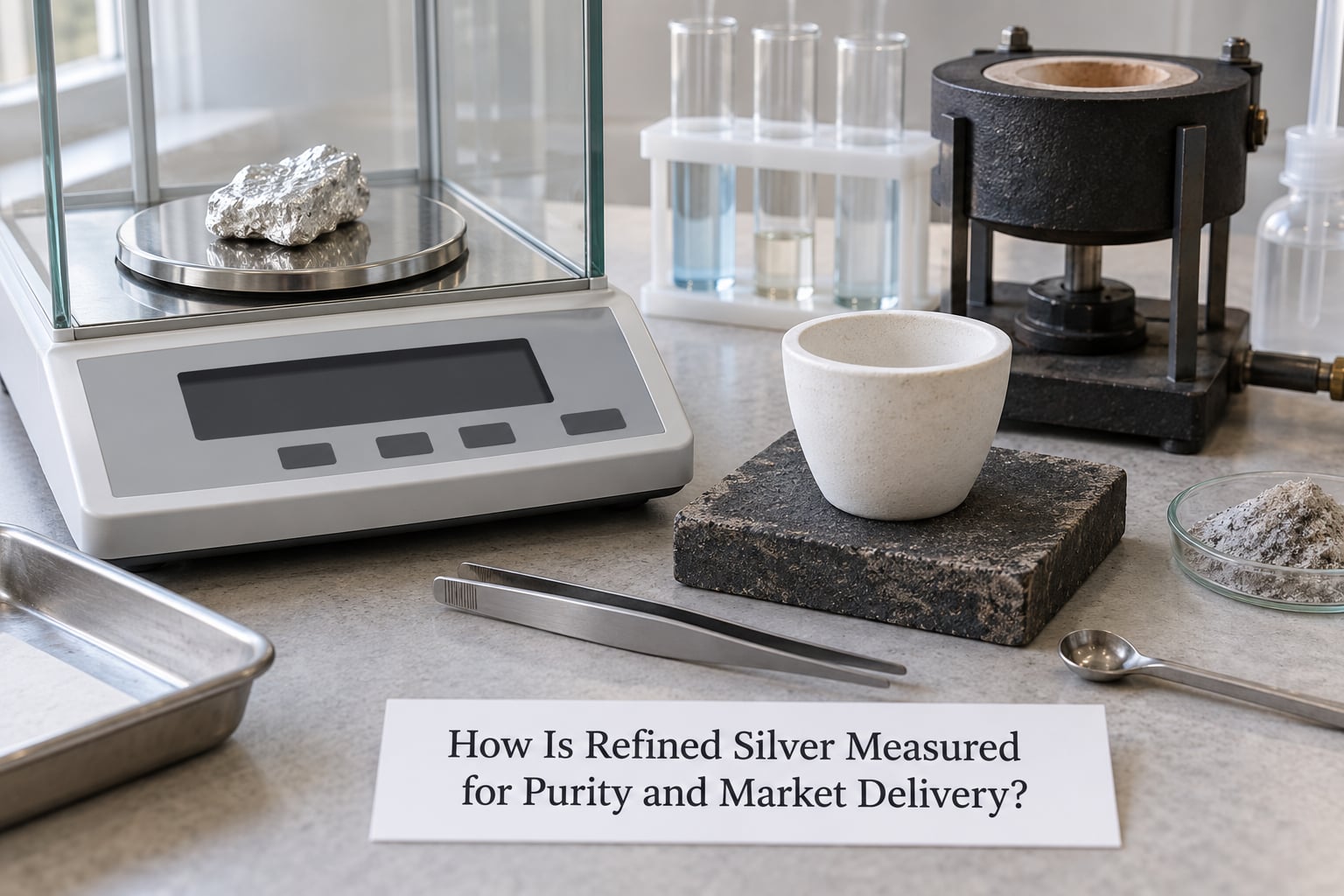
The question readers ask most often is how anyone knows refining is finished. The answer is that nobody guesses — an assay is run on a representative sample before the metal is released.
Fire assay remains the reference method. The sample is mixed with flux and litharge, fused in a cupel, and cupellation drives off the lead and base metals. The bead left behind is parted to separate gold from silver, then weighed. Because it destroys the sample, it is the method of record for bullion deliveries.
X-ray fluorescence is fast and non-destructive, which makes it the usual choice for screening a large incoming lot before a full fire assay on a sample. It is a good tool for sorting and for checking a claim; it is generally not the final word on a contract delivery.
The purity benchmarks themselves are simple once you see them side by side:
| Fineness | Silver content | Where it shows up | Market standing |
|---|---|---|---|
| .900 | 90 percent | Assorted historic and trade silver | Below bullion standard |
| .925 | 92.5 percent | Sterling jewellery, the flatware trade | Widely traded, sold by weight |
| .999 | 99.9 percent | Bullion bars, granules, coin blanks | The investment standard |
| .9999 | 99.99 percent | Industrial and specialty delivery | Premium industrial spec |
Two practical habits close the loop. First, assaying before refining tells you what you actually have, and post-refining assaying tells you what you actually produced. Second, check the hallmark rather than the claim: on jewellery the mark carries the fineness, and on a bar the mint or refiner’s mark with a serial number is what ties the metal to a document.
Weighing is the last step and the one buyers care about most. Weight is taken in troy ounces rather than grams, on a calibrated balance, and it is the number that turns a pile of purified metal into a position you can sell.
Why Does the Refining Method Matter for Silver Investors?
Refining does not set the silver price, and nothing on this page should be read as a forecast. It does shape what you can buy, what you get back when you sell, and how much supply the market has to absorb.
Purity sets the product. .999 is the tradable standard. Anything below it sells as a trade or scrap lot at a different price and on different terms, so a refinery’s job is not merely to remove dirt — it is to reach a fineness that a buyer will settle on.
Recovery rates decide whether refining pays. Every pour loses metal: to dross, to splash, to scale, to sludge. Add refining fees, assay charges, acid and consumables, and small lots often come out behind. Refiners quote minimum lot sizes for exactly this reason, and the widely repeated view among experienced hobbyists is that a small sterling batch costs more to process than the recovered metal is worth. That is a processing-cost statement, not a view on the metal.
By-product economics sit behind the whole supply curve. Because much silver arrives through copper, lead and zinc mines, the cost of producing a pound of silver is partly set by what those mines can charge for their primary metal. A year of weak copper economics can tighten silver supply without anything happening in the silver market itself.
Recycling is a real supply source. Photographic, electronic and jewellery scrap returns metal to the market, which caps how tight scarcity can get and adds a supply source that responds quickly to price.
That industrial layer sits underneath everything else in commodity investing — the mining economics, the supply curve and the bullion you actually hold. If you want that wider picture, the site’s precious metals and investing basics guides cover the fundamentals. What this page gives you is the step below them: the industrial work that turns rock and scrap into something you can own.
Frequently Asked Questions
Commercially, electrorefined silver reaches .9999, meaning 99.99 percent pure. Four-nines fine is the practical ceiling for industrial delivery because pushing beyond it requires handling and analysis that only specialist laboratories justify. Sterling at .925 and trade silver at .900 are alloy grades rather than refined purity levels, and they are made by adding other metals rather than by refining.
Some metal is always lost, mainly to dross, furnace scale, splash and anode sludge. Loss is smallest in a well-run tankhouse and largest in small workshop runs, where a single mishandled pour can eat a noticeable share of a small lot. Assaying the feed and the finished product is the only reliable way to measure your own recovery rate.
Most silver production comes from copper, lead and zinc ores, where silver is present in quantities too small to justify a dedicated mine on its own. Mining the host metal is already economic, and the silver comes along as a bonus, which is why silver supply often moves with copper and lead economics rather than with the silver price alone.
Yes. Once the non-metallic material is stripped out, recycled silver goes through the same smelting and electrolytic steps as mined metal and reaches the same .999 and .9999 grades. The real difference is the front end: scrap arrives mixed with gemstones, plating, plastics and solder, so sorting and pre-cleaning cost far more than they do for a clean concentrate.
Not exactly. Pure silver is 100 percent silver, which is too soft to use for coins or jewellery on its own. Refined silver is metal brought up to a stated fineness by removing impurities, usually .999 or .9999, and that is what the bullion market trades and what refiners deliver. Refining describes the process; the fineness stamp describes the result.
They separate into three groups. Base metals such as copper and zinc dissolve into the electrolyte and simply stay in solution. Noble impurities such as gold and platinum group metals do not dissolve readily and drop to the bottom as anode sludge, which is often refined separately for its own value. Volatile contaminants mostly leave earlier, during smelting and roasting.
Conclusion: Follow the Metal from Ore to Final Product
How silver is refined and purified comes down to one idea: heat removes what burns, acid and electrolysis remove what dissolves, and assaying decides when the job is done. Ore travels through crushing, concentration, smelting, cupellation and electrorefining; scrap travels through sorting, smelting and the same refining steps.
Start where any refiner starts, by identifying the feed material, whether mined concentrate, dore or scrap. That single answer decides which route applies, what purity is realistic and whether refining the lot is worth doing at all.
Source: https://www.pgm-blog.com/how-silver-is-refined-and-purified/
Anyone can join.
Anyone can contribute.
Anyone can become informed about their world.
"United We Stand" Click Here To Create Your Personal Citizen Journalist Account Today, Be Sure To Invite Your Friends.
Before It’s News® is a community of individuals who report on what’s going on around them, from all around the world. Anyone can join. Anyone can contribute. Anyone can become informed about their world. "United We Stand" Click Here To Create Your Personal Citizen Journalist Account Today, Be Sure To Invite Your Friends.
LION'S MANE PRODUCT
Try Our Lion’s Mane WHOLE MIND Nootropic Blend 60 Capsules
Mushrooms are having a moment. One fabulous fungus in particular, lion’s mane, may help improve memory, depression and anxiety symptoms. They are also an excellent source of nutrients that show promise as a therapy for dementia, and other neurodegenerative diseases. If you’re living with anxiety or depression, you may be curious about all the therapy options out there — including the natural ones.Our Lion’s Mane WHOLE MIND Nootropic Blend has been formulated to utilize the potency of Lion’s mane but also include the benefits of four other Highly Beneficial Mushrooms. Synergistically, they work together to Build your health through improving cognitive function and immunity regardless of your age. Our Nootropic not only improves your Cognitive Function and Activates your Immune System, but it benefits growth of Essential Gut Flora, further enhancing your Vitality.

Our Formula includes: Lion’s Mane Mushrooms which Increase Brain Power through nerve growth, lessen anxiety, reduce depression, and improve concentration. Its an excellent adaptogen, promotes sleep and improves immunity. Shiitake Mushrooms which Fight cancer cells and infectious disease, boost the immune system, promotes brain function, and serves as a source of B vitamins. Maitake Mushrooms which regulate blood sugar levels of diabetics, reduce hypertension and boosts the immune system. Reishi Mushrooms which Fight inflammation, liver disease, fatigue, tumor growth and cancer. They Improve skin disorders and soothes digestive problems, stomach ulcers and leaky gut syndrome. Chaga Mushrooms which have anti-aging effects, boost immune function, improve stamina and athletic performance, even act as a natural aphrodisiac, fighting diabetes and improving liver function. Try Our Lion’s Mane WHOLE MIND Nootropic Blend 60 Capsules Today. Be 100% Satisfied or Receive a Full Money Back Guarantee. Order Yours Today by Following This Link.


| Visits: | 1,833,794,133 |
| Stories: | 8,714,586 |
Whistler Blowers, Insiders

