

How Gold Dealers Make Money on Spreads: A Guide (2026)

A bullion dealer’s spread is simply the gap between the bid price, which is what the dealer pays you when you sell, and the ask price, which is what they charge when you buy. On a typical one ounce gold coin that gap runs two to five percent of the metal price, and it is the dealer’s gross margin on the trade. Understanding exactly which costs sit inside that number is the fastest way to tell a fair quote from an expensive one.
There is no affiliate deal behind this guide. I read dealer price pages and buyback policies and forum threads from working dealers, and I want you to be able to check my working rather than trust it.
One warning before we start: the percentage ranges below move with the gold price and differ by country and state. This is a mechanics guide, not financial advice, and nothing here is a forecast of where gold goes next.
What Is a Gold Dealer Spread?
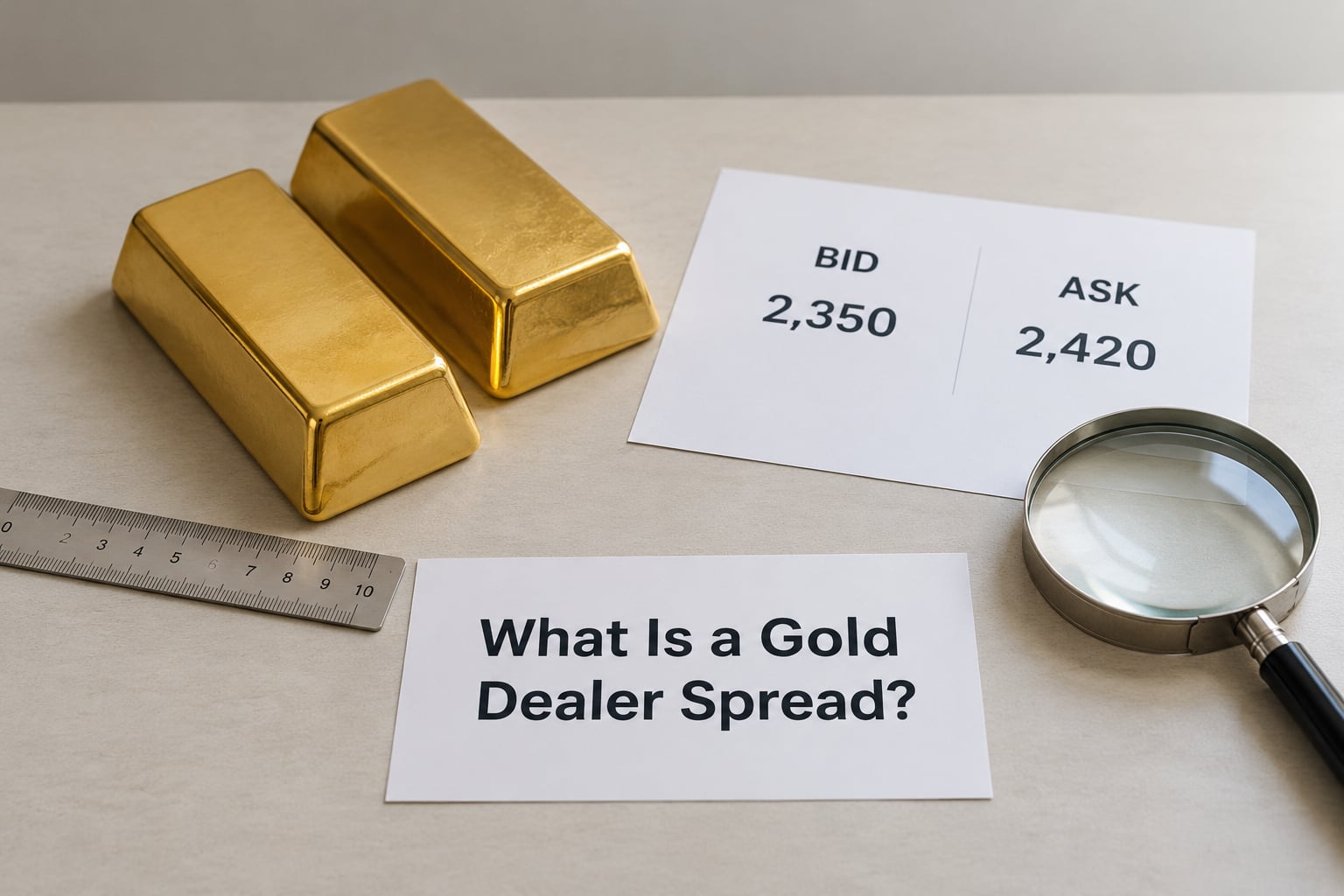
Two prices sit behind every dealer quote, and you only ever see one of them.
The ask is the retail price. You pay it, plus delivery and any payment fee. The bid is the price the dealer pays you when you hand metal over. Dealers rarely publish the bid on the main page because that is the number that would make the spread obvious.
Here is the shape of it on a single one ounce American Gold Eagle, using round illustrative figures:
| Component | Illustrative figure | Share of the ask |
|---|---|---|
| Spot gold reference price | USD 3,200.00 | 96.2% |
| Dealer margin inside the ask | USD 135.00 | 3.8% |
| What you pay | USD 3,335.00 | 100% |
| What the dealer would pay you | USD 3,130.00 | 93.9% of the ask |
| Spread you paid on entry | USD 205.00 | 6.2% of the spot price |
That 6.2% is the number that should interest you, not the headline gold price. It is what you have already spent before the metal moves a cent.
Forum readers often assume the visible gap between two screen prices is the dealer’s entire profit. It usually is not. A Coin Talk dealer member posted a live example from APMEX in 2017, buying a one ounce Eagle at USD 1,287.80 and selling the same coin at USD 1,338.79, a margin of USD 50.99 or 3.81 percent all-in, rather than the sliver of margin the thread’s original poster had assumed. Those are old figures, useful because the structure has not changed.
The Main Parts of a Gold Dealer’s Price
A dealer quote is a stack of layers, and each layer is charged differently. Break them apart and most of the argument about whether a dealer is expensive goes away.
The metal price
Underneath everything is a reference price for fine gold, normally the LBMA gold price benchmark or a dealer house price derived from it. That figure is not a dealer’s creation, though dealers sometimes display a slightly higher number than the published benchmark.
Spread and premium
The spread is ask minus bid. The premium over spot is ask minus the reference price, which is a completely different number. A coin can carry a 6 percent premium and sit inside a 3 percent spread. Buyers mix these up constantly.
Fabrication and mint premium
A tenth ounce coin costs the mint the same tooling setup as a one ounce coin, so the fixed making cost gets spread across less metal. That is why small formats carry fat percentages. Larger bars amortise the same cost over more ounces and get cheaper per ounce.
Delivery, insurance and storage
Delivery with declared-value insurance and signature confirmation is priced into the quote or charged flat. Storage in an allocated vault is usually a separate annual line. A flat fee of ten dollars on a small fractional coin is a much larger percentage than the same fee on a kilo bar, which is why small orders should be batched.
Payment and selling fees
Card and bank transfer surcharges of two to four percent are common, and they are frequently larger than the entire spread difference between two dealers. On the other end, selling back usually brings a fee plus a smaller spread.
Here is the full revenue stack a dealer draws on. Treat every range as a rule of thumb that changes with market conditions.
| Profit line | Typical range | When you meet it |
|---|---|---|
| Retail spread | 2 to 5 percent | Built into the ask price |
| Payment method surcharge | 0 to 4 percent | At checkout |
| Delivery and insurance | Flat fee, sometimes waived above a threshold | At checkout |
| Vault storage | Annual fee by weight and value | If you store with the dealer |
| Buyback discount | 1 to 5 percent below the ask | When you sell back |
| Assay and refining margin | 1 to 3 percent on non-standard metal | Scrap, mixed lots, unusual bars |
| Numismatic margin | Wide, and unrelated to the metal | Collectible coins, graded pieces |
How Do Gold Dealers Make Money on Spreads?
Dealers do not sit on gold waiting for a price rise. They buy and replace inventory constantly, and the profit comes from the number of ounces moved rather than from a favourable move in the metal.
Volume and inventory turnover
This is the part almost no article explains, and it is the answer to the most common forum question about this topic: if the margin is thin, how is the business sustainable?
Run the arithmetic on two hypothetical shops. The high-volume dealer clears 1,000 ounces a year at a 3 percent margin. The independent coin shop moves 400 ounces at 8 percent. On paper the shop looks better. In dollars it does not, and the gap widens fast.
A Coin Talk moderator put the split plainly: most independent dealers aim for around 10 percent, give or take a point or two, while very large dealers reach roughly 4 percent only because of the volume they do. A Reddit user running a gold buying business described buying and selling after every two or three days, and the frustration of watching inventory sit while rates fell.
Turnover is the multiplier. Margin tells you what you earn on one transaction, turnover tells you how many transactions happen. It is also why dealers care about repeat customers more than the single sale.
Hedging inventory
The common fear is that a dealer is betting on gold’s direction and will end up holding a large loss. Most do not. Dealers hedge, using CME and Comex gold futures and forwards, so that the price risk on inventory they have already bought is largely offset against positions in the futures market.
This explains something that confuses buyers. When prices move sharply, availability and delivery terms can change and the premium ratchets upward, which reads to a customer like the dealer is deliberately hoarding. Usually it is inventory risk management against a hedged book that has gone wrong for a moment, not a price forecast. It is also why a dealer can quote a firm price at eight in the morning without being exposed by lunch.
The ancillary lines
Even a dealer running a thin spread earns on surcharges, storage, assay work, and the discount applied when you sell back. That is why a narrow spread does not mean a narrow business. It is also why comparing the spread alone is a weak test.
The buy side
Scrap gold buyers, pawn shops and jewellers run an entirely different model. They buy far below melt value because they cannot resell the piece as an investment, only as raw material, so their exit is constrained. Coin Talk moderators described a pawn shop buying metal at roughly two thirds of melt and selling at about a third above melt, which is close to a hundred percent markup on the buy price. One member reported a local shop paying daily spot minus a quarter for scrap. That is a scrap-processing business, not a bullion dealer, and comparing it with a coin dealer quote is a category error.
Why Do Gold Spreads Differ Between Dealers?
Two dealers quoting the same coin can be several dozen dollars an ounce apart, and Reddit commenters routinely report USD 30 to 60 of variance on an identical item depending on the website. The reasons are structural, not arbitrary.
Product format
The single biggest driver is how much fixed making cost sits inside each piece.
| Format | Typical retail spread | Why |
|---|---|---|
| 1/10 oz and 1/4 oz coin | 8 to 20 percent or more | Fixed mint cost spread over tiny weight |
| 1 oz sovereign coin | 2 to 5 percent | Deep secondary market, easiest to resell |
| 1 oz private-mint round | 4 to 10 percent | Narrower buyer pool |
| 10 oz bar | 1.5 to 4 percent | Low making cost per ounce |
| 1 kg bar | 1 to 3 percent | Cheapest per ounce, institutional standard |
Condition, purity and authenticity
A scratched, cleaned or damaged coin sells into a smaller market. Lower purity or a bar with no assay card attracts a discount because the dealer has to verify it first.
Liquidity
Sovereign mint coins clear worldwide. Regional issues and obscure series do not, so the dealer carries inventory risk it has to pay for. Spread size is a real-time market depth signal: where the order book is deep, the spread is tight.
Order size and overhead
A small order carries the same fixed handling as a large one, so small orders get worse economics. A single-site coin shop carries rent and staff, so it runs a higher percentage than an online warehouse operation.
Volatility and conditions
Refinery shutdowns, logistics disruption and sharp price moves all widen spreads temporarily. During stress periods the safe, liquid formats tighten relative to the awkward ones.
How to Compare Gold Dealer Quotes
Comparing dealer quotes properly takes about fifteen minutes and a notepad. Do it this way.
Fix the reference item first. Choose one specific coin or bar, in a specific year and mint, and get the exact same item quoted everywhere. Last year’s Eagle against this year’s Eagle is not a comparison.
Check the base price is the same. Some dealers display a house spot slightly above the published benchmark and then advertise a low spread over it. A wide-looking premium on a small spread can still be the more expensive quote. Comparing the total you pay is the only comparison that survives this.
Add every compulsory fee. Payment surcharge, delivery, insurance, signature requirement, storage, and any commission. Write the total figure down. That is the real number.
Read the buyback policy, not just the buy policy. A dealer buying back at one to two percent below their ask costs you far less on exit than one paying three to five percent below. Over a multi-year hold, exit terms can outweigh a slightly better entry price.
Check storage, insurance and returns. Home storage adds insurance and home security costs. Dealer storage adds an annual fee. Returns vary, and some dealers do not take physical coin returns at all.
Two coins bought the same week can have very different outcomes on exit:
| Route | Entry cost | Exit cost | Total trading cost |
|---|---|---|---|
| Coin dealer, buy and sell back | 4 percent | 3 percent | About 7 percent |
| Vault-backed platform with clearing | About 1 percent | About 1 percent | About 2 percent plus annual storage |
| Gold fund or ETF | Brokerage commission | Brokerage commission | Commission only, no metal spread |
For a short holding period, that gap dominates the return. Over decades, physical storage and insurance start to matter too.
Spreads, Premiums, and Commissions: What Is the Difference?
Premium over spot, spread, melt value, and commission all get used interchangeably, and they describe four different costs.
Premium over spot is the ask price minus the reference metal price. It is what makes a coin cost more than its gold content.
Spread is the ask minus the bid, and it is the round-trip cost you pay when you buy from and sell back to the same dealer.
Melt value is the intrinsic metal content: the fine weight multiplied by the reference price. A coin sells at melt value only if it has no numismatic value and someone wants raw material.
Commission is a separate transaction charge, common on some dealing platforms and on numismatic sales, where it can be a percentage of the sale rather than a flat fee.
A worked comparison on the same coin: reference price USD 3,200, ask USD 3,335, bid USD 3,130. The premium over spot is 4.2 percent. The spread is USD 205, or 6.2 percent of the reference price. A commission, if charged, sits outside both numbers entirely.
What Makes a Gold Dealer Spread Too Wide?
A spread is not automatically unfair. Some of these are warning signs anyway.
An inflated base. A dealer advertising a low spread against a displayed spot price above the published benchmark is comparing against a number they chose.
Mismatched comparison items. If your quote comes back for a different year, mint or format, the percentage difference is meaningless.
Undisclosed fees at checkout. A 3 percent card surcharge appearing after the total is calculated is a spread wearing a different hat.
Pressure to buy now. Urgency around a “supply” claim, especially when prices are rising, usually marks up the premium rather than securing you a better deal.
Vague buyback terms. If the exit price is described as “subject to inspection” with no published discount, assume you will be offered a bid near melt value plus a small margin.
Terms that change after payment. Repricing, restocking fees and minimum-order thresholds applied after the fact all belong in the margin you did not see.
A stop on selling when prices fall. Dealers widen or pause the bid in fast declines because their hedge ratio and inventory mix are working against them. It feels like being abandoned. It is risk management, and it should make you more careful about buying into a spike, not less.
Can You Negotiate a Gold Dealer Spread?
Sometimes, and the terms you can move are not the ones most people try first.
Negotiable: delivery and insurance on a large order, payment method, which coin within a range you buy, monthly or bulk pricing if you buy regularly, storage terms, and the buyback discount on a business account. Larger single orders also tend to move the ask more than chat does.
Not negotiable: fabrication cost. A one troy ounce coin has a fixed making charge and the mint does not discount it. The premium on a tenth ounce coin is mostly that fixed cost, and no amount of conversation changes it.
Also not negotiable: the market itself. When a metal moves hard or a refinery is down, the bid is set by supply, not by the person on the phone.
What negotiation rarely changes is the buyback discount, because that number is written into the dealer’s risk policy. Ask for it in writing before you buy instead of trying to move it later.
Frequently Asked Questions
A bullion dealer’s spread is the difference between the bid price, what the dealer pays you when you sell gold, and the ask price, what they charge when you buy. On a one ounce coin the ask usually sits 2 to 5 percent above the reference metal price, and the bid sits 1 to 3 percent below it. The gap between the two is the dealer’s gross margin on the transaction.
They turn inventory continuously rather than waiting for the price to rise. Volume and turnover are the multiplier: a dealer clearing far more ounces at a smaller percentage can out-earn a shop with a larger markup and thinner trade. On top of the spread they also earn payment surcharges, delivery fees, storage fees, and a discount when you buy back from them.
For large online dealers, 3 to 6 percent all-in on one ounce sovereign coins is normal, and roughly 4 percent is reachable at high volume. Independent coin shops commonly target around 10 percent, give or take a point or two. Small formats run much higher because fixed minting costs sit on very little metal. Compare the total you pay, including surcharges, not the headline percentage.
Bullion dealers buying coins and bars usually pay somewhere between the spot price and a few percent below their own ask price. Scrap and jewellery buyers pay far less, because they can only resell the metal as raw material. Coin Talk members have described local shops paying daily spot minus a quarter for scrap, and a pawn shop buying at roughly two thirds of melt value.
That is a price-timing question, and this article does not answer it. What the mechanics do tell you is how much any sale costs you: the spread you paid on entry plus the discount applied on exit, which commonly totals around 6 to 8 percent with a coin dealer. Judge whether the round-trip cost justifies the move rather than the headline price.
Reporting depends on the transaction. Cash payments of USD 10,000 or more trigger Form 8300 reporting from the buyer. Sales of investment-grade precious metal coins and bars are generally exempt from Form 1099-B, because they are treated as capital assets rather than securities. Collectible coins and any state reporting requirement can change the picture, so check with a tax professional in your state.
What to Check Before You Buy Gold
Before you place an order, run these five checks. They take a few minutes and they are the whole difference between a fair quote and an expensive one.
Quote the identical item. Same year, same mint, same weight, same condition. If the reference differs, the comparison is void.
Ask for the all-in total. Metal, premium, payment surcharge, delivery, insurance, storage and commission in one figure.
Compare against a published reference price, not the dealer’s display price. Check that the base is the LBMA benchmark or something traceable to it.
Read the buyback terms in writing. The exit discount is part of your cost, and it is the number most buyers never check.
Settle the storage and insurance question. Home versus vault, annual cost, and what happens to the metal if you stop paying.
The reason to understand how gold dealers make money on spreads is not to resent it. Spreads pay for vaults, staff, insurance, assay and the risk of holding metal between the mint and your drawer. Understanding the mechanics just stops you paying for that service twice, once in a wide entry spread and again in a hidden surcharge at checkout.
Source: https://www.pgm-blog.com/how-gold-dealers-make-money-on-spreads/
Anyone can join.
Anyone can contribute.
Anyone can become informed about their world.
"United We Stand" Click Here To Create Your Personal Citizen Journalist Account Today, Be Sure To Invite Your Friends.
Before It’s News® is a community of individuals who report on what’s going on around them, from all around the world. Anyone can join. Anyone can contribute. Anyone can become informed about their world. "United We Stand" Click Here To Create Your Personal Citizen Journalist Account Today, Be Sure To Invite Your Friends.
LION'S MANE PRODUCT
Try Our Lion’s Mane WHOLE MIND Nootropic Blend 60 Capsules
Mushrooms are having a moment. One fabulous fungus in particular, lion’s mane, may help improve memory, depression and anxiety symptoms. They are also an excellent source of nutrients that show promise as a therapy for dementia, and other neurodegenerative diseases. If you’re living with anxiety or depression, you may be curious about all the therapy options out there — including the natural ones.Our Lion’s Mane WHOLE MIND Nootropic Blend has been formulated to utilize the potency of Lion’s mane but also include the benefits of four other Highly Beneficial Mushrooms. Synergistically, they work together to Build your health through improving cognitive function and immunity regardless of your age. Our Nootropic not only improves your Cognitive Function and Activates your Immune System, but it benefits growth of Essential Gut Flora, further enhancing your Vitality.

Our Formula includes: Lion’s Mane Mushrooms which Increase Brain Power through nerve growth, lessen anxiety, reduce depression, and improve concentration. Its an excellent adaptogen, promotes sleep and improves immunity. Shiitake Mushrooms which Fight cancer cells and infectious disease, boost the immune system, promotes brain function, and serves as a source of B vitamins. Maitake Mushrooms which regulate blood sugar levels of diabetics, reduce hypertension and boosts the immune system. Reishi Mushrooms which Fight inflammation, liver disease, fatigue, tumor growth and cancer. They Improve skin disorders and soothes digestive problems, stomach ulcers and leaky gut syndrome. Chaga Mushrooms which have anti-aging effects, boost immune function, improve stamina and athletic performance, even act as a natural aphrodisiac, fighting diabetes and improving liver function. Try Our Lion’s Mane WHOLE MIND Nootropic Blend 60 Capsules Today. Be 100% Satisfied or Receive a Full Money Back Guarantee. Order Yours Today by Following This Link.


| Visits: | 1,833,808,941 |
| Stories: | 8,714,641 |
Whistler Blowers, Insiders

