

Why Most Silver Comes From Other Mines, Explained (October 2026)

Roughly 70% of the silver mined each year is a by-product, recovered while mines produce copper, lead, zinc or gold. Only about 30% comes from primary silver mines built specifically for silver. The reason is grade: silver sits inside those ores at concentrations far too thin to justify a silver-only mine.
That single fact reshapes how you think about the silver market. Supply follows base-metal economics, not the silver price, which is why spikes in silver tend to run into a wall rather than pull out fresh metal.
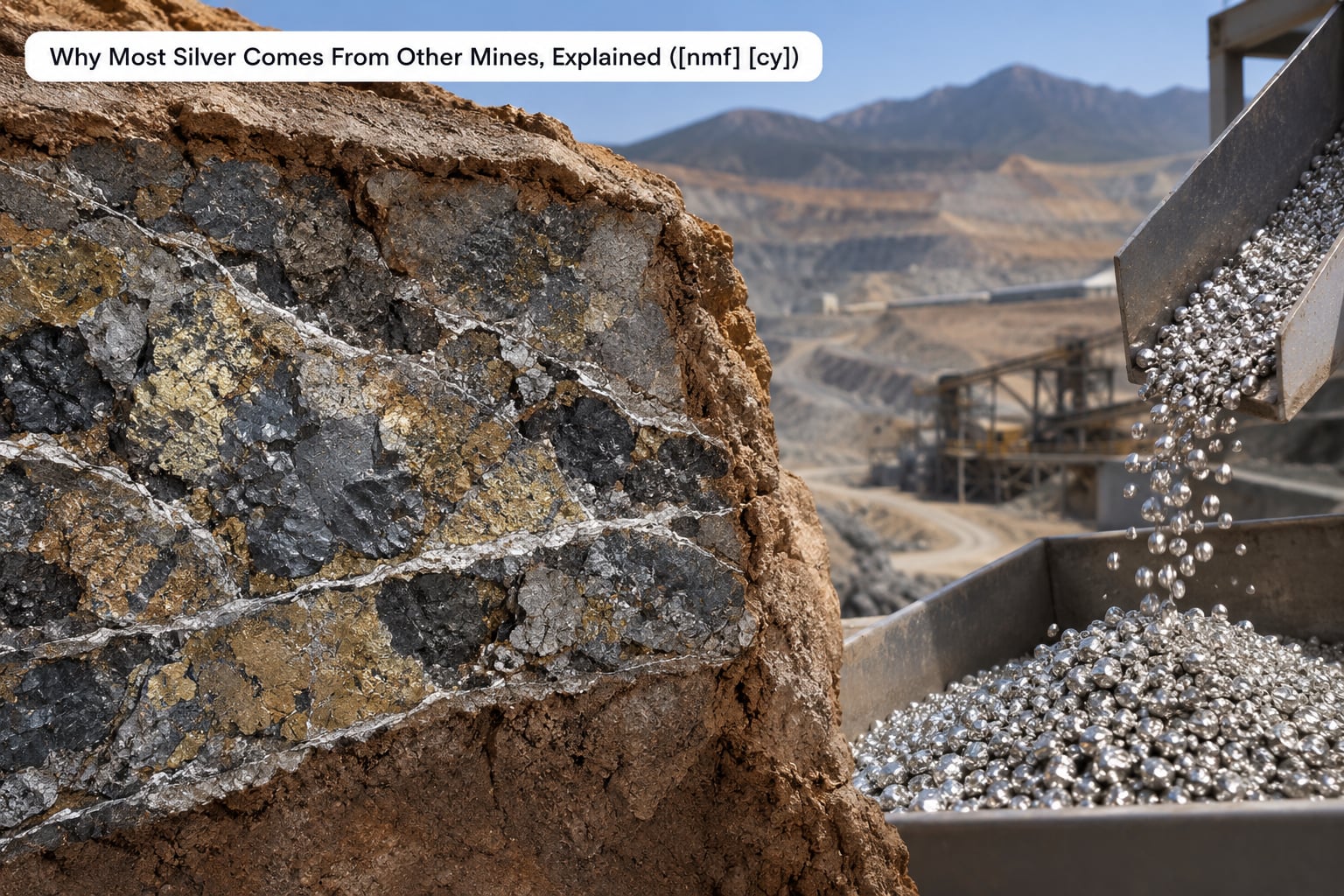
Why Most Silver Comes From Other Mines
Mining companies do not usually dig up rock hoping to find silver. They dig because the rock pays for the operation through copper, lead, zinc or gold, and the silver rides along in the same circuits at a profit nobody planned on.
Silver is a minor accessory mineral in most of those ore bodies. Reported grades in copper, lead and zinc ores commonly sit in the low single digits of grams per tonne, which is a tiny silver value for a very large pile of rock. A dedicated silver mine needs much richer material, so it can only be built where the geology is unusual.
The Silver Institute’s World Silver Survey and Metals Focus mine supply data are the standard references for the split, and both have put by-product output in roughly the same 65-70% band for years.
What Does Byproduct Silver Mean?
A by-product is a metal recovered as a bonus from an operation aimed at something else. The miner would still be mining if silver vanished entirely, which is exactly the point: the silver has no claim on the capital budget or the production decision.
A primary silver mine looks different. It is a mine chosen for its silver, financed on a silver price assumption, and it can shut in when silver disappoints. The two categories have opposite price sensitivity, and that is where the investment consequence sits.
- By-product production tracks the output decisions of copper, lead, zinc and gold miners. Those decisions follow their own metal’s price, costs and treatment charges.
- Primary production tracks the silver price far more directly, and it is the slice of supply that genuinely flexes when silver moves.
Why the by-product share stays high even at record silver prices
Because the copper mine is not standing still for silver’s benefit. Its owners optimise for copper, and they will happily keep running at a thin copper margin if zinc, lead or gold make the margin whole. Adding a small, reliable silver credit makes the mine marginally better, not marginally different.
Which Other Mines Produce the Most Silver?
Copper is the largest single source, ahead of lead and zinc combined in most years. Gold comes next, and a small tail comes from tin, nickel and polymetallic operations. The ranking shifts a little year to year with ore grades and mine performance, but the order rarely changes.
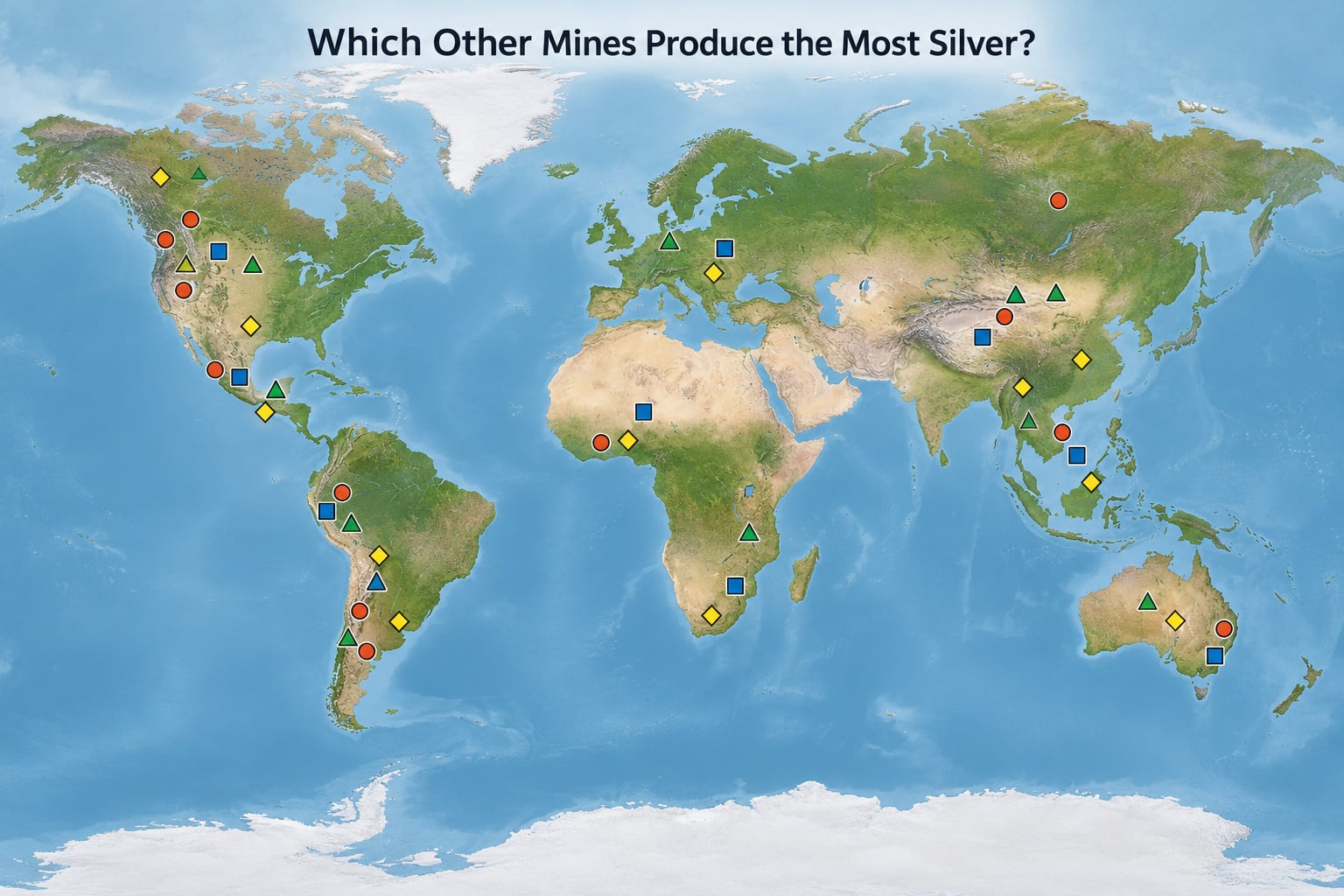
An approximate annual split looks like this, and the percentages are the important part rather than the exact ounce counts:
| Source | Share of mine supply | Typical host region |
|---|---|---|
| Copper by-product | Roughly 30% | Chile, Peru, Mexico, China, Australia |
| Lead-zinc by-product | Roughly 25-30% | Mexico, Peru, Bolivia, Australia, China |
| Gold by-product | Roughly 10% | Australia, Canada, United States, Ghana |
| Primary silver mines | Roughly 30% | Mexico, Peru, China, Bolivia |
| Other sources (tin, nickel, mixed) | Balance | Various |
Notice how much overlap there is between the last two rows and the middle rows. Mexico and Peru dominate both lists. A country can be a major silver producer and still get most of its metal from mines that are officially lead or copper operations.
For the United States, the answer surprises people. Nevada’s famous gold mines supply only a small part of US silver needs, and a majority of US silver is refined from imported concentrates, which means the metal arrives attached to copper, lead and zinc output from mines elsewhere.
How Is Silver Recovered From Other Mines?
The chain runs from ore to concentrate to smelter to refinery, and silver stays in the flow the whole way. Understanding each step explains why the silver ends up with the host metal’s miner rather than a silver specialist.
- Extraction and crushing. Run-of-mine ore is broken down so the silver-bearing minerals can be separated from waste rock.
- Grinding and flotation. The crushed ore is ground finer and agitated in water with reagents. Copper, lead, zinc and gold particles attach to bubbles and float into a froth; the silver travels with them or stays locked into whichever concentrate carries its host mineral.
- Concentrate transport. The concentrate, still around 15-30% of the original ore mass, is trucked or shipped to a smelter. Everything recovered downstream is already inside that small parcel.
- Smelting. The smelter reduces the concentrate to metal, then electrorefines it. Precious metals drop out along the way and end up as anode slime, which gets sent to a refinery.
- Refining and casting. The refinery separates silver from gold and other impurities and casts 99.9% pure bars, or dore for lower-purity output.
What payability means
Payability is the contract term that decides what the miner is paid for. A smelter normally pays for a percentage of the contained silver in a concentrate, and deducts treatment and refining charges for the processing. Those charges can be high enough that some low-silver concentrates are barely worth shipping.
This is the step most explainers skip. Silver in a copper concentrate is not revenue until a smelter accepts it, values it and settles the account, and the percentage that survives that process is the number that shows up in a miner’s revenue line.
Why Are Dedicated Silver Mines Less Common?
Four things stack up, and any one of them is usually enough to kill a silver-only project.
Grade
Primary silver orebodies need enough contained metal per tonne to cover heavy fixed costs. Rich deposits exist, but they are rare and geographically concentrated. Everything else is too dilute for a silver-only mine.
Host metal economics dominate
When a deposit carries copper, lead or zinc alongside the silver, the host metal’s price often decides whether the project gets financed. Silver becomes a bonus revenue line rather than the investment case.
Scale and capital intensity
Underground development is expensive and slow. A new silver mine discovered today typically faces roughly 15 to 18 years before first production, through exploration, resource definition, feasibility study, permitting, financing and construction. The absence of new major discoveries compounds it.
Geology
Silver frequently sits in veins and epithermeral systems alongside gold and base-metal sulphides. Those deposits rarely suit a simple silver-only processing route, so a plant has to handle a multi-metal ore or the deposit gets passed over.
| Factor | Primary silver mine | By-product producer |
|---|---|---|
| What drives the decision to mine | The silver price | Copper, lead, zinc or gold price |
| Silver share of revenue | Nearly all of it | A credit, often single-digit percentage |
| Response to a silver price spike | Strong, within months | Weak, and only via the host metal cycle |
| Closure risk when silver falls | Real | Minimal, since the mine still pays |
What Does Byproduct Production Mean for Silver Prices?
It means the silver supply curve is unusually steep. Demand can rise in a year; mine supply generally cannot, because the decision to produce the silver already happened years earlier and in a different commodity market.
Three effects follow from that structure. First, a higher silver price does not reliably summon new mine supply. Second, base-metal cycles become silver supply cycles: a copper concentrate shortfall or collapsing zinc treatment charges tighten silver supply whether or not anyone looked at silver. Third, low silver prices do not force by-product producers out, because they are not operating on silver margins.
The Silver Institute has run consecutive annual supply deficit figures for several years now, and the by-product structure is a big part of why. When a deficit persists, the balancing act happens on the demand side and in above-ground holdings rather than in the mine.
By-product credits also distort the cost picture that most readers take at face value. Because a copper or gold miner books silver as a credit against costs, some producers report net cash costs for their silver by-product near or below zero. That is not a free lunch; it is an accounting result of credits landing in the wrong line.
How Can Investors Monitor Silver Supply?
Watching the silver price tells you very little about supply. These are the things that actually carry signal.
- Mine production reports. Quarterly releases from the copper, lead, zinc and gold producers with the largest silver credits are the highest-signal documents available, because they show silver as a line item inside a bigger operation.
- Reported versus payable silver. The gap between contained metal in a concentrate and the amount a smelter actually pays for is where economics shift quietly.
- Host-metal trends. Copper mine disruptions, zinc treatment charges falling toward zero, and lead smelter shutdowns all tighten silver supply indirectly.
- Guidance revisions. When a producer trims guidance on a base metal, check whether silver guidance moved with it.
- Above-ground holdings. Exchange inventories, reported vault holdings and recycling flows tell you how much metal is already floating around and could answer a demand shock without any new mining.
- Development timelines. Track permitting and first-production dates for a handful of projects. That is how you judge whether any future supply is real.
None of this is a buy signal, and treat any source presenting it that way with suspicion. The purpose is to understand how physical supply behaves before it shows up in a price chart.
Frequently Asked Questions
Roughly 70% of annual mine supply is recovered as a by-product of copper, lead, zinc and gold mining, leaving about 30% from primary silver mines. Copper is the largest single source. The Silver Institute and Metals Focus publish the yearly breakdown, and the split has stayed in a similar band for several years despite large swings in the silver price.
Both, in a roughly 70/30 split. The by-product share comes out of ores mined for another metal, where silver is too dilute to support a silver-only operation. The 30% primary share comes from deposits rich enough in silver to be financed and built on their own economics, mostly in Mexico, Peru, China and Bolivia.
Because silver occurs at very low concentrations in copper, lead, zinc and gold ores. The contained silver value per tonne of rock is far too small to cover the cost of a dedicated mine, so the metal is recovered only when the host metal is being mined anyway. Rich silver orebodies do exist, but they are rare and geographically concentrated.
Mostly from imported concentrates refined domestically. Nevada’s gold mines contribute only a small share of US silver needs. Because the majority of mined silver travels attached to copper, lead and zinc output, US supply follows those metal markets and overseas mine performance far more closely than it follows anything happening in American silver projects.
Because most supply is decided years earlier, in other commodity markets. A copper or lead mine plans its life and capital budget around its host metal, so a silver price spike cannot add capacity quickly. Development from discovery to first production typically takes 15 to 18 years, and the remaining 30% of supply from primary mines is the only slice that responds on a normal timescale.
There is no reliable public ranking of untapped silver, because undeveloped resources are largely unproven and estimates vary widely between companies and consultants. Mexico and Peru hold the most documented primary silver resources and produce most of the world’s primary silver, but the largest future silver supply probably sits inside undeveloped copper, lead and zinc deposits in Chile, Peru, Mexico and Australia.
What to Take Away
Silver is mostly a base-metal by-product, and that is a supply story before it is a price story. The first thing to do with that knowledge is stop treating the silver price as a supply signal and start watching the production reports of copper, lead, zinc and gold miners, where the real decisions are written down.
Nothing here is investment advice, and commodity markets move for reasons that have nothing to do with geology.
Source: https://www.pgm-blog.com/why-most-silver-comes-from-other-mines/
Anyone can join.
Anyone can contribute.
Anyone can become informed about their world.
"United We Stand" Click Here To Create Your Personal Citizen Journalist Account Today, Be Sure To Invite Your Friends.
Before It’s News® is a community of individuals who report on what’s going on around them, from all around the world. Anyone can join. Anyone can contribute. Anyone can become informed about their world. "United We Stand" Click Here To Create Your Personal Citizen Journalist Account Today, Be Sure To Invite Your Friends.
LION'S MANE PRODUCT
Try Our Lion’s Mane WHOLE MIND Nootropic Blend 60 Capsules
Mushrooms are having a moment. One fabulous fungus in particular, lion’s mane, may help improve memory, depression and anxiety symptoms. They are also an excellent source of nutrients that show promise as a therapy for dementia, and other neurodegenerative diseases. If you’re living with anxiety or depression, you may be curious about all the therapy options out there — including the natural ones.Our Lion’s Mane WHOLE MIND Nootropic Blend has been formulated to utilize the potency of Lion’s mane but also include the benefits of four other Highly Beneficial Mushrooms. Synergistically, they work together to Build your health through improving cognitive function and immunity regardless of your age. Our Nootropic not only improves your Cognitive Function and Activates your Immune System, but it benefits growth of Essential Gut Flora, further enhancing your Vitality.

Our Formula includes: Lion’s Mane Mushrooms which Increase Brain Power through nerve growth, lessen anxiety, reduce depression, and improve concentration. Its an excellent adaptogen, promotes sleep and improves immunity. Shiitake Mushrooms which Fight cancer cells and infectious disease, boost the immune system, promotes brain function, and serves as a source of B vitamins. Maitake Mushrooms which regulate blood sugar levels of diabetics, reduce hypertension and boosts the immune system. Reishi Mushrooms which Fight inflammation, liver disease, fatigue, tumor growth and cancer. They Improve skin disorders and soothes digestive problems, stomach ulcers and leaky gut syndrome. Chaga Mushrooms which have anti-aging effects, boost immune function, improve stamina and athletic performance, even act as a natural aphrodisiac, fighting diabetes and improving liver function. Try Our Lion’s Mane WHOLE MIND Nootropic Blend 60 Capsules Today. Be 100% Satisfied or Receive a Full Money Back Guarantee. Order Yours Today by Following This Link.


| Visits: | 1,833,794,133 |
| Stories: | 8,714,586 |
Whistler Blowers, Insiders

