

How Pawn Shops Price Gold: Spot Rates and Fees 2026

Pawn shops price gold by testing the item’s purity, weighing it in grams, multiplying the fine gold in it by that day’s spot price, and then discounting the resulting melt value by a payout margin of roughly 40% to 70%. If you know how pawn shops price gold, you know the first three steps are fixed and only the margin is negotiable.
In plain text, the whole method is: melt value = spot price per gram multiplied by weight in grams, multiplied by the purity decimal. The offer = melt value multiplied by the shop’s payout percentage.
A few caveats before the numbers. Gold moves daily, so anything written down ages fast; the figures below are illustrations for how the math behaves, not live quotes or offers. Rates and pawn rules vary by state and change over time.
Typical Pawn Shop Gold Price Ranges
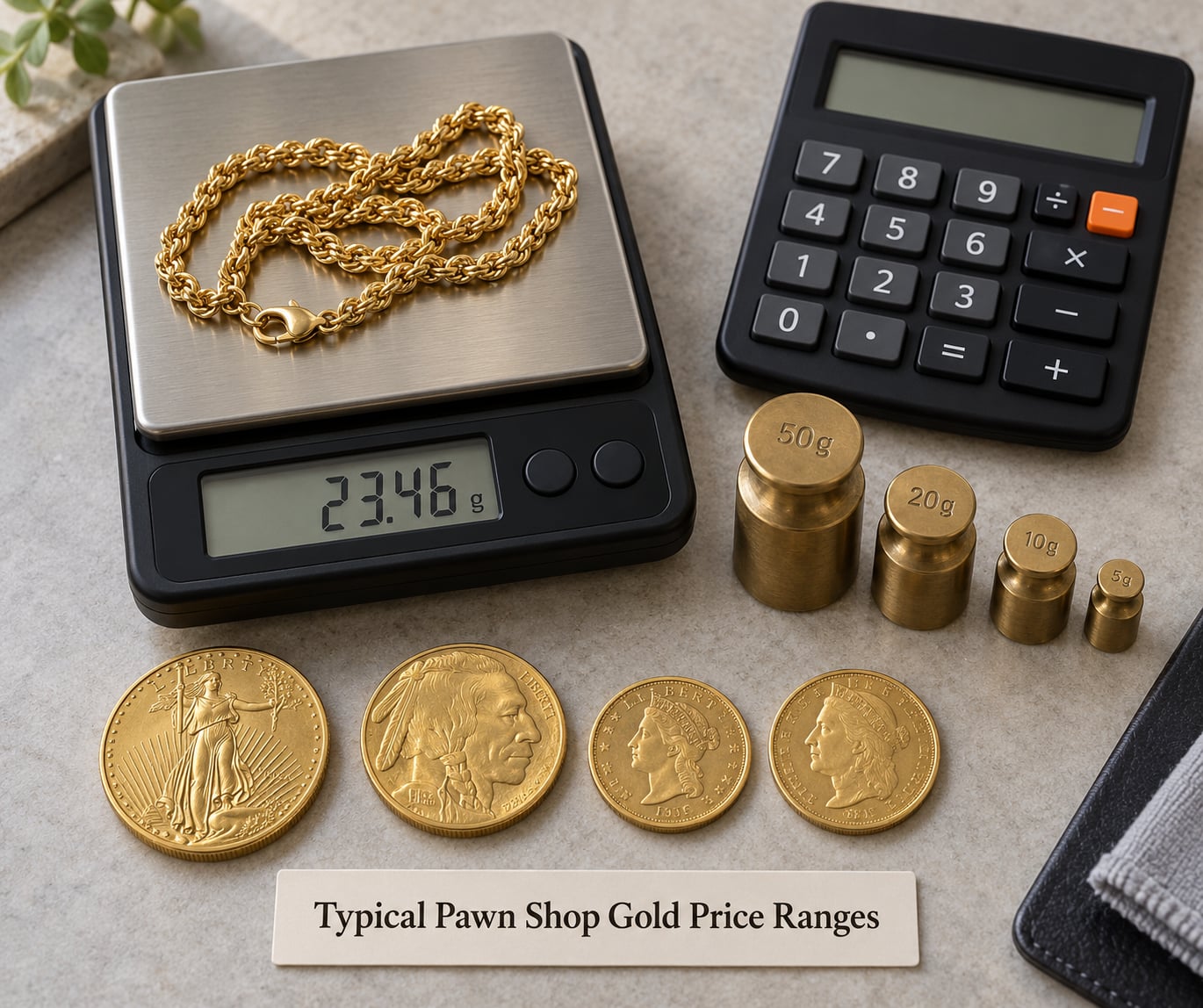
What follows are typical US ranges. Your shop may sit at the low end or well above it, and the same shop can quote differently on two different days.
The most useful benchmark is the payout percentage: how much of melt value the shop actually hands over. Published figures from pawn-industry pages cluster between 40% and 60% of market value, and other shop blogs quote 50% to 65% or 50% to 70%. Individual forum reports run from about 40% of melt at the stingy end up past 95% for a small 24K transaction.
To make those percentages concrete, take an illustrative spot price of 120 dollars per gram of pure gold. That is a round number used purely to show the arithmetic.
| Karat | Purity | Melt per gram | Offer at 45% of melt | Offer at 70% of melt |
|---|---|---|---|---|
| 10K | 41.7% | 50.04 | 22.52 | 35.03 |
| 14K | 58.5% | 70.20 | 31.59 | 49.14 |
| 18K | 75.0% | 90.00 | 40.50 | 63.00 |
| 22K | 91.6% | 109.92 | 49.46 | 76.94 |
| 24K | 99.9% | 119.88 | 53.95 | 83.92 |
Most shops quote per gram, so that table is the one to screenshot. Some older shops and coin buyers still quote per pennyweight, which is one twentieth of a troy ounce, about 1.555 grams. At the same illustrative spot price, one pennyweight of 14K works out to 109.17 in melt value before the margin is applied.
Per item, the same math gives: a 10-gram 14K chain holds 5.85 grams of fine gold, worth 702 in melt, which becomes roughly 316 to 491 offered. A one-ounce 24K bar holds 31.10 grams at 99.9% purity, about 3,730 in melt, which becomes roughly 1,679 to 2,611 offered.
Pawn shops normally pay well under retail replacement value and under what a refinery would pay for clean scrap. Many also charge interest, identification, testing or storage fees on top, which is why the headline offer and the amount you can actually walk away with are different numbers.
How Pawn Shops Price Gold by Item and Purity
The order of operations at the counter is consistent almost everywhere.
- Look for a hallmark. A stamp such as 585, 14K or 417 tells the appraiser where to start. Loose stamps are not proof, so this is a starting point rather than an answer.
- Test the piece. Most shops use an XRF analyzer for a quick non-destructive reading, and some still use an acid test on a scratch point or an electronic conductivity tester.
- Weigh it. The item goes on a calibrated scale, often in front of you, and the weight in grams gets recorded on the receipt.
- Apply the purity decimal. A 14K piece at 58.5% means 58.5% of that weight is fine gold.
- Multiply by spot. Fine grams times the day’s price per gram gives melt value.
- Apply the shop’s margin. Testing labor, counter time, overhead, restocking risk and their own resale spread come out of that number.
- Value the extras separately. Recognizable brand names, gemstones and condition can add a little, mostly on pieces a shop expects to resell rather than melt.
A worked illustration, again on 120 dollars per gram of pure gold. You bring in a chain stamped 585. The XRF reads 14K, the scale says 10.0 grams, and the shop offers 50% of melt.
Step one: 10.0 grams times 0.585 equals 5.85 grams of fine gold. Step two: 5.85 times 120 equals 702 in melt value. Step three: 702 times 0.50 equals 351 offered. Ask the same shop to quote 60% and the answer is 421.20. Nothing about the gold changed; only the margin did, and that is the conversation worth having.
What Affects the Price
Strip away the sales pitch and there are about ten inputs behind the number. Most are fixed by the metal itself. A few are not.
- Spot price. The reference the shop uses, usually a published benchmark rather than a retail bullion ask.
- Karat or fineness. The single biggest lever you control, and the one most often misread from a stamp.
- Contained pure gold. What actually matters. A heavy 10K bangle holds less fine gold than a light 18K chain of similar size.
- Item form. Scrap jewelry, bullion and coins get treated differently.
- Condition. Damaged or broken pieces still carry melt value, and most shops take them in.
- Stones and settings. A mounted diamond ring is mostly a gold loan with a stone attached. Shops generally value the metal and handle the setting separately, and the stones usually come back to you.
- Hallmarks and documentation. A clean, readable stamp and any receipts you bring make the transaction faster, but they rarely raise the payout much.
- Testing cost. Small single items often absorb it into the margin. Larger lots, mixed purity or lots needing extra sorting are where you see it charged.
- Transaction size. A single gram of 24K and a two-ounce lot can price very differently as a share of melt.
- Local demand. Shops buy low into their own resale demand and high into their need to move metal.
One more thing that trips people up: a move in spot does not produce an equal move in every offer. Shops re-price on their own schedule, quotes last minutes rather than hours, and a large lot gets a tighter margin than a single piece.
Karat and fineness stamps, converted
European fineness numbers and US karat marks mean the same thing, so this table converts between them and shows the multiplier a shop applies to your weight.
| Karat | Fineness stamp | Gold percentage | Fine gold per gram |
|---|---|---|---|
| 10K | 417 | 41.7% | 0.417 g |
| 14K | 585 | 58.5% | 0.585 g |
| 18K | 750 | 75.0% | 0.750 g |
| 22K | 916 | 91.6% | 0.916 g |
| 24K | 999 | 99.9% | 0.999 g |
That is why 18K sits much closer to melt than 10K does, and why a shop that quotes one price for a mixed lot is pricing you at the lowest purity in the bag.
How pawn shops test gold before pricing it
Three methods cover most counters. An XRF spectrometer fires X-rays at the surface and reads the alloy back, which is fast, non-destructive and the most common choice now. Acid or touchstone testing scratches a small point and reacts it against solutions, which is older, cheaper and mildly destructive. Conductivity testers pass an electrical current through the piece and infer purity from how well it conducts.
Regardless of method, ask what test was used and ask to see the reading. If a stamp and a test disagree, the test usually wins. Shops weigh in front of customers as a matter of routine, and watching the scale is a reasonable expectation rather than an unusual request.
Coins, bars and broken jewelry
Scrap jewelry is priced on metal alone, so a broken clasp costs you nothing in melt terms. Bullion bars priced close to spot at a dealer are also near pure melt math for a pawn shop, because their resale is commodity-driven.
Coins are the exception. Common bullion coins such as common-date issues trade near melt, while anything a dealer would bid up on for condition, rarity or demand gets a numismatic premium that varies by shop and by the person behind the counter. Shops take gold as it is and generally do not pay extra for a certificate or presentation case.
Selling versus pawning
These are two different products. A sale ends the transaction and the gold leaves your control. A pawn loan is a short-term secured loan against the metal, and the total you recover is the loan plus interest and charges, not the headline offer.
| Factor | Selling outright | Pawning as collateral |
|---|---|---|
| Money you receive now | The full offer, once | The offer, as a loan |
| Interest | None | Charged monthly for the life of the loan |
| Redemption window | Not applicable | Typically a few months, then the item can be sold |
| Other charges | Usually minimal | Storage, identification, testing or reporting fees |
| Get the item back? | No | Yes, if you repay in full and on time |
That last row is the whole trade. People working out how pawn shops price gold often stop at the offer and miss the redemption cost entirely, and the difference between 50% of melt as a sale and 55% as a loan over four months is not really 5%.
Ways to Save
You cannot move the spot price or change the karat. You can change everything about how the transaction is run.
- Get three written offers. Forum advice is consistent on this: never accept the first number. Even a note from each shop on paper gives you something to compare hours later.
- Ask what percentage they are paying. A shop that states a percentage of melt has already shown its math and given up room to argue about the inputs.
- Verify the posted rate. Check the spot reference the shop is using before you go in, not after.
- Bring documentation. Receipts, hallmarks, prior appraisals and inheritance paperwork speed up testing and reduce the chance of a piece being misread.
- Separate stones when it makes sense. If a ring holds a stone you care about, ask whether it can be removed first. Shops usually return stones but not mounted settings.
- Decline tests you do not need. Acid testing is destructive. If the stamp is legible and the shop can use an XRF, that is the cheaper path.
- Ask for the redemption number in writing. On a pawn loan, get the rate, the redemption deadline, the grace period and the storage fee written down before you sign.
- Compare against a refinery or dealer first. For clean, sorted, higher-karat scrap, a refiner is a real benchmark. Pawn shops win on speed and convenience more often than on price.
Red flags worth walking away from
Refusing to let you watch the scale is the big one. So is no itemized receipt, or a receipt that lists a lump sum without weight, karat and the spot reference used. Beyond that, watch for pressure to decide immediately, an unlicensed counter with no posted fee schedule, and a mixed lot priced at the lowest karat in it.
One more that catches people: hollow, plated or gold-filled pieces. A hollow chain weighs almost nothing and tests far below the stamp if the plating is worn through. Forums repeatedly report buyers who assumed a hollow item was solid. Weighing your piece at home first catches this before you walk in.
Frequently Asked Questions
Most shops pay between 40% and 70% of an item’s melt value, with published industry figures clustering nearer 40% to 60%. High-karat scrap and small clean transactions price better than mixed lots or low-karat pieces. Ask the shop to state its percentage of melt outright; a shop that will name one is usually closer to the honest end of that band.
The calculators are good at melt value, which is just spot price times purity times weight. They are not good at the payout, because each shop sets its own margin, changes it with its inventory, and may quote off a different reference price. Use a calculator to know the ceiling on an offer, not to predict what you will be handed.
Because only part of each piece is actually gold. 10K is 41.7% gold, 14K is 58.5%, and 18K is 75%. A 10-gram 14K chain contains 5.85 grams of fine gold, while the same weight of 10K contains 4.17. Pawn pricing follows the fine gold in the piece, so higher karat means a bigger payout for the same weight.
Weight alone is not the input; contained gold is. Two pieces weighing 10 grams can differ in karat, in hollow versus solid construction, in attached stones, and in how much non-gold metal is in the alloy. A shop also adjusts the margin by item type and lot size. Verify the karat and the scale reading before comparing offers on weight.
Stay at the counter and ask which test was used and to see the reading. XRF and conductivity testing are non-destructive; acid testing is not, and a piece retested by a different method can differ. If the stamp and the test disagree, you can ask for a second opinion from an independent appraiser. Document the dispute on the receipt before leaving.
For a sale, confirm the weight in grams, the karat, the spot reference price used, the payout percentage and the total. For a pawn loan, also get the interest rate, the redemption deadline, the grace period, any storage or identification fee, and the total due to get the item back. State licensing should be posted, and you are entitled to an itemized receipt.
Conclusion
Do four things before you walk in: confirm the karat from the stamp, weigh the piece yourself, check the current spot price, and compare each shop’s contained-metal payout plus every fee on top.
Keep the formula in your head rather than the percentage in your head. Spot price, purity and weight are facts. The margin is a decision, and decisions move when you have a second offer and a written number.
And if you are pawning rather than selling, the offer is only the start of the story. Interest, storage charges and the redemption deadline decide what you actually get back, which is why the ticket matters as much as the price.
Source: https://www.pgm-blog.com/how-pawn-shops-price-gold/
Anyone can join.
Anyone can contribute.
Anyone can become informed about their world.
"United We Stand" Click Here To Create Your Personal Citizen Journalist Account Today, Be Sure To Invite Your Friends.
Before It’s News® is a community of individuals who report on what’s going on around them, from all around the world. Anyone can join. Anyone can contribute. Anyone can become informed about their world. "United We Stand" Click Here To Create Your Personal Citizen Journalist Account Today, Be Sure To Invite Your Friends.
LION'S MANE PRODUCT
Try Our Lion’s Mane WHOLE MIND Nootropic Blend 60 Capsules
Mushrooms are having a moment. One fabulous fungus in particular, lion’s mane, may help improve memory, depression and anxiety symptoms. They are also an excellent source of nutrients that show promise as a therapy for dementia, and other neurodegenerative diseases. If you’re living with anxiety or depression, you may be curious about all the therapy options out there — including the natural ones.Our Lion’s Mane WHOLE MIND Nootropic Blend has been formulated to utilize the potency of Lion’s mane but also include the benefits of four other Highly Beneficial Mushrooms. Synergistically, they work together to Build your health through improving cognitive function and immunity regardless of your age. Our Nootropic not only improves your Cognitive Function and Activates your Immune System, but it benefits growth of Essential Gut Flora, further enhancing your Vitality.

Our Formula includes: Lion’s Mane Mushrooms which Increase Brain Power through nerve growth, lessen anxiety, reduce depression, and improve concentration. Its an excellent adaptogen, promotes sleep and improves immunity. Shiitake Mushrooms which Fight cancer cells and infectious disease, boost the immune system, promotes brain function, and serves as a source of B vitamins. Maitake Mushrooms which regulate blood sugar levels of diabetics, reduce hypertension and boosts the immune system. Reishi Mushrooms which Fight inflammation, liver disease, fatigue, tumor growth and cancer. They Improve skin disorders and soothes digestive problems, stomach ulcers and leaky gut syndrome. Chaga Mushrooms which have anti-aging effects, boost immune function, improve stamina and athletic performance, even act as a natural aphrodisiac, fighting diabetes and improving liver function. Try Our Lion’s Mane WHOLE MIND Nootropic Blend 60 Capsules Today. Be 100% Satisfied or Receive a Full Money Back Guarantee. Order Yours Today by Following This Link.


| Visits: | 1,833,808,941 |
| Stories: | 8,714,641 |
Whistler Blowers, Insiders

