

Safe Deposit Box vs Home Safe for Bullion: Which Wins in 2026

A safe deposit box and a home safe both keep bullion out of reach of casual hands, and they fail in completely different ways. The box trades your access and your legal claim for institutional security. The home safe trades your privacy and your house’s exposure for control. When people ask about safe deposit box vs home safe for bullion, the honest answer is that three things decide it: how much metal you hold, how fast you need to reach it, and whether an insurance policy actually covers it where it sits.
Neither option is theft-proof or disaster-proof. A box is only as good as the building it sits in, the branch that still opens its doors, and the contract the bank makes you sign. A home safe is only as good as its rating, its anchoring, and your own discipline about who knows it exists.
What follows is the comparison nobody in this space writes neutrally. Dealers selling vault storage rank boxes and home safes below their own vaults. Forums rank boxes as cheap security that is hard to beat. Both camps are describing different risk profiles, and both are right about the one they are worried about.
Safe Deposit Box vs Home Safe for Bullion at a Glance
| Criterion | Home safe | Safe deposit box |
|---|---|---|
| Theft resistance | Depends entirely on the safe rating and anchoring | Strong: controlled entry, alarms, staff, cameras, audit trail |
| Burglary exposure | Real. A break-in becomes a targeted search | Off-site, so a home burglary does not reach your metal |
| Insurance by default | Often capped or excluded by the homeowners policy | None. FDIC coverage does not apply to box contents |
| Legal claim to contents | Yours as long as you can prove ownership | Yours in practice, but governed by the lease contract |
| Access hours | Whenever you hold the key, day or night | Bank business hours, sometimes by appointment |
| Privacy | Guests, cleaners, contractors and family can see it | Contents are private to named key holders |
| Fire and water | Depends on rating and placement | Depends on the bank’s building and its own protections |
| Branch or house disruption | Fire, flood or a move affects everything at once | A merger or closure can affect access, not custody |
| Portability of the asset | Metal is yours to move whenever | Transport only during bank hours |
| Ongoing outlay | Purchase, insurance, anchoring, alarm, maintenance | Annual rent, key replacement, insurance if added |
| Best for | Smaller holdings and near-daily access | Larger holdings and low access frequency |
One more point before the detail. Anyone who tells you a safe deposit box is insured is wrong, and anyone who tells you a home safe stops burglars is overselling. The security of either arrangement comes from a stack: the institution or the hardware, plus insurance, plus your own procedures.
Physical Security and Theft Risk
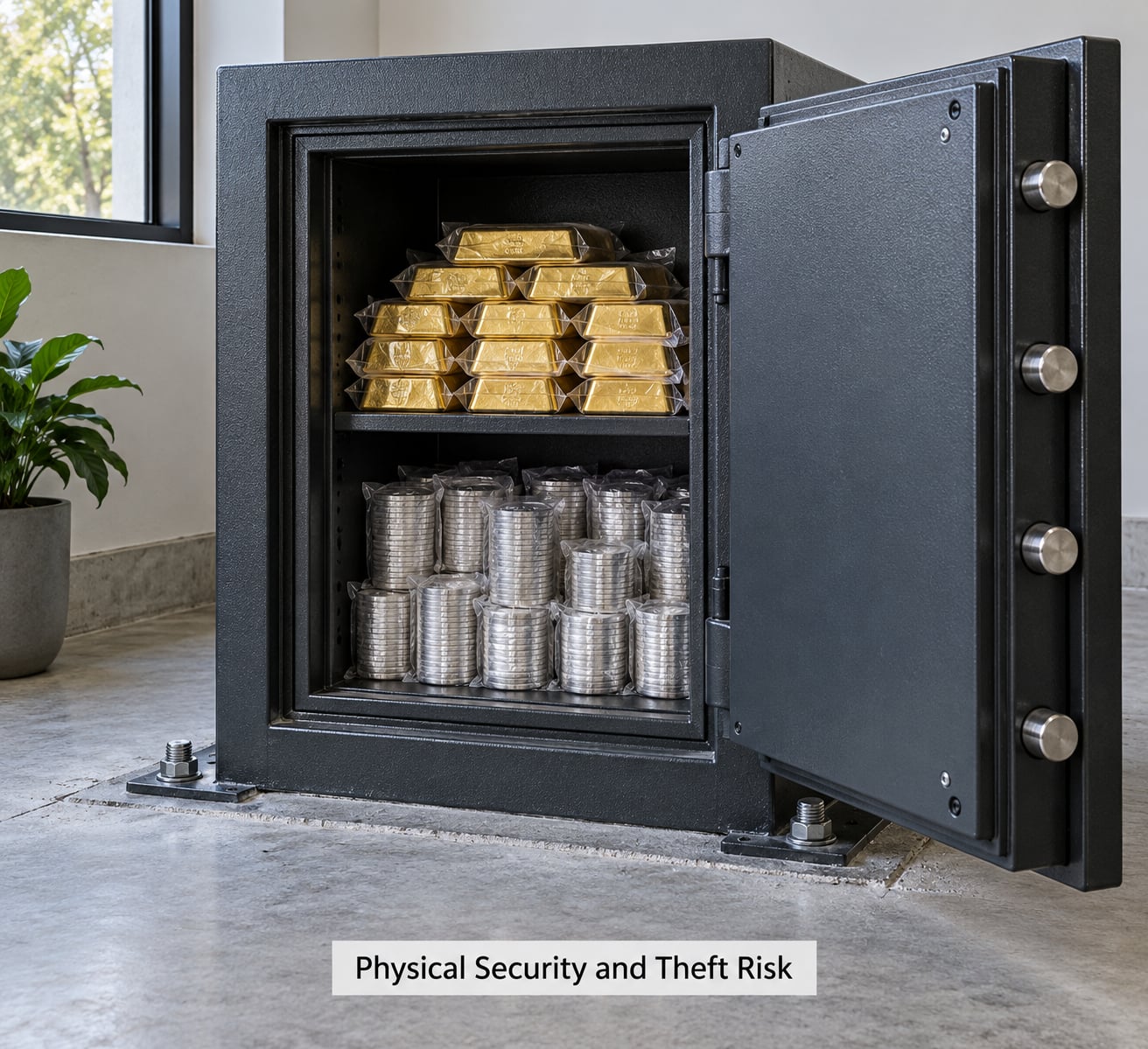
A bank vault is defended in layers: a building designed to resist entry, cameras, alarm systems tied to a monitoring company, staff who work there every day, and an audit trail of who entered and when. Your home has a door, a lock, and whoever broke through it.
That gap is the whole story. Home burglary targets valuables, and bullion is unusually good at this. It is heavy, quiet, easy to carry out in a bag, and it will not trigger a silent alarm by itself. When a burglar is inside your house, they are standing next to your safe with time and tools. An unanchored safe on a concrete floor is furniture with a door handle.
People who store metal at home generally argue the opposite way, and their point is fair: predictability is the real weakness. A safe bolted to a slab in a bedroom tells a burglar exactly where to go. Discretion and unpredictability beat hardware more often than buyers expect.
Three things decide whether a home safe holds up:
- Is it anchored? A safe that can be dragged out is a container, not a vault. Bolts into a concrete floor or a wall frame matter more than the door thickness.
- Does it have a theft-listing rating? Underwriters Laboratories issues a TL series listing for resistance to tools and attacks. A safe with no listing is a guess.
- Where is it? Basements, closets and unfrequented rooms raise the discovery cost. A bedroom safe pointed at by an alarm camera is a different proposition.
The statistical reality is sobering and it applies to both options. FBI data for 2019 recorded more than a billion dollars in jewelry and precious metals stolen in the United States, with only about 3.5 percent recovered. Recovery in bullion theft is rarely better than that, because melted-down metal is untraceable.
Forum readers tend to converge here. Users on r/Safes give specific, unglamorous advice: a serious safe bolted to a concrete floor, an alarm, cameras, and a fire-rated door. Users on r/Wallstreetsilver describe boxes as low-cost security that is hard to beat, provided you accept the access limits and the bank’s total lack of liability. Both descriptions match what the evidence supports.
Insurance and Liability
This is the section that changes outcomes after a loss, and it is the one most storage guides skip. The gap between the two options is not subtle.
Start with the myth. Safe deposit boxes are not insured by the FDIC. The FDIC’s coverage applies to deposits, and its limit applies per depositor per insured bank. Box contents sit outside that entirely. There is no federal statute governing safe deposit boxes at all, which is the detail that surprises people most often when they read the contract their bank made them sign.
What the contract usually says is that the bank has no liability for the contents. Users on r/povertyfinance and r/UKPersonalFinance describe reading a Wells Fargo box agreement and finding it expressly not designed to protect against water, fire, explosives or theft. The recurring comment is variations of the same surprise: I had no idea.
On the home side, homeowners and renters policies commonly either cap precious metals at a low figure or exclude bullion entirely. Many policies schedule jewelry and precious metals as separate, limited, sometimes appraised-at-schedule-value coverage. Without a rider or a separate policy, a total loss of stored metal can be an almost total financial loss.
Here is the part that surprises collectors. Precious metals are fungible and nearly untraceable once stolen, which is why the theft insurance market prices metal much less favorably than cash or a diamond ring with paperwork. That is also why insurers ask about mysterious disappearance coverage, the provision that pays when an item simply cannot be located and no crime is provable.
What actually works, whichever option you pick:
- Ask the insurer in writing whether bullion in a home safe is covered, and for how much. A phone answer is not a coverage confirmation.
- Check whether the policy needs precious metals listed by description rather than lumped into a contents total.
- Look for all-risk or scheduled coverage that does not depend on a police report for a no-sighting loss.
- Keep the purchase receipt, the assay or certificate, dated photographs, and a serial number list off-site so you can prove ownership and value after a fire.
- If you use a box, buy the coverage as a standalone policy in your own name. The bank is not writing it for you and does not offer it.
Coverage rules, limits and exclusions vary by jurisdiction and by provider. Confirm yours before you buy, not after.
Privacy, Ownership Records, and Access
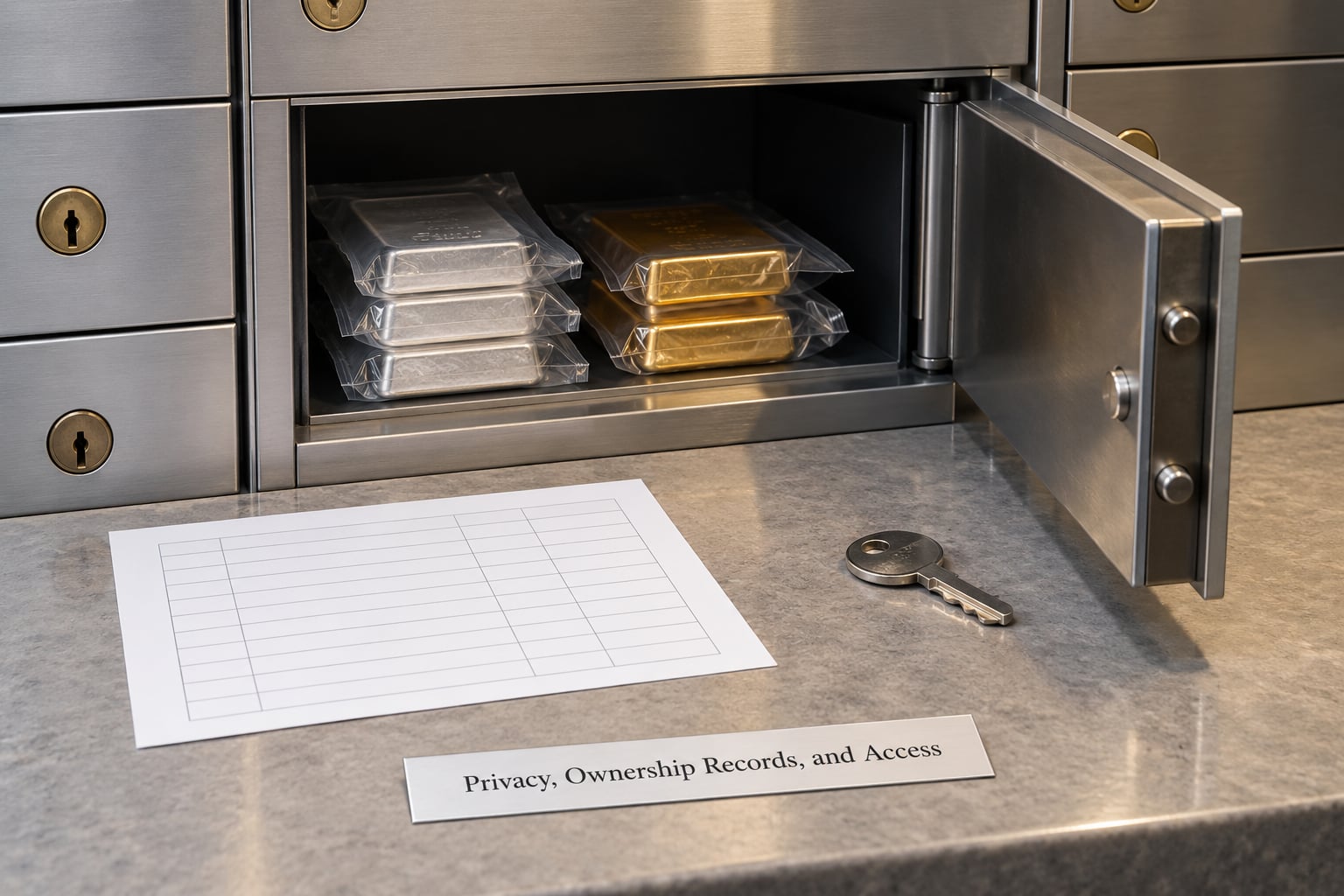
Privacy is the axis on which the two options diverge most sharply, and it usually gets treated as a footnote. It is not a footnote. At home, your exposure is the people who walk through your house: a contractor, a cleaner, a relative, a houseguest, an estate agent. One person notices a safe, connects the dots, and the information moves from there without your knowledge. The Royal Mint’s own guidance, cited by bullion dealers, is simply to tell as few people as possible where the stash is.
A deposit box narrows that list to key holders. Most banks require two keys for access and will not release one without both, plus identification. That is a genuine control, and it also creates a specific problem: if a key holder dies or loses capacity, the access question gets complicated fast.
Then there is the branch. Boxes are a branch product, and branches close. When a bank sells a location or merges, your box typically moves with the portfolio and your access follows, sometimes with a new agreement and a new fee. The harder scenario is a bank winding down box services entirely, which leaves you a window to empty the box and a decision about where the metal goes next.
Bankers who have stopped offering boxes point to low-margin ancillary revenue, vault space they would rather use for something else, branch consolidation, and customers who increasingly do everything online. In parts of the United Kingdom and Europe, box availability is limited or gone altogether, so if you are outside the US, confirm availability before you plan around it. The Reddit and Quora threads on this question are full of people who assumed a box would always be there.
Documentation is where a home safe wins and a box ties. You control the inventory, the photographs, and the receipts at home. In a box, you should still keep a copy of everything off-site, because the metal itself is not proof of anything after a fire. Either way, an inventory list that nobody else can read is a liability if it lives in the same room.
Estate planning deserves one more line. For heirs, a home safe in a wall is simpler than a box held by a bank that may have been sold twice. A trustee, executor, or named successor with clear access beats a locked vault and a corporate contract.
Fire, Water, and Disaster Protection
A home safe is only as disaster-resistant as the building holding it. House fires, flooding, hurricanes, and earthquakes all threaten the same metal that the safe was meant to protect, and a safe installed in a basement in a flood zone is a waterproof box full of water.
Fire rating is the number that matters for metals. Underwriters Laboratories rates fire safes by the minutes they hold interior temperature below a threshold, so a rating of 30 or 60 minutes tells you how long contents survive a house fire. Gold bars barely care; silver coins have a lower melting point and care a great deal. If you hold rounds and coins rather than bars, buy the longer rating.
Water resistance is a separate specification from fire rating, and buyers often skip it. Look for a gasket or seal around the door rather than a safe that is simply heavy steel. Placement matters as much as the box: off concrete floors in flood-prone basements, away from exterior walls, and high enough that a burst pipe or a stack of runoff does not reach it.
A safe deposit box takes your metal out of your house entirely, which is a real disaster advantage. Prepping forums value boxes for exactly that reason, as off-site backup when the house burns or floods. The catch is the bank building carries the same exposure your house does, plus the bank’s own construction, sprinkler systems, and maintenance, which are usually better than yours.
Whatever you choose, keep the record off-site: photos, serials, certificates, and a copy of your policy. A metal-free insurance claim is still a claim you can win, and a metal-full one often is not.
Cost, Convenience, and Holding Size
Cost comparisons for this topic are usually adjectives. Home safes are described as expensive, boxes as cheap. Prices change constantly and vary by region, so ask a local bank and a local safe dealer for current figures rather than trusting any figure you read online, including ours. What follows is the shape of the outlay, not the numbers.
| Cost element | Home safe | Safe deposit box |
|---|---|---|
| Upfront | Safe purchase, plus anchoring hardware and possible floor work | Key deposit and first year of rent |
| Recurring | Insurance rider, alarm monitoring, safe service visits | Annual rent by box size, extra key replacement |
| Hidden | Space, weight, and moving it if you relocate | Travel to the branch and time away from work |
| Hidden risk | Underinsurance is the expensive part | No coverage at all unless you buy it yourself |
| Exit cost | You own it and can sell it | You rent it and it leaves with the bank |
The box is cheaper to start and has almost no maintenance. The home safe costs more up front, then stops costing anything except the insurance rider and an occasional service.
Capacity is the question nobody answers, so here is a practical frame rather than a precise chart. Small bank boxes suit a few ounces of gold or a modest stack of silver rounds, and they fill up fast with tube and slab packaging. Large boxes and safe-deposit safes exist in bigger banks for institutional and estate clients, and availability varies widely. Home safes are sized by interior cubic volume and shelf layout, and bulky packaging eats capacity quickly.
A second point on weight. Gold is heavy. A small collection of ounces and coins gets dense fast, and a safe that weighs several hundred pounds has to be planned around, not dropped into a spare closet. Plan the floor load and the route to the room before you buy, not after.
Holdings above roughly the size where a loss would genuinely hurt your finances start to argue for more than one location. Splitting metal across a box and a home safe is risk diversification, not indecision: you stop being one burglary or one branch closure away from losing everything.
How to Choose for Your Bullion
Work through these in order and the answer usually becomes obvious.
- How much do you hold, and what does it weigh? Small holdings that you want to move often argue for home. Anything you would not want to carry to a branch during banking hours argues for a box or insured vault.
- How fast do you need access? If liquidity matters in a week, a box that opens Monday to Friday is a real constraint. This is why many stackers keep a small working position at home and the long-term position elsewhere.
- Does your insurance actually cover it? Get the answer in writing before the purchase. No coverage means the security question is much more important than it was a paragraph ago.
- What is your local crime and hazard profile? Break-in rates, flood zones, wildfire risk, and earthquake exposure all change the answer. A safe in a coastal flood zone is a poor home for metal.
- Who will inherit this? A home safe is easier for family and executors. A box needs a named plan or an authorized signer.
- What is your real budget? A cheap furniture safe holding serious value is worse than no safe, because it creates confidence without delivering it.
Before signing a box agreement, read it. Look for the liability waiver, any right the bank claims to enter the box, whether access requires an appointment, what happens to contents if the bank merges or closes, and any cap on what the bank will pay if it is at fault. Ask the branch what the policy is when the branch is sold.
Before buying a safe, check four things: the UL fire rating in minutes, whether it carries a TL theft listing, the interior dimensions against your actual packaging, and whether it is being anchored to structure. Weight alone is not a security feature; a 300-pound safe that slides across a garage floor is a cardboard box with a handle.
Which Should You Choose?
Choose a safe deposit box when you are holding a larger position, you rarely need to move metal, your local bank has a branch that is not on a closure list, and you have bought or will buy your own coverage. It wins decisively on theft resistance and discretion, and it keeps the metal out of your house during a burglary. Its weakness is access, and its hidden risk is that the bank relationship that holds your metal can change hands without much warning.
Choose a home safe when you hold a smaller or mid-sized position, you want access on your own schedule, you can anchor it properly, you can conceal it credibly, and you can get an insurance rider that actually names bullion. It wins on control, liquidity, and estate simplicity. Its weakness is that the risk sits inside your walls, where guests, contractors, and burglars all arrive.
If your position is large enough that a total loss would change your plans, stop trying to pick one winner and split it. Two locations, two insurance policies, two access arrangements. No single burglary, flood, or branch closure takes the whole holding.
Safe Deposit Box vs Home Safe for Bullion: Long-Term Storage
Storage decisions that work for a year rarely work for a decade, because the world around them moves. On the box side, the branch holding it may consolidate, the bank may raise the fee, or the box service may be discontinued, and you will get a window to move rather than a warning. On the home side, the risks accumulate quietly: a new contractor sees the safe, a renovation exposes the bolt-down, a policy renewal quietly drops the precious metals rider, or you move and the anchoring no longer means anything.
That is why the long-term question is not which container is stronger. It is whether the arrangement still matches your life. A move across state lines can invalidate local availability assumptions. A change in family circumstances changes who needs access. A change in holdings changes whether a small box is still enough or a safe is now worth the floor space. A change in your own habits changes the privacy exposure more than any lock ever will.
Set a calendar reminder to revisit the arrangement. Re-read the lease, confirm the branch is still open, re-read the insurance declarations page to check the metal rider is still listed, and confirm your off-site records are current. Where the safe deposit box vs home safe for bullion question really bites is not at purchase time but at the third year, when nobody has looked at either.
If the holdings have grown, treat that as a new decision rather than an automatic upgrade. Moving from a home safe to a box at the moment your position grows is a sensible response to a change in access needs and local risk, not a failure of the first choice.
Frequently Asked Questions
Neither is categorically better. A safe deposit box resists theft and keeps metal out of your house, but you lose weekend access and the bank carries no liability for contents. A home safe gives you daily control but puts the target inside your walls. Most holders decide on holding size, access frequency, and insurance rather than on hardware.
No. FDIC coverage applies to deposits, not to box contents, and no federal law governs safe deposit boxes. The rental agreement you sign normally makes the bank free of liability for what is inside. Treat coverage as something you buy yourself, in your own name, and confirm the limit and exclusions with the insurer in writing before you store anything.
A small box comfortably holds a few ounces of gold or a modest stack of silver rounds, and it fills quickly once tubes, slabs, and capsules are counted. Larger boxes exist but availability is patchy and often limited to business customers. Plan on interior volume rather than weight, because packaging consumes a surprising share of the space.
Yes. Graded and certified coins lose value fast from fingerprints, oils, and scratches, so keep them in capsules, holders, and slabs, and never handle a graded coin bare-handed. For bullion rounds, leave them sealed and store them in a non-PVC tube or flip if the mint recommends it. Keep a written inventory so you can identify what is missing.
If you lose box access, contact the branch first and check the agreement for who is authorized, because a second key holder or an estate representative is often required. If your home is damaged, photograph everything before cleanup, then file the claim and supply the receipts, certificates, and inventory kept off-site. Coverage and deadlines vary, so report promptly.
Conclusion
Start with three checks. Get current box fees and rules from a local bank, including what happens to your box if that branch closes. Get a current quote for a properly rated, anchored home safe. Then ask an insurer, in writing, what it will actually pay for bullion in each location.
Only after those three answers exist does the choice make sense. If the numbers are close, decide on access and privacy: a box for metal you will rarely touch, a home safe for metal you need on your own schedule.
For anyone weighing safe deposit box vs home safe for bullion, the best option is not the more secure container. It is the arrangement whose security, insurance, access, and custody match your actual circumstances, revisited when those circumstances change.
Source: https://www.pgm-blog.com/safe-deposit-box-vs-home-safe-for-bullion/
Anyone can join.
Anyone can contribute.
Anyone can become informed about their world.
"United We Stand" Click Here To Create Your Personal Citizen Journalist Account Today, Be Sure To Invite Your Friends.
Before It’s News® is a community of individuals who report on what’s going on around them, from all around the world. Anyone can join. Anyone can contribute. Anyone can become informed about their world. "United We Stand" Click Here To Create Your Personal Citizen Journalist Account Today, Be Sure To Invite Your Friends.
LION'S MANE PRODUCT
Try Our Lion’s Mane WHOLE MIND Nootropic Blend 60 Capsules
Mushrooms are having a moment. One fabulous fungus in particular, lion’s mane, may help improve memory, depression and anxiety symptoms. They are also an excellent source of nutrients that show promise as a therapy for dementia, and other neurodegenerative diseases. If you’re living with anxiety or depression, you may be curious about all the therapy options out there — including the natural ones.Our Lion’s Mane WHOLE MIND Nootropic Blend has been formulated to utilize the potency of Lion’s mane but also include the benefits of four other Highly Beneficial Mushrooms. Synergistically, they work together to Build your health through improving cognitive function and immunity regardless of your age. Our Nootropic not only improves your Cognitive Function and Activates your Immune System, but it benefits growth of Essential Gut Flora, further enhancing your Vitality.

Our Formula includes: Lion’s Mane Mushrooms which Increase Brain Power through nerve growth, lessen anxiety, reduce depression, and improve concentration. Its an excellent adaptogen, promotes sleep and improves immunity. Shiitake Mushrooms which Fight cancer cells and infectious disease, boost the immune system, promotes brain function, and serves as a source of B vitamins. Maitake Mushrooms which regulate blood sugar levels of diabetics, reduce hypertension and boosts the immune system. Reishi Mushrooms which Fight inflammation, liver disease, fatigue, tumor growth and cancer. They Improve skin disorders and soothes digestive problems, stomach ulcers and leaky gut syndrome. Chaga Mushrooms which have anti-aging effects, boost immune function, improve stamina and athletic performance, even act as a natural aphrodisiac, fighting diabetes and improving liver function. Try Our Lion’s Mane WHOLE MIND Nootropic Blend 60 Capsules Today. Be 100% Satisfied or Receive a Full Money Back Guarantee. Order Yours Today by Following This Link.


| Visits: | 1,833,808,941 |
| Stories: | 8,714,641 |
Whistler Blowers, Insiders

