

How to Spot Fake Gold Bars in 2026: 8 Proven Checks That Work

Knowing how to spot fake gold bars comes down to three checks: verify the stamped weight against a 0.01 g scale, confirm the refiner and serial against the assay card, and measure the bar’s dimensions against the manufacturer’s published specs. Those three catch the large majority of counterfeits before you pay. None of them is proof on its own, which is why the professional tests at the end of this guide matter as much as the home ones.
Counterfeit bullion is invisible to the naked eye. The bar in your hand has the right logo, the right fineness stamp, the right weight on paper, and it still might be brass with a gold plating or a gold shell around a tungsten core.
Before you get into the sequence, one number does most of the explaining. Gold has a density of about 19.32 g/cm³. Brass sits near 8.4 to 8.7, copper at 8.96, silver at 10.5, lead at 11.3. A base metal bar simply cannot be made the right weight at the right size. That physical limit is what makes most fakes easy to catch, and it is also what counterfeiters work around when they use tungsten, which comes in at roughly 19.25 g/cm³ and looks like gold on every surface test.
Here is the order I would use: documentation and seller first, then physical checks, then density, then a professional instrument or assay. Stop as soon as you have a clean result from an independent source, because every test you run after that is mostly for your own peace of mind.
What You Need
Most of the useful tests are cheap. The expensive part is professional authentication, and you only need it when the cheap tests leave a question open.
- A digital scale reading to 0.01 g. Kitchen scales and postage scales are not accurate enough. A 10 g bar that is 9.96 g is a problem, and you will never see that on a scale with 1 g steps.
- Digital calipers. For measuring length, width and thickness to a tenth of a millimetre or better.
- A strong neodymium magnet. For the screening check in step four. A fridge magnet is too weak to be meaningful.
- The manufacturer’s published specifications for that exact bar: stamped weight, dimensions, and the fineness and serial format used by that refiner.
- A printed or on-screen copy of the assay card so you can compare serial, weight and refiner in one view.
- A nonporous testing surface and clean white cotton gloves, so fingerprints and oils do not cloud your view of the finish.
- A graduated cylinder or a small container of water if you intend to run a water-displacement density check.
- Access to an assay office, a mint, a refiner, or a bullion dealer that offers XRF or ultrasonic testing. For inherited bullion or any purchase over a few thousand dollars, this is not optional.
One thing to have open on your phone or laptop: the refiner’s own page. Serial formats and security marks change between series, and the official source is the only reliable answer.
Step-by-Step: How to Spot Fake Gold Bars
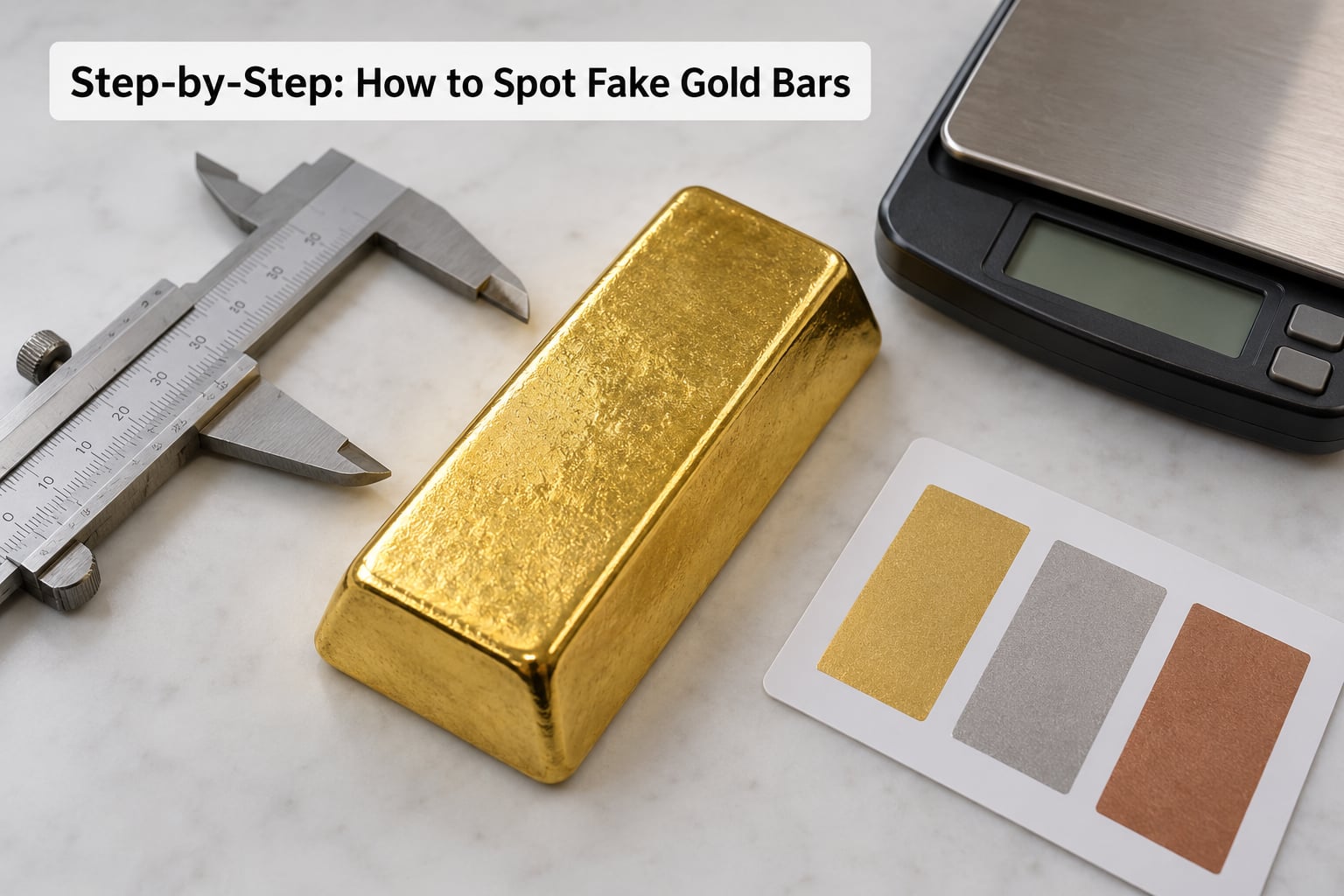
1. Verify the seller, refiner, and serial number before you touch the bar
Start with provenance, because it is the cheapest check and the most decisive. A bar from an established dealer or refinery with a matching serial number is very hard to argue with. A bar from an auction listing with no company history is a different conversation entirely, no matter how convincing the photographs look.
Ask the seller three things before you meet: which refiner minted the bar, what the serial format should look like for that series, and will they authenticate the piece in person before payment. Any hesitation on the third question is an answer.
Then check the refiner’s own records. Most refiners publish serial ranges and packaging details, and a serial that falls outside what that refiner ever issued is a hard stop. Buyers on bullion forums have reported packaging so convincing, down to the serial format, that only checking seal edges under good light for a heat re-seal told the truth.
2. Check the bar’s dimensions and weight
This is the single most useful check a buyer can run at home, because it is objective and takes under a minute. Weigh the bar, measure it, and compare both against the manufacturer’s published figures.
One troy ounce is 31.1 grams. That is the number most people get wrong, because the avoirdupois ounce everyone else uses is 28.35 g. A bar stamped one troy ounce that weighs 30 g is not a rounding issue, it is a different bar.
Here are the stamped weights worth memorising for the most common sizes:
| Bar size | Stamped weight | What a correct reading looks like |
|---|---|---|
| 1 g | 1.00 g | 1.00 g or just over, never under |
| 5 g | 5.00 g | 5.00 g, small bars often carry slight positive tolerance |
| 10 g | 10.00 g | 10.00 g, a hair under is a red flag |
| 1 troy oz | 1 oz | 31.10 g plus a small positive tolerance |
| 50 g | 50.00 g | 50.00 g |
| 100 g | 100.00 g | 100.00 g |
| 500 g | 500.00 g | 500.00 g |
| 1 kg | 1000.00 g | 1000.00 g |
Weight alone will not settle the question, though. A counterfeiter simply adds metal until the scale reads correctly, which is why the dimensions matter as much. A genuine 250 g bar is denser than a fake of the same printed weight, so the genuine one is slightly smaller. Documented examples sit around 250.01 g for the certified bar against roughly 249.75 g for a tungsten-filled copy of the same nominal size, with the size difference showing up under calipers.
Measure at three points on the length and two across the width, because a bar can be planed down in one spot to disguise the total. Finish variation is normal: cast bars look slightly softer-edged than minted ones, so do not read a surface difference as a fake on its own.
3. Look for consistent hallmarks and surface details
Read every stamp and check that they agree with each other and with the assay card. On a bar you should find a refiner mark, a fineness stamp, a weight stamp, and usually a serial number. If the fineness says .9999 but the weight stamp does not match the scale, stop there.
Hallmarks lie more often than they fail to match. Fine lettering should have crisp edges and consistent depth, and reeded, milled, or plain edges should be uniform around the whole bar. Blurred lettering, a stamped font that sits slightly proud of the surface, or one face that is more worn than its opposite suggests a transfer die or a cast copy.
The stamp values themselves are worth decoding, because “gold” covers a wide range:
| Stamp | What it means | Notes for buyers |
|---|---|---|
| 999 / .999 / 9999 | Fine gold, investment grade | The standard on investment bars |
| 916 | 22 karat, 91.6% gold | Common on sovereigns and some bars, so a 916 stamp is not a warning on its own |
| 750 | 18 karat, 75% gold | Jewellery grade, not bullion |
| 585 | 14 karat, 58.5% gold | Jewellery grade |
| 417 / 416 | 10 karat, about 41.7% gold | Jewellery grade, well under 50%, so the bar is not bullion |
| GP, GEP, GCF | Gold plated, gold filled, gold clad | A plated surface over another metal, worth only the base |
| RGP, HGE, 925 | Rolled gold, hard gold electroplate, sterling | Not gold bars in any sense |
None of this proves authenticity on its own. Copper, tungsten and brass can all be stamped convincingly, and counterfeiters copy hallmark designs directly from real bars. Treat marks as confirmation that must agree with your measurements, not as a substitute for them.
4. Test whether the piece is magnetic
Genuine pure gold is weakly diamagnetic and will not cling to a magnet. Bring a neodymium magnet close to several faces of the bar and watch for a pull.
Here is the honest limit of this test: it only rules out magnetic fakes. Copper, brass, silver and non-magnetic stainless alloys are not attracted either, and a tungsten core is not magnetic in the way a casual test can see. So a bar that stays off your magnet has told you it is probably not steel or nickel, and essentially nothing else.
Dealers who work with the public are consistent about this point, and it comes up repeatedly in collector discussions: a magnet test should never be presented to anyone as proof of authenticity. It is a thirty-second screen, nothing more.
5. Use density as a practical screening test
Density is what separates gold from almost every other metal, and it is still a screening test rather than a purity test. Gold comes in at about 19.32 g/cm³ against 1.0 for water at room temperature, so an authentic bar should return close to that figure.
To check by water displacement, measure the bar’s length, width and height with calipers, compute the volume in cubic centimetres, then divide the weight in grams by that volume. A figure near 17 to 19.3 tells you the piece is in the right family. A figure near 9 or 10 means you are holding a copper alloy, whatever the stamp says.
Where a container allows it, weigh the bar in air, then submerge it fully and weigh again. The difference, divided by the water’s density, gives you volume, and weight over volume gives you specific gravity directly. Keep the bar away from the scale’s calibration weight and make sure it does not touch the sides, since air bubbles and contact will both skew the reading.
The weakness here matters. A hollow bar, a plated bar and an irregularly cast counterfeit can all produce a plausible density without being solid gold, and small retail bars are hard to submerge without losing them. Use density to rule things out, never to confirm.
6. Check for tungsten, plating, and other substitutions
Once the cheap checks come back clean, the question is what the bar is made of underneath, and that is where most convincing counterfeits live.
Tungsten is the substitution to know about. At 19.25 g/cm³ it is within a hair of gold’s density, so it passes weight and density checks, and it is not attracted to a magnet, so it passes that too. The tells are small and physical rather than chemical:
- Round spots on the bar’s sides. These are drill holes filled with tungsten and re-soldered shut. Look for a circular outline, a slightly proud or slightly recessed patch, or a seam line that does not run the way a casting line would.
- Broken or interrupted surface texture. Solder has a different grain and colour than the surrounding gold, so the patch often shows under raking light even when it looks fine overhead.
- Edges that are very slightly wrong. Filling changes the internal volume, so a tungsten bar at a correct weight is usually a fraction larger than a genuine one.
- Sound that is too bright. Solid gold carries sound at roughly 3240 m/s, while a tungsten-cored bar measures near 5180 m/s. A ring from a genuine bar is noticeably duller and shorter. This is a coarse screening tool, not a verdict.
Gold-plated bars are a simpler fraud and easier to catch: the volume is wrong, the density reads low, the edges and drilled corners show base metal, and a filed area or a worn corner gives the plating away. Brass cores are the same story. Fake denominations, false serial numbers and counterfeit assay cards are separate problems that a weight check will never solve, because the metal is real gold and only the paperwork lies.
Fool’s gold, pyrite, deserves a mention only because it comes up constantly in searches. Pyrite is brass-coloured and brittle, and it fizzes in acid, so nobody has ever mistaken it for bullion. It is worth knowing so you can dismiss it quickly.
7. Use non-destructive professional testing when home checks can’t spot fake gold bars
Three instruments do the work that home testing cannot, and all three leave the bar intact and saleable.
X-ray fluorescence (XRF) reads the elemental composition of the surface and, with a good unit, penetrates far enough to be meaningful. It reports the gold content and, critically, what else is in there, which is exactly what catches a plated shell or a brass core. Handheld units vary a lot in depth, so treat a shallow-surface reading as a screen rather than a full assay.
Ultrasonic and acoustic testing sends a sound pulse through the bar and measures how it travels. A solid gold bar returns a distinct velocity and impedance signature; a bar with a tungsten plug, an internal void, or a re-soldered seam returns something different. This is the test that catches tungsten cores with real confidence, and it is why conductivity and acoustic instruments, not magnets, are what experienced buyers recommend for bullion.
Electrical conductivity testing relies on gold sitting at an electrical conductivity of about 44.7 MS/m, distinct from every common substitute. Bench instruments that measure this directly are inexpensive compared with XRF and are a sensible home investment if you buy bullion regularly.
Interpret any single instrument result in context. A reading that is right at the surface on a large bar tells you less than the same reading on a small one, and no screening instrument replaces a laboratory assay when the money involved is serious.
8. Get an independent assay or authenticity opinion
This is the step that ends the argument. Fire assay remains the reference method: the sample is dissolved and the gold is measured. It is destructive, which is why it is a last resort and why it belongs with a professional rather than on your kitchen table with a file.
Send the piece to a reputable assayer, a mint, a refiner, or an established bullion dealer, and get a written opinion. Expect to pay a modest fee for a screening and rather more for a full assay, and expect turnaround measured in days rather than hours. If the bar is worth enough that the fee stings, that is precisely the bar worth testing.
Three situations make this non-negotiable: the documentation is incomplete or the serial does not match the card, the seller is unknown or refuses independent verification, or you plan to resell. Dealers will not buy a suspect bar, so the discovery at resale rather than at purchase is the expensive way to find out.
Common Mistakes
Almost every costly mistake here is a shortcut that feels reasonable in the moment.
Judging by colour. Brass, bronze and pyrite are close enough in tone under a shop light to fool anyone. Colour has no evidential value for bullion.
Trusting weight on its own. Metal can be added until the scale agrees. Weight plus dimensions together is a real check; weight alone is not.
Treating a magnet result as an answer. The magnet only rules out magnetic fakes, and that is a small corner of the problem. If a test cannot fail on most counterfeits, passing it means very little.
Running acid tests without experience. Nitric acid is a corrosive chemical and it destroys the surface it touches, wiping out the evidence and the resale value at the same time. Leave it to a professional, and never recommend a bite test to anyone.
Scratching, filing or drilling to check. Each one is permanent. There is no home test that justifies damaging a bar you might later sell, and drilling to be certain means you have already made the decision.
Paying without an invoice. Buy with a written receipt that records the refiner, serial number, weight and the condition of the packaging. Without that record, proving fraud afterwards becomes close to impossible.
Accepting the seller’s verification instead of your own. A refiner name on an invoice is a claim, not a check. Confirm the serial against the refiner’s own published records, because that step takes two minutes.
Opening a sealed bar without thinking it through. Breaking tamper-evident packaging to test a bar can reduce what a dealer will pay for it, and non-standard bars can be remelted and re-struck, which typically costs the holder a double-digit percentage of the metal’s value. Test what you can from outside the package first, and get a professional to open it if it comes to that.
The protocol that avoids all of this is simple: view and test in the seller’s presence, before payment; record the serial on your receipt; decline the sale if independent authentication is refused.
Frequently Asked Questions
For bullion, the fastest reliable screen is weight and dimensions together: weigh the bar on a scale reading to 0.01 g and measure it with calipers, then compare both against the refiner’s published specifications. One troy ounce is 31.1 g, not 28.35 g. Follow with a hallmark and serial check against the assay card, and a magnet test to rule out magnetic fakes. None of these proves authenticity on its own, so anything high value goes to a professional for XRF, ultrasonic or assay testing.
Real gold feels strikingly heavy for its size, because its density is about 19.32 g/cmu0026sup3; against roughly 8.9 for copper and 8.5 for brass. Feeling the weight is a useful instinct, but it is not a measurement. Tungsten sits at 19.25 g/cmu0026sup3; and feels identical, which is why counterfeiters use it. Always confirm the impression with a scale and calipers.
A 916 stamp means 91.6% pure gold, the alloy used in 22 karat sovereigns and many bars, so 916 is not a warning sign by itself. What matters is whether the alloy matches what the refiner should have used for that piece. A bar stamped 916 is not investment-grade .9999 bullion, and it is priced and resold accordingly. Verify the stamp against the refiner’s specifications and check the weight.
10K gold, stamped 417 or 416, contains about 41.7% gold and is far too low for a bullion bar. If someone offers you a 10K piece as investment gold, that is the problem. For jewellery, check the maker’s marks and hallmarks, then confirm with a professional tester, since 10K alloys vary and a magnet or weight check tells you very little about them.
Yes, and this is the most common variety of fraud after plating. A 14K stamp, meaning 750 or 75% gold, describes the alloy, not the piece, and can be stamped onto a plated or hollow item. Plated pieces also carry warning stamps such as GP, GEP or RGP. Acid testing without experience destroys the item, so use a jeweller’s XRF or a pawnbroker’s tester for jewellery instead.
They do, and that is exactly why paperwork alone convinces people. Copying a refiner’s card, serial format and packaging is standard practice for counterfeiters, so a matching-looking card proves very little. Check the serial against the refiner’s own published records, look at the seal edges under good light for signs of a heat re-seal, and treat any seller who declines independent authentication as telling you something.
Serials make genuine bars traceable, because refiners can link a serial to the batch it was minted in. That traceability works only when the serial is genuine, so a copied serial is worthless as evidence. For counterfeit pieces it is worse than useless, since the fake serial points at an innocent buyer or refiner. Always record the serial on your receipt at the time of purchase.
Conclusion
Verify provenance before anything else, because the seller and the serial number eliminate more fakes than any physical test. Then use weight, dimensions and hallmarks as screening tools rather than proof, and remember that a passing magnet test rules out very little.
Document every check, keep the packaging intact, and get an independent professional opinion on anything you intend to keep or resell. If a bar cannot be independently authenticated, pausing the purchase is the cheapest decision in the whole process.
Source: https://www.pgm-blog.com/how-to-spot-fake-gold-bars/
Anyone can join.
Anyone can contribute.
Anyone can become informed about their world.
"United We Stand" Click Here To Create Your Personal Citizen Journalist Account Today, Be Sure To Invite Your Friends.
Before It’s News® is a community of individuals who report on what’s going on around them, from all around the world. Anyone can join. Anyone can contribute. Anyone can become informed about their world. "United We Stand" Click Here To Create Your Personal Citizen Journalist Account Today, Be Sure To Invite Your Friends.
LION'S MANE PRODUCT
Try Our Lion’s Mane WHOLE MIND Nootropic Blend 60 Capsules
Mushrooms are having a moment. One fabulous fungus in particular, lion’s mane, may help improve memory, depression and anxiety symptoms. They are also an excellent source of nutrients that show promise as a therapy for dementia, and other neurodegenerative diseases. If you’re living with anxiety or depression, you may be curious about all the therapy options out there — including the natural ones.Our Lion’s Mane WHOLE MIND Nootropic Blend has been formulated to utilize the potency of Lion’s mane but also include the benefits of four other Highly Beneficial Mushrooms. Synergistically, they work together to Build your health through improving cognitive function and immunity regardless of your age. Our Nootropic not only improves your Cognitive Function and Activates your Immune System, but it benefits growth of Essential Gut Flora, further enhancing your Vitality.

Our Formula includes: Lion’s Mane Mushrooms which Increase Brain Power through nerve growth, lessen anxiety, reduce depression, and improve concentration. Its an excellent adaptogen, promotes sleep and improves immunity. Shiitake Mushrooms which Fight cancer cells and infectious disease, boost the immune system, promotes brain function, and serves as a source of B vitamins. Maitake Mushrooms which regulate blood sugar levels of diabetics, reduce hypertension and boosts the immune system. Reishi Mushrooms which Fight inflammation, liver disease, fatigue, tumor growth and cancer. They Improve skin disorders and soothes digestive problems, stomach ulcers and leaky gut syndrome. Chaga Mushrooms which have anti-aging effects, boost immune function, improve stamina and athletic performance, even act as a natural aphrodisiac, fighting diabetes and improving liver function. Try Our Lion’s Mane WHOLE MIND Nootropic Blend 60 Capsules Today. Be 100% Satisfied or Receive a Full Money Back Guarantee. Order Yours Today by Following This Link.


| Visits: | 1,833,808,941 |
| Stories: | 8,714,641 |
Whistler Blowers, Insiders

