

How to Weigh and Test Bullion at Home: Practical Guide (2026)

To weigh and test bullion at home, you need four things in order: the issuing mint’s published weight, diameter and thickness, a calibrated scale that reads to 0.01 g, digital calipers reading to 0.01 mm, and a neodymium magnet. Measure first, compare against the spec, then use sound and magnetism as secondary screens. The whole routine takes about ten minutes per coin or bar and no chemistry.
The reason it works is density. Pure gold sits at 19.32 g/cm3 and pure silver at 10.49 g/cm3, numbers no cheap base metal reaches. A counterfeit that matches a genuine piece on weight and diameter has to be filled with something dense enough to close the gap, and that filler is usually the tell. This guide covers who needs it, what each step looks like, and where home testing stops being good enough.
It matters most if you buy from a private seller, at a coin show, on a marketplace or in an auction lot. In those transactions you are the only verifier in the room, and a fraction of a gram or two tenths of a millimetre may be the only warning sign you get before money changes hands.
What You Need to Weigh and Test Bullion at Home
A pocket magnifier, a good pair of nitrile gloves and a clean nonporous work mat cover inspection. Gloves matter more than people expect: fingerprints are salts and oils that dull luster and, on a graded coin, cost you at resale.
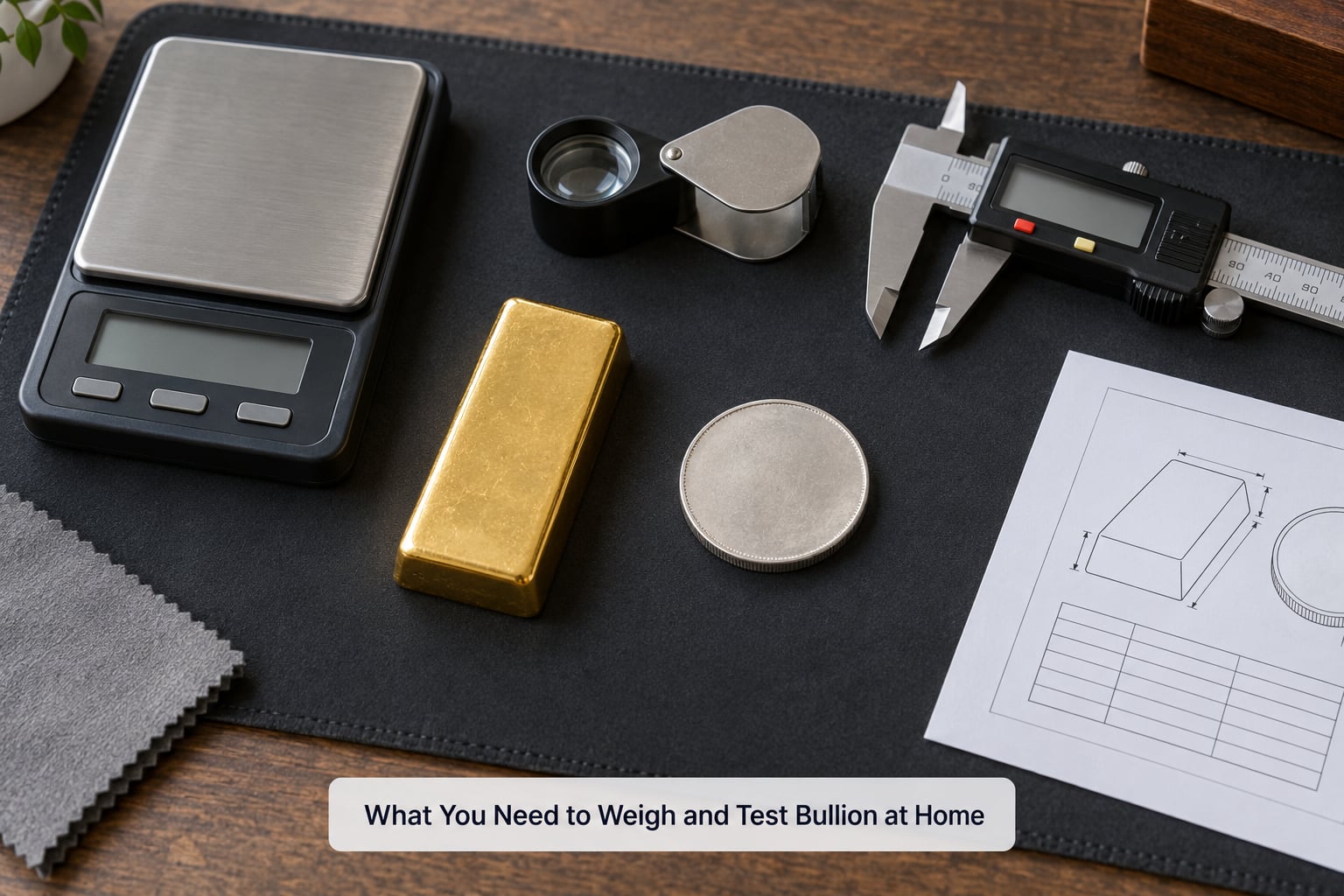
Precision scale with 0.01 g resolution
A kitchen scale is useless here. Most read in whole grams or in tenths, and a tenth of a gram on a 31 g coin is a third of one percent, which is the exact size of deviation you are trying to detect. Forum regulars on r/Silverbugs say it plainly: a kitchen scale gives false confidence.
Check calibration before every session using the test weights that came with the scale, or a coin you have already verified. Put nothing else on the pan during a weighing session, and keep the scale on a hard level surface away from drafts.
Digital calipers reading 0.01 mm
Cheap calipers are fine if you close the jaws, check the display returns to zero, and slide them together with no visible gap. Anything that reads 0.1 mm steps cannot tell you about thickness tolerances.
Neodymium magnet
A small round or disc magnet, strong enough to lift a screw from a steel bench. This is a screening tool only, and step 4 explains exactly how weak it is on its own.
A printed reference of published specifications
Pull the weight, diameter and thickness figures from the mint or refiner’s own site rather than a forum post or an auction listing. Print them and tape them next to your mat. Forum advice is that this single step catches more fakes than any physical test, because it stops you from approving a piece with no criteria.
Something to record on
A phone note is enough. Write down the serial number, the readings, the date and the seller’s name. Dealers ask for this when you later sell, and a collector who inherits your records pays a premium for the paperwork.
Leave acid and scratch tests out. Acid testing removes a small bite of metal, and a scratch near the date ruins a recognizable coin’s grade. Both permanently reduce what a dealer will pay. Only consider them if you own generic, unmarked metal where appearance carries no premium, and even then after a professional has declined the piece.
Step-by-Step: How to Weigh and Test Bullion at Home 1. Check the bullion’s identity and documentation
Read every stamp before you touch a scale. You are looking for the metal, the fineness stamp (.999 or .9999 for silver, .9167 or .9999 for gold), the refiner or mint name, the weight in grams or troy ounces, and a serial number on bars and rounds.
Then research those numbers at the source. The mint’s website or a major distributor’s listing gives you the specification to compare against in the next steps, and it gives you provenance you can point to if a dealer disputes your findings.
A genuine-looking piece can still be counterfeit. Fraudulent bars are cast from base metal and stamped convincingly, and a copied assay card sitting next to a fake proves nothing about the metal it was printed for. That is the single most common trap in peer-to-peer sales, and it is why documentation is step one rather than a formality at the end.
2. Weigh the item accurately: how to weigh bullion at home
Zero the scale or tare the container you are using, place the piece flat in the centre of the pan, wait for the reading to settle, then write it down. Repeat three times. Readings that wander by more than 0.01 g mean the scale is unstable and the measurement is worthless.
Weigh in grams. One troy ounce equals 31.1035 g, while the avoirdupois ounce in your kitchen scale’s instructions is 28.35 g. A one ounce gold Eagle is 33.9 g because it is only .9167 fine, and mixing the two systems is the most common arithmetic error buyers make.
3. Measure dimensions and inspect the surface
Measure the coin at two points at right angles, roughly 90 degrees apart, and record both. A genuine coin is struck to a consistent diameter all the way round; a cast counterfeit is often slightly oval or slightly out of round, and one clean reading hides that.
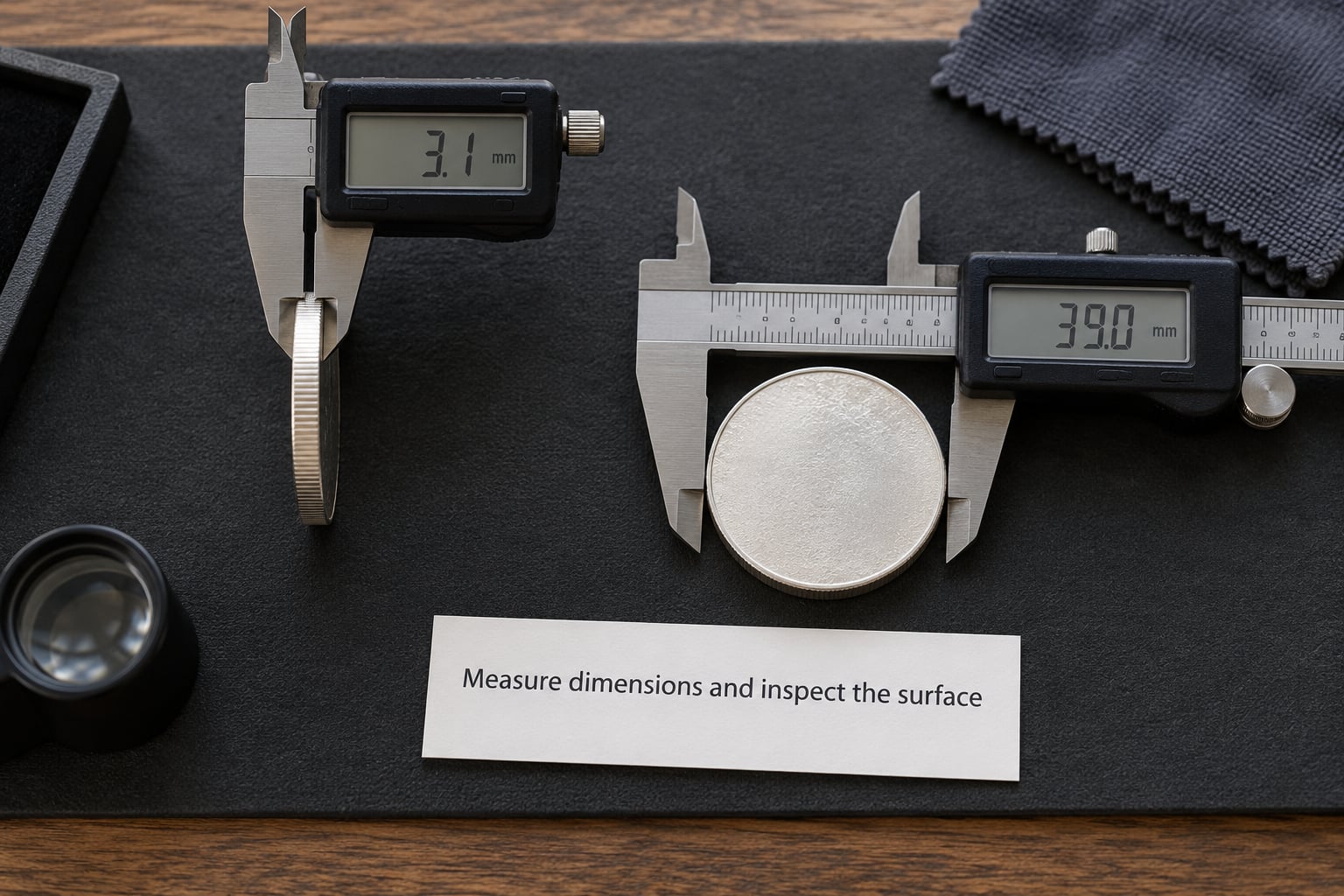
For thickness, measure the rim of a coin or the flat face of a bar with the jaws square and only lightly closed. Many mints publish thickness as a maximum rather than a target, so a genuine coin can be thinner than the number on the website without being fake.
Then put the loupe on it. Lettering should have sharp shoulders and consistent depth, fields should show the expected luster, and the rim should show no seam line, no casting flash and no file marks. Scratches, toning and honest handling marks tell you nothing about authenticity, so do not treat wear as evidence either way.
4. Test magnetic response and density carefully
Gold and silver are not magnetic. If a piece sticks hard to a neodymium magnet, it is not the metal it claims to be, and you can stop there. Gold-plated steel and base-metal fakes often grab a magnet instantly, which is why the test is popular.
The more useful version is the magnet slide. Hold the magnet at a shallow angle so it hovers just above the face and move it along the surface. On gold and silver it skims and slows almost at a standstill, because the moving magnet induces eddy currents in the metal that oppose it. On a plated ferritic fake the magnet grabs hard and drags. Stack holders treat both variants as a screen, never a verdict.
Density is the second secondary signal. Silver measures 10.49 g/cm3, gold 19.32, tungsten 19.25, platinum 21.45, lead 11.34, copper 8.96 and brass around 8.5. A proper specific gravity test needs a beam balance that can suspend the piece in liquid, which most home setups cannot do.
Do not divide weight by cylinder volume calculated as pi r squared h. That method reads several percent low on every genuine coin because real coins are not cylinders, and the error is large enough to pass a fake. If you want true specific gravity, use a suspended hydrostatic setup or leave it to a lab.
5. Compare the results and decide whether to get professional authentication
Put your three readings next to the published numbers and compute the deviation. These thresholds are conservative, and going outside any of them deserves an explanation rather than an assumption.
| Coin | Fineness | Weight (g) | Diameter (mm) | Thickness (mm) |
|---|---|---|---|---|
| American Silver Eagle | .999 | 31.10 | 40.60 | 2.83 |
| American Buffalo | .999 | 31.10 | 32.25 | 3.00 |
| Canadian Maple Leaf (silver) | .999 | 31.10 | 29.80 | 1.78 max |
| Canadian Maple Leaf (gold, 1 oz) | .9999 | 31.10 | 29.00 | 2.13 |
| Britannia (silver, 1 oz) | .958 | 31.10 | 40.00 | 2.96 |
| Krugerrand (gold, 1 oz) | .9167 | 33.93 | 32.70 | 2.37 |
| Austrian Philharmonic (silver) | .999 | 31.10 | 37.00 | 2.50 |
| Australian Kookaburra (silver) | .999 | 31.10 | 39.90 | 2.60 |
| Mexican Libertad (silver, 1 oz) | .999 | 31.10 | 32.50 | 2.50-3.00 |
| American Gold Eagle (1 oz) | .9167 | 33.93 | 32.70 | 2.83 |
| Morgan or Peace dollar (90%) | .900 | 26.73 | 38.10 | 2.24 |
| Pre-1965 silver quarter | .900 | 6.25 | 24.26 | 1.75 |
| Measurement | Investigate if | Why |
|---|---|---|
| Weight | More than 0.4 percent under the stated figure (about 0.12 g on a 31 g coin) | Underweight is the classic hollow or plated construction |
| Weight | More than 1.5 percent over | Heavy pieces suggest a plated core with extra metal added |
| Circulated 90 percent silver | More than 4 percent wear from the nominal weight | Normal wear allowance for a coin that has been in circulation |
| Diameter | More than 0.15 mm off specification | Striking control at the mint is tight; cast copies are not |
| Thickness | More than 0.25 mm off specification | Catches plated pieces where the shell adds measurable height |
Now the honest part. A piece can pass every reading above and still be fake. A tungsten-cored gold coin matches the weight of a genuine coin almost exactly, matches its diameter, is not magnetic, has the right density, and rings correctly. Tungsten sits at 19.25 g/cm3 against gold’s 19.32, which is why it is the most effective counterfeiting material in gold and why calipers and a gram scale alone will never clear a suspect piece.
Other things home testing cannot catch: plated bars where the shell is a few microns thick, filled jewelry with a tungsten or brass core, hollow pieces that only reveal themselves when you look at the edge closely, and pieces whose purity is lower than the stamp claims even though the weight and size are perfect.
When any red flag shows up, escalate. Serious dealers run XRF, ultrasonic thickness gauges and conductivity verifiers, which read alloy composition and conductivity without removing any metal. Mints and major refiners confirm a serial number and packaging, and an independent assay office gives you a written opinion you can hand to the next buyer. Bring the piece, the packaging and your own notes to the appointment.
For poured bars and generic rounds there is often no published specification at all, which is where the escalation path starts immediately. Work from the refiner’s stated weight and fineness, weigh and measure anyway, and if the numbers sit right but nothing else identifies the piece, treat it as unverified until a professional has seen it.
Common Mistakes Weighing on an uncalibrated or kitchen scale
A scale that has drifted by two hundredths of a gram will flag a genuine coin or clear a fake, and you will never know which. Check the calibration weights at the start of every session and treat an unstable reading as no reading at all.
Confusing grams, troy ounces and avoirdupois ounces
One troy ounce is 31.1035 g and an avoirdupois ounce is 28.35 g. A gold coin marked one ounce weighing 33.9 g is correct for its .9167 fineness, not overweight. Check fineness against weight every time and the confusion disappears.
Working on a soft or contaminated surface
A soft mat leaves a dent in a soft proof coin and skin oils dull luster permanently. Use a hard nonporous surface, handle pieces with gloves, and never rest a bar on cloth.
Treating nonmagnetism as proof
Most base-metal fakes are not magnetic in a way a cheap magnet detects, and every genuine piece passes. The magnet rules out a small class of fakes. It cannot clear anything, and a strong result should never outweigh a failed weight reading.
Rushing to a destructive test
A scratch test on a graded coin costs you real money at resale, and acid testing removes metal that can never be replaced. Do every non-destructive check first, get a professional opinion, and only then decide whether a piece is worth damaging.
Testing jewelry like bullion
Stones, hollow construction, clasps and solder all break the weight comparison, and this comes up constantly on jewelry forums. For anything with stones set into it, the only meaningful check is a professional assay or an XRF reading.
One habit worth keeping: write down every reading the moment you take it. Six months later, when you are selling, you will not remember whether the Eagle was 31.09 g or 30.88 g, and neither will the dealer.
Frequently Asked Questions
Check the refiner stamp, fineness mark and serial number against the refiner’s published specification, then weigh the bar on a 0.01 g scale and measure it with 0.01 mm calipers. A weak magnet held flat to the face should skim and slow rather than grab. If the readings sit within tolerance but you have any doubt, take it to a dealer with an XRF or conductivity verifier, because a tungsten-cored bar passes weight and size checks.
Compare the coin’s weight, diameter and thickness with the mint’s published figures for that exact issue, then screen with a magnet slide and a ping. Recirculated and proof issues have different tolerances from bullion strikes, so use the specification that matches the version you hold. Gold coins are not magnetic, so strong attraction rules the piece out immediately, though a nonmagnetic result proves nothing at all.
Weigh it, measure it, and compare both against the mint’s published numbers before you sound it. Silver measures 10.49 g/cm3, far denser than copper or brass, so most base-metal fakes fail on weight. Add a magnet slide and a ping as secondary checks, and record every reading. A genuine coin rings with a long, clear tone; base metal gives a short, dull thud.
Pure silver has a density of 10.49 g/cm3, and sterling silver containing 92.5 percent silver sits slightly lower at about 10.36 g/cm3. Gold is far denser at 19.32 g/cm3, which is why a silver piece that feels implausibly heavy for its size is a warning sign. Proper measurement requires a beam balance that can suspend the piece in liquid, since weight divided by cylinder volume gives a badly wrong result.
The phrase is a pejorative collectors use for cheap base-metal counterfeits sold to look like silver, usually brass, copper or plated steel with a convincing stamp. They typically fail a weight check because base metals are much less dense than silver, though plated pieces with a heavy core can be made to weigh correctly. Buy from a dealer who offers a buyback guarantee rather than chasing bargains from private sellers.
You need a beam balance that can suspend the item submerged in liquid, a graduated cylinder or overflow can for volume, and a 0.01 g scale for the weight. A hydrostatic bench with density attachments is the practical option for small samples. Jewelry scales with a platform alone cannot do it, and calculating volume as pi r squared h is invalid because ore pieces are not cylinders.
Conclusion
Start with the mint’s published weight, diameter and thickness, write them down, and compare everything you measure against those numbers rather than against your memory of what the coin should feel like. Calibrate the scale, square the caliper jaws, read twice at right angles, and record the figures as you go.
Inspect rather than damage. Magnet and sound are screens that rule things out; they never prove anything. And when the numbers sit right but something still feels off, stop and take the piece to someone with an XRF, an ultrasonic gauge or a conductivity verifier. Home checks are a filter, not a verdict.
Source: https://www.pgm-blog.com/how-to-weigh-and-test-bullion-at-home/
Anyone can join.
Anyone can contribute.
Anyone can become informed about their world.
"United We Stand" Click Here To Create Your Personal Citizen Journalist Account Today, Be Sure To Invite Your Friends.
Before It’s News® is a community of individuals who report on what’s going on around them, from all around the world. Anyone can join. Anyone can contribute. Anyone can become informed about their world. "United We Stand" Click Here To Create Your Personal Citizen Journalist Account Today, Be Sure To Invite Your Friends.
LION'S MANE PRODUCT
Try Our Lion’s Mane WHOLE MIND Nootropic Blend 60 Capsules
Mushrooms are having a moment. One fabulous fungus in particular, lion’s mane, may help improve memory, depression and anxiety symptoms. They are also an excellent source of nutrients that show promise as a therapy for dementia, and other neurodegenerative diseases. If you’re living with anxiety or depression, you may be curious about all the therapy options out there — including the natural ones.Our Lion’s Mane WHOLE MIND Nootropic Blend has been formulated to utilize the potency of Lion’s mane but also include the benefits of four other Highly Beneficial Mushrooms. Synergistically, they work together to Build your health through improving cognitive function and immunity regardless of your age. Our Nootropic not only improves your Cognitive Function and Activates your Immune System, but it benefits growth of Essential Gut Flora, further enhancing your Vitality.

Our Formula includes: Lion’s Mane Mushrooms which Increase Brain Power through nerve growth, lessen anxiety, reduce depression, and improve concentration. Its an excellent adaptogen, promotes sleep and improves immunity. Shiitake Mushrooms which Fight cancer cells and infectious disease, boost the immune system, promotes brain function, and serves as a source of B vitamins. Maitake Mushrooms which regulate blood sugar levels of diabetics, reduce hypertension and boosts the immune system. Reishi Mushrooms which Fight inflammation, liver disease, fatigue, tumor growth and cancer. They Improve skin disorders and soothes digestive problems, stomach ulcers and leaky gut syndrome. Chaga Mushrooms which have anti-aging effects, boost immune function, improve stamina and athletic performance, even act as a natural aphrodisiac, fighting diabetes and improving liver function. Try Our Lion’s Mane WHOLE MIND Nootropic Blend 60 Capsules Today. Be 100% Satisfied or Receive a Full Money Back Guarantee. Order Yours Today by Following This Link.


| Visits: | 1,833,808,941 |
| Stories: | 8,714,641 |
Whistler Blowers, Insiders

