

How Gold Scrap Pricing Works: Spot Prices and Assays 2026

Gold scrap pricing is a dealer bid built from four inputs in sequence: the live spot price for pure gold, the purity of your metal, the weight of the gold actually present, and the buyer’s payout percentage after testing, refining, insurance and margin. Once you can do that arithmetic yourself, you can walk into any shop and tell in about thirty seconds whether an offer is fair or padded.
I have watched enough people get confused by a cash-for-gold counter to write this the way I would explain it across the counter. No jargon, every term defined, and every number traceable back to something you can check yourself. Spot figures last checked against public market sources in 2026; since the metal price moves daily, treat every number here as a method rather than a quote.
One thing to say up front: this is general information about how the pricing chain works, not financial advice, and tax or reporting rules for selling gold vary by country and by state.
What Determines the Value of Gold Scrap?
Gold scrap is any gold item a buyer will not sell to an end customer as jewellery: broken chains, empty settings, single earrings, snapped pendants, dental gold, gold-plated electronics, mixed bags of inherited pieces. Its value is not the value of the object. It is the value of the metal inside it, discounted by the cost of getting that metal back into a sellable state.
Buyers evaluate four things in order: what the item is, how much gold-alloy weight it contains, what that weight is worth at the current spot price, and what they can afford to pay after their own costs. Everything else a seller might care about — brand, workmanship, age — affects a resale price, not a scrap price.
That gap matters. Melt value is what the fine gold in the piece would fetch at the benchmark price if it were already refined and delivered. The dealer offer is what one company will hand you today, cash, for the sorting, testing, melting and selling they still have to do. An insurance appraisal is a third number entirely: it estimates what the piece would cost to replace, so a modest chain can carry an appraisal far above its metal content.
How Gold Scrap Pricing Works Step by Step
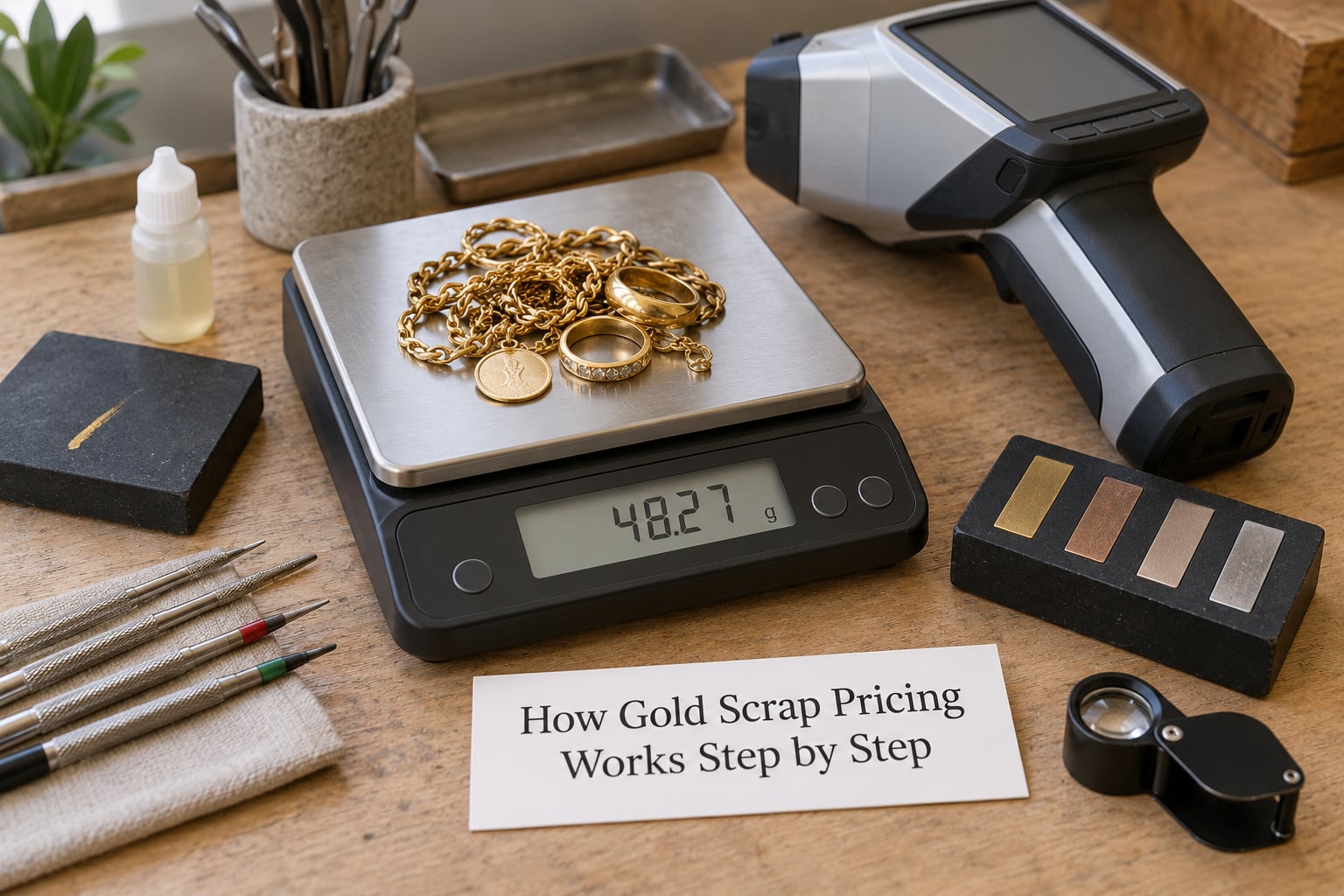
The whole formula fits on one line, and every version you will ever see from a buyer, a calculator or a jeweler’s website is a rearrangement of it.
Offer = net gold-alloy weight in grams × purity fraction × spot price per gram of fine gold × the buyer’s payout percentage
In plain terms: take the metal, not the item; take the pure-gold fraction, not the karat number; price it at the current fine-gold price, not at a retail jewellery price; then apply whatever share the buyer keeps.
Step 1: Identify and sort the item
The buyer looks at hallmarks, item type and weight band first. A 14K chain goes in one pile, an 18K ring in another, a gold-filled brooch in a rejection pile. Gold-filled, gold-plated and vermeil items are nearly worthless as scrap because the surface layer is a few microns of gold over brass.
Step 2: Remove or account for what is not gold
Stones get removed or deducted. Clasps, pendants that are not gold, watch cases, batteries and crowns come out. What is left is the net gold-alloy weight — the only number that enters the formula.
Step 3: Test the purity
Most shops use an X-ray fluorescence machine, which is non-destructive and reads the surface composition in seconds. When a piece is suspect — plated, hollow, mixed karats disguised by a stamp, or simply valuable — the buyer may cut it and send a representative sample for fire assay, which is accurate but destructive.
Step 4: Calculate fine weight and multiply out
Net alloy weight multiplied by the verified purity fraction gives fine gold. Fine gold multiplied by the spot price per gram gives melt value. Melt value multiplied by the payout percentage gives the cash offer. Here is the arithmetic with the spot price held as the variable P, the current price of one gram of 99.99% gold, so the example holds at any metal price:
- Gross weight of a broken chain: 12.40 g
- Less stones and a non-gold clasp: 1.10 g removed
- Net gold-alloy weight: 11.30 g
- Tested as 14K, fineness 585: 11.30 × 0.585 = 6.59 g fine gold
- Melt value: 6.59 × P
- At an 85% payout after a flat refining charge of 0.15P: about 5.45P
The same 6.59 g of fine gold quoted as an amount per fine troy ounce is 6.59 ÷ 31.1035 = 0.212 troy ounces. If the buyer offers less than 0.212 × P, ask what was deducted and why.
How Spot Gold Prices Affect Scrap Quotes
Spot is the price of one troy ounce of 99.99% gold for immediate delivery on the London and COMEX markets, reported by the LBMA and by exchanges such as COMEX. It is the benchmark every dealer starts from, and it is quoted two ways: the bid, which is what a dealer can sell at, and the ask, which is what they pay to acquire. Buyers quote off the bid side because that is the price at which they can resell.
Quotes also shift within a single day, sometimes by several percent across a week, and every gold scrap pricing page you check will be working from slightly different moments. One uses a live feed, another a once-daily fix. That is a normal reason two shops can quote differently on the same afternoon, and it is not by itself a bad sign about either shop.
Converting an ounce price into a per-gram estimate is simple arithmetic: divide the troy ounce quote by 31.1035 to get P. A quote expressed per pennyweight converts by dividing by 1.55517. Watch for quotes per avoirdupois ounce, which is a different unit entirely at 28.3495 g — comparing it with a troy ounce quote is one of the most common ways sellers talk themselves into thinking an offer is generous.
For context on direction rather than a prediction: gold tends to respond to interest-rate expectations, inflation, US dollar strength, central bank buying and geopolitical risk, and to seasonal jewellery demand in India and China. Sellers ask whether to wait constantly, and the honest answer is that nobody knows. What you can control is the payout percentage you accept and the number of offers you collect.
What Do Karat, Purity, and Weights Mean?
Four different weights get confused constantly, and knowing which one a buyer used tells you whether their offer was honest. Gross weight is the item as it sits on the scale, stones and all. Stone weight is the removed non-gold material. Net gold-alloy weight is what remains after deductions. Fine weight is the actual pure gold inside that alloy, and it is the only figure multiplied by the spot price.
Karat measures purity in parts out of 24. Fineness measures the same thing in parts per thousand, which is why European pieces carry millesimal stamps like 585, 750 and 916 instead of 14K, 18K and 22K. Fineness is the more precise of the two, and a careful buyer will quote you one rather than the other.
| Karat | Fineness mark | Percent pure gold | Fine gold per 10 g of alloy |
|---|---|---|---|
| 24K | 999 | 99.9% | 9.99 g |
| 22K | 916 | 91.6% | 9.16 g |
| 18K | 750 | 75.0% | 7.50 g |
| 14K | 585 | 58.5% | 5.85 g |
| 12K | 500 | 50.0% | 5.00 g |
| 10K | 417 | 41.7% | 4.17 g |
Conversions worth memorising, because they cause more arguments than any karat number:
| Measure | Grams |
|---|---|
| 1 troy ounce | 31.1035 g |
| 1 avoirdupois (ordinary) ounce | 28.3495 g |
| 1 pennyweight (dwt) | 1.55517 g |
| 1 metric carat | 0.2 g |
| 20 pennyweights | 1 troy ounce, 31.1035 g |
Why Gold Scrap Buyer Quotes Differ
Two buyers can agree on the weight and the karat and still differ by thousands on the same lot. Here is where that difference goes.
- Testing and assay. An XRF read is near-free; a destructive cut plus fire assay is not, and some buyers pass that cost on as a flat charge per item or per lot.
- Refining charges. Sorting, melting and refining cost real money per ounce, commonly quoted as a flat rate or a percentage of contained metal. Refiners frequently publish figures in the range of about 5% to 10% of the base value.
- Stone removal and cutting. Labour to unset stones, saws, solvents and operator time.
- Overhead and margin. Rent, staff, scales, insurance, security, and the profit the business needs to survive a low-volume month.
- Location and competition. Regional buyers compete with each other; where several shops want the same estate lot, offers tighten.
- Payment timing and price lock. A counter offer is priced at the moment of weighing. A mail-in offer is priced only when the item is received and assayed, unless the price is locked at dispatch.
- Item quality and resale option. A buyer may melt a broken clasp but resell a signed Cartier link, so identical karat content yields different payouts for different items.
One error deserves its own warning because it costs sellers real money: double-deducting. If a buyer subtracts a stated refining loss from the weight and then applies a purity multiplier to what remains, the alloy is being charged for twice. The purity fraction has already excluded the non-gold part of the alloy. Ask whether refining loss is applied to gross weight or to fine gold content, and insist it applies only once.
How Gold Scrap Pricing Calculators Are Used
Every free scrap gold calculator does the same three steps: multiply a weight by a purity assumption, multiply that by a reference price per gram, then apply a payout percentage. They are useful for one job — telling you roughly what to expect before you walk in, so a lowball does not surprise you.
A trustworthy calculator asks for net weight rather than gross, lets you enter the tested karat instead of defaulting to 14K, and lets you change the reference price. It should also show the payout percentage separately from the melt value, because that is the number that varies most between buyers.
Check the assumptions rather than the result. If your bag of inherited pieces has no marks at all and the calculator assumes 14K on the whole lot, the output is fiction. Sort by karat, weigh each group, and use the calculator per group. Coins and bars are another trap: a calculator multiplies bullion by melt value, while a numismatic coin may be worth well above it, and most scrap buyers simply decline tradeable coins.
How to Compare a Gold Scrap Offer
Compare net proceeds on identical terms, not headline percentages. The method that works is unglamorous: walk away, collect two or three written offers describing the pieces the same way, and only then accept one.
1. Confirm the weight you are being paid for
Ask for the net gold-alloy weight in writing and watch the weighing if the shop permits it. A buyer willing to put the item on the scale in front of you removes the most common dispute before it starts, and witnessed weighing is the single strongest trust signal a shop can offer.
2. Confirm the tested purity
Ask what test was used and on what basis. A non-destructive XRF result on a solid, well-marked piece is reasonable; a spot test on an unknown or plated item is not.
3. Work out the implied price per fine troy ounce
Divide the cash offered by fine ounces of gold in the item. If that implied price sits far under the current spot bid, the deductions are doing the work and you should itemise them.
4. Audit every deduction
Stone removal, testing charge, refining fee, insured handling. Ask for the net figure after all of them, in writing.
5. Get two or three competing quotes on the same description
Describe the pieces identically to each buyer so the weight and karat assumptions match. A headline around 80% of melt is roughly what most sellers end up with once deductions are counted, and anyone promising well above spot for a bag of broken jewellery is describing an item they hope to reselect and resell, not melt.
One comparison people get wrong: a numerically larger price per pennyweight is not automatically a better price. Compare net cash for the same pile of metal instead.
How to Sell Gold Scrap Safely and Transparently
Good buyers do a handful of things consistently, and you can screen for all of them before you hand anything over.
- A written, itemised quote showing weight, purity, reference price and each deduction.
- A price locked at the moment of sale or dispatch, not a price that can shift after your item is in the post.
- Witnessed weighing, and the option to decline the offer and take the item back.
- Insured transit both ways, with free return if you decline.
- An assay certificate, with a free re-assay if you dispute the result.
- No pressure. A free, no-obligation appraisal is normal; a same-day-only deal is a tactic.
Red flags run the other way: refusing to quote a percentage, deductions that only appear after the item is opened, cutting or stone removal without your consent, anchoring a deliberately low opening offer on the assumption you will negotiate upward, and no return option. That last pattern — a low anchor followed by pressure to accept it in the room — is the one sellers complain about most often.
On mail-in, the honest summary is that it suits larger, clearly marked, easy-to-weigh lots with insured shipping and a price lock, and it costs you time and some peace of mind on smaller or mixed pieces. The counter trade-off is that a busy shop may not want a 40 g mixed bag at all.
Frequently Asked Questions
No. Spot price is a benchmark for pure gold, not the amount every scrap buyer pays. The offer reflects the item’s tested purity and fine weight, then accounts for testing, refining, insured handling and margin. A piece with 6.59 g of fine gold has a melt value of 6.59 times the price per gram, and the cash offer is that figure multiplied by the buyer’s payout percentage.
Most dealers identify the gold type, remove or account for stones, weigh the metal and test its purity, usually with a non-destructive XRF machine. They calculate fine-gold content from net weight times the verified purity fraction, apply a current reference price per gram, then subtract testing and refining charges and their margin. The written quote should show each of those steps.
A calculator gives an estimate, not an offer. Results depend on your assumed weight, assumed purity, whether stones are deducted, the reference price used and the payout percentage chosen. Those are exactly the four things that differ between buyers, so treat calculator output as a floor for comparison rather than a quote you can expect to be paid.
Published ranges put pawn shops at roughly 50% to 65% of melt value, jewellers and independent recyclers around 70% to 85%, and mail-in refiners at about 85% to 95%. Buyers of traceable bars and sovereign coins often quote much tighter, commonly only 2% to 5% below spot, because bullion is already assayed and standardised. Ranges vary by location, lot size and market conditions.
The best choice depends on the item and what is available locally. A jeweller is convenient for recognisable pieces and may resell rather than melt them. A recycler handles mixed lots well. A mail-in refiner suits larger, clearly marked lots with insured shipping and a price lock. Get two or three written quotes on identical terms and compare net proceeds, not headline percentages.
Because you are selling an alloy, not pure metal. A 10 g 14K piece contains about 5.85 g of fine gold, not 10 g, so its melt value is roughly 58.5% of the same weight in pure gold. On top of that come stone deductions, testing and refining charges, insured handling and the buyer’s margin. Gold-filled and plated items are worth very little as scrap for the same reason.
What to Do Before Selling Gold Scrap
Start by knowing your own number. Verify what the item actually is, get its net gold-alloy weight after stone deductions, establish the tested purity, and multiply through to fine gold and melt value using the current spot price per gram. Then ask two or three buyers for a written, itemised offer and compare the net proceeds.
That is the whole method behind gold scrap pricing, and once you have done it once you will never accept a number without knowing where it came from.
Source: https://www.pgm-blog.com/how-gold-scrap-pricing-works/
Anyone can join.
Anyone can contribute.
Anyone can become informed about their world.
"United We Stand" Click Here To Create Your Personal Citizen Journalist Account Today, Be Sure To Invite Your Friends.
Before It’s News® is a community of individuals who report on what’s going on around them, from all around the world. Anyone can join. Anyone can contribute. Anyone can become informed about their world. "United We Stand" Click Here To Create Your Personal Citizen Journalist Account Today, Be Sure To Invite Your Friends.
LION'S MANE PRODUCT
Try Our Lion’s Mane WHOLE MIND Nootropic Blend 60 Capsules
Mushrooms are having a moment. One fabulous fungus in particular, lion’s mane, may help improve memory, depression and anxiety symptoms. They are also an excellent source of nutrients that show promise as a therapy for dementia, and other neurodegenerative diseases. If you’re living with anxiety or depression, you may be curious about all the therapy options out there — including the natural ones.Our Lion’s Mane WHOLE MIND Nootropic Blend has been formulated to utilize the potency of Lion’s mane but also include the benefits of four other Highly Beneficial Mushrooms. Synergistically, they work together to Build your health through improving cognitive function and immunity regardless of your age. Our Nootropic not only improves your Cognitive Function and Activates your Immune System, but it benefits growth of Essential Gut Flora, further enhancing your Vitality.

Our Formula includes: Lion’s Mane Mushrooms which Increase Brain Power through nerve growth, lessen anxiety, reduce depression, and improve concentration. Its an excellent adaptogen, promotes sleep and improves immunity. Shiitake Mushrooms which Fight cancer cells and infectious disease, boost the immune system, promotes brain function, and serves as a source of B vitamins. Maitake Mushrooms which regulate blood sugar levels of diabetics, reduce hypertension and boosts the immune system. Reishi Mushrooms which Fight inflammation, liver disease, fatigue, tumor growth and cancer. They Improve skin disorders and soothes digestive problems, stomach ulcers and leaky gut syndrome. Chaga Mushrooms which have anti-aging effects, boost immune function, improve stamina and athletic performance, even act as a natural aphrodisiac, fighting diabetes and improving liver function. Try Our Lion’s Mane WHOLE MIND Nootropic Blend 60 Capsules Today. Be 100% Satisfied or Receive a Full Money Back Guarantee. Order Yours Today by Following This Link.


| Visits: | 1,833,808,941 |
| Stories: | 8,714,641 |
Whistler Blowers, Insiders

