

How to Calculate Melt Value of Silver Coins (October 2026)

Melt value is the worth of the silver metal inside a coin, and the whole calculation is one line: actual silver weight in troy ounces multiplied by the current silver spot price. If you know how to calculate melt value of silver coins, you can price any stack in under a minute and tell instantly whether a dealer offer is fair. It takes four inputs and a calculator, and it works for a single Mercury dime or a bag of mixed junk silver.
One warning before the method. Melt value is a floor, not a price. A coin can be worth far more than its metal, and dealers rarely pay full melt. Both facts are part of the arithmetic, not footnotes.
What You Need
Four things, and only one of them is hard to get right.
- A live silver spot price in dollars per troy ounce. Not the retail price of bars, not what a dealer asks you for an Eagle. The spot quote is the number metal is priced against globally.
- The coin’s weight and silver purity. For US coins, that means the face value and the date, which together tell you the metal content. For anything foreign, you need the weight and the fineness marking.
- A calculator and, ideally, a small digital scale. A phone calculator handles the arithmetic. A scale lets you check your assumptions instead of trusting them.
- A sense of the dealer’s spread. Whoever buys from you buys below spot, because they need margin to resell. Expect an offer somewhere in the 80 to 95 percent range of your calculated melt.
That is the whole toolkit. Anything beyond it is a shortcut for steps you can already do.
Step-by-Step: How to Calculate Melt Value of Silver Coins
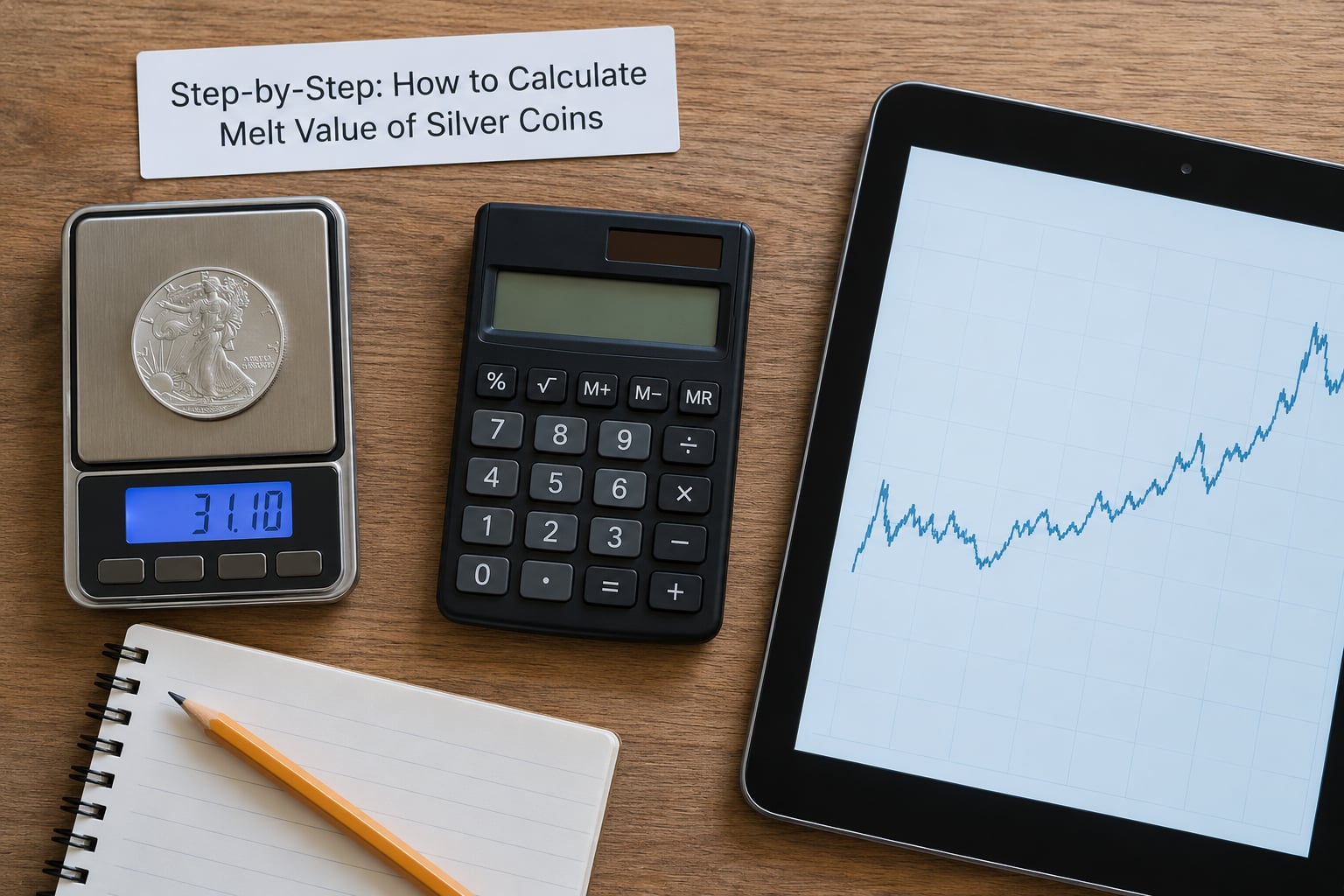
The method runs in six steps. Steps one and three catch most of the errors people make, so do not skip them even when the coin looks obvious.
Step 1: Confirm the Coin’s Weight and Silver Purity
Start with the coin itself. For US silver, the date tells you almost everything. Dimes, quarters and half dollars dated 1964 or earlier are 90 percent silver, an alloy of 90 percent silver and 10 percent copper. Half dollars dated 1965 through 1970 drop to 40 percent silver, an alloy of 40 percent silver and 60 percent copper. War nickels from 1942 to 1945 carry 35 percent silver.
The face value on the coin is not the value. Nobody ever redeemed a dime for ten cents of silver. Face value matters only as a shortcut for counting a stack quickly, which I get to in step five.
Most coins also state their purity on the reverse: .999, .9999 or .925 sterling. Bullion coins such as the American Silver Eagle and Canadian Maple Leaf are one troy ounce of .999 silver each, so their melt value is simply the spot price.
Step 2: Find a Current Silver Spot Price
Spot price is what one troy ounce of fine silver trades for on the open market right now. Dealers buy at or under it and sell above it. The spread between those two quotes is their margin, and it is the reason your calculated melt is a benchmark rather than an offer.
Pick one source and use it every time you calculate, so your numbers stay comparable. A live quote from a major exchange, a metals dealer page or a reputable melt value calculator all work. Check the date stamp on it. Silver moves daily, and a cached number from last month is worthless for anything you intend to act on.
Step 3: Convert the Coin’s Weight to Silver Ounces
This is where most mistakes happen. Precious metal prices are quoted in troy ounces, and a troy ounce is 31.1035 grams. An ordinary avoirdupois ounce, the one on your kitchen scale, is 28.3495 grams. Divide grams by the wrong number and you will misstate the silver in a stack by roughly 10 percent.
If your coin is listed in troy ounces already, skip ahead. If it is listed in grams, divide by 31.1035. If you only have a reading from a kitchen scale, the same division works, though expect to be off by a few hundredths from wear and handling.
Here are the standard weights, so you rarely need a scale at all:
| Coin | Years | Weight in grams | Actual silver weight (troy oz) |
|---|---|---|---|
| Walking Liberty / Barber half dollar | 1892-1947 | 12.50 | 0.3617 |
| Franklin half dollar | 1948-1963 | 12.50 | 0.3617 |
| Kennedy half dollar (90 percent) | 1964 | 12.50 | 0.3617 |
| Kennedy half dollar (40 percent) | 1965-1970 | 12.50 | 0.1447 |
| Barber quarter | 1892-1915 | 6.25 | 0.1808 |
| Standing Liberty quarter | 1916-1930 | 6.25 | 0.1808 |
| Washington quarter | 1932-1964 | 6.25 | 0.1808 |
| Barber dime | 1892-1916 | 2.50 | 0.0723 |
| Mercury dime | 1916-1945 | 2.50 | 0.0723 |
| Roosevelt dime | 1946-1964 | 2.50 | 0.0723 |
| Morgan / Peace dollar | 1878-1964 | 26.73 | 0.7734 |
| War nickel | 1942-1945 | 5.00 | 0.0343 |
| American Silver Eagle | 1986-present | 31.10 | 1.0000 |
Actual silver weight, sometimes shortened to ASW, is the pure silver portion only. The 40 percent Kennedy weighs the same 12.5 grams as the 1964 version but carries roughly 60 percent less silver, and the 60 percent copper content is not precious metal at all.
Step 4: Apply the Coin’s Purity
Pure silver content is total weight multiplied by fineness. A coin weighing 2.5 grams at .900 fineness contains 2.25 grams of silver. Convert that to troy ounces by dividing by 31.1035, or skip straight to the ASW column in the table when you already know the series.
- .999 and .9999 Bullion coins, rounds and most modern commemoratives. Treat one troy ounce coin as one full ounce.
- .925 Sterling silver. Common in flatware and jewelry, where melt value is irrelevant because the workmanship and hallmark dominate.
- .900 US dimes, quarters and half dollars through 1964. The classic junk silver.
- .800 Canadian silver from 1920 to 1966, plus much foreign silver. Weight alone will not separate these, so read the marks.
- .500 and .835 German and other pre-war European issues. Heavier than they look, low purity, and a common surprise in estate boxes.
Never assume purity from appearance. Colour is a poor guide at the thresholds that matter here.
Step 5: Calculate the Gross Melt Value
Here is the formula in full:
Melt value = actual silver weight in troy ounces × silver spot price in dollars per troy ounce
For a stack, multiply that result by the number of coins. The worked examples below use a round placeholder spot price of 30 dollars per troy ounce so the arithmetic stays easy to redo. Substitute whatever the live quote reads on the day you check, because these numbers move with the market and are not a quote or an offer.
- Washington quarter, 90 percent: 0.1808 × 30 = about 5.43 dollars of silver.
- Roosevelt dime, 90 percent: 0.0723 × 30 = about 2.17 dollars.
- Kennedy half, 1964: 0.3617 × 30 = about 10.85 dollars.
- Kennedy half, 1968, 40 percent: 0.1447 × 30 = about 4.34 dollars. Same date family, less than half the metal value.
- Morgan dollar: 0.7734 × 30 = about 23.20 dollars.
- War nickel: 0.0343 × 30 = about 1.03 dollars.
- Ten-dollar roll of 90 percent quarters: 40 × 0.1808 = 7.2336 troy ounces, then 7.2336 × 30 = about 217 dollars of melt.
The face value shortcut gets you close on a mixed pile. Collectors on r/Silverbugs repeat one rule constantly: for dimes, quarters and half dollars dated 1964 or earlier, every dollar of face value carries roughly 0.715 troy ounces of silver. Multiply your total face value by 0.715, then by spot. That gives about 214 dollars for the ten-dollar roll above, a touch under the exact figure of 217.
The gap comes from the shortcut itself. Working from the real weights, one dollar of 90 percent coin contains 0.7234 troy ounces, not 0.715. The rule of thumb runs about one percent low, which is fine for a fast sanity check and wrong for anything you intend to sell. Half dollars break it anyway, since 1965 and later are 40 percent silver, and a nickel or a Canadian dollar in the same bag skews it further.
The ladder version, for a quick mental estimate. Read it as face value, then the coin count, then the silver those coins actually hold:
| Face value | Coins (dimes, quarters or halves) | Troy ounces of silver at 90 percent | Melt value at 30 dollars per oz |
|---|---|---|---|
| 1 dollar | 10 dimes, 4 quarters or 2 halves | 0.715 to 0.7234 | about 21.45 to 21.70 |
| 5 dollars | 25 dimes, 20 quarters or 10 halves | 3.6170 | about 108.50 |
| 10 dollars | 40 quarters | 7.2336 | about 217 |
| 20 dollars | 40 halves | 14.4680 | about 434 |
| 50 dollars | 100 halves | 36.1700 | about 1085 |
Compare the ten-dollar roll of quarters with a twenty-dollar stack of halves. The roll of quarters holds about 7.23 troy ounces and the halves about 14.47, so twenty dollars in half dollars carries roughly twice the silver of ten dollars in quarters. Half dollars were the heaviest coin in common circulation, and that is exactly why face value stops working as a proxy once a bag mixes denominations.
Step 6: Account for the Dealer’s Bid and Selling Costs
Calculated melt is the ceiling of an immediate cash sale, never the expectation. Buyers must resell the metal at or above spot and cover postage, insurance, refining and rent in between, so they bid below it. Coin shops commonly pay 80 to 90 percent of melt on bulk silver, and online buyers tend to sit at the better end of that range.
Run it through: the ten-dollar quarter roll calculated at about 217 dollars of melt, sold locally at 85 percent, pays about 184 dollars. Over a few hundred coins that difference is the entire profit on the transaction.
Other costs eat into the same pot. Refining and assay charges, postage if you mail coins, sales tax on the transaction in some jurisdictions, and a bad exchange rate if you convert to another currency all reduce the final number. Getting two or three written dealer quotes costs you nothing and gives you the real spread.
Selling privately can beat the dealer spread, but it takes time and carries the usual risks of handling cash and arranging a meeting. Scrap silver recyclers pay less still, usually a low percentage of spot, and pay by weight rather than by purity.
Common Silver Coin Melt Value Mistakes
Every one of these comes up repeatedly in collector forums, usually attached to the same “I thought this was worth more” surprise.
Using an avoirdupois ounce instead of a troy ounce
The kitchen-scale ounce is 28.3495 grams. The troy ounce is 31.1035 grams, about 9.7 percent heavier. Divide by the lighter number and you misstate the silver in every coin you are pricing.
Treating face value as value
A quarter stamped 25 cents carries about five dollars of silver at a 30 dollar spot price. Face value is a printing convention left over from when coins held real money, useful only as the 0.715 ounce shortcut.
Assuming every pre-1965 half dollar is the same
The 1964 Kennedy is 90 percent silver at 0.3617 troy ounces. The 1965 through 1970 halves are 40 percent at 0.1447. Same weight on a scale, wildly different value, and the single most common sorting error on inherited collections.
Guessing at purity on foreign coins
Canadian silver runs at .800, much of pre-war European silver sits at .500 or .835, and sterling flatware is .925. Read the marks or get it tested. Weight alone will mislead you across those thresholds.
Using a stale spot price
Spot moves daily. A number you saw last month is not a benchmark you can argue with, and it is not a reason to hold or sell either. Pull a live quote every time.
Ignoring the dealer spread
Calculated melt is what the metal is worth, not what someone will hand you. Comparing a bid against melt without adjusting for the spread is comparing two different things.
Confusing melt value with collector value
Melt value is the floor. A 1921 Morgan, a mint-error coin or an uncirculated proof can sit many multiples above it. That is the fear that comes up most often in r/coincollecting threads: not that melt is too low, but that a key date gets sold at melt without anyone checking first.
Treating coins as if-worn unless graded
Circulation wear reduces the metal in a coin only slightly, but a graded coin can be worth several times melt. Sort into three piles: bulk silver, dates worth checking, and pieces already graded or clearly premium.
Before you sell anything you have not sorted, spend ten minutes on the date and mint mark. That one habit prevents nearly every expensive mistake people make in this market.
Frequently Asked Questions
No. Face value is a printing convention, not a metal price. A 90 percent silver quarter stamped 25 cents holds about 0.1808 troy ounces of silver. Face value only works as a counting shortcut, because every dollar of 90 percent coin in dimes, quarters or halves carries roughly 0.715 troy ounces of silver.
Look up the coin’s actual silver weight in troy ounces, multiply it by the current silver spot price per troy ounce, and add up the coins. For a one troy ounce .999 bullion coin, the answer is simply the spot price. Online melt value calculators do the same arithmetic for mixed stacks.
Divide grams by 31.1035, since one troy ounce equals 31.1035 grams. A 6.25 gram quarter at .900 fineness contains 5.625 grams of silver, and 5.625 divided by 31.1035 gives about 0.1808 troy ounces. Keep the distinction clear: an ordinary kitchen-scale ounce is 28.3495 grams.
Yes, and that is exactly why people get hurt. Melt value depends only on weight and purity, so a 1921 Morgan and a 1955 Morgan contain the same metal. The difference sits in condition, rarity and demand. Sort for key dates and mint marks before a bulk sale, and separate anything already graded.
Because the dealer has to resell the metal and cover costs in between. Buyers typically bid 80 to 90 percent of calculated melt on bulk silver, more at the top of that range online, with refining, postage and taxes taking a further cut. Calculated melt is the ceiling of a cash offer, not the expectation.
Usually yes, for US silver. If you know the denomination and the date, the weight is fixed: dimes, quarters and half dollars dated 1964 or earlier are 90 percent silver at 0.0723, 0.1808 and 0.3617 troy ounces respectively. Foreign coins are different, and there a scale or a purity test is worth the trouble.
Conclusion
To calculate melt value of silver coins, multiply the coin’s actual silver weight in troy ounces by the live silver spot price. Everything else is adjustment: purity on the input side, the dealer spread on the output side.
Three things to do first. Confirm the weight and purity from the denomination and date, especially the 40 percent halves from 1965 to 1970. Pull a current quote per troy ounce from one consistent source rather than a number from memory. Then compare your calculated melt against two or three real dealer offers so you know what the spread costs you before you commit to a sale.
Spot prices, dealer margins and tax rules change, and this is a working method rather than financial advice. Check the live numbers before you act on any of it.
Source: https://www.pgm-blog.com/how-to-calculate-melt-value-of-silver-coins/
Anyone can join.
Anyone can contribute.
Anyone can become informed about their world.
"United We Stand" Click Here To Create Your Personal Citizen Journalist Account Today, Be Sure To Invite Your Friends.
Before It’s News® is a community of individuals who report on what’s going on around them, from all around the world. Anyone can join. Anyone can contribute. Anyone can become informed about their world. "United We Stand" Click Here To Create Your Personal Citizen Journalist Account Today, Be Sure To Invite Your Friends.
LION'S MANE PRODUCT
Try Our Lion’s Mane WHOLE MIND Nootropic Blend 60 Capsules
Mushrooms are having a moment. One fabulous fungus in particular, lion’s mane, may help improve memory, depression and anxiety symptoms. They are also an excellent source of nutrients that show promise as a therapy for dementia, and other neurodegenerative diseases. If you’re living with anxiety or depression, you may be curious about all the therapy options out there — including the natural ones.Our Lion’s Mane WHOLE MIND Nootropic Blend has been formulated to utilize the potency of Lion’s mane but also include the benefits of four other Highly Beneficial Mushrooms. Synergistically, they work together to Build your health through improving cognitive function and immunity regardless of your age. Our Nootropic not only improves your Cognitive Function and Activates your Immune System, but it benefits growth of Essential Gut Flora, further enhancing your Vitality.

Our Formula includes: Lion’s Mane Mushrooms which Increase Brain Power through nerve growth, lessen anxiety, reduce depression, and improve concentration. Its an excellent adaptogen, promotes sleep and improves immunity. Shiitake Mushrooms which Fight cancer cells and infectious disease, boost the immune system, promotes brain function, and serves as a source of B vitamins. Maitake Mushrooms which regulate blood sugar levels of diabetics, reduce hypertension and boosts the immune system. Reishi Mushrooms which Fight inflammation, liver disease, fatigue, tumor growth and cancer. They Improve skin disorders and soothes digestive problems, stomach ulcers and leaky gut syndrome. Chaga Mushrooms which have anti-aging effects, boost immune function, improve stamina and athletic performance, even act as a natural aphrodisiac, fighting diabetes and improving liver function. Try Our Lion’s Mane WHOLE MIND Nootropic Blend 60 Capsules Today. Be 100% Satisfied or Receive a Full Money Back Guarantee. Order Yours Today by Following This Link.


| Visits: | 1,833,808,941 |
| Stories: | 8,714,641 |
Whistler Blowers, Insiders

