

Where to Sell Silver Coins for a Fair Price (October 2026) Guide

Where to sell silver coins for a fair price comes down to one thing: matching your coins to a buyer that pays close to melt value for common silver, and something closer to collector value for anything rare. Refineries and established mail-in bullion buyers usually pay the most for junk silver, auction houses and certified specialists pay the most for graded or scarce coins, and local coin shops are convenient but usually pay the least. Get three written offers before you accept a single one.
The gap between a good offer and a bad one is not small. Buyers who process metal in-house pay 90% to 100% of spot for common 90% silver, while walk-in shops and mail-in services quoting 30% of spot on supposedly low-purity coins are a recurring complaint on silver forums. Here is how to work out what you have, who to ask, and how to check their numbers before you ship anything.
Where to Sell Silver Coins: What You Need
You do not need anything expensive to start. You need a way to know what the metal is, a way to know what it is worth today, and a way to compare buyers against each other.
A gram scale that reads to 0.01 g. A kitchen scale is not precise enough. Purists like a little jeweler’s loupe with a 10x lens so you can read the purity stamp on the coin and look for problems like cleaning, scratches or damage.
A live spot price source. Most major bullion dealers publish the silver spot price on their homepage, and it changes through the day. Spot price is the current market price of one troy ounce of silver, and it is the baseline every buyer’s offer is built from.
A spreadsheet or notebook. Write down every coin: date, denomination, mint mark if you can see one, weight, and any condition notes. This takes twenty minutes for a jar of coins and it becomes your inventory, your offer checklist and your recordkeeping later.
Photographs. Snap a photo of each group of coins before you separate them. If a buyer later claims a coin was scratched or that you misrepresented it, you have a dated record.
A list of at least three buyers. One shop down the road is not an option, it is the only option. Write down three mail-in buyers plus one local shop if you can. Ask all of them the same questions so the answers are comparable.
If the collection came to you through an estate or an inheritance, also gather anything you know about where the coins came from. Provenance affects collector value more than almost anything else a dealer will look at.
Step-by-Step: Selling Silver Coins Safely and Profitably Where to Sell Silver Coins for a Fair Price: Check the Current Silver Spot Price
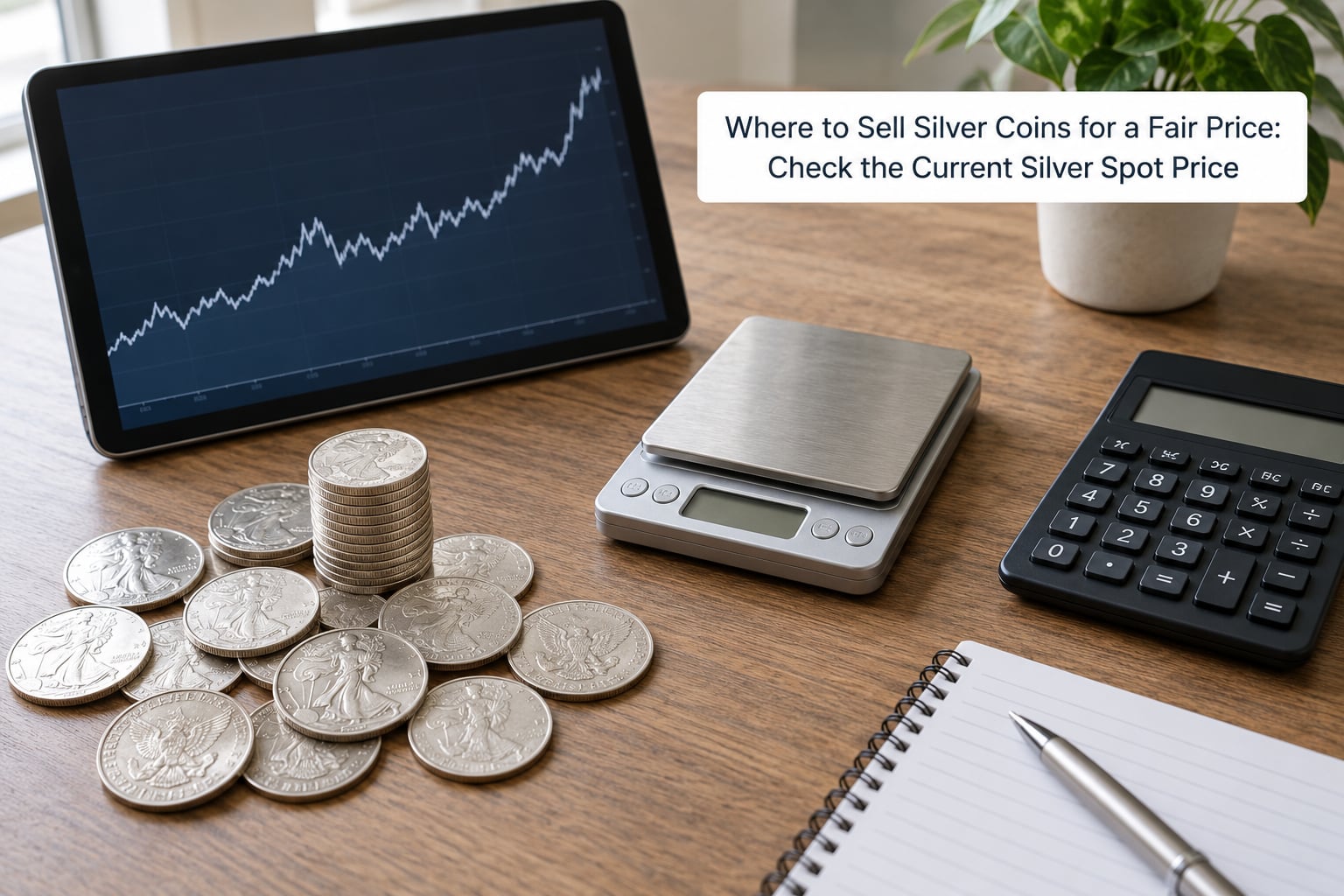
Check the live silver spot price on the day you value the coins, and check it again on the day you accept an offer. It moves, and a quote made last week against an old posted price is not a quote.
Here is the melt value formula, and it is the whole calculation:
Melt value = weight in troy ounces × purity × current spot price
A troy ounce is 31.1035 grams, which is the unit precious metals are priced in. To convert a metric weight, divide the grams by 31.1035 first.
Worked example on 100 US silver dimes weighing 242 grams total: 242 ÷ 31.1035 = 7.78 troy ounces. Those coins are 90% silver, so 7.78 × 0.90 = 7.00 troy ounces of fine silver. Multiply that by whatever spot says that morning and you have melt value.
Melt value is the floor, not the goal. Numismatic value is what a collector will pay above melt for rarity, condition and demand. Common pre-1965 dimes, quarters and half dollars are what the trade calls junk silver, and they are almost always valued at melt only, because millions of identical examples exist.
A handful of exceptions are worth separating out before you sell anything: pre-1933 silver dollars, key dates and mint marks, silver proof sets from the US Mint, and anything already graded by PCGS or NGC. Those have a collector premium that melt value ignores entirely. Selling a graded coin to a melt buyer destroys value, and that mistake is hard to undo.
Where to Sell Silver Coins for a Fair Price: Compare Buyer Options
Here is how the main options compare on the things that actually matter to a seller: the price they typically pay, how fast you get paid, what it costs you, and how much trust you have to extend.
| Selling venue | Typical payout on common 90% silver | Speed | Cost to you | Best for |
|---|---|---|---|---|
| Precious metals refinery | Highest, often 97-100% of melt | Several days after the metal is received and assayed | Usually none, many supply prepaid insured labels | Large amounts of junk silver, sterling, flatware |
| Mail-in bullion buyer | Often 90-100% of melt when the payout is itemized | A few days to a couple of weeks | Should be zero, watch for buyers who charge for shipping | Convenience, no local shop nearby |
| Online bullion dealer | Close to mail-in buyers, varies | Varies by payment method | Usually none | Bullion rounds, bars, modern Eagles and similar |
| Local coin shop | Often well below spot, room to negotiate | Same day, cash in hand | None | Convenience, moderate amounts, quick cash |
| Pawn shop | Lowest of the walk-in options | Same day | None | Emergency cash only |
| Auction house | Well above melt when a coin is genuinely scarce | Weeks to months | Commission, typically 10-20% | Rare, graded and high-value collector coins |
| Marketplaces such as eBay | Market price, minus fees | Days to weeks | Listing plus final value fees, can exceed the margin on small denominations | Individually valuable coins, not bulk junk silver |
| Private or community buyer | Negotiated, anywhere from fair to poor | Varies | None, unless you are the one shipping | Coin lots where you have patience |
Community consensus on silver forums is consistent on two points. For common junk silver, refiners and reputable mail-in buyers beat local shops on price. For rare or graded coins, auction houses and certified specialists beat everyone.
Forum sellers also point out a fee problem worth knowing before you list small denominations yourself: marketplace fees can eat the entire margin on dimes and nickels, which is why bulk lots sell better than individual coins there.
Where to Sell Silver Coins for a Fair Price: Verify the Buyer and Terms
Before you mail a single coin, spend ten minutes checking the buyer. This is where most bad outcomes happen, and the checks are simple.
Ask for the payout method in writing. A buyer who will not itemize how the offer was calculated is telling you something. A reputable operation will show you the weight, the purity, the spot price used and the resulting figure. Buyers who quote one lump-sum number are asking you to trust a number you cannot check.
Confirm whether the price locks. Good mail-in buyers lock the price once your metal is received and assayed. Buyers who only quote a range, or who want to re-evaluate the offer after you ship, are setting up a bait and switch.
Check for a real physical address and a long history. A website alone is not a business. Look for a street address, a phone number that a human answers, an established operating history and accreditation from a third party such as the Better Business Bureau.
Read the payout and return policy. You want a stated payment timeline, a stated policy on what happens if the buyer disputes your purity claim, and a willingness to return items at their expense if you are not satisfied.
Check who pays shipping. A legitimate buyer supplies a prepaid, insured label and insures the shipment for full value while it is in transit. If you are asked to pay outbound postage, walk away.
Look at reviews that mention the payout, not just the service. Volume matters here. A large body of verifiable third-party reviews that mention itemized assay reports is a much better sign than a handful of testimonials.
If someone claims your 90% silver is only 80% or 40% silver, do not argue at the counter. That claim is checkable in seconds against the US Mint composition record for the date and denomination, so ask which test produced the result, ask to see it, and get a second opinion from another buyer before you accept anything.
Where to Sell Silver Coins for a Fair Price: Complete the Sale
Once you have picked your buyer, work through this in order so nothing gets missed.
1. Finalize your inventory. Separate the pieces you are selling by type and count them. Include a photo of the sorted groups.
2. Get the offer in writing. Reference the total weight, the purity, the spot price used and the payment method. For mail-in, confirm the offer method in writing so the payout can be checked against it later.
3. Package it properly. Coins go in a rigid holder or a bag that cannot tear, then inside a padded envelope, then inside a box with cushioning. Fill every gap. A padded mailer alone is not enough for heavy metal, and a damaged shipment is a total loss unless the buyer insured it properly.
4. Ship insured and tracked. Use the prepaid label if the buyer provides one, and photograph the coins, the packaging and the sealed box before it leaves your hands.
5. Confirm receipt and payment. Track the shipment until it is delivered. When payment lands, verify the amount matches the agreed figure before you consider the deal done. Watch for payment arriving in an unexpected form, which is a reason to pause.
6. Keep the paperwork. Save the offer sheet, the shipping receipt, the tracking number and the payment confirmation together. You need them for tax reporting, and they are your only defense if a payout is disputed later.
On taxes: in the US, bullion coins and bars are treated differently from collectible coins when you sell, and precious metals are usually exempt from sales tax at the retail level, though state rules differ. Capital gains reporting thresholds and cost-basis rules apply to collectible coins under specific rules. None of this is something to guess at. Check the current treatment for your holding and talk to a tax professional before a large sale.
Common Mistakes That Can Lead to a Low Silver Coin Offer
Accepting the first offer you get. This is the single most expensive habit. Forum sellers repeatedly describe the value of shopping multiple buyers, and the difference between the best and worst offer on the same pile of coins is often many percentage points of spot.
Walking in without knowing the melt value. If you do not know what your coins contain, you cannot tell a fair offer from a low one. Fix: weigh and calculate before you go anywhere.
Letting a buyer select the good pieces and lowball the rest. A common tactic is a lowball offer on the whole collection followed by the buyer picking out only the valuable coins. Fix: separate your numismatic pieces from your junk silver, and sell them through different channels.
Selling rare or graded coins as melt. A pre-1933 dollar or a graded proof set sent to a melt buyer gets valued purely on weight. Fix: get a numismatic opinion first, even a paid one, before you commit a high-value piece.
Cleaning your coins. Polishing silver coins destroys surface detail and permanently lowers collector value. Fix: never clean. If you want to sell them, leave them alone.
Trusting a purity claim you cannot verify. Mail-in buyers have claimed 90% silver was only 80% silver, producing an offer under a third of spot. Fix: know your dates and denominations, and get a second opinion.
Failing to separate coin types before quoting. A buyer asking about “silver coins” is not the same as a buyer quoting a specific grade holder or a specific date variety. Fix: get quotes on specific, listed items.
Shipping without insurance and proof of contents. Fix: insured, tracked shipping, and photos of the sealed package before it leaves.
Listing small denominations individually on a marketplace. Fees can exceed the margin. Fix: sell in lots, or skip the venue.
Rushing the sale. Sellers who need cash immediately accept the worst terms by choice. If you can, get quotes first and let the choice be yours.
Frequently Asked Questions
For common 90% silver, a precious metals refinery or an established mail-in bullion buyer that publishes an itemized payout is usually the best choice, because they pay closest to melt value with no retail overhead. For rare, scarce or graded coins, an auction house or a certified specialist usually pays far more than any melt buyer. Always get at least three written offers before you accept one.
Work from melt value: weight in troy ounces multiplied by purity, multiplied by the current spot price. Common pre-1965 silver dollars and junk silver are usually offered at 90% to 100% of melt by refiners and mail-in buyers. Scarce dates and graded coins are worth far more than melt, so have those appraised separately before selling them as bulk metal.
Not reliably. Walk-in shops often pay well below spot, and pawn shops less still, because they need to resell at a markup and cover overhead. Refineries and reputable mail-in buyers come closest to spot because they process metal in-house. That is why getting two or three quotes from different types of buyer matters more than which shop you happen to walk into.
Look for a physical street address, a long operating history, third-party accreditation, and a written payout policy that itemizes weight, purity and the spot price used. Legitimate buyers provide prepaid insured shipping, lock the price once the metal is received, and state a payment timeline. Walk away from anyone who refuses to explain the calculation or asks you to pay shipping.
No. Polishing or scrubbing removes surface detail and permanently reduces collector value, and no cleaning will raise melt value because melt is pure weight. Many professionals consider cleaned coins unsellable to serious collectors. If you want to protect value, store the coins in non-PVC holders in a cool, dry place and let the buyer handle them.
It depends on the coin and your state. Bullion coins and bars are generally exempt from state sales tax at retail, but collectible coins and precious metals are treated differently in some jurisdictions. Selling precious metals for a gain is a taxable event under federal rules, with cost-basis rules that differ for collectibles. Check current treatment for your holding and speak to a tax professional before a large sale.
Conclusion: Start With Three Quotes Before You Sell
Identify what you actually have, then separate it into two piles: melt-value metal and potential collector coins. Work out the melt value yourself using weight, purity and the live spot price, so you know what a fair offer looks like before anyone quotes you.
Then ask at least three buyers, ideally including one refinery or mail-in buyer, for a written payout that shows their math. Pick the offer with the best combination of price and security, not the highest headline number alone. That is where to sell silver coins for a fair price: with a buyer whose calculation you can check and whose terms you can verify.
Source: https://www.pgm-blog.com/where-to-sell-silver-coins-for-a-fair-price/
Anyone can join.
Anyone can contribute.
Anyone can become informed about their world.
"United We Stand" Click Here To Create Your Personal Citizen Journalist Account Today, Be Sure To Invite Your Friends.
Before It’s News® is a community of individuals who report on what’s going on around them, from all around the world. Anyone can join. Anyone can contribute. Anyone can become informed about their world. "United We Stand" Click Here To Create Your Personal Citizen Journalist Account Today, Be Sure To Invite Your Friends.
LION'S MANE PRODUCT
Try Our Lion’s Mane WHOLE MIND Nootropic Blend 60 Capsules
Mushrooms are having a moment. One fabulous fungus in particular, lion’s mane, may help improve memory, depression and anxiety symptoms. They are also an excellent source of nutrients that show promise as a therapy for dementia, and other neurodegenerative diseases. If you’re living with anxiety or depression, you may be curious about all the therapy options out there — including the natural ones.Our Lion’s Mane WHOLE MIND Nootropic Blend has been formulated to utilize the potency of Lion’s mane but also include the benefits of four other Highly Beneficial Mushrooms. Synergistically, they work together to Build your health through improving cognitive function and immunity regardless of your age. Our Nootropic not only improves your Cognitive Function and Activates your Immune System, but it benefits growth of Essential Gut Flora, further enhancing your Vitality.

Our Formula includes: Lion’s Mane Mushrooms which Increase Brain Power through nerve growth, lessen anxiety, reduce depression, and improve concentration. Its an excellent adaptogen, promotes sleep and improves immunity. Shiitake Mushrooms which Fight cancer cells and infectious disease, boost the immune system, promotes brain function, and serves as a source of B vitamins. Maitake Mushrooms which regulate blood sugar levels of diabetics, reduce hypertension and boosts the immune system. Reishi Mushrooms which Fight inflammation, liver disease, fatigue, tumor growth and cancer. They Improve skin disorders and soothes digestive problems, stomach ulcers and leaky gut syndrome. Chaga Mushrooms which have anti-aging effects, boost immune function, improve stamina and athletic performance, even act as a natural aphrodisiac, fighting diabetes and improving liver function. Try Our Lion’s Mane WHOLE MIND Nootropic Blend 60 Capsules Today. Be 100% Satisfied or Receive a Full Money Back Guarantee. Order Yours Today by Following This Link.


| Visits: | 1,833,808,941 |
| Stories: | 8,714,641 |
Whistler Blowers, Insiders

