

How Gold Performs During Recessions in 2026: A Practical Guide

Gold usually gains during a recession. Schroders’ research on US recessions since 1970 puts the average return at about 28%, roughly 37 percentage points ahead of the S&P 500, with gold rising in six of eight episodes. That record is genuinely useful. It is also not a guarantee: gold fell in two of those eight recessions, and anyone who bought the 1980 peak spent decades waiting to break even.
So the honest answer to how gold performs during recessions is “usually well, with real exceptions worth understanding.” This guide walks through the mechanism, the scorecard by episode, the situations where the hedge breaks, and how to size a position without turning it into a bet.
Key Takeaways
- Gold gained in 6 of 8 US recessions since 1970, averaging about 28% (Schroders).
- The driver is falling real interest rates and safe-haven demand, not recession headlines themselves.
- Gold carries no income and can fall hard: a 62% peak-to-trough decline is in its history.
- A small, mechanically rebalanced allocation is a different proposition from buying gold outright.
What Happens to Gold During a Recession?
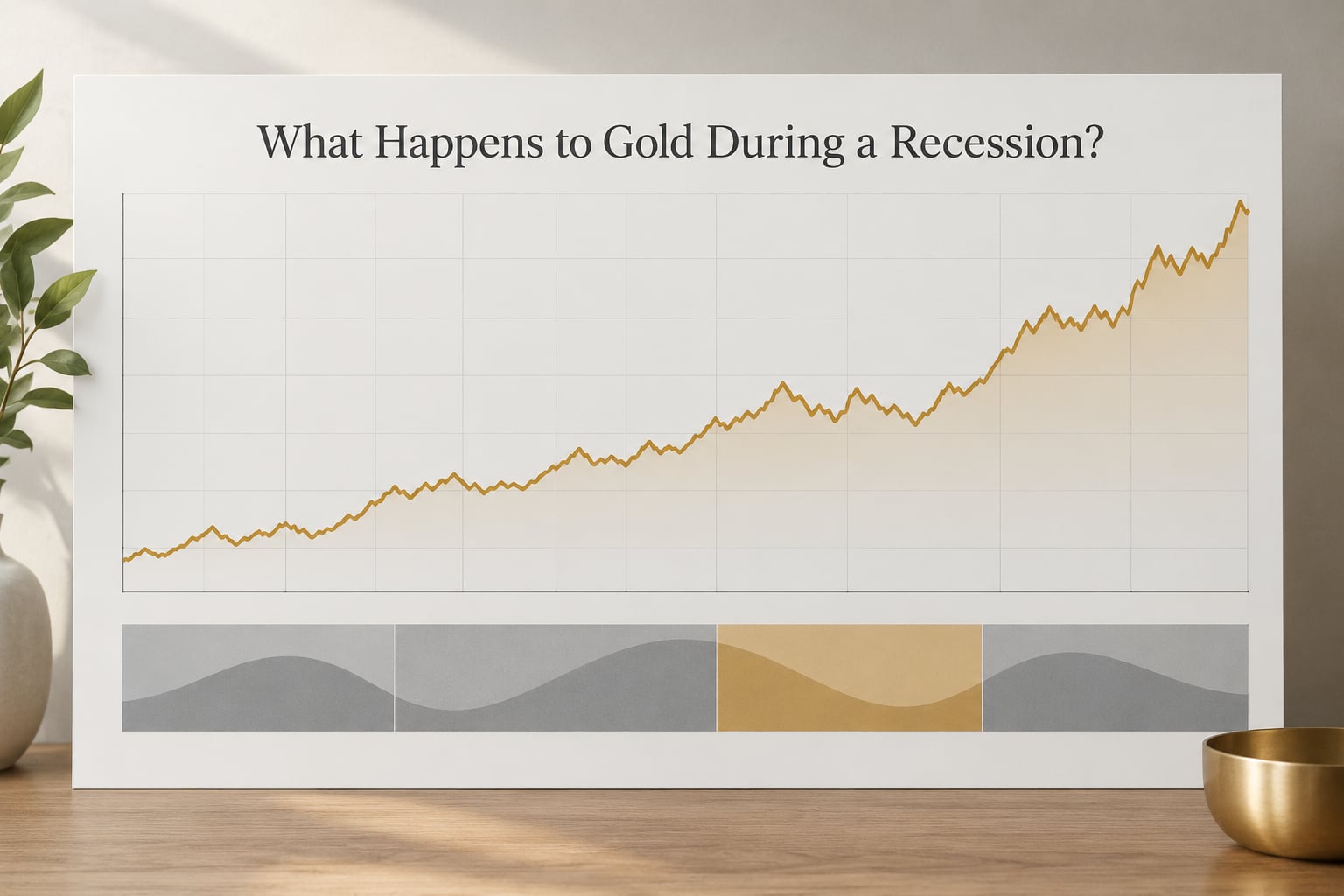
When growth rolls over, the Federal Reserve normally cuts. Gold pays no interest, so a lower real yield lowers the cost of holding it. At the same time, people start buying the one asset with no counterparty, no issuer, and no dependence on a recovering economy. Those two forces usually line up, and gold rises.
The pattern is not smooth. Gold often peaks before the economy does, because the rates move first and the official recession call comes later. By the time the National Bureau of Economic Research dates a downturn, the safe-haven bid is frequently already well advanced.
Why Investors Buy Gold in a Downturn
Six drivers explain most of the demand that shows up when economic data turns soft.
- Rate cuts. Policy easing lowers the yield on Treasuries, and gold competes with a zero-yield asset directly against those bonds.
- Falling real yields. When inflation-adjusted yields fall, holding dollars becomes less attractive relative to a hard, finite store of value.
- Quantitative easing and stimulus. Large-scale asset purchases expand the balance sheet and raise questions about currency durability.
- Dollar weakness. Gold is priced in dollars, so a softer dollar mechanically lifts the dollar price for everyone else.
- Safe-haven flows. Investors rotating down from equities into something tangible and crisis-proof.
- Central bank buying. Official sector purchases, which have run at a structurally higher level in recent years, act as a floor under long-horizon demand.
The World Gold Council has found gold returned roughly 15% a year in periods when inflation ran above 3%, versus about 6% otherwise. That gap is the inflation story. The recession story is different, and conflating the two is the most common mistake people make.
How Gold Performs During Recessions, Stage by Stage
Recessions move in three phases, and gold behaves differently in each.
The early slowdown. Equities fall on earnings fears while yields stay relatively high. Gold often gets its first bid here, though it can sell off briefly if the dollar strengthens, since that is the standard response to a global risk-off shock.
The recession itself. Cuts arrive, real yields compress, and safe-haven demand peaks. This is usually where gold delivers its best returns, and it is also where margin calls force investors to sell their most liquid winners to cover losses elsewhere. Gold ETFs are liquid, so that liquidation hits gold too.
The initial recovery. Gold tends to lose momentum once markets price in a recovery and long yields start rising again. In several episodes gold gave back a meaningful part of its recession gain before equities made new highs. Holding gold for the whole cycle is a different decision from selling at the recession trough.
The Main Factors That Change Gold’s Performance
Here is what actually moves the price when the economy weakens, and what each factor usually does to gold.
| Factor | What happens in a downturn | Usual effect on gold |
|---|---|---|
| Real interest rates | Central bank cuts; inflation falls with growth | Supports gold when real yields decline |
| U.S. dollar | Safe-haven demand for dollars can strengthen it | A strong dollar suppresses gold |
| Inflation expectations | Fall in deflationary recessions, hold up in supply shocks | Falling expectations hurt gold |
| Central bank purchases | Official sector keeps buying through the cycle | Structural support under the price |
| Investor risk sentiment | Flight to tangible, issuer-free assets | Raises the safe-haven bid |
| Liquidity conditions | Margin calls force selling of liquid assets | Can drive sharp, temporary declines |
Notice that the same event can push two of these rows in opposite directions. The 2008 crisis was deflationary: inflation expectations collapsed and the dollar surged, and both worked against gold for most of that year even as equity losses were enormous.
Real Interest Rates and Gold’s Price Reaction
A real yield is the nominal Treasury yield minus expected inflation. It is the cleanest single explanation for gold’s medium-term behavior, because it measures what a dollar of holding gold actually costs you in opportunity terms.
When real yields fall, gold usually rises, and the relationship is reasonably reliable over months. Two examples cut the other way. In 1981 and 1982 real yields were elevated and volatility was high, and gold stayed range-bound for years. After the 2022 rate hikes pushed real yields sharply higher, gold spent much of the following year’s opening period correcting rather than rallying on recession fear.
The practical lesson: do not treat a recession as an automatic gold signal. Watch the real yield. If the Fed is cutting into falling inflation and real yields keep climbing, gold can struggle even while the economy contracts.
Gold Versus Stocks and Bonds During Recessions
Each asset does a different job. Stocks provide growth and dividends but carry the most risk when earnings collapse. Government bonds hedge deflationary recessions well, because falling rates push prices up, but they fail in inflationary ones. Gold pays nothing and moves on real rates and sentiment rather than earnings.
The cross-asset picture across four crisis windows makes the differences plain. Returns are approximate, in nominal dollars, over each stated window.
| Window | Gold | S&P 500 | Long Treasuries | TIPS |
|---|---|---|---|---|
| 1973-1974 stagflation | Roughly flat after a strong run | About -40% cumulative | Negative | Little help |
| 2008-2009 financial crisis | Up modestly in 2008, up sharply in 2009 | About -37% cumulative | Strong gains | Negative in 2008 |
| 2020 pandemic crash | Sharp dip in March, then a strong second half | Positive for the year | Strong | Mixed |
| 2022 to date | Up over the period with a deep correction inside it | Choppy, negative in 2022 | Negative | Mixed to positive |
Correlation is the part people get wrong. Gold’s correlation to equities is low on average but not stable, and in some periods it moves the same direction as stocks. A hedge that sometimes fails exactly when you need it is a partial hedge, not insurance.
What Gold’s Historical Record Actually Shows
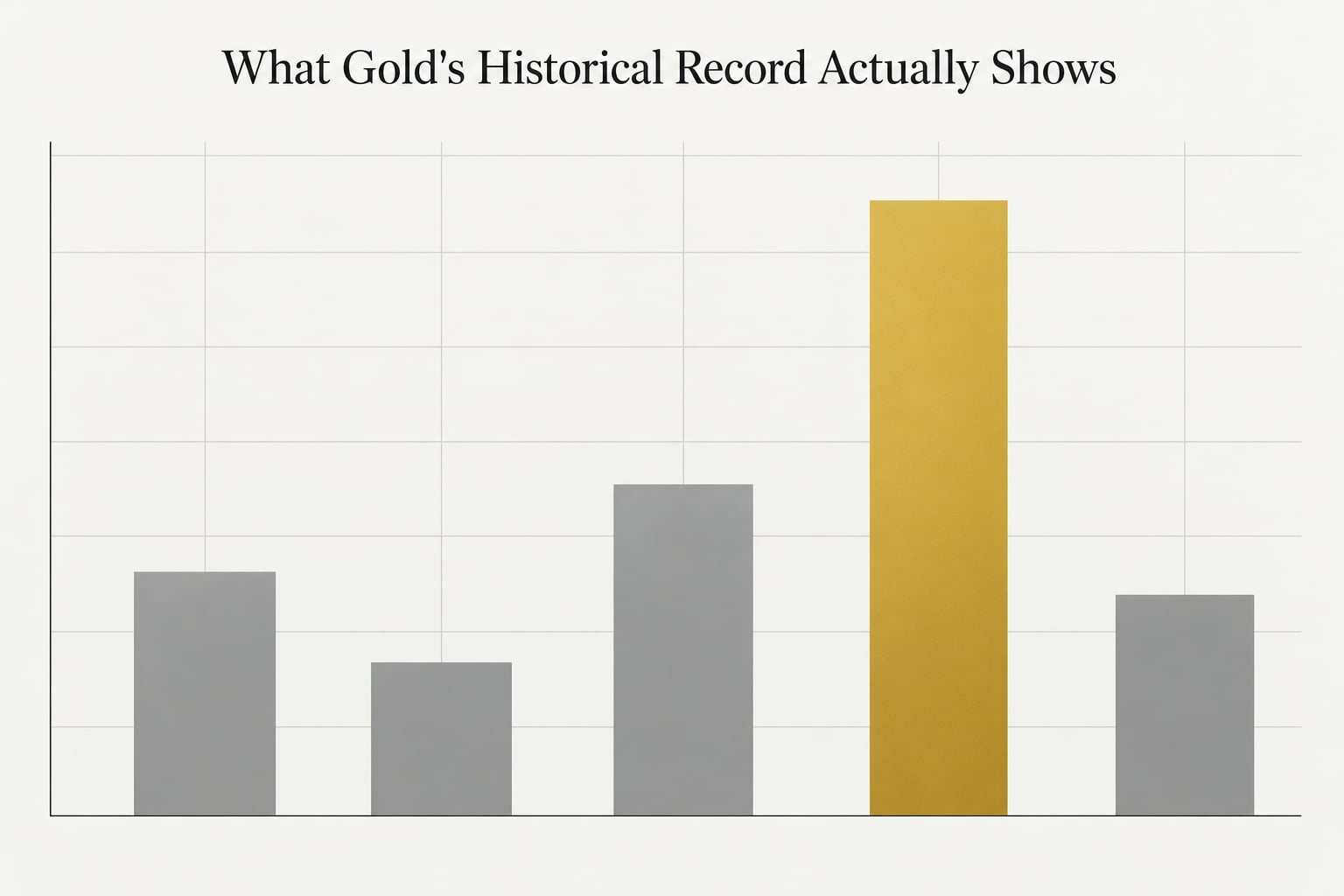
Recession-by-recession, the scorecard is mixed in a useful way. Approximate nominal spot returns, best shown episode by episode.
| Episode | Gold | S&P 500 | Dominant driver |
|---|---|---|---|
| 1973-1975 recession | Positive but choppy | Deeply negative | Inflation and dollar debasement fears |
| 1980-1982 recession | Negative to flat | Mixed | Very high real yields and peak dollar rates |
| 1990-1991 recession | Negative | Negative | Disinflation and the Gulf War premium fading |
| 2001 recession | Roughly flat | Negative | No rate relief until late in the downturn |
| 2007-2009 recession | Positive | Severely negative | Rate cuts to zero plus safe-haven demand |
| 2020 pandemic recession | Positive over the full year | Positive over the full year | Rate cuts, stimulus, dollar debasement worry |
Two of those six were losses for gold, and the average return across recessions since 1970 sits near 28%. Investors.com cited a mean gain of 20.8% in dollars during the 1970s recession specifically, which is a fair reminder that the headline average is pulled up by the best episodes.
The 1980 to 2000 drawdown is the record that matters
Gold peaked in January 1980 and then fell for two decades, losing roughly 58% at the trough while US stocks multiplied many times over. Buyers at that peak did not regain their purchasing power until roughly 2010. An investor who put ten thousand dollars into gold twenty-five years ago would have watched most of that shrink before any recovery at all.
This is sequence-of-returns risk in its purest form, and it is why a growth allocation and an insurance allocation are not interchangeable.
Where gold and stocks have actually landed over 55 years
A back-test run by a retail investor using World Bank monthly gold prices back to 1971 alongside Ken French US stock data produced numbers worth knowing, and worth checking for yourself because no two back-tests are identical. Gold returned about 8.8% a year against 11.3% for stocks. Its worst peak-to-trough decline was 62% versus 50% for stocks. Adding a rebalanced 20% gold allocation produced nearly identical long-run returns while cutting the worst-case drawdown from 50% to 39%, and it dropped the chance of a halving from roughly one in four to one in seventeen over ten thousand reshuffles.
That is the real argument for gold, and it is not a return argument. It is a risk argument.
When Gold Fails as a Recession Hedge
Gold’s safe-haven label has taken real hits, and ignoring that makes any guide like this useless.
Margin-call liquidations are the most common failure. When leveraged investors need cash, they sell what is liquid, and gold funds are liquid. That selling can be violent and has historically coincided with the worst stages of a crisis rather than the best.
Real-yield shocks are the second. When inflation collapses faster than nominal rates fall, gold loses its main support even in a recession, which is largely what happened around 2008 and again after the 2022 hiking cycle.
The recent record is the third and most uncomfortable. Gold has dropped roughly 12% during a major conflict and about 14% from its peak following other geopolitical flare-ups, per market discussion in recent years. Whatever the safe-haven premium is, it is not automatic, and it weakens when positioning is already crowded. Kiplinger’s warning about gold getting crowded at the point of maximum pessimism applies here too.
And the honest counterweight on inflation: Damodaran’s data show gold outpaced inflation in only about 42% of calendar years since 1928. Gold is not a dependable inflation lock, which means it is not automatically a dependable recession lock either.
How Investors Can Use Gold During a Recession
Assume you are not picking the top. The realistic goal is to change the shape of your portfolio’s outcomes.
Size it as insurance. Five to ten percent of portfolio value is a common range, and it is small enough that a 60% gold drawdown costs you six percent of the whole portfolio. That is the calculation that makes the position tolerable.
Rebalance mechanically. Set bands, such as rebalancing back to target once or twice a year, and let the rules decide. Trading gold on macro news is how people end up with either too much or none.
Stage entries. Dollar-cost averaging across several purchases spreads timing risk and removes the need to call a bottom, which nobody can do reliably.
Match the horizon. Gold has no cash flow. Money you need within a few years has no business sitting in it.
Pick the vehicle with costs in mind. A physically backed ETF gives you daily liquidity at a low ongoing fee. Physical coins carry storage, insurance, and spread costs, plus in the US a collectibles capital gains rate of 28%, far above the long-term rate on stocks and bonds. A gold IRA wraps the same assets in a tax-advantaged account but adds annual storage fees often running roughly one to three percent of the value. Futures require margin and are unsuitable outside professionals.
None of this is individual investment advice. Position sizing depends on your horizon, tax situation, and how much volatility you can actually live with.
Common Misunderstandings About Gold as a Recession Hedge
“Gold always goes up when a recession is announced.” It does not. Gold rose in six of eight recessions since 1970, which means it fell in two. And because gold often peaks before the official recession date, the announcement can arrive after the move.
“Gold reliably beats inflation.” The evidence says otherwise. Gold beat inflation in roughly 42% of calendar years since 1928 according to Damodaran’s series. It works much better as a diversifier than as a purchasing-power guarantee.
“Gold is risk-free.” It had a 62% drawdown at one point and fell 58% from 1980 to 2000. Risk-free describes Treasuries, not bullion.
“I should wait until the recession is confirmed.” Confirmation is a lagging signal, and rates usually turn first. Waiting for confirmation usually means entering after the safe-haven bid has already run.
“Inflation-led and deflationary recessions are the same trade.” They are not. A supply-shock recession with rising inflation has historically been kindest to gold. A deflationary credit crisis like 2008 was not, because collapsing inflation expectations undercut the entire case.
Frequently Asked Questions
Usually, though not reliably. Schroders found gold gained in 6 of 8 US recessions since 1970, averaging about 28% and beating the Su0026amp;P 500 by roughly 37 percentage points. It fell in the 1980-1982 and 1990-1991 episodes. The mechanism is falling real rates plus safe-haven demand, so recessions driven by collapsing inflation can produce the opposite result.
Yes, and the contrast with equities is the clearest example in the modern record. Gold rose modestly in 2008 and then climbed sharply in 2009, while the Su0026amp;P 500 suffered one of its worst drawdowns on record. Inflation expectations were collapsing, which worked against gold all year, and margin-call selling added pressure before the rate cuts to zero pushed real yields down.
Expect a bid in the early slowdown as investors rotate into tangible, issuer-free assets, and expect the strongest phase once the central bank starts cutting. Watch the real yield rather than the headlines: falling real yields lift gold, while falling inflation expectations can drag it lower. The metal usually peaks before the official recession is dated, then gives back part of the gain as the recovery is priced in.
It is a partial hedge, not insurance. Gold returned about 8.8% a year against 11.3% for US stocks over a 55-year back-test, with a worse maximum drawdown, 62% versus 50%. Its value shows up in a portfolio: a rebalanced 20% allocation produced near-identical returns while cutting worst-case drawdown from 50% to 39%. Treat it as a small sleeve, not a strategy.
There is no single winner, because recessions arrive in different flavors. Government bonds work well in deflationary downturns like 2008; equities rebound hardest once rates fall; cash holds value but loses purchasing power; gold helps when real yields fall and inflation fears persist, and struggles when inflation collapses. The practical answer is a mix sized to your horizon, with gold as one diversifier rather than the whole answer.
Buffett has long been skeptical of gold, and the reason he gives is structural: bullion produces nothing, while payrolls, taxes, wages and equipment costs keep rising around it. His framing puts productive assets against non-productive stores of value. That view sits uncomfortably next to gold’s recession record, which is a fair reminder that a hedge can work for reasons its holders dislike.
Conclusion
Gold has earned its reputation as a recession refuge in six of the last eight US recessions, and it does something no bond or equity can: it responds to falling real rates and rising uncertainty rather than to earnings.
Do one thing first. Decide your gold allocation as an insurance premium sized near five to ten percent, set a rebalancing rule you will actually follow, and fund it in stages. Then stop watching the recession calendar and watch the real yield.
Source: https://www.pgm-blog.com/how-gold-performs-during-recessions/
Anyone can join.
Anyone can contribute.
Anyone can become informed about their world.
"United We Stand" Click Here To Create Your Personal Citizen Journalist Account Today, Be Sure To Invite Your Friends.
Before It’s News® is a community of individuals who report on what’s going on around them, from all around the world. Anyone can join. Anyone can contribute. Anyone can become informed about their world. "United We Stand" Click Here To Create Your Personal Citizen Journalist Account Today, Be Sure To Invite Your Friends.
LION'S MANE PRODUCT
Try Our Lion’s Mane WHOLE MIND Nootropic Blend 60 Capsules
Mushrooms are having a moment. One fabulous fungus in particular, lion’s mane, may help improve memory, depression and anxiety symptoms. They are also an excellent source of nutrients that show promise as a therapy for dementia, and other neurodegenerative diseases. If you’re living with anxiety or depression, you may be curious about all the therapy options out there — including the natural ones.Our Lion’s Mane WHOLE MIND Nootropic Blend has been formulated to utilize the potency of Lion’s mane but also include the benefits of four other Highly Beneficial Mushrooms. Synergistically, they work together to Build your health through improving cognitive function and immunity regardless of your age. Our Nootropic not only improves your Cognitive Function and Activates your Immune System, but it benefits growth of Essential Gut Flora, further enhancing your Vitality.

Our Formula includes: Lion’s Mane Mushrooms which Increase Brain Power through nerve growth, lessen anxiety, reduce depression, and improve concentration. Its an excellent adaptogen, promotes sleep and improves immunity. Shiitake Mushrooms which Fight cancer cells and infectious disease, boost the immune system, promotes brain function, and serves as a source of B vitamins. Maitake Mushrooms which regulate blood sugar levels of diabetics, reduce hypertension and boosts the immune system. Reishi Mushrooms which Fight inflammation, liver disease, fatigue, tumor growth and cancer. They Improve skin disorders and soothes digestive problems, stomach ulcers and leaky gut syndrome. Chaga Mushrooms which have anti-aging effects, boost immune function, improve stamina and athletic performance, even act as a natural aphrodisiac, fighting diabetes and improving liver function. Try Our Lion’s Mane WHOLE MIND Nootropic Blend 60 Capsules Today. Be 100% Satisfied or Receive a Full Money Back Guarantee. Order Yours Today by Following This Link.


| Visits: | 1,833,824,436 |
| Stories: | 8,714,683 |
Whistler Blowers, Insiders

