

My Family Fled Socialism. Then I Voted for Bernie Sanders.


In 2005, when I was 11, my mother and I fled Venezuela because the government was going to arrest her for her reporting. She was among the first investigative journalists to document how President Hugo Chávez and the socialist party were taking control of the judiciary and integrating Cuban operatives into the military and security apparatus. She exposed how Chávez and his cronies were enriching themselves with oil revenues, creating what would become the largest corruption ring in modern world history. In an effort to silence her, the regime fabricated charges that she had orchestrated the murder of a corrupt prosecutor and put out a warrant for her arrest.
My mother’s escape from Venezuela played out like a Hollywood thriller. She hid in safe houses, was transported in the trunk of a car covered with trash bags, and eventually made it out of the country stowed away on a small boat. A family friend shepherded me to Miami to join her a few days later.
My family had already experienced the brutality of “Chavismo.” The police had raided our home, our car had been fired at, and our family bodyguard, Germán Delgado, had been kidnapped and tortured to death by state security thugs. My grandfather was charged with bogus crimes for his journalism. He was arrested by Italian authorities at Interpol’s direction, and eventually joined us in exile. The socialist regime forced the newspaper and magazine he owned to close down by preventing them from importing paper to run their printing presses. One by one, my relatives were forced to flee, including my grandmother, who spent her final years desperate to see her home in Caracas one last time before she died.
A radical leftist government uprooted my family and wrecked my homeland. Yet after I arrived at New York University (NYU) as a freshman in 2013, I became a leftist.
How NYU’s Groupthink Turned Me Into a Leftist
It was all about fitting in.
When we first moved to Miami, I longed for Venezuela. We sang the “Star-Spangled Banner” every morning in school, and I refused to put my hand over my heart. (“That’s not my anthem,” I told my mom.) But I quickly learned English and made friends with gringas. By the time I was a teenager, I wanted nothing more than to be an all-American girl, which entailed sealing off my Venezuelan identity.
At first, I was a moderate liberal Democrat, campaigning for Barack Obama’s reelection in high school. Then I arrived in New York and encountered NYU’s hyperprogressive campus culture. Like my classmates, I became obsessed with social justice. I majored in journalism and politics, and my course load included “The Politics of Inequality,” “LGBT Politics,” and “Latina Feminist Studies.” My professors included militant leftists, an anti-establishment Catalan independence supporter, and a pro-Palestine activist who assigned a book edited by the Marxist historian Vijay Prashad—a defender of Chávez, Nicolás Maduro, and their socialist dictatorships.
The year I arrived on campus, Chávez died of cancer and was succeeded by Maduro, who continued dismantling Venezuela’s democratic institutions and doubled down on Chávez’s socialist policies. I was still a freshman in 2014 when the country erupted in daily protests, with millions occupying the streets across the country. They were driven by a fury and desperation that my classmates at NYU could hardly imagine.
I knew that Chávez and Maduro were socialists, but I wasn’t focused on their economic policies. The problem, I figured, was that Chavez and Maduro were authoritarians who trampled on civil liberties.
In the classic immigrant narrative, the protagonist, who wants nothing more than to be a real American, eventually reconnects with her past through nostalgia or family obligation. I experienced plenty of both, but my transformation was ultimately the result of a profound intellectual dissonance: I couldn’t reconcile what had happened to my family with what I was being taught in my Latin American studies classes.
I was told that U.S. and European colonialism and imperialism were solely to blame for poverty in the region. I was being indoctrinated into the philosophy of tercermundismo, or “Third-Worldism,” as the Venezuelan classical liberal Carlos Rangel dubbed it—a modification to the socialist creed made by Vladimir Lenin. After the proletariat failed to revolt, as Marx had predicted, Lenin recast communism in internationalist terms. Capitalism’s real victims were the uncorrupted peoples of the Third World, whose land had been pillaged by colonialists. They, not the workers, would rise up and overthrow the bourgeois countries.
I was assigned Eduardo Galeano’s Open Veins of Latin America, the seminal text of Latin American studies and a manifesto of Third World victimhood, which Chávez had publicly gifted to Obama at the Summit of the Americas in 2009. It tells of how European colonists and American imperialists impoverished Latin America by extracting its resources. But in Venezuela, the nationalization of the oil industry in 1976 marked the end of our most prosperous years. Chávez then dismantled the state-owned oil company’s independence and turned its revenues into his personal piggy bank. He stopped maintaining the oil industry’s basic infrastructure and seized the assets of foreign operators. Our own government was making us poor.
When Campus Politics Collided With My Family’s Story
At NYU, we believed that unconstrained capitalism and “trickle-down economics” were causing the calamity of inequality in the U.S., and it was our moral duty to fight back by promoting social justice and progressive values. We learned about the Iraq war, the Abu Ghraib scandal, and why the U.S. was to blame for the recent right-wing dictatorships in Argentina and Chile.
But this narrative didn’t square with what I knew about Venezuela’s recent history. In 2002, the military had briefly removed Chávez from power; I was taught at NYU that the U.S. government had engineered the failed coup out of fear that Chávez would cut off access to our oil. But my mother had been in the room when members of the Venezuelan media were discussing the possibility of a Chávez overthrow. The U.S. ambassador emphatically told everyone present that the Americans wouldn’t support a coup. Perhaps Latin American history wasn’t as simplistic as I was being taught.
I became acutely aware of how many of my NYU classmates were obsessed with race and identity, and how they believed that silencing Republicans was more important than protecting free speech. It reminded me of how Chávez had shut down the free press (with support from the American and European left) on the grounds that they were a propaganda tool of the oligarchy.
My NYU classmates characterized those who disagreed with them as deserving total exclusion from polite society. They shouted down right-wing speakers. Anyone considered a Republican, or Republican-adjacent, was socially ostracized. I met rich kids who called themselves “antifa,” and heard protest chants like, “How do you spell racist? NYU!” As a Venezuelan in exile, I could see what they couldn’t: U.S. democracy, capitalism, and the rule of law had afforded us unimaginable wealth, freedom, and security.
I was excited when one of my professors encouraged our class to attend a lecture by Alejandro Velasco, an assistant professor at NYU who had grown up in Caracas. Imagine my disappointment when I showed up at the lecture and learned that Velasco was an apologist for the regime. His views are summed up in his 2019 In These Times article characterizing the opposition to Chávez as the “middle-class and elite sectors.” While acknowledging Maduro’s authoritarianism, Velasco advised his fellow progressives “to resist a growing narrative that uses the last five years of economic crisis in Venezuela to retroactively cast the entire chavista project—even socialism itself—as an unmitigated failure.”
Velasco’s version of Venezuelan history didn’t square with my own memories or my mother’s reporting. Socialism was an unmitigated failure.
You’ll never encounter a Venezuelan in the U.S. who supports Chávez—except in academia. The same is true of Cubans. In my senior year, while studying abroad in Madrid, I took a class with the NYU anthropologist Aida Esther Bueno Sarduy, who to this day is the only leftist Cuban I’ve ever met.
I wrote a paper for Bueno Sarduy pointing out the irony that Podemos, a Spanish far-left party that at the time was gaining young followers, had supported the Venezuelan dictatorship, and that its policies were causing Venezuelans to migrate to Spain, spurring a nativist backlash. When it came time to discuss my paper, Bueno Sarduy explained that she had knocked my grade down from an A to an A- because I’d included “false information” about Podemos.
For years afterward, I forwarded her citations showing the direct relationship between Podemos and Chavismo. She shifted her argument, claiming that there was nothing “illegal” about those ties and pointing out that Partido Popular, Spain’s conservative party, was involved in financial crimes. This was completely beside the point, but it was a rhetorical tactic I heard over and over again at NYU: Bring up the topic of leftist authoritarianism and get an earful about the evils of U.S. imperialism.
I Voted for Bernie Sanders Anyway
By my junior year, I was still doing my best to fit in. On April 13, 2016, Sen. Bernie Sanders (I–Vt.) held a massive campaign rally in New York City’s Washington Square Park, with about 27,000 attendees. I remember walking through the crowd, trying to ignore the communist iconography and all the Che Guevara T-shirts. But Sanders called himself a “democratic socialist.” He wanted to make the U.S. more like Norway or Sweden, I reasoned, which had nothing to do with Fidel Castro or Hugo Chávez.
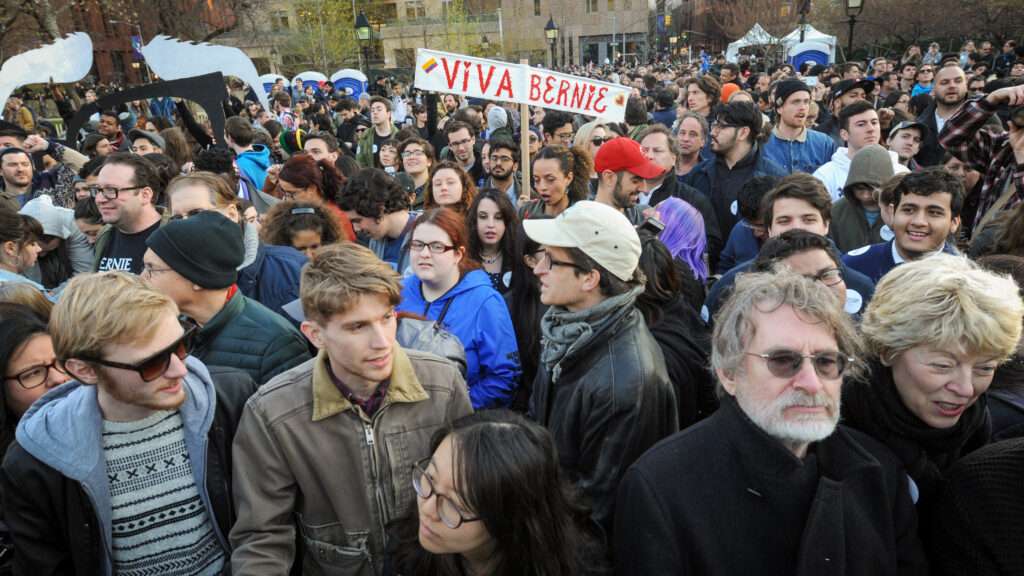
Except that five weeks before the Washington Square Park rally, Sanders had participated in a Democratic presidential primary debate in Miami against Hillary Clinton, in which he was asked about his past praise of Castro and Nicaraguan socialist dictator Daniel Ortega.
“[The Cubans] are sending doctors all over the world,” Sanders said on the debate stage. “They have made some progress in education.” I’ve met Cuban doctors, who told me that they were forced into service and were paid almost nothing for their labor. Castro’s so-called medical missions were a modern-day slave racket.
Sanders would later defend the claim that Cuba had made “progress in education” in a 60 Minutes interview: “When Fidel Castro came into office, you know what he did? He had a massive literacy program,” Sanders told Anderson Cooper. “Is that a bad thing?” Cuba’s literacy program was a socialist indoctrination program, and its achievements were mostly fabricated.
In his debate with Clinton, Sanders avoided the topic of Ortega, turning the conversation, naturally, to the U.S. government’s culpability, specifically the Reagan administration’s support for the Contras. “The United States was wrong to try to invade Cuba,” Sanders said, and it was “wrong trying to support people to overthrow the Nicaraguan government…[and it was] wrong trying to overthrow in 1954 the…democratically elected government of Guatemala.”
It was the same tactic yet again: When asked about leftist dictators, pivot to talking about the Cuban embargo, the Bay of Pigs, and the overthrow of Jacobo Árbenz in Guatemala. Those episodes had shaped Latin American history in profound ways, but Sanders and the American left use them to avoid acknowledging the crimes of Latin America’s socialist tyrants.
Sanders had praised the Cuban Revolution in 1985, and he had visited Cuba in 1989, trying and failing to meet with Castro. At the time, the Soviet Union was about to crumble, meaning it would soon stop propping up the Castro regime with economic subsidies. In 2000, Chávez came to Cuba’s rescue with regular oil shipments worth billions of dollars. In exchange, Castro helped Venezuela build a network of spies to rat out dissent in the military, and he sent the doctor-slaves whom Sanders so revered.
Growing up in Miami, I had met Cubans with immigration stories similar to my own: Their country had been captivated by a charismatic leader who promised to restore the indigenous, communitarian values that predated the colonial invasion. Once in power, like Chávez, Castro locked up dissenters, shut down the free press, nationalized businesses, destroyed the productive economy, and enriched himself and his family.
How I Finally Broke With the Left
I’m ashamed to admit that after Sanders made his comments in defense of the Cuban and Nicaraguan dictatorships in 2016, I still voted for him in the Democratic primary.
My break from the left didn’t happen until my senior year, when I started having conversations with my relatives and other survivors of socialist dictatorships. By then, Venezuela was experiencing the worst peacetime economic collapse in modern world history, and millions were fleeing the country. When we emigrated in 2005, you’d almost never hear Venezuelan accents around Miami. There was a small community of exiled dissidents who would gather at El Arepazo, the iconic Venezuelan restaurant that opened in the Doral neighborhood in 2004. By the time I graduated from college, Venezuelans were moving into Miami en masse, and Doral was known as “Doralzuela.”
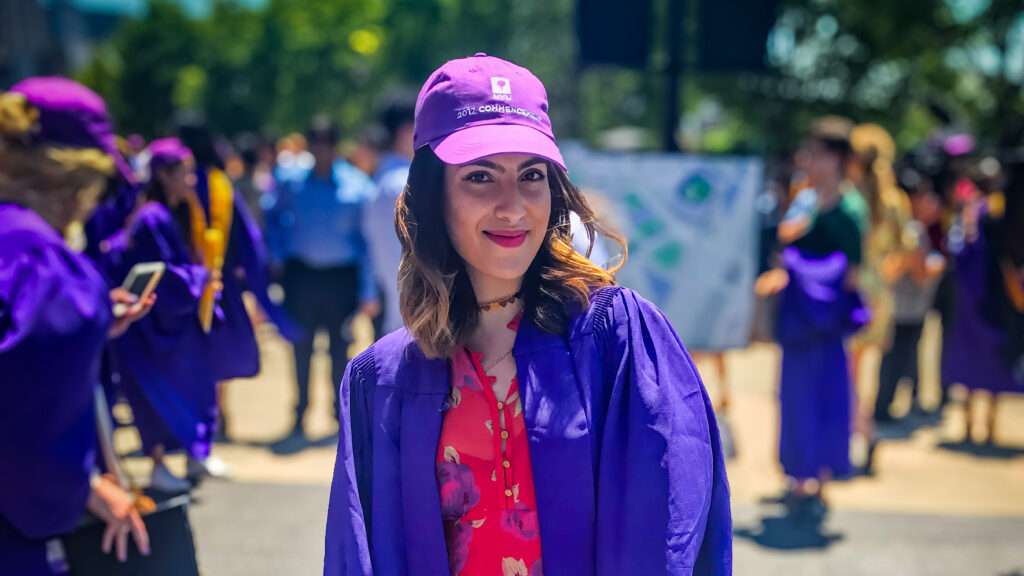
After I graduated and was far removed from NYU’s left-wing milieu, I learned about trips organized by the Democratic Socialists of America to Cuba and Venezuela, where participants visited Potemkin villages and soaked up socialist propaganda. I learned that Norway and the other Scandinavian countries were more capitalist than the United States in many respects. I learned that the Democratic Socialists of America were more closely aligned with the tyrannical forces that had destroyed my homeland than I had wanted to accept.
Sanders called for a single-payer healthcare system in America; Venezuela had a single-payer healthcare system that had turned its hospitals into infection-ridden death factories. Curable forms of cancer became a death sentence—except for those with government connections who could arrange for them to jump the line and see a doctor.
True single-payer healthcare would entail forcing private healthcare providers to turn over their businesses to the government, and it reminded me of how Chávez had seized and expropriated private property in Venezuela. In 2010, he famously went on television and declared, “Expropriate that!” while pointing to stores in a historic square of Caracas. Chávez justified seizing private businesses on the grounds that capitalism was based on theft.
I remembered how Chávez had dismantled Venezuela’s oldest and most beloved TV station, Radio Caracas Televisión, turning it into another state-owned channel for disseminating propaganda. I remember how, after my father died, his house had been invaded by squatters sanctioned by the regime. I remembered the withered face of Franklin Brito, who went on a hunger strike after Chávez sanctioned the taking of his family farm. Brito starved to death in 2010. I realized that property rights and human rights are intertwined.
Spreading the Truth About Socialism
When I finally decided that I was done with the left, all I felt was shame. In attempting to assimilate, I had buried the truth about what had happened to my country because I wanted to be accepted into a culture of upper-middle-class privilege. I had been uprooted by the evils of Castro-Chavismo, and yet had done nothing to counter the ignorance of my NYU classmates.
I vowed to do whatever I could to communicate what had happened in Venezuela so that my well-intentioned peers could better understand the reality of socialism and learn to look past their immense privilege. If I could fall for socialist propaganda, anyone could.
I became outspoken about Venezuela on social media to counter the avalanche of misinformation you read online. Through Twitter, I connected with a community of survivors of anti-Western tyrannies. I met refugees of socialism—not just Venezuelans—who were brilliant at explaining how the First World misunderstands what happened to our countries and favors policies that would cause the same tragic errors to repeat.
Some American and European progressives have accused me of being a CIA agent. Others have called me a gusana, an epithet that means “worm” in Spanish and that was popularized by Castro and his comrades as a way to describe Cubans who opposed the 1959 revolution. They have questioned my cultural identity, saying that I’m “white” and “not really a Venezuelan” because I speak perfect English and oppose Chavismo.
The Venezuelans I met online recommended that I read Carlos Rangel’s 1976 masterpiece, From the Noble Savage to the Noble Revolutionary, which is an antidote to Galeano’s Open Veins of Latin America. It helped me to deprogram the propaganda I had been fed at NYU. The book is a manual for understanding leftist ideology, countering the myth of Latin Americans’ victimhood and the claim that we’re all descended from one-dimensional noble savages. It explains why Latin American culture and history have made the region particularly vulnerable to populist strongmen, who are the real culprits in our social and economic backwardness.
I can’t take back my vote for Bernie Sanders, and I still feel shame for all the years I spent defending democratic socialism. I’m now honoring my heritage by spending the rest of my life spreading the truth about the ideology that destroyed Venezuela and caused so much human suffering. Socialism turned the wealthiest nation in Latin America into the site of the worst peacetime tragedy in modern world history. We honor its victims by making sure it doesn’t happen again.
The post My Family Fled Socialism. Then I Voted for Bernie Sanders. appeared first on Reason.com.
Source: https://reason.com/2026/06/30/my-family-fled-socialism-then-i-voted-for-bernie-sanders/
Anyone can join.
Anyone can contribute.
Anyone can become informed about their world.
"United We Stand" Click Here To Create Your Personal Citizen Journalist Account Today, Be Sure To Invite Your Friends.
Before It’s News® is a community of individuals who report on what’s going on around them, from all around the world. Anyone can join. Anyone can contribute. Anyone can become informed about their world. "United We Stand" Click Here To Create Your Personal Citizen Journalist Account Today, Be Sure To Invite Your Friends.
LION'S MANE PRODUCT
Try Our Lion’s Mane WHOLE MIND Nootropic Blend 60 Capsules
Mushrooms are having a moment. One fabulous fungus in particular, lion’s mane, may help improve memory, depression and anxiety symptoms. They are also an excellent source of nutrients that show promise as a therapy for dementia, and other neurodegenerative diseases. If you’re living with anxiety or depression, you may be curious about all the therapy options out there — including the natural ones.Our Lion’s Mane WHOLE MIND Nootropic Blend has been formulated to utilize the potency of Lion’s mane but also include the benefits of four other Highly Beneficial Mushrooms. Synergistically, they work together to Build your health through improving cognitive function and immunity regardless of your age. Our Nootropic not only improves your Cognitive Function and Activates your Immune System, but it benefits growth of Essential Gut Flora, further enhancing your Vitality.

Our Formula includes: Lion’s Mane Mushrooms which Increase Brain Power through nerve growth, lessen anxiety, reduce depression, and improve concentration. Its an excellent adaptogen, promotes sleep and improves immunity. Shiitake Mushrooms which Fight cancer cells and infectious disease, boost the immune system, promotes brain function, and serves as a source of B vitamins. Maitake Mushrooms which regulate blood sugar levels of diabetics, reduce hypertension and boosts the immune system. Reishi Mushrooms which Fight inflammation, liver disease, fatigue, tumor growth and cancer. They Improve skin disorders and soothes digestive problems, stomach ulcers and leaky gut syndrome. Chaga Mushrooms which have anti-aging effects, boost immune function, improve stamina and athletic performance, even act as a natural aphrodisiac, fighting diabetes and improving liver function. Try Our Lion’s Mane WHOLE MIND Nootropic Blend 60 Capsules Today. Be 100% Satisfied or Receive a Full Money Back Guarantee. Order Yours Today by Following This Link.


| Visits: | 1,818,456,630 |
| Stories: | 8,666,212 |
Whistler Blowers, Insiders

