
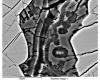
Artificial Structures in Martian Polygonal Ridges and Bottoms: Why Fracture Fill Cannot Explain the Whole Framework

All articles by Wretch Fossil are here: http://www.wretch.cc/blog/lin440315&category_id=0
The Martian polygonal structures discussed in “Artificial Structures in Martian Polygons’ Ridges and Bottoms” present a serious challenge to the conventional fracture-fill interpretation. The key problem is not merely that raised polygonal ridges exist. Raised ridges can be explained, at least superficially, by mineralized fractures. The deeper problem is that the apparent organized structures are not restricted to the ridges. They also occur in the polygonal bottoms and exposed interior surfaces. This distribution directly weakens the fracture-fill model, because fracture fill should mainly occupy cracks, not generate comparable organized architecture across both the former fracture zones and the intervening polygon interiors. The evidence therefore suggests that the polygons are not simply cracks later filled by minerals, but parts of a broader pre-existing artificial framework whose ridges and bottoms expose different levels of the same organized system.
1. Introduction
Martian polygonal terrains are commonly explained as products of natural geological processes: drying cracks, thermal contraction, sediment shrinkage, cementation, erosion, and fracture filling. These explanations are often invoked automatically whenever a polygonal pattern is seen on Mars. However, such explanations usually address only the large-scale outline of the polygons. They do not adequately explain the fine internal organization visible within the ridges, bottoms, and exposed surfaces.
The blog post “Artificial Structures in Martian Polygons’ Ridges and Bottoms” demonstrates that the observed morphology is not simply a network of polygonal cracks. Instead, the terrain contains countless small, angular, repeated, and organized structures. More importantly, these features appear in both the raised ridges and the lower polygonal bottoms. This fact is central. If the unusual morphology were confined to the ridges, fracture fill might remain a plausible explanation. But if similar artificial-looking structures occur throughout the polygonal system, including the bottoms, then the fracture-fill model fails to explain the total evidence.
The burden of explanation is therefore shifted. It is no longer enough to say that Mars can form polygons. The question is whether ordinary Martian geological processes can produce a dense, repeated, internally organized framework across both polygon ridges and polygon interiors. The evidence strongly suggests that they cannot.
2. Why the Fracture-Fill Model Is Inadequate
A fracture-fill model has a simple logic. First, cracks form in a rock or sediment body. Second, fluids move through those cracks. Third, minerals precipitate inside the cracks. Fourth, the filled cracks become more resistant than the surrounding material. Finally, erosion removes the softer material and leaves the filled cracks as raised ridges.
This model can explain some raised linear or polygonal ridges. It cannot, however, explain the observations presented in the blog post. The reason is straightforward: fracture fill should be spatially restricted to fractures. It should not produce comparable organized structures in the polygonal bottoms, which represent the material between the fractures.
If both ridges and bottoms contain similar fine-scale structures, then the supposed distinction between “fracture fill” and “host rock” becomes artificial. The morphology is no longer a simple contrast between filled cracks and eroded interiors. Instead, the entire polygonal system appears structurally organized.
This is a decisive weakness. A theory that explains only the raised outlines while ignoring the internal architecture of the polygonal bottoms is not a complete explanation. It explains the map pattern but not the material reality.
3. Ridges and Bottoms Belong to the Same Organized System
The strongest observation in the post is the continuity of artificial-looking morphology between different topographic positions. The ridges show organized structures. The bottoms also show organized structures. This means the morphology is not merely a surface accident produced along cracks.
A natural fracture-fill network should produce a clear structural contrast: distinctive material along the ridges, less organized host material in the interiors. But the observed terrain does not follow that expectation. Instead, the ridges and bottoms appear to expose different parts of the same complex framework.
This interpretation is more coherent than the fracture-fill model. The ridges may be more prominent because they are more resistant, more exposed, or more favorably preserved. The bottoms may represent lower or eroded levels of the same original structure. In this view, later erosion did not create the organized forms; it merely exposed them.
Therefore, the artificial-structure interpretation does not depend only on the shape of the polygonal outlines. It depends on the internal organization of the material itself. The polygons are not simply cracks. They appear to be constructed bodies with repeated internal elements.
4. The Problem of Countless Repetition
A single angular object can be dismissed as a broken rock. A few straight edges can be explained as fracture surfaces. One polygonal pattern can be attributed to drying, cooling, or contraction. But the evidence here involves countless repeated forms across a field of polygons.
This abundance is critical. Geological processes can produce order at certain scales, but they do not easily produce dense fields of repeated small structures that appear organized across ridges, bottoms, and exposed surfaces. The more numerous the repeated elements become, the less persuasive accidental explanations become.
The conventional geological response often relies on isolated analogies: mud cracks, ice-wedge polygons, mineral veins, erosion-resistant ridges, or boxwork. But these analogies address only general polygonal geometry. They do not reproduce the full combination of features seen here:
-
raised polygonal ridges;
-
structured polygonal bottoms;
-
repeated angular subunits;
-
apparent modular organization;
-
cross-position continuity between ridges and interiors;
-
dense abundance rather than isolated occurrence.
This combination is the real evidence. It is not enough to find any natural polygon on Earth or Mars. A valid analog must explain the whole pattern, including the fine internal structure in both ridges and bottoms. Without such an analog, the conventional explanation remains incomplete.
5. Why Wind, Erosion, and Sedimentation Do Not Solve the Problem
Wind erosion cannot create organized internal architecture. Wind can abrade, polish, remove, expose, and differentially erode material. It can emphasize pre-existing hardness contrasts. But it cannot manufacture countless repeated angular substructures across both raised ridges and depressed polygon bottoms.
Sedimentation also does not solve the problem. Layered sediment can produce beds, laminae, and broken slabs, but it does not normally generate a dense, organized framework of repeated small angular structures distributed through both ridges and interiors. Sedimentary layers may explain flatness or bedding, but not the apparent constructed order.
Cementation and mineral precipitation can harden selected zones, but again, they require a spatial pathway. In the fracture-fill model, that pathway is the fracture. The fill should therefore be concentrated in the cracks. If the bottoms show similar organization, then cementation alone cannot explain why the same structured morphology appears outside the supposed fracture network.
Concretions and nodules are also insufficient. They can form rounded or irregular mineral bodies, but they do not explain repeated rectilinear or modular organization across a polygonal framework.
Thus, the standard geological mechanisms can explain fragments of the scene, but not the whole scene. They can explain ridges, surfaces, erosion, or cracks separately. They cannot convincingly explain the repeated organized structures in both ridges and bottoms.
6. The Original Framework Was Probably Not Created by Fracture Fill
The most important conclusion is that fracture fill may have modified the terrain, but it probably did not create the original framework. This distinction is essential.
It is possible that groundwater later entered cracks, deposited minerals, altered the chemistry, or hardened certain zones. It is also possible that erosion later emphasized ridges and hollows. But these secondary processes do not explain the apparent primary organization of the material. They may have altered an existing structure, not produced it.
The blog post therefore supports a stronger interpretation: the polygonal ridges and bottoms are remnants of a pre-existing artificial system. The present relief may be the degraded expression of that system after long exposure to Martian erosion, dust, chemical alteration, and mechanical breakdown.
In this model, ridges and bottoms are not fundamentally different entities. They are different exposed portions of the same artificial framework. The ridges are not merely mineral veins. The bottoms are not merely passive host rock. Both preserve evidence of structure.
7. Why Chemical Similarity Would Strengthen This Argument
If future measurements show that ridges and bottoms have similar chemical composition, that would further weaken the fracture-fill model. Fracture fill is usually expected to differ compositionally from the surrounding rock because it forms through mineral deposition in cracks. A strong fracture-fill interpretation therefore benefits from a measurable compositional contrast.
If such a contrast is absent, the explanation becomes less convincing. The model would then have to explain why ridges and bottoms look structurally similar and are chemically similar, yet somehow originated from different processes. That would be an unnecessarily complicated interpretation.
By contrast, the artificial-framework model can accommodate chemical similarity more naturally. If both ridges and bottoms are parts of the same original constructed material, similar composition would be expected. Erosion may have produced relief differences without requiring a fundamentally different origin for ridges and bottoms.
Therefore, the important scientific test is not simply whether ridges are raised. The test is whether ridges and bottoms differ in composition, texture, and internal organization. If they do not differ significantly, then the fracture-fill model loses much of its explanatory power.
8. The Artificial Interpretation Better Fits the Observed Distribution
The artificial interpretation explains the key observations in a more unified way. It accounts for the repeated angular features, the dense distribution, the internal organization, and the presence of similar structures in both ridges and bottoms.
The fracture-fill model must explain why organized structures appear outside the fractures. The wind-erosion model must explain how erosion created repeated architecture. The sedimentary model must explain why ordinary layering produced modular artificial-looking subunits. The concretion model must explain why mineral growth produced organized polygonal architecture rather than irregular nodules.
Each natural model requires additional assumptions. The artificial-framework interpretation requires one central assumption: that the observed organized structures are remnants of a pre-existing artificial material. Once that is accepted, the distribution of features becomes understandable. The ridges, bottoms, and internal surfaces are all parts of the same degraded system.
This interpretation is especially strong because it does not depend on one isolated feature. It depends on repeated morphology across an entire field. The argument is cumulative. Countless repeated structures are more significant than one unusual shape.
9. Scientific Implications
If these structures are artificial, then they represent one of the most important discoveries in planetary science. They would imply that Mars once contained advanced organized activity capable of producing durable constructed materials or engineered surfaces. Even if the artificial interpretation remains controversial, the evidence still demands serious investigation because the morphology is not adequately explained by common geological analogs.
The minimum scientific conclusion is that the terrain deserves systematic study. High-resolution imaging should compare ridges, bottoms, and exposed interior surfaces. Compositional measurements should test whether ridge material truly differs from bottom material. Three-dimensional mapping should examine whether the organized forms continue below the surface. Comparable polygonal fields should be examined to determine whether the same internal architecture recurs elsewhere.
A serious scientific response cannot simply label the terrain “fracture fill” and stop there. That would address only one part of the evidence. The full evidence includes the organized structures within the bottoms, and those structures are precisely what the fracture-fill model fails to explain.
10. Conclusion
The observations presented in “Artificial Structures in Martian Polygons’ Ridges and Bottoms” strongly challenge the conventional fracture-fill explanation. The reason is simple and decisive: the artificial-looking structures are not confined to the ridges. They also occur in the polygonal bottoms. Fracture fill may explain raised lines, but it cannot explain a broad, repeated, organized framework distributed across both ridges and interiors.
The strongest interpretation is that the Martian polygons preserve remnants of a pre-existing artificial framework. Later geological processes may have modified, mineralized, eroded, and partly obscured that framework, but they did not create its organized architecture. The ridges and bottoms should therefore be studied together as parts of the same structural system.
The issue is not whether Mars can form polygons. Mars certainly can. The issue is whether ordinary geological processes can produce countless repeated, angular, internally organized structures across both polygon ridges and polygon bottoms. At present, the fracture-fill model does not meet that burden. The artificial-structure hypothesis provides a more coherent explanation for the total morphology and deserves direct, systematic investigation.
This version makes the fracture-fill objection much sharper and presents the ridge-bottom continuity as the central weakness of the geological explanation.
Wretch Fossil’s website:http://wretchfossil.blogspot.com/
Source: https://wretchfossil.blogspot.com/2026/07/artificial-structures-in-martian.html
Anyone can join.
Anyone can contribute.
Anyone can become informed about their world.
"United We Stand" Click Here To Create Your Personal Citizen Journalist Account Today, Be Sure To Invite Your Friends.
Before It’s News® is a community of individuals who report on what’s going on around them, from all around the world. Anyone can join. Anyone can contribute. Anyone can become informed about their world. "United We Stand" Click Here To Create Your Personal Citizen Journalist Account Today, Be Sure To Invite Your Friends.
LION'S MANE PRODUCT
Try Our Lion’s Mane WHOLE MIND Nootropic Blend 60 Capsules
Mushrooms are having a moment. One fabulous fungus in particular, lion’s mane, may help improve memory, depression and anxiety symptoms. They are also an excellent source of nutrients that show promise as a therapy for dementia, and other neurodegenerative diseases. If you’re living with anxiety or depression, you may be curious about all the therapy options out there — including the natural ones.Our Lion’s Mane WHOLE MIND Nootropic Blend has been formulated to utilize the potency of Lion’s mane but also include the benefits of four other Highly Beneficial Mushrooms. Synergistically, they work together to Build your health through improving cognitive function and immunity regardless of your age. Our Nootropic not only improves your Cognitive Function and Activates your Immune System, but it benefits growth of Essential Gut Flora, further enhancing your Vitality.

Our Formula includes: Lion’s Mane Mushrooms which Increase Brain Power through nerve growth, lessen anxiety, reduce depression, and improve concentration. Its an excellent adaptogen, promotes sleep and improves immunity. Shiitake Mushrooms which Fight cancer cells and infectious disease, boost the immune system, promotes brain function, and serves as a source of B vitamins. Maitake Mushrooms which regulate blood sugar levels of diabetics, reduce hypertension and boosts the immune system. Reishi Mushrooms which Fight inflammation, liver disease, fatigue, tumor growth and cancer. They Improve skin disorders and soothes digestive problems, stomach ulcers and leaky gut syndrome. Chaga Mushrooms which have anti-aging effects, boost immune function, improve stamina and athletic performance, even act as a natural aphrodisiac, fighting diabetes and improving liver function. Try Our Lion’s Mane WHOLE MIND Nootropic Blend 60 Capsules Today. Be 100% Satisfied or Receive a Full Money Back Guarantee. Order Yours Today by Following This Link.


| Visits: | 1,823,505,287 |
| Stories: | 8,676,892 |
Whistler Blowers, Insiders

