

Dealing with Cheating in Golf: How to Respond Fairly and Keep Your Composure

What do you do when a playing partner takes a questionable drop or reports a score that doesn’t match what you saw? Speaking up can feel necessary, but acting on an assumption can turn a friendly round into a confrontation. Dealing with cheating in golf starts with a pause: establish what happened before deciding what it means.
A disputed score or possible advantage can be frustrating, and it’s reasonable to care about fairness. But an apparent breach isn’t always deliberate. A player may misunderstand a rule, remember a stroke differently, or make an honest mistake. A calm response protects the integrity of the game and helps you stay focused.
This article will help you clarify the relevant rule before drawing conclusions, raise a concern respectfully, and decide when to involve a rules official or competition committee. You’ll also learn how to respond proportionately, prevent conflict from taking over, and return your attention to the next shot. The goal isn’t to ignore a genuine problem. It’s to address it with composure and sound judgment.
- Separate deliberate rule-breaking for advantage from an honest misunderstanding before deciding how to respond.
- When dealing with cheating in golf, describe the action and establish the facts before checking the relevant rule or competition process.
- Raise concerns at a suitable moment with specific, neutral wording that leaves room for an honest mistake.
- Once the issue is addressed, accept the outcome, breathe naturally, and direct your attention to the next shot.
- Mental training can help build emotional steadiness and focus. Golf State of Mind Mental Coach David MacKenzie studied Sports Psychology at the University of St. Andrews.
Dealing with Cheating in Golf Starts with Separating a Mistake from Intent
Suspecting a playing partner of breaking a rule can make the whole group uncomfortable. You may care about fairness but still be unsure whether you saw the full sequence or understood the rule correctly. That uncertainty matters. A suspicion deserves attention, but it isn’t proof of deliberate cheating.
Cheating means knowingly breaking a rule to gain an advantage. An accidental error or misunderstanding may still need to be addressed under the applicable rules, but it doesn’t automatically show that someone intended to deceive. Keep the questions separate: first establish what happened and what the rule requires, then consider whether there’s evidence of intent.
What counts as a possible breach of golf rules?
A changed score or a ball that appears to have moved from its original lie can raise a question. Neither example, by itself, establishes that a rule was broken. The details matter: what was observed, what the player did, and the circumstances at the time. The relevant ruling depends on the facts and the current Rules of Golf, not on how suspicious an action may look at first glance.
For context, the Rules of Golf are maintained by golf’s governing bodies, including The R&A and the USGA. Use an overview as a starting point, then check the rule that applies to the specific situation. An incident that looks familiar can turn on details that weren’t clear to everyone in the group.
Why intent and context matter before you speak
Golf decisions can unfold quickly. A ball’s position may be hard to see, a player may misremember a stroke, or two people may understand a rule differently. These possibilities don’t settle the issue, but they are good reasons to ask and clarify before assigning motive.
Separate what you observed from what you inferred. “I saw the ball move before the next shot” describes what you believe you witnessed. “You moved it to improve your lie” assumes a reason. Starting with observable details gives the other player a fair chance to explain and helps the group establish what happened.
A possible breach is a reason to clarify what happened; evidence of deliberate cheating requires more than suspicion.
This distinction is central to dealing with cheating in golf fairly. It protects the standard of the round without turning an uncertain moment into a personal accusation. Start with a neutral question, such as, “I may have missed something. Can we clarify what happened with the ball and check the rule?” Calm fact-finding doesn’t mean overlooking a genuine concern. It means responding to what you know instead of letting frustration fill in what you don’t.
Check the Rule and the Facts Before Calling It Cheating
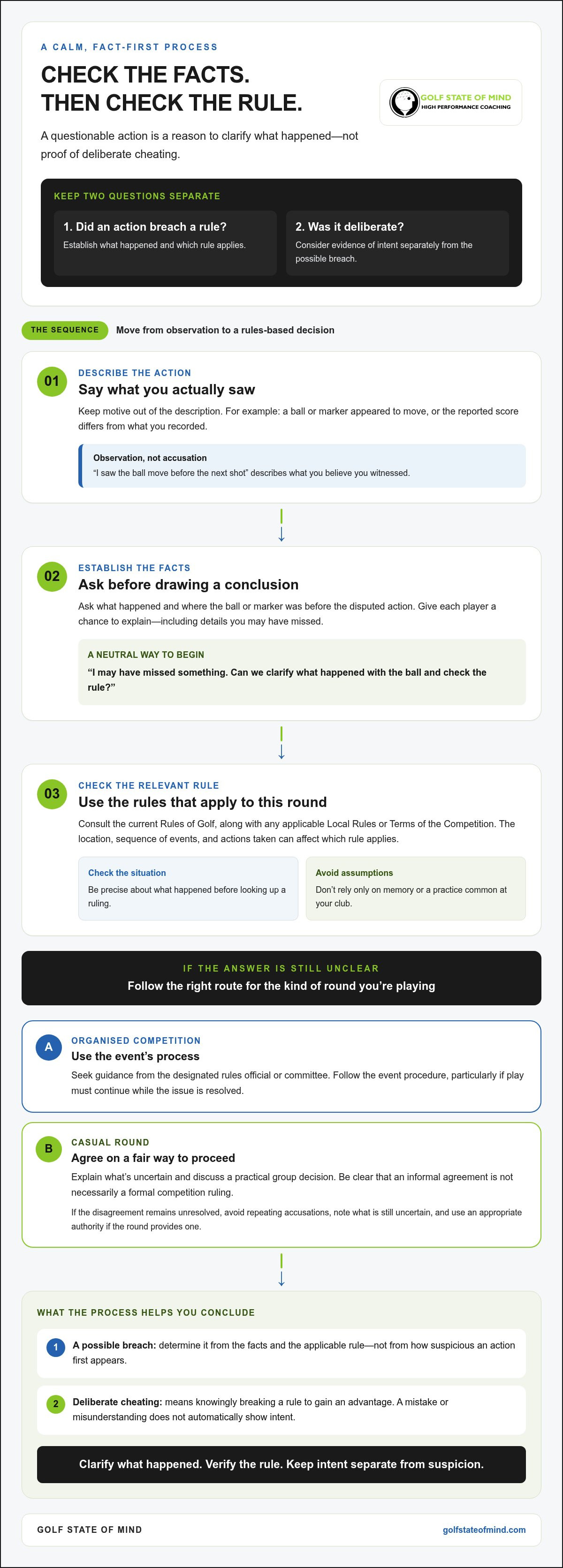
When you notice something questionable, resist settling the matter from memory or instinct. A steady process helps the group work out what happened and what the rules require, without turning uncertainty into an accusation. Keep two questions distinct: did an action breach a rule, and is there evidence it was deliberate?
A questionable action alone doesn’t establish intent. First verify the facts and the rule that applies.
Use this sequence:
- Describe the action. State what you actually saw without adding a motive. For example, say that a ball or marker appeared to move, or that a reported score differs from what you recorded.
- Establish the facts. Ask what happened and where the ball or marker was before the disputed action. Give each player a chance to explain what they observed, including details you may have missed.
- Check the relevant rule. Consult the current Rules of Golf and any applicable Local Rules or Terms of the Competition. Don’t rely only on memory or a practice that happens to be common at your club.
How to verify a suspected rules breach
Be precise about the situation before looking up a ruling. The location, sequence of events, and actions taken can affect which rule applies. If the answer remains unclear, don’t present a guess as an official decision. In a competition, seek guidance from the designated rules official or committee and follow the event’s procedure, particularly if play must continue while the issue is resolved.
The USGA’s guidance on Rules of Golf player conduct addresses players’ responsibilities and conduct. Use the applicable current rules and competition information for the situation in front of you. A general reference can’t establish what happened in your group.
Does the same process apply in every golf round?
The fact-finding principles apply in any round, but the route to a decision can differ. An organised competition may have a designated official, a committee, and published procedures for rules questions. Follow those procedures rather than treating a playing group’s informal agreement as an official ruling.
In a casual round, explain what’s uncertain and agree on a fair way to proceed. Be clear that this is the group’s practical decision, not necessarily a formal ruling for competition play. If the disagreement can’t be resolved, avoid repeating accusations. Note what remains uncertain and use the appropriate authority if the round or event provides one.
Rule knowledge helps you check the situation, but it won’t control your reaction to it. Practising focus and emotional steadiness through the Ultimate Mental Game Training System For Golf can support composure during a tense moment. Mental training doesn’t determine a ruling. Your task is to verify the facts, follow the right process, and keep your response measured.
How to Raise a Concern About Cheating in Golf Without Escalating
Once you’ve reviewed what you observed and the relevant rule, choose how to raise the issue. The aim is to clarify the situation, not win an argument or force a confession. Speak at a suitable moment, keep your tone even, and give the other player room to explain. A measured opening can protect the round while still taking fairness seriously.
What can you say when you notice a questionable action?
Use a simple sequence: choose a calm moment, describe the specific action, then ask to clarify what should happen under the rule. Avoid raising your voice across the group or turning the concern into a public accusation. If play is moving quickly, wait for a practical pause rather than interrupting someone mid-shot or making a spectacle of the exchange.
For example: “Can we check the rule for what happened there? I saw the ball move before the next shot, but I may not have the full picture.” Or, if a score is disputed: “I had a different number for that hole. Can we go through the strokes together?” These phrases identify the issue without labelling the player. Then listen. The explanation may resolve the discrepancy, or make it clear that the group needs to check the rule or event procedure.
When should a competition official or committee get involved?
If the group can’t resolve a rules question, or the event’s procedures call for an official decision, use the competition’s stated process. Share what you directly observed, where and when it happened, and what remains unclear. Keep your account factual. Don’t embellish, speculate about motive, or demand a particular outcome. Not every disagreement needs a formal complaint, but an unresolved issue in an organised event shouldn’t be settled by escalating a personal argument.
Repeated concerns call for the same discipline. Record specific incidents accurately and raise them through the appropriate channel if the situation warrants it. Avoid threats, gossip, or public shaming; those responses can deepen conflict without establishing what happened. The PGA’s discussion of the psychology of cheating in golf considers possible motivations, but a theory about why people cheat can’t tell you what a particular player intended. Stay with observable conduct and let the proper process assess the facts.
In dealing with cheating in golf, composure isn’t passivity. It helps you speak clearly, choose a proportionate response, and avoid letting anger decide the next step. Practising that steadiness away from the course can support your ability to return your attention to play. The Ultimate Mental Game Training System For Golf offers self-paced mental training for golfers, supporting focus and emotional control rather than rules decisions.
After a Golf Cheating Dispute, Reset Your Attention for the Next Shot
A rules disagreement can be settled while the frustration remains. You may replay what happened, question the other player’s explanation, or carry resentment to the next tee. That mental loop takes attention away from decisions you can make now. Once the issue has been addressed through the appropriate process, focus on returning to the round rather than trying to change what has already been decided.
How to stop the dispute replaying in your mind
Don’t demand that irritation disappear instantly. Notice it without feeding it. Silently name the thought: “I’m still frustrated about that ruling.” Then let it be present without reopening the case or trying to prove what another player intended. Acceptance doesn’t mean agreeing with every outcome. It means recognising that the question has been handled for now.
Use a simple transition before preparing for your next shot:
- Acknowledge the outcome. Remind yourself that the rules issue has been addressed, or that the next step is outside your control.
- Exhale once deliberately. Let the breath out naturally, without forcing a technique or expecting it to change your score.
- Choose one task. Bring your attention to the target, the lie, or the decision you need to make next.
This isn’t a way to deny anger. It gives you a practical point of return when your thoughts keep circling back. The guide to golf emotional control explores how golfers can respond to emotional reactions with greater awareness and steadiness.
How to protect the rest of the round
Keep the dispute separate from the shot in front of you. Don’t use the next swing to make a point, compensate for a perceived injustice, or test a new mechanical thought. Return to your familiar pre-shot routine: assess the situation, select a target, commit to the shot, and proceed at your usual pace. A routine offers structure even if your mood hasn’t fully settled.
Under stress, attention can drift toward the argument instead of the target and decision. The guide to handling pressure in golf can help you think about directing focus when tension rises. Apply the same principle here: keep your attention on the next controllable action. You can’t guarantee a particular result, but you can choose where to place your focus and how to prepare.
Dealing with cheating in golf tests more than your knowledge of the rules. It also tests whether you can regain your composure after a decision. Practise that mental reset with the Ultimate Mental Game Training System For Golf, a self-paced way to work on the mental side of your game and return your attention to the next shot.
Build the Mental Skills to Handle Golf Disputes with Composure
A difficult exchange can reveal how prepared you are to manage your attention under pressure. Mental training gives you a chance to practise noticing frustration, choosing a measured response, and returning focus to the task in front of you. These skills can support composure during a dispute, but they don’t determine whether another golfer broke a rule. Rulings depend on the applicable rules and competition process.
That distinction matters. Dealing with cheating in golf can involve uncertainty and strong emotions, but a steadier response is something you can practise before the next disagreement. Build a simple mental routine: notice your reaction, pause before speaking, and decide what action is within your control. The goal isn’t to suppress every feeling or guarantee a conflict-free round. It’s to respond deliberately instead of letting frustration make the decision for you.
What mental practice can and cannot do after a dispute
After an exchange, your attention may stay fixed on what the other player said or what you think should have happened. Practise recognising that pull, then shift your focus to your next responsibility: assess the lie, select a target, or begin your familiar pre-shot routine. Repeating this process during ordinary rounds can make it easier to call on when tension rises.
Mental skills can also support self-belief. You may not control how another golfer responds, but you can prepare to communicate clearly, follow the appropriate process, and make your next decision with care. Coaching and mental training support focus and emotional steadiness. They don’t adjudicate rules, guarantee lower scores, or promise that disputes won’t happen.
A practical next step for ongoing mental-game development
Golf State of Mind founder David MacKenzie is a Mental Coach who studied Sports Psychology at the University of St. Andrews. His work focuses on golf performance and the mental habits that support it. Over 100k golfers worldwide have used the Ultimate Mental Game Training System For Golf, which combines audio and workbook learning that golfers can use at their own pace.
Use this kind of practice as ongoing preparation, not a quick fix for one tense round. You might focus on recognising emotional triggers, choosing a response before reacting, and returning your attention to the next shot after a difficult moment. Keep the practice grounded in your own controllable actions. A consistent mental process can help you approach challenges with greater awareness, even though it can’t decide a rules question or control the outcome of a round.
If you want a structured way to continue developing your golf mindset, explore the Ultimate Mental Game Training System For Golf. Treat mental training as a continuing discipline: practise the skills, reflect on how you respond, and carry that awareness into your next round.
Make Composure Part of Your Preparation
The next difficult moment on the course may not unfold exactly as you expect. You can still prepare for it. Decide now how you want to respond when tension rises: pause, act on what you know, and return your attention to the shot in front of you. Rehearsing that response during ordinary rounds can make it easier to use when a disagreement interrupts your focus.
That is the deeper value of dealing with cheating in golf fairly. Your response reflects the kind of competitor and playing partner you choose to be, even when you can’t control what someone else does or says. Composure isn’t passive. It’s the discipline to act with care, then move forward.
Build that discipline through regular mental practice. The Ultimate Mental Game Training System For Golf was developed by David MacKenzie, who studied Sports Psychology at the University of St. Andrews, and offers self-paced audio and workbook learning. Over 100k golfers worldwide have used the system. Explore the Ultimate Mental Game Training System For Golf and take a deliberate next step in your mental-game development.
Frequently Asked Questions Is it cheating in golf if someone improves their lie?
Not automatically. Whether improving a lie breaks a rule depends on what the player did, where the ball was, and whether a rule allowed the action. A player may be entitled to move or replace a ball in some situations, while deliberately altering its position or the conditions affecting a stroke to gain an advantage may be a breach. Establish the facts and check the current rule before judging intent.
Can you call out another golfer for cheating during a round?
You can raise a concern, but avoid making a public accusation before the facts are clear. Speak calmly at a suitable moment and describe what you observed: “I saw you touch the ball before that shot. Can we clarify what happened?” Listen to the response. If the issue remains unresolved in a competition, follow the event’s process rather than turning the exchange into a personal confrontation.
What should you do if you are unsure whether a golf rule was broken?
Describe the action as precisely as you can, then check the current Rules of Golf and any competition-specific terms. For example, note whether a player lifted, moved, or replaced the ball instead of relying on a vague impression that the lie changed. If you still can’t determine the ruling, ask the designated official or committee in a competition. Follow the event’s procedure for continuing play while the question is resolved.
How do you handle a golfer who repeatedly bends the rules?
Keep your response tied to specific incidents, not reputation or hearsay. If a questionable action happens again, state what you observed and ask for the relevant rule to be applied. In an organised event, use its reporting process and share factual details with the official or committee. In a casual group, set a clear expectation for how scores and rules will be handled, then avoid threats or public shaming.
Can a golf competition official settle a rules dispute?
Yes. A competition may designate a rules official to help players determine how a rule applies, while the committee administering the event handles questions under its procedures. The official can assess the facts and provide guidance; the exact process depends on the competition. Share what you saw, what remains disputed, and relevant information from the players involved. A casual group without an appointed official shouldn’t describe its informal agreement as an official ruling.
What is the difference between a golf rules mistake and cheating?
A rules mistake is an accidental error or misunderstanding; cheating involves knowingly breaking a rule to gain an advantage. The distinction is about intent, and intent can’t be established just because an action looks unusual. A player who misunderstands a relief option may still need to correct a rules issue, but that alone doesn’t prove deception. In dealing with cheating in golf, separate what happened from what you believe motivated it.
How can you refocus after an argument on the golf course?
After the matter is addressed, acknowledge that you’re still annoyed without replaying the exchange. Let out one natural, deliberate breath, then name the next useful task: choose a target, assess the lie, or begin your usual pre-shot routine. If the thought returns, notice it and redirect your attention rather than trying to settle the argument in your head. This reset supports a more deliberate next decision, but can’t guarantee a particular shot or score.
The post Dealing with Cheating in Golf: How to Respond Fairly and Keep Your Composure appeared first on Instruction For The Mental Game of Golf.
Source: https://golfstateofmind.com/dealing-with-cheating-in-golf-how-to-respond-fairly-and-keep-your-composure/
Anyone can join.
Anyone can contribute.
Anyone can become informed about their world.
"United We Stand" Click Here To Create Your Personal Citizen Journalist Account Today, Be Sure To Invite Your Friends.
Before It’s News® is a community of individuals who report on what’s going on around them, from all around the world. Anyone can join. Anyone can contribute. Anyone can become informed about their world. "United We Stand" Click Here To Create Your Personal Citizen Journalist Account Today, Be Sure To Invite Your Friends.
LION'S MANE PRODUCT
Try Our Lion’s Mane WHOLE MIND Nootropic Blend 60 Capsules
Mushrooms are having a moment. One fabulous fungus in particular, lion’s mane, may help improve memory, depression and anxiety symptoms. They are also an excellent source of nutrients that show promise as a therapy for dementia, and other neurodegenerative diseases. If you’re living with anxiety or depression, you may be curious about all the therapy options out there — including the natural ones.Our Lion’s Mane WHOLE MIND Nootropic Blend has been formulated to utilize the potency of Lion’s mane but also include the benefits of four other Highly Beneficial Mushrooms. Synergistically, they work together to Build your health through improving cognitive function and immunity regardless of your age. Our Nootropic not only improves your Cognitive Function and Activates your Immune System, but it benefits growth of Essential Gut Flora, further enhancing your Vitality.

Our Formula includes: Lion’s Mane Mushrooms which Increase Brain Power through nerve growth, lessen anxiety, reduce depression, and improve concentration. Its an excellent adaptogen, promotes sleep and improves immunity. Shiitake Mushrooms which Fight cancer cells and infectious disease, boost the immune system, promotes brain function, and serves as a source of B vitamins. Maitake Mushrooms which regulate blood sugar levels of diabetics, reduce hypertension and boosts the immune system. Reishi Mushrooms which Fight inflammation, liver disease, fatigue, tumor growth and cancer. They Improve skin disorders and soothes digestive problems, stomach ulcers and leaky gut syndrome. Chaga Mushrooms which have anti-aging effects, boost immune function, improve stamina and athletic performance, even act as a natural aphrodisiac, fighting diabetes and improving liver function. Try Our Lion’s Mane WHOLE MIND Nootropic Blend 60 Capsules Today. Be 100% Satisfied or Receive a Full Money Back Guarantee. Order Yours Today by Following This Link.


| Visits: | 1,835,316,726 |
| Stories: | 8,722,598 |
Whistler Blowers, Insiders

