

Thomas Jefferson Wanted To Bring Calvin’s Academy To America… Professors And All

Imagine somebody proposing that America import an entire college. Not buy a few books. Not hire one famous professor. Bring the faculty across the Atlantic and plant the institution on American soil.
Now imagine Thomas Jefferson helping pursue the idea—and the college being the Geneva Academy that John Calvin established more than two centuries earlier.
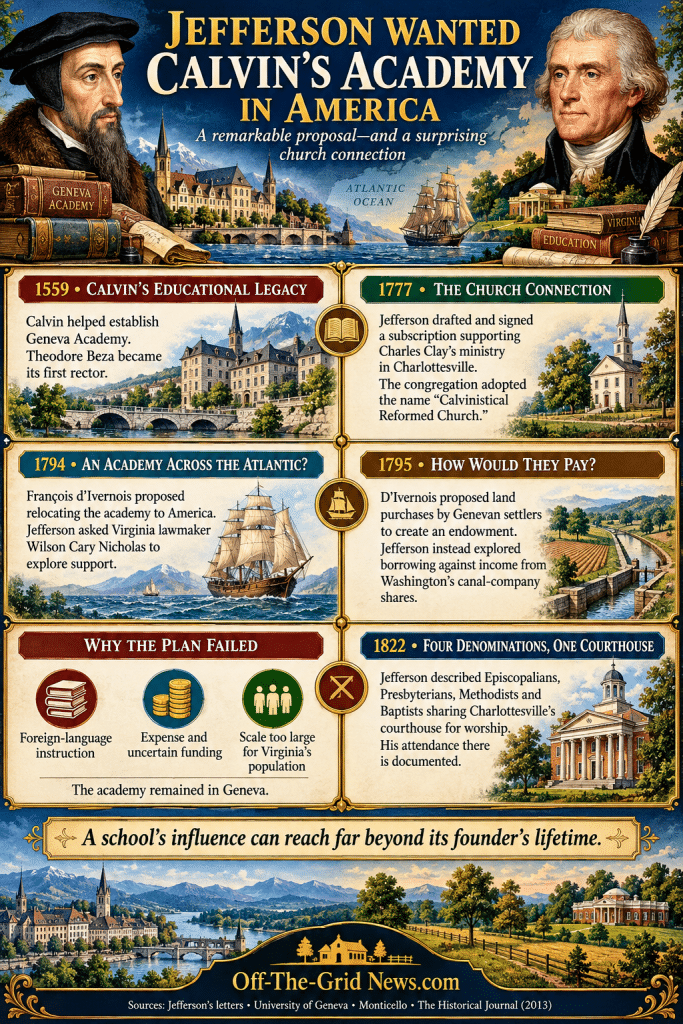
That sounds like somebody dropped two history books down the stairs and shuffled the pages together. But the correspondence survives. In 1794 and 1795, Jefferson helped explore an extraordinary proposal to transplant Geneva’s academy to America. upload.wikimedia.org
And there’s another wrinkle. Years earlier, Jefferson had helped organize and support a Charlottesville congregation bearing the name “Calvinistical Reformed Church.”
There’s considerably more under this floorboard than most of us were taught.
Before Jefferson Took An Interest, Calvin Built A School

First, travel back to Geneva in 1559. Calvin’s reforming work included an ambitious educational undertaking: a college providing preparatory instruction and an academy offering advanced learning. Theodore Beza became its first rector.
According to the University of Geneva’s own history, Calvin was the driving force behind the academy’s creation. Originally conceived as a theological and humanist seminary, it became the institution from which today’s university developed. www.unige.ch
Its early instruction included theology, Hebrew, Greek, and philosophy. Students encountered biblical interpretation alongside classical authors, logic, rhetoric, and the natural philosophy of their day.
That educational purpose reached beyond filling pulpits. The university’s historical account of its theology faculty traces Calvin’s intention to prepare young people for both ministry and civil government. A community needed educated people to shoulder its responsibilities. www.unige.ch
Think of a homestead where somebody plants an orchard knowing he may never eat its best harvest. Schools are another way a generation provides for people it will never meet.
Calvin died in 1564. His academy kept growing.
The School Outgrew The Lifetime Of Its Founder
Over the following centuries, Geneva’s institution developed a wider intellectual life. Its teaching came to encompass fields including mathematics, astronomy, botany, law, and physics alongside theology.
The university’s archives describe that expanding curriculum. An observatory followed in 1773, connecting astronomical study with Geneva’s important watchmaking industry. Learning had work to do in the surrounding city. www.unige.ch
By Jefferson’s time, the academy possessed an inheritance accumulated over generations: teachers, scholarly relationships, disciplines, and a reputation that crossed borders.
A building can go up quickly if you have money and willing hands. An institution with that kind of accumulated knowledge takes longer.
And now political upheaval threatened its future.
A Revolutionary Storm Blew The Proposal Across The Atlantic
Geneva’s late eighteenth-century politics were turbulent. Republican struggles, foreign intervention, and the upheaval surrounding the French Revolution sent Genevans searching for safety and opportunities elsewhere.
Historians Jennifer Powell McNutt and Richard Whatmore trace these circumstances in “The Attempts to Transfer the Genevan Academy to Ireland and to America, 1782–1795.” Their account places the American proposal within a larger effort to preserve Genevan learning and republican life under pressure. www.cambridge.org
One advocate was François d’Ivernois, a Genevan writer and political exile whom Jefferson knew from his years in Paris. D’Ivernois proposed bringing the academy to America.
Consider the nerve of it. Professors had households, obligations, and uncertain futures. An ocean stood between them and a country still building its own institutions.
Nevertheless, d’Ivernois went looking for Americans who could recognize the opportunity.
Jefferson did.
Jefferson Started Knocking On Virginia’s Door
In his November 22, 1794, letter to Wilson Cary Nicholas, Jefferson described the proposal:
“to translate the academy of Geneva in a body to this country.”
He also called Edinburgh and Geneva “the two eyes of Europe” in matters of science. Nicholas, a Virginia legislator, was asked to investigate whether his colleagues would support the undertaking. Jefferson wanted a serious private inquiry before anyone forced a public decision. www.gutenberg.org
Here was a man who could have put the papers aside, sent a pleasant reply, and returned to his farm. Instead, he sought a political opening.
The proposal offered something a young country could use: an established body of learning brought within reach of its own students.
It was an enormous idea. Unfortunately, enormous ideas still arrive with bills attached.
Yes, Land Was Part Of The Financing Scheme
This is where the story gets especially interesting for anyone who thinks in acres, annual income, and what a family can actually afford.
In his February 23, 1795, letter to George Washington, Jefferson explained d’Ivernois’s proposed financing. About one hundred Genevan families would purchase and settle appropriated land. Their payments would provide capital whose income would support the educational establishment.
D’Ivernois envisioned annual revenue of $15,000. His scheme included advanced scientific instruction, preparatory language education, and free basic instruction for the poor.
Jefferson proposed modifications. He estimated that retaining the principal scientific institution could reduce the annual requirement to approximately $10,000. He also set aside the land-financing approach and accompanying farming colony.
Instead, he suggested borrowing against anticipated income from the Potomac and James River company shares Washington had received from Virginia. The borrowing could help cover transportation, establishment, and the initial shortfall in operating income. originalsources.com
So there really was a land component. The surviving account identifies d’Ivernois’s proposal and Jefferson’s alternative clearly.
This was practical discussion about getting people across an ocean and keeping an institution alive afterward.
Virginia Liked The Idea… Until It Counted The Cost
Meanwhile, Nicholas’s inquiries produced disappointing news.
In his February 6, 1795, reply to d’Ivernois, Jefferson explained that Virginia lawmakers had considered the project privately. Some were enthusiastic, but they concluded it could not be accomplished.
Their objections were understandable. Virginia’s students lacked the necessary foreign-language preparation. The expense could upset constituents and undermine continued support. The institution’s proposed size exceeded what they considered suitable for the state’s population.
Jefferson regretted the outcome. He even suggested that, had the academy been established, he might have obtained a nearby residence for seasons when agricultural work demanded less attention. let.rug.nl
That is a striking measure of interest: he imagined arranging part of his life around access to these scholars.
His subsequent approach to Washington opened another possibility, but the academy never crossed the Atlantic. Nicholas Hans’s study of the project, drawing on papers in America and Geneva, documents this unusual episode in early American educational ambition. www.cambridge.org
Now Open The Courthouse Door

Before leaving Jefferson and Calvin in separate corners of the room, consider Charlottesville in 1777.
Jefferson drafted a subscription to support the ministry of Charles Clay, an Anglican clergyman. Historian Mark Beliles describes the resulting independent congregation as drawing from both Anglican and Presbyterian communities.
Initially identified as Protestant Episcopal, it adopted the name Calvinistical Reformed Church. Jefferson, Philip Mazzei, and John Harvie were among the subscribers. Beliles also reports that editor Julian P. Boyd characterized Jefferson as having organized the congregation. api.pageplace.de
The surviving language is fascinating. Subscribers sought the benefits of religious instruction and undertook to support a minister through voluntary contributions.
Beliles’s account of the congregation points to Clay’s surviving sermons and Jefferson’s recorded payments as evidence of an operating church, apparently lasting from 1777 to 1785. Some sermons specifically identify the Albemarle Courthouse as their preaching location. api.pageplace.de
The name alone cannot settle every question about the congregation’s doctrine. But Jefferson’s involvement deserves its place in the story.
He helped put financial support beneath a local religious undertaking. That is considerably more interesting than a tidy label pasted onto a textbook portrait.
Four Denominations Under One Roof
Later, the courthouse continued serving Charlottesville’s religious life.
Monticello documents Jefferson’s attendance at services there, where ministers of different denominations rotated. Its historical magazine identifies Baptist, Episcopal, Methodist, and Presbyterian participation. www.monticello.org
In a November 2, 1822, letter to Thomas Cooper, Jefferson described the courthouse as their shared place of worship, with one Sunday each month allotted to each denomination.
He pictured neighbors singing together, hearing one another’s preachers, and mixing peacefully in society. tjrs.monticello.org
Picture that courthouse on a Sunday morning: familiar neighbors gathering beneath a roof used during the week for public business. Their differences remained real. So did their ability to occupy the same room.
That scene deserves a little space in our understanding of early America.
Look At The Beams Before You Judge The Barn
What makes this history compelling is the unexpected connection.
A school born of Calvin’s Reformation developed a reputation that attracted Jefferson’s serious attention. A man whose religious convictions followed his own course could recognize value in an institution with a very different theological inheritance.
Country people understand something about that. You can inherit a well-built barn without agreeing with everything the man who raised it believed. Before you start tearing out timbers, you examine what they support.
Jefferson examined Geneva’s educational inheritance and saw something America might benefit from bringing home.
The relocation failed. The questions it raises remain.
What allows learning to survive political storms? How do communities support teachers? And how much of our own inheritance have we dismissed before bothering to discover what is holding up the roof?
Source: https://www.offthegridnews.com/religion/thomas-jefferson-wanted-to-bring-calvins-academy-to-america-professors-and-all/
Anyone can join.
Anyone can contribute.
Anyone can become informed about their world.
"United We Stand" Click Here To Create Your Personal Citizen Journalist Account Today, Be Sure To Invite Your Friends.
Before It’s News® is a community of individuals who report on what’s going on around them, from all around the world. Anyone can join. Anyone can contribute. Anyone can become informed about their world. "United We Stand" Click Here To Create Your Personal Citizen Journalist Account Today, Be Sure To Invite Your Friends.
LION'S MANE PRODUCT
Try Our Lion’s Mane WHOLE MIND Nootropic Blend 60 Capsules
Mushrooms are having a moment. One fabulous fungus in particular, lion’s mane, may help improve memory, depression and anxiety symptoms. They are also an excellent source of nutrients that show promise as a therapy for dementia, and other neurodegenerative diseases. If you’re living with anxiety or depression, you may be curious about all the therapy options out there — including the natural ones.Our Lion’s Mane WHOLE MIND Nootropic Blend has been formulated to utilize the potency of Lion’s mane but also include the benefits of four other Highly Beneficial Mushrooms. Synergistically, they work together to Build your health through improving cognitive function and immunity regardless of your age. Our Nootropic not only improves your Cognitive Function and Activates your Immune System, but it benefits growth of Essential Gut Flora, further enhancing your Vitality.

Our Formula includes: Lion’s Mane Mushrooms which Increase Brain Power through nerve growth, lessen anxiety, reduce depression, and improve concentration. Its an excellent adaptogen, promotes sleep and improves immunity. Shiitake Mushrooms which Fight cancer cells and infectious disease, boost the immune system, promotes brain function, and serves as a source of B vitamins. Maitake Mushrooms which regulate blood sugar levels of diabetics, reduce hypertension and boosts the immune system. Reishi Mushrooms which Fight inflammation, liver disease, fatigue, tumor growth and cancer. They Improve skin disorders and soothes digestive problems, stomach ulcers and leaky gut syndrome. Chaga Mushrooms which have anti-aging effects, boost immune function, improve stamina and athletic performance, even act as a natural aphrodisiac, fighting diabetes and improving liver function. Try Our Lion’s Mane WHOLE MIND Nootropic Blend 60 Capsules Today. Be 100% Satisfied or Receive a Full Money Back Guarantee. Order Yours Today by Following This Link.


| Visits: | 1,837,622,485 |
| Stories: | 8,733,756 |
Whistler Blowers, Insiders

