

When A Nation Forgets God… It Always Finds Something Else To Worship

Walk any fence line at dusk, and you’ll spot it. One post leans toward the creek, another toward the road, and a third looks like it’s waiting for a stiff breeze to finish the job. But every last one is planted somewhere.
Ideas work the same way. So do schools, governments, churches, and nations. They all stand on something, whether anybody admits it or not.
That’s the trouble Dutch Christian thinker Herman Dooyeweerd wanted people to notice. The issue for him was much larger than economics, political freedom, and schools for kids… he was asking an uncomfortable question: What happens when people forget their Creator and hand His job to something He created?
You don’t need a philosophy degree to follow the answer. Let’s clear away the fog and bring it home to the kitchen table.
The Dutchman Who Exposed A Dangerous Blind Spot
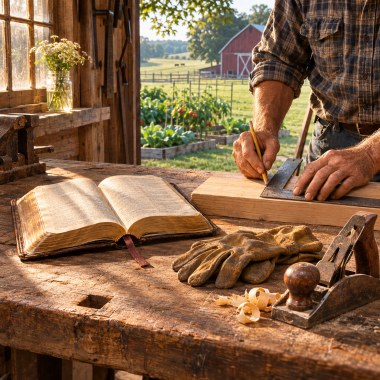
Born in Amsterdam in 1894, Herman Dooyeweerd earned his doctorate in law in 1917. He worked in government, including a tax office in Friesland, before serving at the research institute associated with Abraham Kuyper’s political party. Later, he taught legal philosophy at Amsterdam’s Free University.
In other words, he was a man of God, but not a pastor looking for a Sunday illustration. He had another calling. Dooyeweerd spent his working life investigating law, authority, scholarship, and the overlooked assumptions people tuck underneath them.
His essays, collected in Christian Philosophy and the Meaning of History, follow those assumptions down to their roots. Some of his conclusions are disputed, including by other Christians. Still, his central challenge is worth bringing home to the kitchen table.
Here’s the crucial question: Before you trust the house, have you looked under the floorboards?
Nobody Plants A Fence Post In Thin Air
First, Dooyeweerd argued that thinking never begins from nowhere. Before we start weighing evidence, we already have deep commitments about reality, meaning, and what deserves our trust. Those commitments reach into the heart, the center of the person. That doesn’t mean every calculation is a disguised sermon.
A Christian and an atheist can measure the same board and agree it’s eight feet long. But questions about what a human being is, what justice requires, or whether nature explains itself reach a whole lot deeper than a tape measure can go.
Now here’s the blind spot. When somebody announces that his entire outlook is perfectly neutral, ask where he planted his post. Does he believe reason answers to God? Or has human reason quietly promoted itself to the highest court in the universe?
For Dooyeweerd, the biblical starting point was creation, fall, and redemption through Jesus Christ in fellowship with the Holy Spirit. God made the world, sin reaches the whole person, and Christ’s redemption concerns all of life. That includes the courthouse, classroom, workshop, and barn. In other words…
Faith doesn’t stop at the church parking lot.
Good Gifts Make Terrible Gods
Now picture a working farm. Soil matters, rain matters, livestock matter, and so does having enough money to pay the feed bill. But nobody with much sense would mistake the checkbook for the whole operation.
Yet that’s what we do with God’s gifts. We take something real and valuable, such as reason, freedom, money, government, or national identity, and ask it to carry the weight of everything. Dooyeweerd called that making the relative absolute.
In plain English, we like to build idols out of useful things and important concepts. Then we’re shocked when the idol starts barking out demands.
Make the state your savior, and families become problems for officials to manage. Make the market your final authority, and anything without a price tag starts looking disposable. Make personal freedom supreme, and even ordinary obligations begin to feel like trespassing.
Here’s the trap: These things all have a proper place, but we keep promoting them beyond it. The trouble isn’t that they’re useless. It’s that none belongs on God’s throne. As Romans 1 describes it, people can exchange the Creator for created things without giving up worship at all. So worship keeps on happening, but the worship target changes.
The Ancient Tug Of War That Won’t Let Go
To explain how these loyalties shape history, Dooyeweerd went back to ancient Greece. In his reading, Greek religion and philosophy carried a deep tension between the restless flow of life and the desire for fixed forms, order, and beauty.
On one side were religions and the worship associated with revolution, emphasizing radical change in the temporal sense. All about the “river of life” down here. Usually associated with fertility, ecstasy, and death.
Then there was the more ordered world above… the world of the Olympian gods. He called the resulting philosophical tension the form-matter motive.
That’s his broad interpretation, not a complete description of every Greek thinker or religious practice. Ancient Greece was more complicated than two neighbors arguing across a fence. But his question is easy enough to understand: How do you explain both a changing world and the order that brings it together and makes it intelligible?
Plato and Aristotle offered different answers. Dooyeweerd believed neither could finally resolve the tension by looking within creation for its ultimate explanation.
Here’s what happened: Early Christian thinkers began borrowing Greek philosophical tools. Some of this borrowing might have helped Christians state difficult questions more clearly. But Dooyeweerd thought certain borrowed assumptions slipped in like weed seeds in a load of hay. Once they take root, they’re pretty darn hard to get rid of.
Did Christians Build A Two Story Faith
Now the story gets up close and personal inside the church. Dooyeweerd believed medieval Christianity tried to fit biblical faith and Greek philosophy into one house. The downstairs was nature and reason; the upstairs was grace and Biblical revelation.
Thomas Aquinas became a major example in his criticism. Aquinas distinguished truths autonomous reason can discover from truths known through divine revelation. Dooyeweerd feared that this arrangement gave autonomous reason too much room downstairs.
However, we need to be fair to the man I’m criticizing. Aquinas did teach that sin wounds human nature, including reason and the will. Saying he thought the fall left human nature completely untouched would be wrong. But wounded is different from dead in sins.
In fact, the real disagreement runs a lot deeper. Dooyeweerd believed biblical faith must challenge the very roots of philosophy itself, rather than just supplying the truths philosophy can’t reach. He also argued that Arminian thinkers carried versions of the same division forward as Aquinas.
Meanwhile, you can recognize the practical trap without settling every medieval debate. We go to church and pray on Sunday, then treat Monday’s business, schooling, and politics as territory where God’s authority needs an invitation. In all this we tend to treat God as a consultant rather than an ultimate authority in every area of life. Pretty soon, the upstairs faith has no say over what happens downstairs in the kitchen.
When Man Decided To Be His Own Maker
Next came the modern struggle Dooyeweerd described as nature against freedom. Renaissance and later humanist thought increasingly placed confidence in humanity’s power to understand, shape, and master the world. Autonomous human freedom was always at the center of the picture.
But then a glaring problem appeared. If everything in nature operates like a closed machine, and people belong entirely to that machine, what happens to the “free person” who was supposed to run it? Suddenly, the fellow holding the wrench turns out to be just another gear in the machine.
Different thinkers tried different repairs. Rousseau stressed freedom and challenged the corruptions of civilization. Kant distinguished the world investigated by science from the standpoint of moral freedom. Hegel sought a larger reconciliation through historical development.
Later, positivist approaches emphasized scientific knowledge, while Marx interpreted social history through material conditions and class conflict. These weren’t identical projects, and they didn’t form one tidy relay race. Dooyeweerd read their disagreements as evidence of an unresolved religious tension beneath modern thought.
Meanwhile, radical historical relativism raised another difficulty. If every truth and moral judgment is merely a product of its time, on what grounds can we condemn any evil or any normalized cruelties of our own age? A calendar can tell you the date. It can’t tell you whether the thing being celebrated is good or not.
History Is More Than Yesterday With Dust On It
At this point, Dooyeweerd made a distinction that sounds odd until you put work boots on it. The past includes everything that happened. But the historical aspect of life concerns our power to form and develop culture. Now that sounds highfalutin, right? But let’s consider what he’s saying from the ground up.
Think about building a barn. There’s a physical side involving a lot of timber and gravity, an economic side involving costs, and a legal side involving ownership and agreements. There’s also a cultural side: people use skills, tools, and inherited knowledge to shape something that wasn’t there before.
That shaping power carries responsibility. A storm can knock down the barn, but the storm doesn’t answer moral questions about its conduct. A builder who knowingly cheats his neighbor does.
So history isn’t a river that washes responsibility away. People make decisions within it, and those decisions can honor or violate the order God gives His world. That said, even making the best bad decision doesn’t make that decision bulletproof, and it certainly doesn’t settle whether it’s right.
After all, rot can spread just as surely as a good crop can grow.
A Strong Community Leaves Room For Different Callings
Dooyeweerd also contrasted relatively closed cultures with cultures whose institutions become more differentiated. In a tightly fused community, one authority may control family life, worship, trade, education, and justice. There’s little room for institutions to develop their own responsibilities.
As cultural life unfolds, those responsibilities can become clearer. A court administers justice. A business produces and trades. A church ministers according to its calling, while a family has obligations no public office can or should simply absorb.
This wasn’t a claim that isolated people lack dignity or that every modern society is morally superior. Nor does living in a small rural community make you culturally backward. The important issue is whether distinct responsibilities can develop without one institution swallowing the others.
Here’s why that distinction ought to hit close to home. Capable neighbors can cooperate without turning every household into a branch office. A healthy community needs common purposes, but it also needs boundaries around power.
Don’t Let A New Boss Swallow The Whole Farm
Of course, opening up cultural life doesn’t mean burning every tradition. Dooyeweerd recognized that people inherit far more than they invent. Conceptual frameworks such as language, craftsmanship, legal habits, and ordinary customs arrive before we do.
That should make us cautious about anybody promising to erase the past and start humanity over. You can tear down the old barn in an afternoon. Replacing the knowledge that built it takes a whole lot longer.
Even so, tradition can lure us into the same old trap. Dooyeweerd opposed outright nationalism. In his time, it took the form of the Nazi glorification of blood and soil, which treated “national belonging” as though ancestry and land supplied a people’s ultimate meaning and purpose. In his judgment, forcing a developed society into an all-consuming tribal identity was a retreat disguised as renewal.
Here the warning reaches beyond one historical movement. Whenever rulers demand that churches, schools, businesses, and households serve one political mission without limit, the problem is bigger than a bad policy. Somebody is trying to dominate the whole farm.
A flag can mark a nation. It can’t redeem one.
Don’t Let One Crop Take The Whole Field
At this point, we reach one of Dooyeweerd’s most valuable insights for everyday life. Different parts of society have different tasks, and a healthy culture respects those differences. He connected that balance with what he called cultural economy.
Think of a farm where one single crop occupies every acre on that farm, including the garden and pasture. It might look very efficient on a chart or a spreadsheet. But you’ll discover the hidden cost when the animals need feeding and supper needs vegetables.
Likewise, government has real duties, including public justice, but that doesn’t make it the parent of every child or the pastor of every congregation. Business serves real needs, but profit can’t decide the worth of a person. Scientific inquiry can tell us a great deal about the world without becoming the final judge of what life is for.
The church needs the same humility. Affirming Christ’s authority over all life doesn’t give church officers jurisdiction over every household decision or every technical question. Christ is Lord of the whole field; none of His servants gets the deed to it.
That’s a bracing thought for any institution that has grown fond of issuing orders.
More Power Won’t Cure The Human Heart

Here’s the thing: Dooyeweerd offered no big cheerful promise that better institutions would end human wickedness. Cultural development gives people greater powers, and sinners can use those powers to do greater harm. A sharper tool doesn’t improve the character of the hand holding it. Put more power in reckless hands, and the damage can multiply.
That’s why his account of history leaves room for suffering, conflict, and terrible misuse of human gifts. Better medicine and stronger bridges can and do coexist with organized cruelty. Technical progress doesn’t automatically bring moral progress along for the ride.
Here his Christian outlook draws on the conflict Augustine first described between loves directed toward God and loves turned away from Him. The deepest problem isn’t simply that the wrong people hold office. It’s that fallen people keep asking created things to save them.
Consequently, no civilization can serve as our final hope. The West isn’t the kingdom of God, and neither is any other nation or cultural inheritance. Christians may love their country and work for its good without expecting it to do the work of Christ.
The Quiet Surrender That Leaves Christians Vulnerable
One essay in the collection dates to 1937 and addresses the danger of Christian intellectual surrender. Dooyeweerd objected to a bargain that treated scholarship as religiously neutral while confining faith to a private corner. In his view, Christians were surrendering crucial ground by accepting the rules before examining who wrote them.
He criticized approaches he associated with theologians including Karl Barth and Emil Brunner. Those debates deserve more room than a passing label can give them. His central complaint, though, was clear: Christian faith can’t be declared irrelevant to our basic understanding of reality.
That doesn’t mean unbelievers can’t discover truths or do excellent scientific work. They can, and they do, often better than we as Christians do. Nor does it mean a Christian’s conclusions become reliable because he quotes Scripture before presenting them. Cold, hard facts still need careful handling, and mistakes still need correcting.
Rather, Dooyeweerd always wanted Christians to examine the larger claims attached to the findings. Measuring brain activity is one thing. Declaring that a human being is nothing more than measurable activity is another. That’s the crucial distinction. The second claim carries a philosophy with it, whether the speaker mentions that or not.
You Can Leave The Grid Without Leaving God’s World
So let’s put it on the table. What do we do with all this at home? Start by noticing what we expect to save us. Is it the next election, a bigger bank balance, the latest expert, or our own ability to stay one step ahead of trouble?
Preparedness and self-reliance have their place. So do learning, honest work, wise government, and independence from systems that fail. But a pantry full of jars can’t carry the weight of eternal hope, any more than a politician can forgive sins.
Next, teach your children to ask patient, practical questions. What is this person assuming? Where does this institution’s authority begin and end? Has something useful been promoted into something ultimate?
Above all, keep Christ at the center. Colossians 1 presents Him as the One through whom and for whom all things were created. That leaves no abandoned corner where families, history, learning, or work can finally explain themselves apart from Him.
Next time you walk the fence line, look down at the posts. Every post is planted somewhere, and sooner or later the weather will test the ground. The same goes for a nation. The same goes for us.
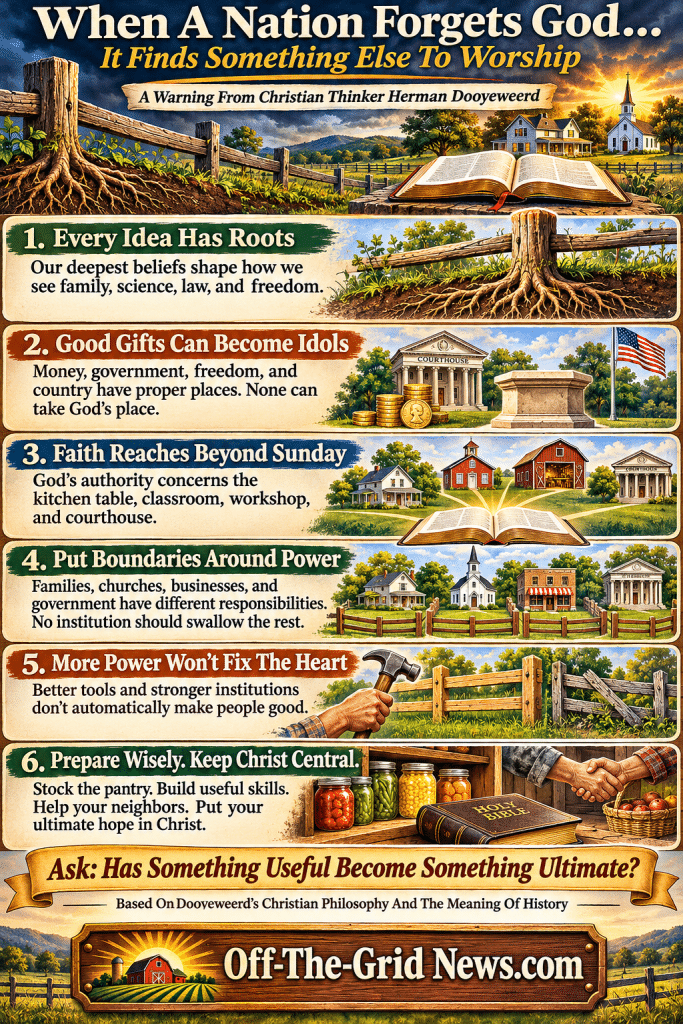
Source: https://www.offthegridnews.com/religion/when-a-nation-forgets-god-it-always-finds-something-else-to-worship/
Anyone can join.
Anyone can contribute.
Anyone can become informed about their world.
"United We Stand" Click Here To Create Your Personal Citizen Journalist Account Today, Be Sure To Invite Your Friends.
Before It’s News® is a community of individuals who report on what’s going on around them, from all around the world. Anyone can join. Anyone can contribute. Anyone can become informed about their world. "United We Stand" Click Here To Create Your Personal Citizen Journalist Account Today, Be Sure To Invite Your Friends.
LION'S MANE PRODUCT
Try Our Lion’s Mane WHOLE MIND Nootropic Blend 60 Capsules
Mushrooms are having a moment. One fabulous fungus in particular, lion’s mane, may help improve memory, depression and anxiety symptoms. They are also an excellent source of nutrients that show promise as a therapy for dementia, and other neurodegenerative diseases. If you’re living with anxiety or depression, you may be curious about all the therapy options out there — including the natural ones.Our Lion’s Mane WHOLE MIND Nootropic Blend has been formulated to utilize the potency of Lion’s mane but also include the benefits of four other Highly Beneficial Mushrooms. Synergistically, they work together to Build your health through improving cognitive function and immunity regardless of your age. Our Nootropic not only improves your Cognitive Function and Activates your Immune System, but it benefits growth of Essential Gut Flora, further enhancing your Vitality.

Our Formula includes: Lion’s Mane Mushrooms which Increase Brain Power through nerve growth, lessen anxiety, reduce depression, and improve concentration. Its an excellent adaptogen, promotes sleep and improves immunity. Shiitake Mushrooms which Fight cancer cells and infectious disease, boost the immune system, promotes brain function, and serves as a source of B vitamins. Maitake Mushrooms which regulate blood sugar levels of diabetics, reduce hypertension and boosts the immune system. Reishi Mushrooms which Fight inflammation, liver disease, fatigue, tumor growth and cancer. They Improve skin disorders and soothes digestive problems, stomach ulcers and leaky gut syndrome. Chaga Mushrooms which have anti-aging effects, boost immune function, improve stamina and athletic performance, even act as a natural aphrodisiac, fighting diabetes and improving liver function. Try Our Lion’s Mane WHOLE MIND Nootropic Blend 60 Capsules Today. Be 100% Satisfied or Receive a Full Money Back Guarantee. Order Yours Today by Following This Link.


| Visits: | 1,839,289,344 |
| Stories: | 8,741,640 |
Whistler Blowers, Insiders

