

When Sunday Was Still A Workday: How The First Christians Found Time For Church

Picture Corinth around A.D. 55.
The sun is beginning to crawl over the tiled roofs, and down toward the harbor, carts are already moving. Shopkeepers are opening shutters, somebody’s hammer is ringing against metal, and somewhere a slave is carrying water for a household that owns not only his labor, but much of his time.
And somewhere in that waking Roman city is a Christian.
It’s Sunday… and he’s probably going to work.
That sounds strange to modern ears because we’ve inherited nearly 2,000 years of Christian history. Sunday morning means church, and even people who haven’t darkened a church door in years understand the rhythm: Sunday is different.
But Paul’s Christians didn’t live in that world.
There were no Christian Sunday-closing laws in Corinth. No Roman employer was required to release a Christian for worship, and there wasn’t a church parking lot filling up at 9:45 because, for the earliest Christians, there probably wasn’t a purpose-built church building to drive to in the first place.
So when exactly did these people worship?
The answer takes us into one of the most fascinating corners of early Christianity. And once you see it, several familiar passages in the New Testament begin looking a little different.
Sunday Morning… And The Hammer Is Already Swinging
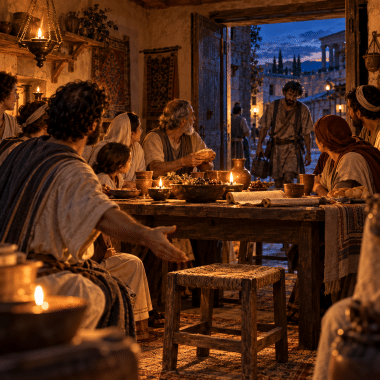
First, we need to clear away one misconception. Rome didn’t simply force every person to work seven straight days every week; Roman working schedules included festivals and religious observances and varied considerably depending upon whether you were a farmer, craftsman, merchant, slave or wealthy householder.
But here’s the important part: a Christian had no general legal right to take Sunday off because he was a Christian. For a slave or household servant, the problem was even more obvious because somebody else largely controlled his time.
Imagine telling a pagan Roman master, “Sorry, I can’t work today. It’s the Lord’s Day.”
That wasn’t much of an option.
Paul knew this working world firsthand. When he arrived in Corinth, Acts 18:1–3 says he stayed with Aquila and Priscilla because they shared the same trade: they were tentmakers, or more broadly workers in that trade.
Paul worked with his hands, and he later reminded the Thessalonians that he had been “labouring night and day” so he wouldn’t become a financial burden upon them (1 Thessalonians 2:9). Christianity didn’t arrive in the Roman Empire as a religion designed around people with leisurely Sunday mornings.
It arrived with dirt underneath its fingernails.
Somebody’s House Is Getting Ready
Now move ahead several hours. Our imaginary Corinthian Christian may still be working, but across town another believer could already be preparing for the gathering.
That Christian has something particularly useful: a house large enough for people to meet.
That’s important because Paul’s letters repeatedly place Christian congregations inside homes. He mentions the church in Aquila and Priscilla’s house (1 Corinthians 16:19), another congregation associated with Nympha’s house (Colossians 4:15), and another meeting in connection with Philemon’s household (Philemon 1–2).
There was no steeple over the building and no row of padded pews waiting inside. There was simply a household opening its doors, preparing food and making room for brothers and sisters who would begin arriving when circumstances allowed them to get there.
And that difference in circumstances matters.
Wait For The Fellow Who’s Still Working
One of Paul’s sharpest rebukes to the Corinthians concerned what happened when Christians gathered around the table. Their gathering included food and the Lord’s Supper, but something had gone badly wrong.
Paul writes in 1 Corinthians 11 that while they were supposedly coming together, “one is hungry, and another is drunken.” Some had plenty while others had little, turning the Lord’s Supper into something that exposed the very social divisions the church was supposed to overcome.
Scholars debate exactly how class differences, dining customs and differing arrival times contributed to the problem. Scripture doesn’t tell us enough to reconstruct every detail, so we shouldn’t pretend it does.
Still, we know what Corinthian society looked like. Wealthy householders, independent tradesmen, laborers and slaves did not possess equal control over their schedules, making it easy to imagine one Christian already reclining at the table while another is only now finishing his work and hurrying through the streets.
Then Paul gives the church an extraordinarily simple command:
“Wherefore, my brethren, when ye come together to eat, tarry one for another.”
Wait for each other.
That is more than good table manners. In a Roman world built around rank, privilege and social status, Paul is telling Christians that the brother walking through the door late matters just as much as the man whose house they’re sitting in.
Then The Lamps Are Lit
By evening, imagine the room beginning to fill. Oil lamps flicker against plaster walls as children settle beside their parents, bread appears on the table and tired people find somewhere to sit.
A slave may be sitting beside a free man. A Jewish believer may be eating beside a Gentile, while somebody who commands servants outside that room is being reminded that inside Christ’s body he has brothers rather than inferiors.
Paul describes the principle plainly:
“For by one Spirit are we all baptized into one body, whether we be Jews or Gentiles, whether we be bond or free…”
Then the gathering begins, and it might look strange to Christians accustomed to sitting quietly while one professional minister conducts nearly everything from the front.
Paul says in 1 Corinthians 14:26, “When ye come together, every one of you hath a psalm, hath a doctrine, hath a tongue, hath a revelation, hath an interpretation.” There was participation, teaching, prayer and discernment—and apparently enough disorder in Corinth that Paul had to spend much of the chapter explaining how it should all happen decently and in order.
But there’s something beautiful underneath the mess.
The household itself had become a sanctuary.
And Then Somebody Fell Out The Window
A couple of years later, Luke gives us an unforgettable picture of another Christian gathering. This time we’re across the Aegean at Troas, and the details are so ordinary that they almost smell like smoke from the oil lamps.
Acts 20:7–12 says the disciples gathered “upon the first day of the week” to break bread. Paul was preparing to leave the next day, so he kept talking until midnight.
Then Luke slips in a wonderfully earthy detail:
“And there were many lights in the upper chamber, where they were gathered together.”
It’s dark outside.
Paul keeps talking as the lamps burn. Ten o’clock comes and goes, then eleven, and eventually midnight arrives with Paul apparently showing no interest whatsoever in the first-century equivalent of checking his watch.
Meanwhile, a young man named Eutychus is sitting in a third-story window. His eyelids get heavy as Paul continues speaking, sleep finally wins, and Eutychus tumbles from the window and is taken up dead.
Paul rushes downstairs, embraces him and tells everyone not to be troubled because his life is in him. Then, remarkably, they go back upstairs, break bread, eat—and Paul continues talking until daylight. The biblical account explicitly describes the first-day gathering, the many lamps, midnight and then conversation continuing until dawn.
Poor Eutychus has taken grief for falling asleep in church for roughly two thousand years. Yet Scripture never tells us whether he’d been working that day, and we shouldn’t turn an attractive possibility into a fact.
Still, put a tired young man into a crowded upper room filled with people and burning lamps, keep him there until midnight, and you don’t need much imagination to understand what happened.
Anybody who has stacked firewood from sunup to sundown knows the feeling.
Before Sunrise, Christians Are Singing Again
Now move forward about fifty years.
Around A.D. 111–112, Roman governor Pliny the Younger was investigating Christians in Bithynia-Pontus and wrote Emperor Trajan asking how these strange people should be handled. This evidence is particularly valuable because Pliny wasn’t writing a church history or trying to prove Christianity true; he was a Roman official trying to deal with Christians as a legal and administrative problem.
The Christians he interrogated reportedly said they customarily assembled on a fixed day before daylight. They sang responsively to Christ “as to a god,” bound themselves to refrain from crimes and later gathered for ordinary food.
Think about the practical picture.
Before daylight.
The town is still dark. Shops haven’t opened, much of the household is sleeping, and Christians are already gathering to worship Christ before the day’s obligations close around them.
Pliny then gives us another remarkable detail: he interrogated two female slaves who were called deaconesses or ministers. Whatever every detail of their church office meant at that moment, their social position is unmistakable—they were slaves.
These weren’t women deciding whether the early service or late service worked better with their Sunday plans. Their masters possessed enormous authority over their daily lives, yet somehow these Christian women were serving the church.
So picture one of them walking home while the eastern sky begins turning gray. She has already sung to Christ, prayed with other believers and stood among people whom Roman society would ordinarily separate according to rank.
Then the sun rises.
And her workday begins.
Suddenly Hebrews Sounds Different
Read Hebrews 10:24–25 against that background: “Not forsaking the assembling of ourselves together.”
For us, assembling may mean getting everybody dressed, finding the car keys and trying to reach church before the opening hymn. For some early Christians, gathering may have meant sacrificing sleep, walking through dark streets, working around a master’s demands or arriving after a long day’s labor.
Yet they gathered.
And by the middle of the second century, the pattern becomes even clearer. Justin Martyr describes Christians assembling on Sunday, hearing readings from the apostles and prophets, receiving instruction, praying, celebrating the Eucharist and collecting assistance for widows, orphans, prisoners, strangers and others in need. Justin explicitly says Sunday was the common day of assembly and connects it both with creation and Christ’s resurrection.
So Sunday worship is unmistakable very early.
Sunday as a legally protected day off is another matter entirely.
The Lord’s Day Before There Was A Weekend
That’s the distinction we’ve largely forgotten.
The earliest Christians didn’t need Rome to recognize their calendar before they recognized Christ’s resurrection. They gathered on the first day, broke bread, prayed, taught one another and organized their lives around worship long before the government rearranged the workweek for them.
The major civil change came centuries later. Constantine’s A.D. 321 legislation gave Sunday substantial legal recognition as a day of rest for judges, city people and trades, while retaining an agricultural exception when farm work couldn’t conveniently wait.
Paul’s letters to Corinth belong around the middle of the first century.
That’s roughly two and a half centuries of Christian Sundays before Constantine’s law.
Two and a half centuries of lamps being lit.
Two and a half centuries of bread being broken.
Two and a half centuries of believers fitting worship around a world that wasn’t going to rearrange itself for them.
Maybe We’ve Been Asking The Wrong Question
So perhaps the question isn’t, “Did the first Christians go to church Sunday morning?”
That’s our world being pushed backward onto theirs.
A better question is this: How did Christians arrange their lives so they could gather when the surrounding culture gave them no Christian calendar at all?
The New Testament and earliest Christian evidence give us glimpses rather than a universal timetable. But those glimpses show believers gathering in homes, breaking bread, meeting at night and, not long afterward, assembling before daylight.
They gathered when faithful people could get there.
The carpenter finished his work. The servant completed her duties. The lamps were lit, the bread came out, somebody opened the Scriptures, and brothers and sisters began slipping through the door.
Tomorrow morning Rome would still be Rome. Caesar would still sit on his throne, the shop would reopen, the master’s voice would still call from another room, and the day’s work would still have to be done.
But for a few hours inside that crowded house, another Kingdom was visible.
Bond and free ate from the same table. Christians with plenty were commanded to wait for Christians who had little, and men and women possessing almost nothing gathered in the darkness to sing to Christ as King.
Then the door opened.
Morning came.
And they went back to work.
Sunday wasn’t theirs yet.
But the Lord’s Day was.
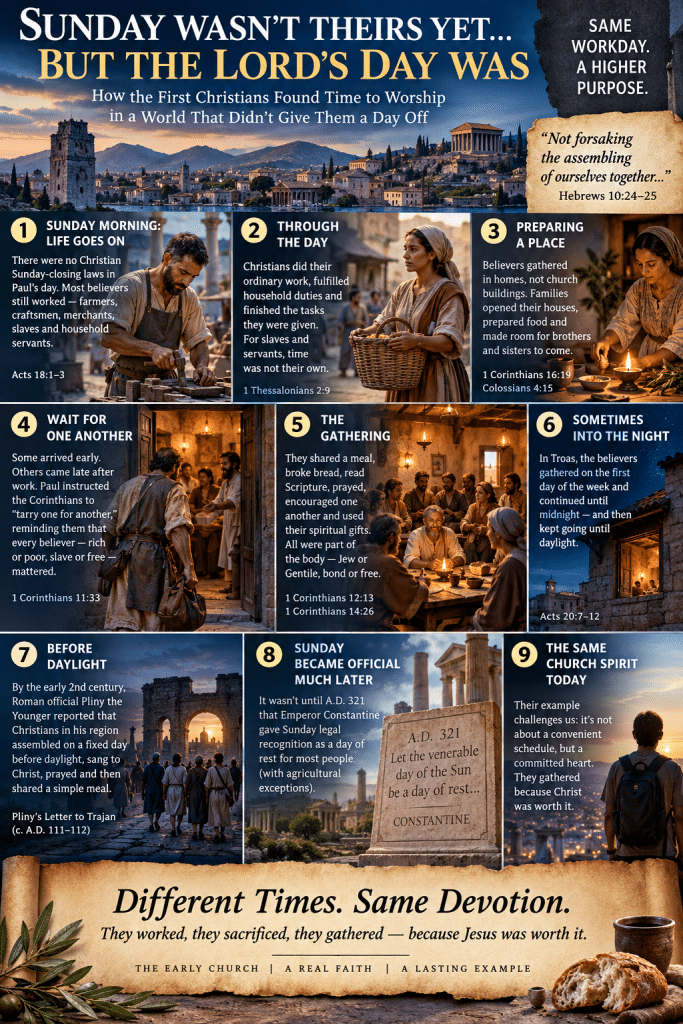
Source: https://www.offthegridnews.com/religion/when-sunday-was-still-a-workday-how-the-first-christians-found-time-for-church/
Anyone can join.
Anyone can contribute.
Anyone can become informed about their world.
"United We Stand" Click Here To Create Your Personal Citizen Journalist Account Today, Be Sure To Invite Your Friends.
Before It’s News® is a community of individuals who report on what’s going on around them, from all around the world. Anyone can join. Anyone can contribute. Anyone can become informed about their world. "United We Stand" Click Here To Create Your Personal Citizen Journalist Account Today, Be Sure To Invite Your Friends.
LION'S MANE PRODUCT
Try Our Lion’s Mane WHOLE MIND Nootropic Blend 60 Capsules
Mushrooms are having a moment. One fabulous fungus in particular, lion’s mane, may help improve memory, depression and anxiety symptoms. They are also an excellent source of nutrients that show promise as a therapy for dementia, and other neurodegenerative diseases. If you’re living with anxiety or depression, you may be curious about all the therapy options out there — including the natural ones.Our Lion’s Mane WHOLE MIND Nootropic Blend has been formulated to utilize the potency of Lion’s mane but also include the benefits of four other Highly Beneficial Mushrooms. Synergistically, they work together to Build your health through improving cognitive function and immunity regardless of your age. Our Nootropic not only improves your Cognitive Function and Activates your Immune System, but it benefits growth of Essential Gut Flora, further enhancing your Vitality.

Our Formula includes: Lion’s Mane Mushrooms which Increase Brain Power through nerve growth, lessen anxiety, reduce depression, and improve concentration. Its an excellent adaptogen, promotes sleep and improves immunity. Shiitake Mushrooms which Fight cancer cells and infectious disease, boost the immune system, promotes brain function, and serves as a source of B vitamins. Maitake Mushrooms which regulate blood sugar levels of diabetics, reduce hypertension and boosts the immune system. Reishi Mushrooms which Fight inflammation, liver disease, fatigue, tumor growth and cancer. They Improve skin disorders and soothes digestive problems, stomach ulcers and leaky gut syndrome. Chaga Mushrooms which have anti-aging effects, boost immune function, improve stamina and athletic performance, even act as a natural aphrodisiac, fighting diabetes and improving liver function. Try Our Lion’s Mane WHOLE MIND Nootropic Blend 60 Capsules Today. Be 100% Satisfied or Receive a Full Money Back Guarantee. Order Yours Today by Following This Link.


| Visits: | 1,837,639,421 |
| Stories: | 8,733,802 |
Whistler Blowers, Insiders

