

The Great Six Month Financial Blindfold

Submitted by QTR’s Fringe Finance
As many including myself recently have noted, we are already living through an extraordinary age of financial grift, accounting games, promotional fraud, speculative mania and almost total contempt for basic investor skepticism.
The SEC’s apparent response is to consider giving public companies less frequently required financial disclosure in the face of demonstrable public disapproval of the idea. You genuinely can not make this shit up.
At a moment when public markets increasingly resemble a casino operated by executives, influencers, investment bankers, meme-stock promoters, crypto carnival barkers and apparently untouchable fraudsters, the agency responsible for protecting investors is moving toward allowing companies to disappear behind the curtain for six months at a time. That’s plenty of time to “hide a body” in the accounting world.
According to The Wall Street Journal, the SEC is expected to proceed with a version of its proposal allowing public companies to report comprehensive financial results twice a year rather than quarterly, even after receiving more than 200,000 public comments, most of them opposing the change. Many commenters warned that the proposal would deprive investors of information, let companies operate behind closed doors and allow fraud to fester.
No sh*t.
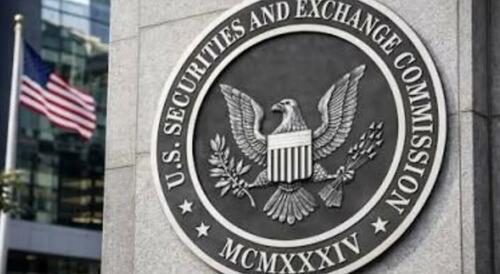
Apparently the public can see what the Securities and Exchange Commission cannot: when markets are already saturated with deception, euphoria, leverage and narrative-driven bullshit, the answer probably isn’t to give corporate management teams an additional three months to conceal deteriorating financial conditions.
The SEC officially proposed the change on May 5. Under the plan, companies could file one new semiannual Form 10-S instead of three quarterly Form 10-Q reports. Chairman Paul Atkins has described the proposal as part of his “Make IPOs Great Again” agenda, arguing that greater flexibility could encourage companies to enter and remain in public markets.
What a slogan. Not proposing to make accounting more reliable, punish executives who mislead shareholders, improve audit quality or help ordinary investors compete with institutions that purchase satellite data and scrape credit-card transactions. Proposing to make IPOs “great again” by letting companies tell their owners what is happening less often.
There is nothing populist about expanding the informational advantage enjoyed by executives, insiders, hedge funds, private-equity firms and institutions with access to management. There is nothing populist about telling ordinary investors to sit quietly for six months while insiders watch the business evolve in real time. There is nothing populist about weakening one of the few standardized disclosures that retail investors, pension beneficiaries and smaller asset managers can all access simultaneously.
This is regressive corporate deregulation dressed up in a red hat and marketed as liberation from paperwork. The public apparently understands the scam. According to the Journal, the SEC received a record number of comments on the proposal, and the opposition came from nonprofits, retirement funds, academics, individual investors and other members of the public.
Roughly 40,000 comments reportedly warned that the change would prevent investors from accessing information, let companies hide behind closed doors and allow fraud to grow. Yet the agency is still expected to push forward.
Why bother soliciting public comments at all?
Just publish a PDF saying, “Thank you for your concern. Management has reviewed management’s proposal and management remains extremely pleased with management.”
One public-school teacher reportedly observed that she must report grades every quarter so parents can monitor their children’s progress. She asked whether regulators trying to reduce corporate paperwork would be equally comfortable receiving updates about their own children only twice a year.
A childhood-cancer nonprofit offered an even more devastating example. According to the Journal, the organization said it learned from a quarterly update that a potential supplier had suffered a loss threatening its ability to manufacture components for an immunotherapy clinical trial. Without the disclosure, the nonprofit said it could have misallocated donations and lost time that sick children did not have.
The SEC’s apparent response to examples like these is that perhaps the final language can be adjusted before the agency does roughly what it intended to do anyway.
This entire proposal would be difficult to comprehend in a healthy market. In the current market, it borders on institutional malpractice.
As I wrote recently in Your Delusion Doesn’t Make Me a “Doomer,” we are already operating in an environment where asking a public-company executive to remain consistent is treated as a hate crime.

Investors increasingly regard skepticism as sabotage. Valuation questions are dismissed as “FUD.” Executives can promote a preferred metric while it is rising, quietly stop discussing it when it deteriorates and then rely on an army of shareholders to attack anyone rude enough to notice.
Public-company management teams increasingly operate less like employees of shareholders and more like heads of personality cults.
Meanwhile, passive funds continue buying. Options activity supplies additional momentum. Social media turns every stock into a tribal identity. Financial television recycles management talking points. Influencers explain that revenue is an obsolete concept. Promoters insist profitability will arrive at some distant point after the heat death of the universe. And when anyone asks a basic question about cash flow, accounting or dilution, they are told they simply do not understand innovation.
This is the environment in which the SEC wants to reduce mandatory reporting frequency.
We have companies trading at valuations that would once have been considered satire. We have unprofitable businesses raising billions based on stories that change every six months. We have aggressive adjusted earnings, customized metrics, endless stock-based compensation, related-party transactions, reverse mergers, promotional projections and balance sheets so complex they require an archaeological expedition.
Management already has an enormous information advantage over shareholders. The proposal would widen it.
Quarterly reports do not eliminate fraud. They do not guarantee honest management. They do not prevent executives from polishing adjusted figures until they shine like a bowling ball at a used-car dealership.
But quarterly reporting creates regular checkpoints. It forces management to reconcile narratives with numbers. It gives investors more frequent information about cash, debt, margins, customer concentration, working capital, dilution and operating performance. It gives auditors, analysts, short sellers, journalists and shareholders additional opportunities to notice that something is beginning to smell like the dumpster behind a Long Island boiler room.
Semiannual reporting would create longer stretches during which deterioration can accumulate before investors receive a full standardized update. Six months is a long time in a leveraged company. It is a long time when customers are leaving. It is a long time when cash is burning. It is a long time when a lender is tightening terms, inventory is piling up, receivables are deteriorating or management is desperately trying to refinance debt.
It is practically an eternity when executives know what is happening and ordinary shareholders do not.
The absence of information will itself become information, but by the time investors fully understand why management chose silence, management may have enjoyed months to sell stock, raise capital, renegotiate compensation or prepare a new narrative.
 50% OFF FOR LIFE: Using this coupon entitles you to 50% off an annual subscription to Fringe Finance for life: Get 50% off forever
The SEC’s rationale centers on encouraging more companies to go public. Supporters argue that disclosure requirements make public listings too burdensome and contribute to the declining number of publicly traded companies. The Commission itself says its proposal is meant to provide flexibility based on a company’s business model, industry and investor expectations.
But public listing is supposed to involve obligations. Being able to raise enormous amounts of money from the public is an extraordinary privilege. Access to liquid equity markets is an extraordinary privilege. Index eligibility is an extraordinary privilege. The ability of executives and early investors to convert private stakes into publicly traded wealth is an extraordinary privilege.
In exchange, companies should be required to tell their owners what the f**k is happening more than twice a year. If quarterly financial reporting is simply too oppressive, companies remain free to stay private.
As I just noted hours ago banks are exploring ways to package stakes in difficult-to-value private-credit funds into securities that can receive stronger ratings through insurance guarantees. Risk is rearranged, wrapped, renamed and granted more favorable regulatory treatment, not necessarily because the underlying assets became safer, but because the structure became more elaborate. (Read: Oh My F**king God, They’re Doing It Again)
That is the broader pattern of the current financial system. Opacity is treated as innovation.
The fact that more than 200,000 comments were submitted should have caused the SEC to stop and consider whether the public understands something regulators have forgotten. Ordinary investors know they are operating at an informational disadvantage.
Even r/WallStreetBets, a community not traditionally confused with the Financial Accounting Standards Board, submitted a letter opposing the proposal. Its members argued that reducing disclosure would disproportionately benefit sophisticated firms with alternative data, private meetings and extensive research resources.
How can we look at a market already overflowing with promotional nonsense, distorted incentives, complicated financial engineering and widespread distrust and still conclude that corporate issuers needed relief from telling investors how they were doing every three months?
And when the next company collapses after spending months insisting everything was fine and keeping the world in the dark, everyone will express astonishment, executives will say no one could have predicted it, and television pundits will spend three days asking how the warning signs were missed.
But we’ll look back and see that the warning signs were not missed. We simply decided companies should be required to show them less often.
–
QTR’s Disclaimer: Please read my full legal disclaimer on my About page here. This post represents my opinions only. In addition, please understand I am an idiot and often get things wrong and lose money. I may own or transact in any names mentioned in this piece at any time without warning. Contributor posts and aggregated posts have been hand selected by me, have not been fact checked and are the opinions of their authors. They are either submitted to QTR by their author, reprinted under a Creative Commons license with my best effort to uphold what the license asks, or with the permission of the author.
This is not a recommendation to buy or sell any stocks or securities, just my opinions. I often lose money on positions I trade/invest in. I may add any name mentioned in this article and sell any name mentioned in this piece at any time, without further warning. None of this is a solicitation to buy or sell securities. I may or may not own names I write about and are watching. Sometimes I’m bullish without owning things, sometimes I’m bearish and do own things. Just assume my positions could be exactly the opposite of what you think they are just in case. If I’m long I could quickly be short and vice versa. I won’t update my positions.
As of May 20, 2026 I am attempting to no longer actively trade (read my story here). My investing/saving is mostly done by recurring contributions mostly to sector ETFs and a few select equities, trusted third parties who oversee my accounts, and advisors. Such advisors or funds, through individual equities, options, index funds, mutual funds, ETFs, or other securities, may have positions in, exposure to, or holdings of names mentioned herein that I know nothing about. Basically, via index funds, ETFs and individual equities it is possible I could own, have exposure to, or not own anything at any point. As of the same date, May 20, 2026, in an attempt to lead a healthier lifestyle, I’ve also excluded myself from fantasy sports, sports betting, online and in-person casinos and prediction markets.
And all positions can change immediately as soon as I publish this, with or without notice and at any point I can be long, short or neutral on any position. You are on your own. Do not make decisions based on my blog. I exist on the fringe. If you see numbers and calculations of any sort, assume they are wrong and double check them. I failed Algebra in 8th grade and topped off my high school math accolades by getting a D- in remedial Calculus my senior year, before becoming an English major in college so I could bullshit my way through things easier.
The publisher does not guarantee the accuracy or completeness of the information provided in this page. These are not the opinions of any of my employers, partners, or associates. I did my best to be honest about my disclosures but can’t guarantee I am right; I write these posts after a couple beers sometimes. I edit after my posts are published because I’m impatient and lazy, so if you see a typo, check back in a half hour. Also, I just straight up get shit wrong a lot. I mention it twice because it’s that important.
Tyler Durden Wed, 07/22/2026 – 13:40
Source: https://freedombunker.com/2026/07/22/the-great-six-month-financial-blindfold/
Anyone can join.
Anyone can contribute.
Anyone can become informed about their world.
"United We Stand" Click Here To Create Your Personal Citizen Journalist Account Today, Be Sure To Invite Your Friends.
Before It’s News® is a community of individuals who report on what’s going on around them, from all around the world. Anyone can join. Anyone can contribute. Anyone can become informed about their world. "United We Stand" Click Here To Create Your Personal Citizen Journalist Account Today, Be Sure To Invite Your Friends.
LION'S MANE PRODUCT
Try Our Lion’s Mane WHOLE MIND Nootropic Blend 60 Capsules
Mushrooms are having a moment. One fabulous fungus in particular, lion’s mane, may help improve memory, depression and anxiety symptoms. They are also an excellent source of nutrients that show promise as a therapy for dementia, and other neurodegenerative diseases. If you’re living with anxiety or depression, you may be curious about all the therapy options out there — including the natural ones.Our Lion’s Mane WHOLE MIND Nootropic Blend has been formulated to utilize the potency of Lion’s mane but also include the benefits of four other Highly Beneficial Mushrooms. Synergistically, they work together to Build your health through improving cognitive function and immunity regardless of your age. Our Nootropic not only improves your Cognitive Function and Activates your Immune System, but it benefits growth of Essential Gut Flora, further enhancing your Vitality.

Our Formula includes: Lion’s Mane Mushrooms which Increase Brain Power through nerve growth, lessen anxiety, reduce depression, and improve concentration. Its an excellent adaptogen, promotes sleep and improves immunity. Shiitake Mushrooms which Fight cancer cells and infectious disease, boost the immune system, promotes brain function, and serves as a source of B vitamins. Maitake Mushrooms which regulate blood sugar levels of diabetics, reduce hypertension and boosts the immune system. Reishi Mushrooms which Fight inflammation, liver disease, fatigue, tumor growth and cancer. They Improve skin disorders and soothes digestive problems, stomach ulcers and leaky gut syndrome. Chaga Mushrooms which have anti-aging effects, boost immune function, improve stamina and athletic performance, even act as a natural aphrodisiac, fighting diabetes and improving liver function. Try Our Lion’s Mane WHOLE MIND Nootropic Blend 60 Capsules Today. Be 100% Satisfied or Receive a Full Money Back Guarantee. Order Yours Today by Following This Link.


| Visits: | 1,830,130,501 |
| Stories: | 8,693,616 |
Whistler Blowers, Insiders

