

How to Test a Marketing Idea Without Wasting Money

- Most small business owners skip the test entirely and go straight to spending — which is exactly why so much marketing money disappears without a trace.
- Stated purchase intentions are poor predictors of actual buying behavior. What people say they’ll do and what they do are two different things — and the research backs this up.
- After reading this, you’ll have a step-by-step system for validating any marketing idea in 14 days for under $100 — before you spend a dollar on ads, tools, or production.
One of the most cost saving skills you can have today is knowing how to test a marketing idea. I know, you don’t want to get caught up in that whole paralysis of analysis cycle. But that’s not what I’m talking about. I’m talking about how to get the most from very scarce marketing time and money. Our goal here is to make sure that we’re doubling down on what works and eliminating anything else that distracts us from our desired results.
The fastest way to test a marketing idea before spending money is putting one narrow offer in front of 20–30 real prospects and watching what they do — not what they say they’ll do.
I’ve watched smart business owners drop $2,000 on a direct mail campaign with zero responses. I’ve seen consultants build out entire course platforms — recording, editing, the whole thing — before a single person paid them. And I’ve done it myself. I once spent three months writing content for a service nobody asked for. The research was solid. The branding was nice. The demand was imaginary.
The good news: you don’t need a failed launch to figure out whether an idea works. You need 14 days and less than $100.
Why “I Think This Will Work” Is Not a Business Decision
Before you test anything, you need to get honest about what you’re testing. “Will this marketing idea work?” is way too vague to answer with any experiment. A marketing result depends on five things working together at the same time: the right audience, the right message, the right offer, the right channel, and economics that make sense. Change any one of those, and the result changes completely.
That’s why the first step to testing a marketing idea before spending money is writing it out as a specific, falsifiable statement. Not “I want to offer a new package.” Something like this:
“If independent consultants who have overdue follow-up systems receive a personal email offering a $149 lead-revival sprint, at least 3 of 30 qualified recipients will book a call and at least 1 will pay within 10 days.”
See what changed? Now you have a specific customer, a specific offer, a specific channel, a specific action, and a specific time limit. That’s testable. “I want to offer a new package” is something you’ll spend a lot of money on without learning anything.
The DIYMarketers Validation Sprint
14 days. Under $100. One customer, one problem, one offer, one channel. You either get a signal worth building on — or you save yourself an expensive mistake. This is the framework Ivana Taylor uses before recommending any new marketing tactic to clients.
The Evidence Ladder: What Your Test Results Are Telling You
Here’s where things get tricky. You run a post, get 47 likes, and feel validated. You send a survey, 80% say they’d buy, and you start building. This is the fastest way to waste your next six months.
A large empirical comparison of stated purchase intentions and actual buying behavior found that what people say they’ll do is a poor predictor of what they do. More recent experimental work confirms it: decisions involving real money produce more accurate willingness-to-pay evidence than any survey ever will.
Think of evidence as a ladder. Every rung gets more credible — and more useful.
| Evidence Level | Customer Action | What It Actually Proves |
|---|---|---|
| Weak | Likes, poll votes, “I’d buy that!” comments | Topic salience. Nothing else. |
| Directional | Detailed interview, waitlist signup, content click | Problem relevance. Message clarity. |
| Useful | Reply, booked call, completed application | Urgency. Fit. Willingness to invest time. |
| Strong | Deposit, preorder, paid pilot | Real commitment. Price acceptance. Actual demand. |
| Strongest | Repeat purchase, referral, renewal | Ongoing value. Working economics. |
The rule: move one rung higher before increasing your budget. A waitlist justifies asking for deposits. It doesn’t justify ordering inventory. A few paid pilots justify improving your delivery. They don’t automatically justify a big ad campaign. This is the mistake most marketing strategies that fail for small businesses have in common — they skip rungs.
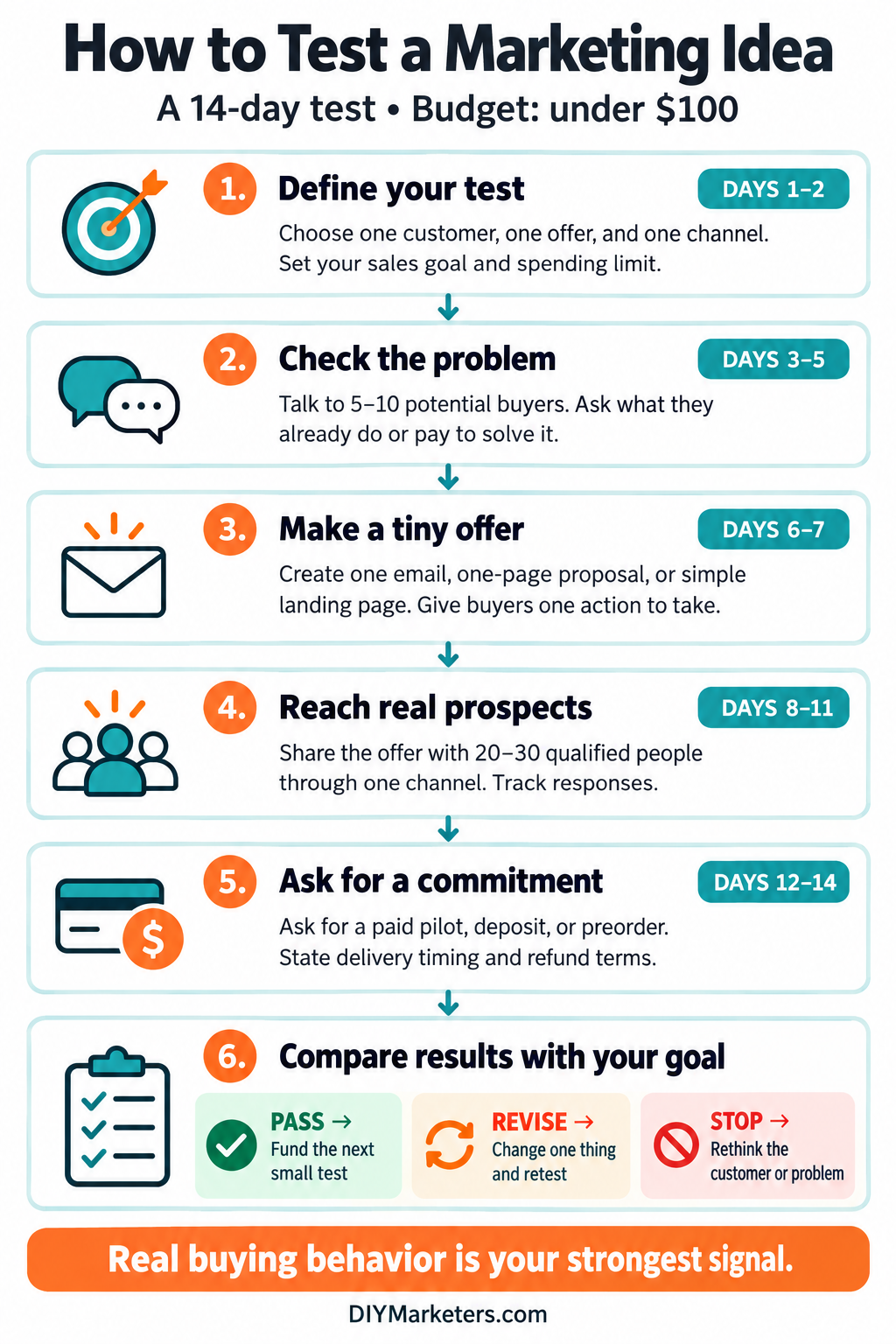
The 14-Day Validation Sprint (The $100 System That Replaces Guessing)
This is the DIYMarketers Validation Sprint — a 14-day, under-$100 sequence designed for solopreneurs and service businesses. The goal is not a miniature launch. The goal is a learning purchase: you spend a controlled amount to answer the riskiest question before spending more.
Days 1–2: Write the one-sentence hypothesis
Fill in this template and don’t skip it:
“If [specific customer in a specific situation] sees [your promise + offer] through [your channel], then [number] will [observable action] by [date], at a cost below [your ceiling].”
Notice what’s NOT there: “my target audience,” “compelling content,” and “social media.” Those are not test parameters. They’re wishes. If your hypothesis reads vague, your test will confirm whatever you want it to confirm — which helps nobody.
Days 3–5: Talk to 5–10 real people (the right way)
The SBA recommends combining secondary market data with direct customer research. Fine. But the key word is behavioral research, not encouragement-gathering. Your job is to reconstruct what people actually did the last time the problem occurred — not ask whether they’d theoretically solve it with your idea.
Use these exact questions:
- “Tell me about the last time you dealt with [problem].”
- “What did you try first, then what?”
- “What have you already paid for or spent time on?”
- “What happens if you leave it alone?”
- “Show me the tool, workaround, or invoice you used.”
A systematic review of qualitative research saturation found that narrowly focused studies with similar participants reached meaningful insight after 9–17 interviews. For a cheap directional test, five conversations expose obvious flaws. Nine to seventeen gives you something more defensible if the stakes are higher.
Days 6–7: Build the smallest possible offer
Here’s what you need to create a testable offer: one of the following. A plain email with a reply CTA. A one-screen landing page with a single button (“Book,” “Apply,” “Reserve,” or “Buy”). A one-page PDF proposal. A short video showing the promised outcome. That’s it.
Here’s what you do NOT need yet: branding, a full funnel, a complete course, custom software, bulk printing, or inventory. Strategyzer’s testing framework makes this explicit: building is often the most expensive way to learn. Don’t build before you know someone will pay. This is the exact principle behind a great landing page that converts — simplicity wins.
Days 8–11: Run one-channel outreach to qualified people
Choose the channel where your target customer already pays attention. Send the same core offer to a small, qualified group. The test should evaluate your idea — not a mixed audience that throws off your data.
Practical options that cost almost nothing:
- 20–30 personally selected emails or LinkedIn messages to qualified prospects
- One segmented email to subscribers who match the problem you’re solving
- One post or contribution in a niche community (where promotion is welcome)
- A partner email or customer introduction from someone who already has their trust
- A local pop-up, market table, or appointment day
- A capped $25–$100 ad campaign — but only after you have some organic evidence first
Track the funnel as counts: people reached → meaningful responses → CTA clicks → real conversations → payments. Do not judge the test by impressions, reach, or applause. Those are feelings. You need numbers.
Days 12–14: Ask for money
This is the part most business owners skip because it feels uncomfortable. Ask for money before the thing is fully built. This is not a scam — it’s how you find out if your idea is real.
For a service business: offer a paid audit, diagnostic, strategy sprint, or limited pilot at a founding-client price. For a course or digital product: run a live paid workshop or founding cohort before you record anything. For a software-style idea: deliver the result manually, by hand, to your first three customers. For a physical product: take preorders or refundable reservations — and clearly tell people the product isn’t ready yet, with a realistic delivery date.
How to Set Your Pass Threshold (So You Don’t Move the Goalposts)
There’s no universal conversion rate that validates every idea. A $20 impulse buy, a $2,000 consulting engagement, and a local dental appointment have completely different buying cycles, margins, and test requirements. You need to set your own threshold from your own business model — before you run the test.
Write out four numbers before Day 1:
- Maximum customer acquisition cost: the contribution profit available from a new customer.
- Minimum test sales: enough revenue or committed pipeline to justify the next stage.
- Minimum gross margin: price minus direct fulfillment, transaction fees, and contractor costs.
- Required quality signal: a completion rate, repeat use, referral, or testimonial you need to see.
For a practical example: proceed only if 30 carefully chosen prospects produce at least 3 qualified conversations, 1 paid pilot, and delivery at an effective hourly rate you’d work for. Write this rule before you start. Otherwise, a disappointing result always becomes “promising” after you’ve spent time and money — a classic sunk-cost trap that kills more marketing plans than bad ideas do.
What Idea Type Are You Testing? (The Right Test for Each One)
Not every marketing idea gets tested the same way. Here’s a quick guide for the most common scenarios small business owners face.
| What You’re Testing | Cheapest Useful Test | Don’t Overinterpret |
|---|---|---|
| New service package | Offer 3–5 founding-client slots at a pilot price | Compliments from colleagues |
| Workshop or course | Free problem-focused session, then paid live cohort | Poll votes about desired topics |
| Lead magnet or freebie | Direct outreach or partner placement to narrow audience | Download count with no downstream action |
| Referral campaign | Ask one small customer cohort with one script | Number of asks made |
| Physical product | Sample or mockup, then preorder with refundable deposit | “I’d buy that!” comments |
| Paid ad concept | Validate offer organically first, then run a capped campaign | Click-through rate without economics |
| Software or automation idea | Deliver the result manually as a concierge service | Feature requests before anyone has used it |
The pattern is consistent: get a behavioral commitment before you spend money on production. That one principle eliminates the majority of expensive marketing mistakes. It’s also the heart of any solid simple marketing process for small business — test the demand, then build the supply.
The Five Traps That Blow Up Marketing Tests
Even with the right framework, tests go sideways for predictable reasons. Here are the five that show up most often — and how to avoid each one.
Trap 1: Testing with the wrong people. Friends, peers, and fans are often enthusiastic but they rarely resemble the actual buyer. Recruit based on a recent behavior — they experienced the problem, purchased an alternative, searched for help, or control the relevant budget.
Trap 2: Asking leading questions. “Would this be helpful?” invites politeness. Instead, ask for a recent example. Inspect the existing workaround. Request a concrete next step. Stated intent should produce a stronger test, not trigger a large investment.
Trap 3: Mistaking attention for demand. A post earning 400 likes is not a validated offer. A blog post with 800 views is not proof of a sellable course. Every awareness metric needs a downstream action tied directly to revenue.
Trap 4: Running tiny A/B tests on low-traffic sites. Conventional A/B tests need enough observations to separate a real effect from noise. With limited traffic, you need months to get reliable data — and you still might be wrong. Test one bold proposition against all qualified traffic. If it clears the threshold, then test the next major alternative.
Trap 5: Letting sunk cost rewrite the result. Write your pass, revise, and stop rules before you launch. A disappointing result has a way of becoming “promising” after you’ve spent time and money. Pre-committing to a decision rule is the only protection against this. It’s one of the first things I walk through in a marketing audit — knowing in advance when to stop is as important as knowing when to go.
How to Score Your Test Results Before You Decide What’s Next
After 14 days, score each dimension from 0 to 2 to get a clear read on what the data actually says. This removes emotion from the decision — which is where most people go off track when marketing strategies fail for small businesses.
| Dimension | Score 0 | Score 1 | Score 2 |
|---|---|---|---|
| Problem evidence | General interest only | Recent problem stories | Repeated problem + active spending on workaround |
| Message | Confusion or indifference | Some qualified response | Clear resonance from the target segment |
| Commitment | Likes or vague interest | Calls, applications, referrals | Deposit, preorder, or paid pilot |
| Economics | Can’t estimate viability | Plausible with major unknowns | Price covers acquisition and delivery with margin |
| Repeatability | One friendly buyer | Similar response from multiple prospects | Sales from unrelated customers or repeated channel performance |
Score 0–3: Stop or redefine the customer and the problem.
Score 4–6: Keep the budget frozen. Revise the message, offer, or segment and rerun.
Score 7–8: Fund the next test, not the full rollout.
Score 9–10: Consider a controlled launch with explicit spending checkpoints.
These cutoffs aren’t magic numbers from a research paper. Their value comes from forcing you to make an explicit decision and document contradictory evidence before you spend another dollar. That discipline is what separates marketing strategy from marketing tactics — knowing when the evidence supports the next move, versus when you’re hoping harder.
Frequently Asked Questions About Testing Marketing Ideas Cheaply
The DIYMarketers Validation Sprint takes 14 days and costs under $100. Days 1–2 go toward writing a specific, falsifiable hypothesis. Days 3–5 involve 5–10 behavioral interviews with real prospects — not friends or supportive peers. Days 6–7 require building the smallest possible version of the offer: a plain email, a one-page landing page, or a one-page PDF proposal. Days 8–11 involve running single-channel outreach to 20–30 qualified people. Days 12–14 are about asking for a real commitment — a deposit, preorder, or paid pilot. If the result clears your pre-set threshold, you fund the next test. If it doesn’t, you’ve spent under $100 to avoid a much larger mistake. The 14-day timeline isn’t arbitrary: it’s long enough to get meaningful responses and short enough to force decisiveness. A test dragged past three weeks usually produces data that confirms what you already wanted to believe.
Pre-selling a service, course, or product before it’s complete is one of the most reliable ways to test a marketing idea before spending money on production. The key is transparency: tell buyers the product isn’t finished, give them a realistic completion timeline, and clearly explain your refund policy. Course creator Susanne Rieker famously sold her course before recording a single module, then delivered lessons over time. Hardware startup Hearth Display used a $50 deposit preorder campaign to validate demand — and that evidence helped them raise a $2.8 million seed round. For service businesses, the equivalent is a paid founding-client pilot at a discounted or fixed rate. You deliver it manually, track every hour and cost, and use that data to decide whether the economics work before investing in systems, tools, or automation. Pre-selling proves purchase intent in the only language that matters: someone’s credit card.
For a practical directional test, reach 20–50 qualified people through direct outreach. Qualified means they match your specific target customer: they’ve experienced the problem recently, they have the budget to solve it, and they’re not personal friends obligated to be supportive. For behavioral interviews, research on qualitative saturation suggests that 5 conversations expose obvious flaws, while 9–17 interviews with similar participants is more defensible when the stakes are meaningful. The number matters less than the quality of the audience. Fifty unqualified people who saw a vague post will produce worse data than 10 carefully selected people who received a personal email about a specific offer. One paid pilot from a customer outside your personal network carries more weight than 200 enthusiastic survey responses. Focus on behavioral commitment from the right people — not on maximizing reach.
A failed test is not automatically a failed idea. It’s data about one specific combination of audience, message, offer, and channel. Before you abandon the idea, diagnose which element failed using the Validation Sprint scorecard: was the problem evidence weak (people didn’t care about the problem)? Was the message confusing (right problem, wrong framing)? Was the commitment level too low (people liked it but didn’t want to pay)? Were the economics unworkable (the math doesn’t support the price you need)? Each of those diagnoses points to a different fix. Weak problem evidence points to the wrong customer. A confusing message means the offer needs reframing. Low commitment might mean the price is wrong or the trust isn’t built. Failed economics usually mean the delivery model needs to change, not the idea itself. Run one variable at a time in the next test. If you change everything at once, you learn nothing.
For most small businesses, traditional A/B tests are the wrong tool for validating a marketing idea before spending money. A/B tests divide traffic between two near-identical versions and require enough observations to distinguish a real effect from statistical noise. With limited traffic, a typical headline or button-color test can run for months and still produce misleading results. A better approach for small business owners: put all available qualified traffic behind one bold hypothesis, compare it against a pre-set threshold, and use the qualitative data from conversations and objections to inform the next test. If you do run sequential tests, compare similar time periods and hold audience quality constant. The goal at this stage is not statistical significance — it’s behavioral evidence that a specific offer from a specific audience delivers economics you can work with. Save the formal A/B testing for after you’ve validated that the offer itself is worth optimizing.
Additional Reading
- Your Email List Isn’t Dead — Your Offer Is Wrong
- Why Your Referral Marketing Stops Working (And How to Fix It in 24 Hours)
- How to Get More Customers Without Spending a Lot of Money
- Stop Chasing Freebie Seekers: Build a Lead Generation System That Works Like Science
- Marketing Burnout Is Real. Here’s a Reset.
Not Sure If Your Marketing Idea Will Work?
Book a Fix-It Session with Ivana. You’ll get specific feedback on your offer, your message, or your campaign — what’s missing, what to test first, and what to skip entirely. A clear next move from someone who has been in the trenches for 35+ years.
Low budget marketing strategies for CEOs with no marketing department. Join DIYMarketers.com for free marketing tips.
Source: https://diymarketers.com/how-to-test-a-marketing-idea/
Anyone can join.
Anyone can contribute.
Anyone can become informed about their world.
"United We Stand" Click Here To Create Your Personal Citizen Journalist Account Today, Be Sure To Invite Your Friends.
Before It’s News® is a community of individuals who report on what’s going on around them, from all around the world. Anyone can join. Anyone can contribute. Anyone can become informed about their world. "United We Stand" Click Here To Create Your Personal Citizen Journalist Account Today, Be Sure To Invite Your Friends.
LION'S MANE PRODUCT
Try Our Lion’s Mane WHOLE MIND Nootropic Blend 60 Capsules
Mushrooms are having a moment. One fabulous fungus in particular, lion’s mane, may help improve memory, depression and anxiety symptoms. They are also an excellent source of nutrients that show promise as a therapy for dementia, and other neurodegenerative diseases. If you’re living with anxiety or depression, you may be curious about all the therapy options out there — including the natural ones.Our Lion’s Mane WHOLE MIND Nootropic Blend has been formulated to utilize the potency of Lion’s mane but also include the benefits of four other Highly Beneficial Mushrooms. Synergistically, they work together to Build your health through improving cognitive function and immunity regardless of your age. Our Nootropic not only improves your Cognitive Function and Activates your Immune System, but it benefits growth of Essential Gut Flora, further enhancing your Vitality.

Our Formula includes: Lion’s Mane Mushrooms which Increase Brain Power through nerve growth, lessen anxiety, reduce depression, and improve concentration. Its an excellent adaptogen, promotes sleep and improves immunity. Shiitake Mushrooms which Fight cancer cells and infectious disease, boost the immune system, promotes brain function, and serves as a source of B vitamins. Maitake Mushrooms which regulate blood sugar levels of diabetics, reduce hypertension and boosts the immune system. Reishi Mushrooms which Fight inflammation, liver disease, fatigue, tumor growth and cancer. They Improve skin disorders and soothes digestive problems, stomach ulcers and leaky gut syndrome. Chaga Mushrooms which have anti-aging effects, boost immune function, improve stamina and athletic performance, even act as a natural aphrodisiac, fighting diabetes and improving liver function. Try Our Lion’s Mane WHOLE MIND Nootropic Blend 60 Capsules Today. Be 100% Satisfied or Receive a Full Money Back Guarantee. Order Yours Today by Following This Link.


| Visits: | 1,835,382,595 |
| Stories: | 8,723,374 |
Whistler Blowers, Insiders

