

America Exports Its Monetary Soul

This post America Exports Its Monetary Soul appeared first on Daily Reckoning.
Did you know that much of the gold mined and refined in the U.S. gets exported? And much of that metal ultimately heads toward Asia, where China and other gold-hungry nations have read the world’s balance sheet better than the policy wonks in Washington?
Meanwhile, are you skeptical about what passes for “tech” these days? Software, chips, AI, data centers, visa-heavy labor force, stock options, trillion-dollar market caps… and what exactly is the return to America and its people?
Asked another way: are we turning good money, energy, concrete, steel, other scarce metals, engineering talent and national savings into waste heat? Maybe much of today’s tech should be called “toasters that don’t make toast.”
With that in mind, today we’ll discuss gold and capital misallocation: hard assets, monetary insurance, wealth preservation and, where possible, yield from assets that make the world run.
Plus, in a note at the bottom, I’ll tell you how to register and watch (at no cost) a talk I’m having tomorrow evening, July 29th, with two of the best gold and investment guys in the business.
Let’s dig in…
Welcome to New Readers
First, a warm welcome to new subscribers. In addition to the newsletter you signed up for, Paradigm Press also sends supplements like Morning Reckoning and Rude Awakening at no extra cost.
Our idea is simple: focus on hard assets such as precious metals, energy and foundational sectors that create real value. We like things that preserve wealth over time. Many also offer a yield angle, meaning your assets can work for you and deliver income.
Now let’s discuss gold, energy and capital allocation — because the story of the dollar is also the story of what America builds, what it neglects and what it ships away.
First, Follow the Gold
Long ago, I learned not to trust speeches from politicians and central bankers. And when it comes to gold, it’s better to watch the loading docks, refinery flows, cargo manifests and vault inventories. The real story is about who holds the metal and where.
Oddly enough, I learned that lesson at Harvard — the old Harvard, not today’s ideological theme park. In fact, in an intro economics class called “Ec 10,” we spent a month on gold: ancient money, medieval banking, gold-backed notes, Spanish treasure fleets, New World bullion and the inflation that followed when too much metal chased too few goods. All that, and more.
Then, citing Keynes (badly, as usual), the instructors told us to forget gold because it was a barbarous relic. The message was clear: gold was quaint and academic economics was modern.
But gold stuck in my head. Plus, I found a geology professor who taught mines and minerals and happened to be a gold bug. And I learned quite a bit of useful economics from handling Harvard’s world-class mineral collection; in some ways more than from the economics department, although I offer respectful nods to all the Nobel Prize winners there.
Now skip ahead. In much of the West, gold remains a monetary embarrassment, nor for polite bankers to discuss. The official economic future is derivatives, cloud computing, social media, AI and other abstractions promoted by guys with glossy investor decks.
Meanwhile, foreign central banks are buying gold at a pace not seen in generations: China, India, Russia, Poland and many more.
The World Gold Council says central banks bought over 1,000 tonnes annually in each of the three years through 2024, far above the previous pace of 400–500 tonnes per year. In its 2025 survey, 95% of respondents expected global central bank gold reserves to rise this year, while 73% expected the dollar’s share of global reserves to fall over five years.
So, follow the gold and the message is plain: the dollar-dominated monetary order is fading. The future may not be “gold-backed” in the old textbook sense. But any credible reserve system must respect gold again. Learn it now, or learn it the hard way later on.
China Reads the Balance Sheet
We’re entering a new monetary jungle where China is the 800-pound gorilla. Beijing runs trade surpluses, collects dollars and has options. In the old model, China recycled dollars into Treasuries. China made goods, America consumed them, and the proceeds returned to Wall Street. But no more.
In recent years, Beijing has reduced Treasury holdings while accumulating gold, some reported and much likely off the books. And China’s logic is simple. Gold has no counterparty risk. A U.S. Treasury bond is a promise from a near dysfunctional government that runs chronic deficits and issues debt by the trillions.
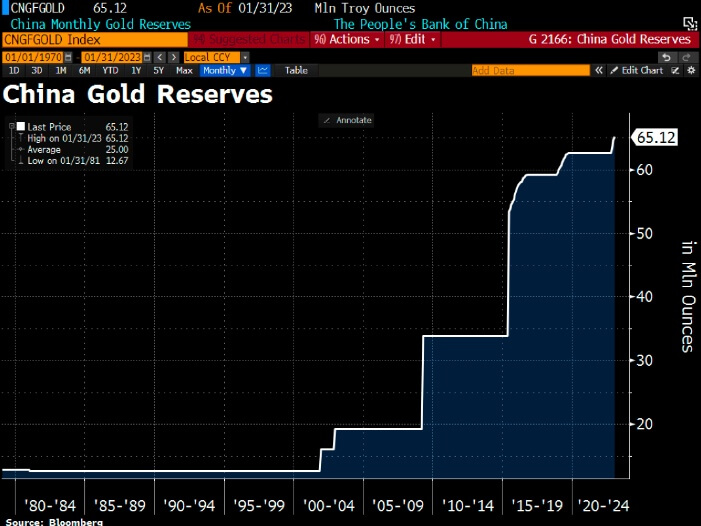
China gold reserves over past 45 years. Credit Bloomberg News.
One standard knock against gold is that it pays no interest. True. But neither does gold default. That is, gold in a Chinese vault is immune to Congress, the Federal Reserve, the Treasury Department and sanctions lawyers. Nobody can print it. Nobody can conjure it from a server farm. That is why gold is back in fashion among people who manage national balance sheets.
America, the Monetary Resource Colony
Now comes the scary part. In Q1 2026, U.S. exports of non-monetary gold reached about $47.2 billion, according to U.S. data, per the St. Louis Federal Reserve Bank/FRED. Suddenly, gold has moved into export levels normally associated with Boeing aircraft and ExxonMobil or Chevron refined petroleum.
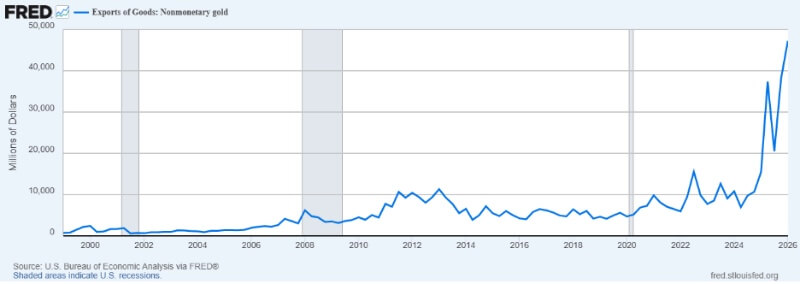
U.S. “non-monetary gold” exports surged in recent quarters. Credit FRED/Federal Reserve Bank St. Louis.
In plain English, the U.S. is shipping out its gold – “non-monetary,” they say; but STILL a monetary metal! – while importing consumer goods, electronics, pharmaceuticals and financial obligations.
Think about that. This country still claims “world reserve currency” status, yet exports the world’s most revered and ancient reserve asset. And buyers want gold precisely because they want less dependency on the dollar. (“Here are a bunch of dollars; now gimme the gold!”)
Exporting primary value is what resource colonies do; they sell hard assets for paper. And at least to a geologist, it’s crystal clear that a resource colony ships ore while the imperial power keeps the refinery, the bank, the pricing power and the ledgers.
In short, America is behaving less like a value-add economy and more like a quarry.
De-Dollarization Does Not Show Up in Press Releases
Oh… And don’t expect de-dollarization to arrive with a brass band. No treaty. No press conference. No magic BRICS note.
It arrives as portfolio adjustment: fewer Treasuries in foreign accounts, and more bullion. Or perhaps an oil seller accepts non-dollar payment and later turns that surplus into gold in Shanghai.
Right now, day-to-day, the dollar still dominates because of liquidity, legal infrastructure, habit and network effects. But reserve status is not a force field. As Hemingway said about going broke, it happens gradually, then suddenly.
The Tech Mirage and the Mine Shaft
Meanwhile, American capital markets worship at another altar. We are told – by academic economists and Wall Street promoters – that value and wealth creation now resides in software, platforms, AI and data centers. There’s a cultural theme that mining is dirty, petroleum is old, refineries are ugly, ore bodies are relics. And the future is weightless; just a universe of infinite ones and zeros floating in a cloud.
Except this allegedly weightless economy has become very heavy. AI requires data centers, power lines, cooling systems, backup turbines, chips, specialty equipment, concrete, steel, copper, rare earths and electricity by the gigawatt.
The old Silicon Valley story was that a few clever people in a garage could create global wealth with code. But today’s AI giants need hundreds of billions merely to keep the Wall Street growth story alive. And frankly, “tech” no longer looks asset-light. It looks like classic heavy industry with better public relations.
Capital Misallocation, Value Mispricing
Often, investors avoid miners because mines need big upfront capital: exploration, mapping, engineering, permitting, roads, drill rigs, site prep, mills, tailings systems, equipment, skilled labor and endless maintenance and operational expense.
But now Big Tech has the same curse of capital intensity. Yet many tech and AI valuations still assume the old nine-month software cycle and zero-cost scaling. It’s gross capital misallocation, hiding in plain sight. Hundreds of billions are flowing into AI infrastructure on the assumption that future software revenues will justify today’s checkbook.
But currently, the big cash flow is not floating into a high-margin profit cloud. It is being poured into land, concrete, power hookups, cooling loops, chips, backup systems and long-dated contracts. This is not a software cycle. It is an industrial buildout like the country ought to have for, say, shipbuilding or battery plants.
And the question is not whether AI and data centers are useful. Some of this techy magic works quite well. The question is whether this buildout will earn a return on capital. And that answer remains far from proven.
When tech companies spend like miners building, say, a giant, multibillion-dollar porphyry copper project, investors should stop valuing them like garage software firms. Future cash flows have not yet been earned; they’re not even in sight on a distant horizon.
Meanwhile, many AI plays face the same bottlenecks as every other industrial project: energy, materials, skilled labor and time. Markets punish miners for capital intensity and yet reward tech firms for the same behavior.
Through it all, the unfashionable foundations of civilization — energy, ore, mining, refining, metals, shipping, manufacturing and grid — remain underbuilt in America. But the digital future still begins down in a mine, a power plant and a factory.
Mispriced Reality
And this gets us back to gold miners, companies that sell something of which central banks in China and other nations cannot seem to get enough. Gold supply is limited by geology, permitting, mining, metallurgy, politics and time. You cannot summon a tier-one gold mine with a venture-capital term sheet.
Yet many gold-mining equities still trade as if official-sector gold demand is temporary. Meanwhile, many tech leaders trade as if AI revenue will soon arrive in tidal waves, and that Chinese competition will stand aside, while electricity will stay cheap and capex will magically convert into high-margin profits.
Somebody is wrong here. Either central banks are fools for buying gold at scale, or markets are misallocating capital into stories and fables, while starving the companies that produce actual metal, let alone monetary metal. My instinct is that people with vaults know more than people with pitch decks.
The Dollar’s Store-of-Wealth Problem
A deeper issue is the dollar itself. The dollar is useful. It pays bills, settles invoices and measures retirement accounts. But as a long-term store of wealth, it has a design flaw; namely, that the U.S. system depends on issuing more and more of them.
And this leads us to look at inflation, which is a feature and not a bug in modern monetary policy. Debasing the currency is part of the operating system.
Sad to say, a dollar saved in a drawer or bank account for more than a few years, let alone decades, is a wasting asset unless converted into something productive, scarce or both. So, when central banks buy into gold they are not saying the dollar will disappear tomorrow. They are saying dollar-only reserves are long-term imprudent. And this should make every saver pause.
If reserve managers want more gold and fewer dollar claims, why should private investors assume cash and conventional financial assets are enough? So, what to do? Well… own physical gold, and own companies that mine it, or control royalties on productive mines. This just reflects the world as it is.
The Big Picture
To sum up where we’ve been today… Big Tech builds while mined gold leaves the country. And definitely, the monetary map of the world is being redrawn.
Of course, America possesses immense advantages; things like energy, agriculture, capital markets, technology, rule of law (when courts choose to honor it), and a stubborn entrepreneurial culture.
But no nation stays wealthy by exporting hard assets, importing paper claims and directing capital toward fashionable abstractions while neglecting mines, metals, energy, and basic necessities of industry like roads, railways, ships, factories and the like.
Again, follow the metal! Follow the balance sheets. Follow what serious people do when they are not talking.
The fact of gold leaving America is not just a trade statistic, it’s a warning flare. It’s a blaring smoke alarm. The world is preparing for a less dollar-centered future, and the United States is helping to build the off-ramp.
That’s all for now, but!!!
If you want to know more, tomorrow evening at 7:00pm Eastern, Wednesday July 29th, I’ll be on a broadcast with old friends Rich Checkan and Adrian Day, to discuss precious metals, mining ideas, energy, the war in Iran and much else. Both of these gents are deeply knowledgeable about gold, silver and the mining biz, and I suspect that we’ll open the throttles wide on ideas. It’s free to sign up and watch; see you there!
And… Thank you for subscribing and reading.
The post America Exports Its Monetary Soul appeared first on Daily Reckoning.
This story originally appeared in the Daily Reckoning
Source: https://dailyreckoning.com/america-exports-its-monetary-soul/
Anyone can join.
Anyone can contribute.
Anyone can become informed about their world.
"United We Stand" Click Here To Create Your Personal Citizen Journalist Account Today, Be Sure To Invite Your Friends.
Before It’s News® is a community of individuals who report on what’s going on around them, from all around the world. Anyone can join. Anyone can contribute. Anyone can become informed about their world. "United We Stand" Click Here To Create Your Personal Citizen Journalist Account Today, Be Sure To Invite Your Friends.
LION'S MANE PRODUCT
Try Our Lion’s Mane WHOLE MIND Nootropic Blend 60 Capsules
Mushrooms are having a moment. One fabulous fungus in particular, lion’s mane, may help improve memory, depression and anxiety symptoms. They are also an excellent source of nutrients that show promise as a therapy for dementia, and other neurodegenerative diseases. If you’re living with anxiety or depression, you may be curious about all the therapy options out there — including the natural ones.Our Lion’s Mane WHOLE MIND Nootropic Blend has been formulated to utilize the potency of Lion’s mane but also include the benefits of four other Highly Beneficial Mushrooms. Synergistically, they work together to Build your health through improving cognitive function and immunity regardless of your age. Our Nootropic not only improves your Cognitive Function and Activates your Immune System, but it benefits growth of Essential Gut Flora, further enhancing your Vitality.

Our Formula includes: Lion’s Mane Mushrooms which Increase Brain Power through nerve growth, lessen anxiety, reduce depression, and improve concentration. Its an excellent adaptogen, promotes sleep and improves immunity. Shiitake Mushrooms which Fight cancer cells and infectious disease, boost the immune system, promotes brain function, and serves as a source of B vitamins. Maitake Mushrooms which regulate blood sugar levels of diabetics, reduce hypertension and boosts the immune system. Reishi Mushrooms which Fight inflammation, liver disease, fatigue, tumor growth and cancer. They Improve skin disorders and soothes digestive problems, stomach ulcers and leaky gut syndrome. Chaga Mushrooms which have anti-aging effects, boost immune function, improve stamina and athletic performance, even act as a natural aphrodisiac, fighting diabetes and improving liver function. Try Our Lion’s Mane WHOLE MIND Nootropic Blend 60 Capsules Today. Be 100% Satisfied or Receive a Full Money Back Guarantee. Order Yours Today by Following This Link.


| Visits: | 1,830,155,011 |
| Stories: | 8,693,704 |
Whistler Blowers, Insiders

