

How Permitting Delays Affect Mining Supply (October 2026)

Permitting delays cut mining supply by removing planned tonnage from the future production pipeline. A mine cannot dig, build or ship anything until its environmental, land-use and operating approvals are in hand, so a project stuck in review contributes zero metal to the market that was counting on it. Understanding how permitting delays affect mining supply starts with one simple idea: supply forecasts are really forecasts about permits, not about rock in the ground.
Most of the ore that will matter for energy grids, electric vehicles and data centres over the next two decades is already discovered. What is missing is the legal permission to turn it into metal. That gap between a resource and an approved mine is where most of the risk sits, and it is the part that command presentations tend to gloss over.
Below I walk through what a permitting delay actually is, how the supply chain transmits it, which commodities are most exposed, and how you can monitor the risk yourself rather than relying on headlines.
What Permitting Delays Mean for Mining Supply
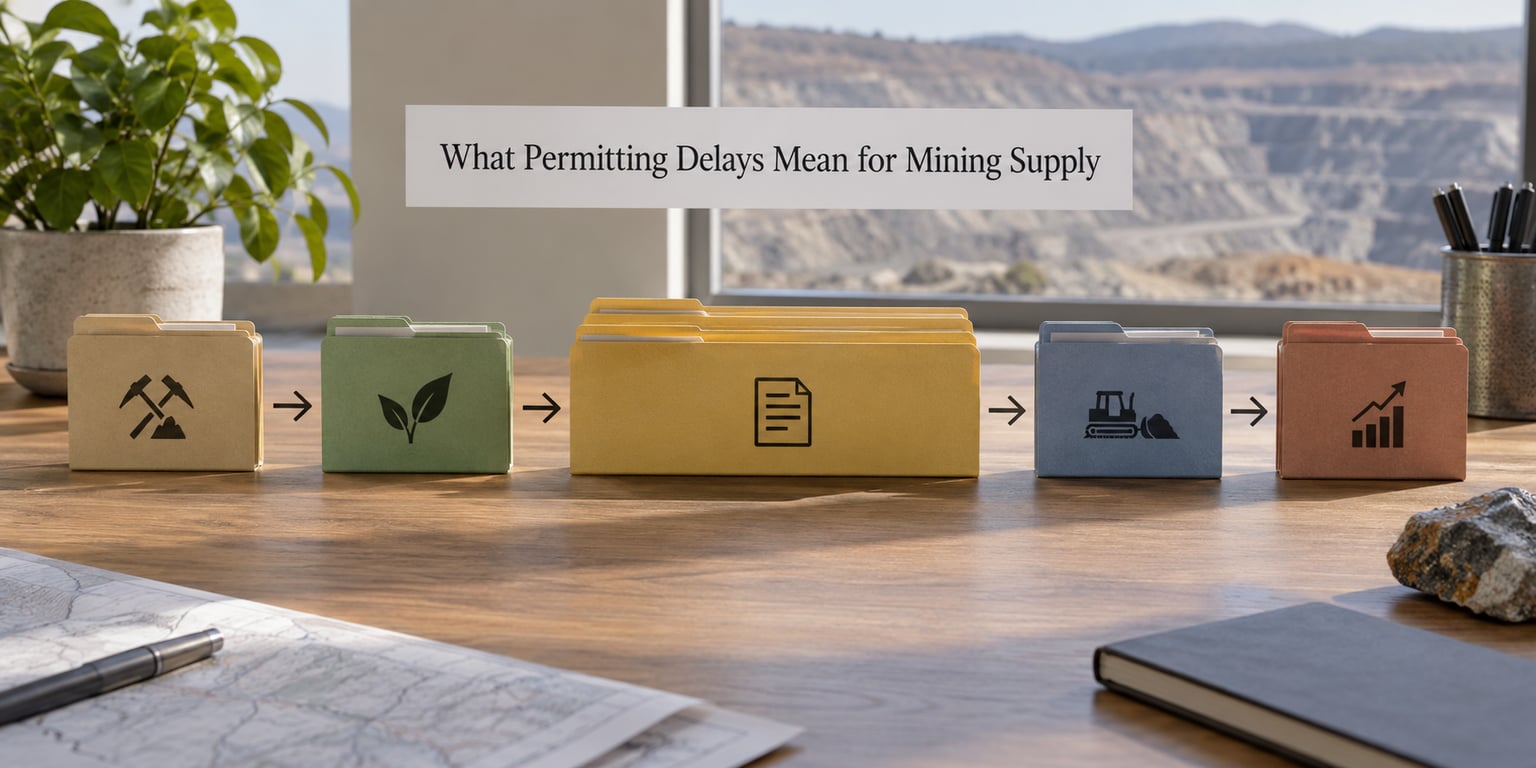
A permitting delay is any extension to the regulatory approval timeline between a mining project being defined and it receiving the approvals required to start construction and reach first production. A permitting delay suppresses mining supply by pushing a mine’s output further into the future, where it competes with a longer queue of projects for the same buyers.
It helps to be precise about what is not a permitting delay. An environmental impact assessment that takes three years to complete is part of the standard pre-permit process, not an extension of it. Land access negotiations, water rights and a court challenge that suspends an approval can each be layered on top, and each one moves the date. A construction delay, by contrast, happens after every approval is already in hand, usually because of labour, equipment, weather or cost escalation.
The distinction matters because the two have opposite implications for a producer. A construction delay usually costs money on a project that will still produce. A permitting delay can cost you the entire position in the queue, because a competing project may receive its approval while yours is still in review.
Set the delay in context. The average time from discovery to first production for a mine is about 16.9 years, of which roughly 12.5 years elapse before production begins. A three-year permitting slip in that context is not a scheduling irritation. It moves a meaningful volume of metal out of every supply forecast drawn in the following decade.
How Permitting Delays Affect Mining Supply
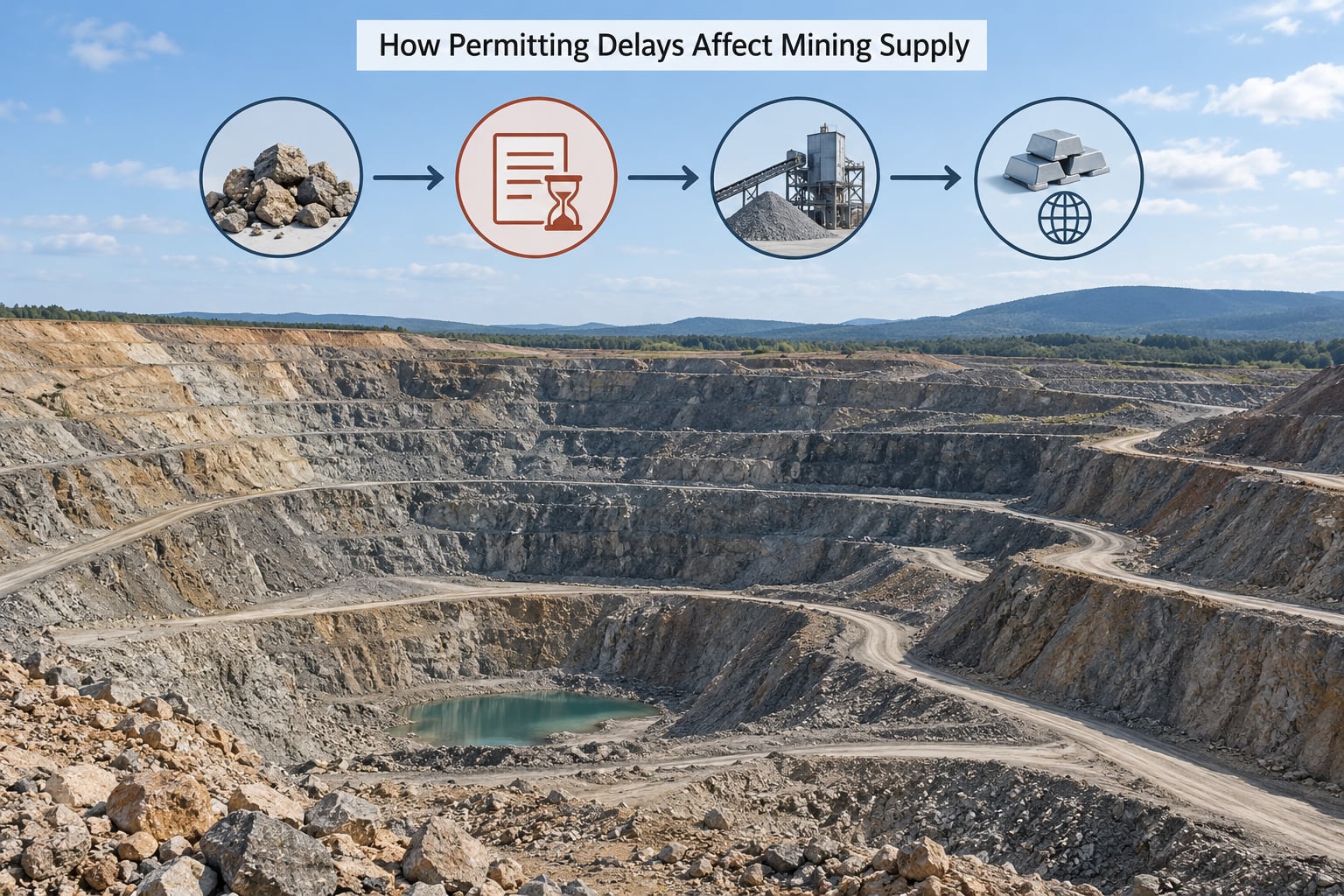
The mechanism runs in a straight line: a delayed approval means no first production date, which means less metal arrives, which means tighter inventories, which means import demand rises and prices react. Each link weakens the effect, which is why the same delay produces a sharp price move for one metal and almost nothing for another.
The five ways a delay reaches the market
1. Planned tonnage never arrives on schedule. Supply models are built from project-level production profiles with assumed start dates. Move those dates and the tonnes do not exist, so the forecast must be revised down even though the resource is unchanged.
2. Depleting mines have no replacement. Every operating orebody is finite, and many are delivering lower grades each year as the easiest material is mined first. When a replacement is late, the decline is not offset. Annual output falls even though total global resource estimates look healthy.
3. The cost curve shifts upward. Scarcity pushes marginal production toward more remote, deeper or lower-grade options that need higher prices to justify development. Delays accelerate that shift, because the cheap tonnes that were expected are the ones that disappear.
4. Prices and import demand respond first. Buyers notice physical tightness before annual averages do. A delayed mine can trigger spot buying, a weaker currency in the producer country, and heavier drawdowns from exchange inventories in the weeks after the news breaks.
5. The delay feeds the next queue. Higher prices attract capital, more capital means more project applications, and more applications mean a heavier permitting workload. The system that produced the first delay then produces the second, which is the loop investors tend to underestimate.
None of this is automatic. The size of the effect depends on how much inventory is buffered up, whether buyers can substitute another material or supplier, and whether another approved project is available to pick up the slack. A delay during a period of heavy destocking can be almost invisible in price; the same delay during tight stocks can be violent.
One more piece of context worth holding onto. Roughly 45% of mining project delays have been attributed to permitting, and about 62% of delayed projects were affected at the permitting stage in one widely cited industry survey. Permitting is no longer the administrative footnote to a mining project. For a large share of the industry, it is the critical path.
How Permitting Delays Affect the Supply Chain
Permitting does not sit at the start of a mining project. It sits in the middle of a long chain, and a project can need years of pre-construction work before anyone applies for a permit, then years of post-approval work before it ships a single tonne.
The usual sequence looks like this:
- Exploration and resource definition. Drilling, assays and a resource estimate, sometimes repeated several times as the model grows.
- Scoping and pre-feasibility study. Early testing of the orebody’s continuity, metallurgy and infrastructure requirements.
- Feasibility study. The expensive, bankable study that carries most of the capital cost of a project before a single approval is applied for.
- Community and Indigenous consultation. Agreements, access negotiation and the social licence work that determines whether a project is politically viable.
- Environmental impact assessment and permitting. Submission, agency review, requests for additional work, hearings, and in some jurisdictions court review.
- Financing and offtake. Debt and equity raised against the permitted project, often alongside long-term supply contracts whose delivery dates depend on the permit.
- Construction and commissioning. Earthworks, plant, power and water infrastructure, then a ramp-up to nameplate capacity.
A delay inside step five can cascade backwards. A feasibility study written around an assumed approval date may need updating. Financing commitments carry deadlines that expire. Contracts signed on a first-production assumption can be renegotiated at a worse price, or lost to a competitor that already had its permit.
It also cascades forwards. Shorter ramp-ups and shared infrastructure are harder to justify when the cost of that delay has already mounted. A project approved three years late is often approved with more conditions attached, which then adds work to the construction phase rather than removing it.
Why Do Mining Permits Take So Long?
Approvals are slow for a handful of recurring reasons, and they rarely have anything to do with the quality of the orebody. Understanding them helps you judge whether a delay is administrative friction or a structural problem.
Incomplete or outdated studies. Agencies routinely ask for more work: additional baseline data, a wider social impact study, a revised water balance, or a longer modelling horizon. Each request is reasonable on its own and expensive in aggregate.
Land and water access. A permit is not a licence to build if the company cannot legally access the land or draw the water the plant needs. Obtaining those rights can take as long as the environmental approval itself, and the two processes are frequently run in sequence rather than in parallel.
Indigenous and community consultation. In several jurisdictions, consent or formal consultation is a legal precondition rather than a courtesy. A process restarted by a legal decision, or one that requires broader community assent than the applicant expected, adds months to years and can be reopened after approval.
Fragmented government responsibility. Water, forestry, heritage, transport, energy and labour approvals can sit with different agencies under different mandates and different timelines. A project that needs all of them effectively waits for the slowest, and a change of government can reset the whole sequence.
Litigation and political change. Environmental claims that stop construction work while a court decides them are a routine feature of mining in several major jurisdictions. Chile, for example, has been working through a pipeline of stalled projects valued in the region of 100 billion US dollars, with a substantial share of that value tied up in environmental claims litigation rather than engineering problems.
Timelines differ sharply by jurisdiction, which is why the same company will approve a project in one country and struggle in another.
| Jurisdiction | Typical permitting timeline | Most common bottleneck |
|---|---|---|
| Latin America (Chile, Peru, Argentina) | Often 5 to 15 years | Environmental claims litigation and prior-consultation processes |
| United States | Federal permitting adds years to a development cycle averaging roughly 29 years from discovery | Multi-agency review and fragmented jurisdiction |
| Canada and Australia | Roughly 2 to 3 years for a well-prepared application | Native title and land access agreements |
| European Union | Varies widely by member state | Strategic project designation and grid permitting |
Read that table as a range for well-run projects, not a guarantee. Even in the faster jurisdictions, a contested consultation or a judicial review can add years.
Which Mining Stages Are Most Exposed?
Permitting risk does not hit every kind of mining project in the same way. Where a project sits in its life cycle determines the supply effect, the financial damage and the signals worth watching.
| Project type | Likely supply effect | Timing of impact | Financial exposure | What to monitor |
|---|---|---|---|---|
| Greenfield project | Lose an entire new source of metal; no partial output | Impacts supply a full permitting cycle later | Highest. Pre-permit spending with no revenue | Submission dates, agency scoping comments, consultation milestones |
| Brownfield expansion | Incremental tonnes lost; base production continues | Impacts near-term supply | Moderate. Sunk study cost plus deferred growth capital | Modification approvals, updated production guidance |
| Mine restart | Removes a supply source that buyers may already be relying on | Often immediate once suspended | High against a restart budget built on a known date | Rehabilitation sign-off, water treatment milestones, community agreements |
| Producing mine facing permit renewal | Threatens existing output, not just growth | Sharp and immediate if a permit lapses | Severe. A lapse can end production entirely | Renewal filings, compliance reports, any transfer of the operating licence |
The asymmetry is the point. A delay at a producing mine is a genuine supply shock that hits the market within quarters. A delay at a greenfield project is a quiet event that changes forecasts in five to ten years. Investors often price the second one too gently and the first one too late.
How Supply Changes Differ by Commodity
Not all metals are equally exposed to a permitting delay. Four variables decide how much damage a slip does: how concentrated the supply is geographically, how long a replacement takes to bring online, how much inventory exists to bridge the gap, and whether buyers can substitute or recycle.
Copper is the most closely watched, because supply is concentrated in a handful of countries, ore grades are declining, and new mines are large, remote and slow. A copper project moving three years later has a direct, visible effect on the supply curve.
Lithium behaves differently. Permitting matters, but so do water rights, brine and hard-rock processing choices, and local content rules, and a wave of projects approved together in 2022 and 2023 can flood the market even while individual projects are delayed.
Uranium is unusually exposed to permitting relative to its price, because conversion and enrichment capacity sits behind a small number of licensed facilities. A delayed mine can be held back by the bottleneck downstream of it.
Gold and silver are less supply-constrained overall because output is spread across many jurisdictions and gold in particular has a large recycled supply stream. Delays still matter, but they rarely move the global balance on their own.
Nickel and rare earths sit in between. Rare earths carry a second, distinct permitting risk: export permits. A concentrate can be mined and processed under full domestic approval and still be unable to leave the country. That is a different bottleneck from a mine-site permit, and retail investors frequently conflate the two.
Coal illustrates the boundary case. Where thermal or metallurgical coal competes with gas or renewables, a permit delay can remove planned capacity without tightening the market at all, because the demand disappears first.
Do Permitting Delays Always Push Metal Prices Higher?
No. Higher prices are possible, not guaranteed. A delay only tightens a market if buyers cannot get the metal from somewhere else, and that depends on conditions at the moment the delay lands rather than on the delay itself.
A delay announced during weak demand, comfortable inventories and rapid substitution can be almost invisible in price. The same delay, announced with exchange inventories low and no alternative project able to deliver, can move a futures curve sharply within days.
| Scenario | Inventory position | Substitute or alternative supply | Likely price response | Likely equity response |
|---|---|---|---|---|
| Tight market, strong demand | Low | None available in time | Sharp upward repricing | Delay benefits incumbents; delayed project’s stock discounts the delay |
| Balanced market, moderate demand | Normal | Partial, from scrap or another region | Short-lived increase, then fade | Mixed. Incumbents gain relative positioning |
| Weak demand, high inventories | High | Abundant | Little or no response | Delay punished. Funding and guidance credibility questioned |
| Structural deficit forecast | Low and forecast to stay low | Replacement projects also delayed | Long-run upward bias regardless of short-term demand | Delay is absorbed; the market has already priced scarcity |
The last row explains why some delays barely register. When a market has already priced a structural deficit, a single project’s slip changes little. The delays that move prices are the ones that arrive as a surprise, when inventories are thin and the alternatives are themselves stuck in the same queue.
What Do Delays Mean for Mining Stocks and Investors?
For a company holding a permitted, funded project, a delay is a direct financial event. It extends the period of spending before any revenue, which means more cash to raise. Financing raised later, into a weaker share price, on worse terms, is the most common way a delay turns from an inconvenience into a solvency question.
Capital costs also tend to drift upward during a delay, through inflation in equipment and services, contract renegotiation, and the cost of keeping a project team warm. Guidance is normally revised, and the gap between the new schedule and the company’s earlier statements is a useful measure of how much trust to place in the next one.
Contract timing deserves attention. Long-term offtake agreements are usually signed against an assumed first-production date. A delay can push a customer toward a competitor who already has a permit, which turns a scheduling problem into a commercial one.
Government relationships matter just as much. Companies with a long operating history in a jurisdiction tend to move faster through review than newcomers. Persistent friction with regulators, local government or community leaders is often the more informative signal, because it affects the operating mine as well as the expansion.
Finally, a delay is rarely bad news for everyone. If a major new copper project slips three years, its nearest producing competitor gains pricing power, better market access and stronger negotiating position. One company’s permitting problem is another’s competitive advantage, which is why the sector rarely moves as a single unit on permitting news.
None of this is individual investment advice. The purpose here is to describe how permitting risk flows through company fundamentals so you can evaluate a stock on its own facts rather than on a headline.
How Investors Can Monitor Permitting Risk
You do not need industry contacts to do this. Most of the evidence is public, dated and specific, and the problem most retail investors report is not access but the absence of a routine for reading it.
Start with the company’s own disclosure. Technical reports and annual filings list which permits a project holds, which are pending, and any conditions attached. Look for the word used in the report: an approval, a submission, a scoping consultation and a draft are four very different stages.
Track the milestone dates, not the adjectives. A project described as advanced is less useful than one with a stated submission date and a stated decision window. Where a company has previously moved a date, that history is more informative than the current schedule.
Watch the agency side. Public comment periods, environmental assessment filings and agency decision notices are published in most jurisdictions and are dated. A consultation period that opens is a stronger signal than a press release announcing one.
Check the court record. Where environmental claims are common, a docket search by project name shows whether litigation is active, stayed or resolved. Suspended work orders appear here before they appear in a company’s guidance.
Read guidance revisions closely. A first-production date that quietly moves by a year, a capital estimate that rises without explanation, or a change in which project is described as the lead development asset are all telling.
Follow the public accounts. Government budget lines, environmental agency staffing and published permitting dashboards often show whether a jurisdiction is genuinely speeding up or only announcing it.
Then separate routine from meaningful. Agencies regularly request additional work, and a project moving from scoping to full review is normal progress, not a setback. A meaningful change looks different: the same study requested twice, a consultation period that reopens, a court decision that suspends work, or a company replacing its own published date without a new approval milestone.
Finally, rank the risk against the alternatives. Ore grade decline, water availability, power access, labour and trade policy all remove supply too, and on some projects any one of them is a bigger constraint than the permit. A permit that is granted in a jurisdiction with no water is not a supply solution.
Sources and dates: discovery-to-production lead time of about 16.9 years and the 12.5-year pre-production component come from S&P Global data as compiled by Statista; the 45% share of project delay attributed to permitting and the 62% figure for delayed projects affected at the permitting stage come from an ERM study reported in 2025; the estimate that an average mine can lose roughly one third of its value to permitting delays dates from a 2015 SME study; the 5 to 15 year Latin American and 2 to 3 year Canadian and Australian ranges are 2024 figures; the roughly 29-year United States development average is a longer-cycle estimate. Figures span 2015 to 2026 and are cited here so you can check them against the primary sources, including S&P Global, the IEA, the ICSG and company filings.
Frequently Asked Questions
Yes. Supply forecasts count tonnes delivered in a given year, not deposits in the ground. A project that has not broken ground contributes nothing to that year’s supply, so a multi-year permitting slip reduces forecast output for the years it would have been producing. The effect is usually invisible in the first year and compounds, because the mine also stops offsetting the decline of older, lower-grade operations that are already running out of easy material.
Short extensions of a few months are routine, often caused by an agency request for additional work. A meaningful delay runs one to three years and usually involves a reopened consultation, a legal challenge or a change in government. Multi-year delays of five years or more are uncommon but not rare in jurisdictions where litigation and prior-consultation processes can restart a review from the beginning. For context, the full discovery-to-production cycle averages about 16.9 years.
The effect depends on whether buyers have an alternative. A delay in a concentrated market with low exchange inventories and no substitute in time lifts prices, because buyers must compete for a smaller pool of metal. A delay in a market with high inventories, weak demand or an available alternative supplier barely registers, because buyers simply buy somewhere else. Gold, for example, has a large recycled supply stream, so a new mine slipping rarely moves the price much.
Only partly, and only for some metals. Recycling responds with a lag of months rather than days, is limited by the scrap actually available, and in several important metals the volume of recoverable scrap is small relative to annual demand. Recycling helps most where end-of-life material is genuinely abundant, as with some base metals, and helps least where demand is growing quickly or where the material is used in applications that are hard to recover. It softens a delay rather than cancelling it.
No, and the distinction changes the analysis. A construction delay happens after every approval is already in hand, usually because of labour, equipment, weather or cost escalation, so the project still has a legal right to operate. A permitting delay means an approval is missing, contested or conditional, so the company cannot yet build. The first mainly raises cost and defers cash flow. The second can remove the project’s place in the approval queue and let a competing project reach production first.
Conclusion
The takeaway is that how permitting delays affect mining supply is mostly a question of timing and concentration, not of geology. Ore in the ground is not a constraint; approved, funded and permitted capacity is. When approvals slip, forecast tonnes disappear, existing mines keep declining, and the market only closes the gap later at prices high enough to justify the harder projects that are also waiting in the queue.
When you assess a company or a commodity exposed to this, check five things in order. What stage is the project actually at, when is first production realistically expected, how much inventory bridges the gap, what alternative supply exists, and does the company’s guidance and valuation already reflect the revised schedule. That last question decides whether a delay is a problem, an opportunity, or something the market has already priced in.
Source: https://www.pgm-blog.com/how-permitting-delays-affect-mining-supply/
Anyone can join.
Anyone can contribute.
Anyone can become informed about their world.
"United We Stand" Click Here To Create Your Personal Citizen Journalist Account Today, Be Sure To Invite Your Friends.
Before It’s News® is a community of individuals who report on what’s going on around them, from all around the world. Anyone can join. Anyone can contribute. Anyone can become informed about their world. "United We Stand" Click Here To Create Your Personal Citizen Journalist Account Today, Be Sure To Invite Your Friends.
LION'S MANE PRODUCT
Try Our Lion’s Mane WHOLE MIND Nootropic Blend 60 Capsules
Mushrooms are having a moment. One fabulous fungus in particular, lion’s mane, may help improve memory, depression and anxiety symptoms. They are also an excellent source of nutrients that show promise as a therapy for dementia, and other neurodegenerative diseases. If you’re living with anxiety or depression, you may be curious about all the therapy options out there — including the natural ones.Our Lion’s Mane WHOLE MIND Nootropic Blend has been formulated to utilize the potency of Lion’s mane but also include the benefits of four other Highly Beneficial Mushrooms. Synergistically, they work together to Build your health through improving cognitive function and immunity regardless of your age. Our Nootropic not only improves your Cognitive Function and Activates your Immune System, but it benefits growth of Essential Gut Flora, further enhancing your Vitality.

Our Formula includes: Lion’s Mane Mushrooms which Increase Brain Power through nerve growth, lessen anxiety, reduce depression, and improve concentration. Its an excellent adaptogen, promotes sleep and improves immunity. Shiitake Mushrooms which Fight cancer cells and infectious disease, boost the immune system, promotes brain function, and serves as a source of B vitamins. Maitake Mushrooms which regulate blood sugar levels of diabetics, reduce hypertension and boosts the immune system. Reishi Mushrooms which Fight inflammation, liver disease, fatigue, tumor growth and cancer. They Improve skin disorders and soothes digestive problems, stomach ulcers and leaky gut syndrome. Chaga Mushrooms which have anti-aging effects, boost immune function, improve stamina and athletic performance, even act as a natural aphrodisiac, fighting diabetes and improving liver function. Try Our Lion’s Mane WHOLE MIND Nootropic Blend 60 Capsules Today. Be 100% Satisfied or Receive a Full Money Back Guarantee. Order Yours Today by Following This Link.


| Visits: | 1,834,001,127 |
| Stories: | 8,715,728 |
Whistler Blowers, Insiders

