

What Are Gold Reserves and Who Holds the Most? (October 2026)

Gold reserves are the official monetary gold — physical bullion held as bars and coins — that a central bank or monetary authority owns as part of its reserve assets. The United States holds the most gold reserves at 8,133.5 tonnes, followed by Germany at 3,349.3 tonnes and Italy at 2,451.9 tonnes.
That is the short answer to what are gold reserves and who holds the most. The longer answer is messier than the ranking suggests, because central bank gold, gold exchange-traded fund holdings, private investment bars and gold still sitting in the ground are four very different things that often get added together in headlines.
Figures in this article come from World Gold Council compilations of IMF International Financial Statistics, using the most recently published country data available as of July 2026. Reporting runs roughly two months behind, so treat every number as a snapshot rather than a live feed.
What Are Gold Reserves?
Gold reserves are the gold bullion a country owns outright, counted in tonnes, and held by its central bank or monetary authority. It is one line inside a much larger figure called foreign exchange reserves, which also includes foreign currency deposits, bonds, IMF position and Special Drawing Rights.
The technical term is monetary gold: fine gold of at least 99.5 per cent purity held by official institutions or international organisations. Central banks report these holdings to the IMF, the World Gold Council compiles them, adjusts some series and republishes them alongside dollar values and gold’s share of total reserves.
Two practical points follow from that definition. First, the tonnage is physical ownership, not a claim on someone else’s gold. Second, the dollar value attached to it moves daily with the gold price while the tonnage does not move at all, so a change in market value says nothing about whether a country bought or sold metal.
On the accounting side, there is a wrinkle worth knowing about US holdings. The US Treasury carries its gold at a statutory book value of 42.2222 US dollars per troy ounce, a figure fixed by law in 1973. Valued at 2026 market prices, the same metal is worth roughly 1.05 trillion dollars against about 11 billion dollars on the books.
What Counts as a Country’s Gold Holdings?
Not every bar in a vault belongs in the ranking, and the official figures are narrower than readers often assume. Here is what does and does not count.
- Allocated physical bullion held by the central bank: this is the core of official gold reserves, and it is what the tables below measure.
- Sovereign gold outside the central bank, held by a treasury or finance ministry: some countries report this separately, which is why totals can shift between sources.
- Gold deposits and swapped gold, where bullion is lent out and other metal is pledged in return: reported in some cases, omitted in others.
- Gold-pool and pooled positions shared between institutions: not attributable to a single country.
- ETF and private holdings: excluded from official reserve figures, even though the metal is often the same metal sitting in the same vault.
- Gold in the ground: mined reserves and geological resources held by companies and governments. Australia and South Africa rank near the top here while sitting far down the official gold table.
This is the trap behind the question “which country has the most gold”. Australia has more recoverable gold than anyone, Russia and China mine heavily, and private investors hold thousands of tonnes. None of that is gold reserves.
Who Holds the Most Gold Reserves?
The United States holds the most gold reserves, at 8,133.5 tonnes — nearly as much as the next three countries combined, and a stock that has barely changed since the early 1970s. Below is the ranking of the largest official holders, with the share of each country’s total reserves that gold represents.
| Rank | Holder | Gold holdings (tonnes) | Gold share of total reserves |
|---|---|---|---|
| 1 | United States | 8,133.5 | 81.3% |
| 2 | Germany | 3,349.3 | 80.8% |
| 3 | IMF (institution, not a country) | about 2,814 | Not a national reserve |
| 4 | Italy | 2,451.9 | 77.0% |
| 5 | France | 2,437.0 | 78.6% |
| 6 | China | about 2,346 (reported) | 8.0% |
| 7 | Russia | about 2,326.5 | Not published |
| 8 | Switzerland | 1,039.9 | High share of a small reserve base |
| 9 | India | about 880.5 | Large share |
| 10 | Japan | about 846.0 | 8.5% |
| 11 | Turkey | about 772.5 (530.6 excluding commercial-bank gold) | High |
| 12 | Poland | 640.2 | Rising sharply |
| 13 | Netherlands | 612.5 | High |
How the Largest Gold Holders Are Ranked
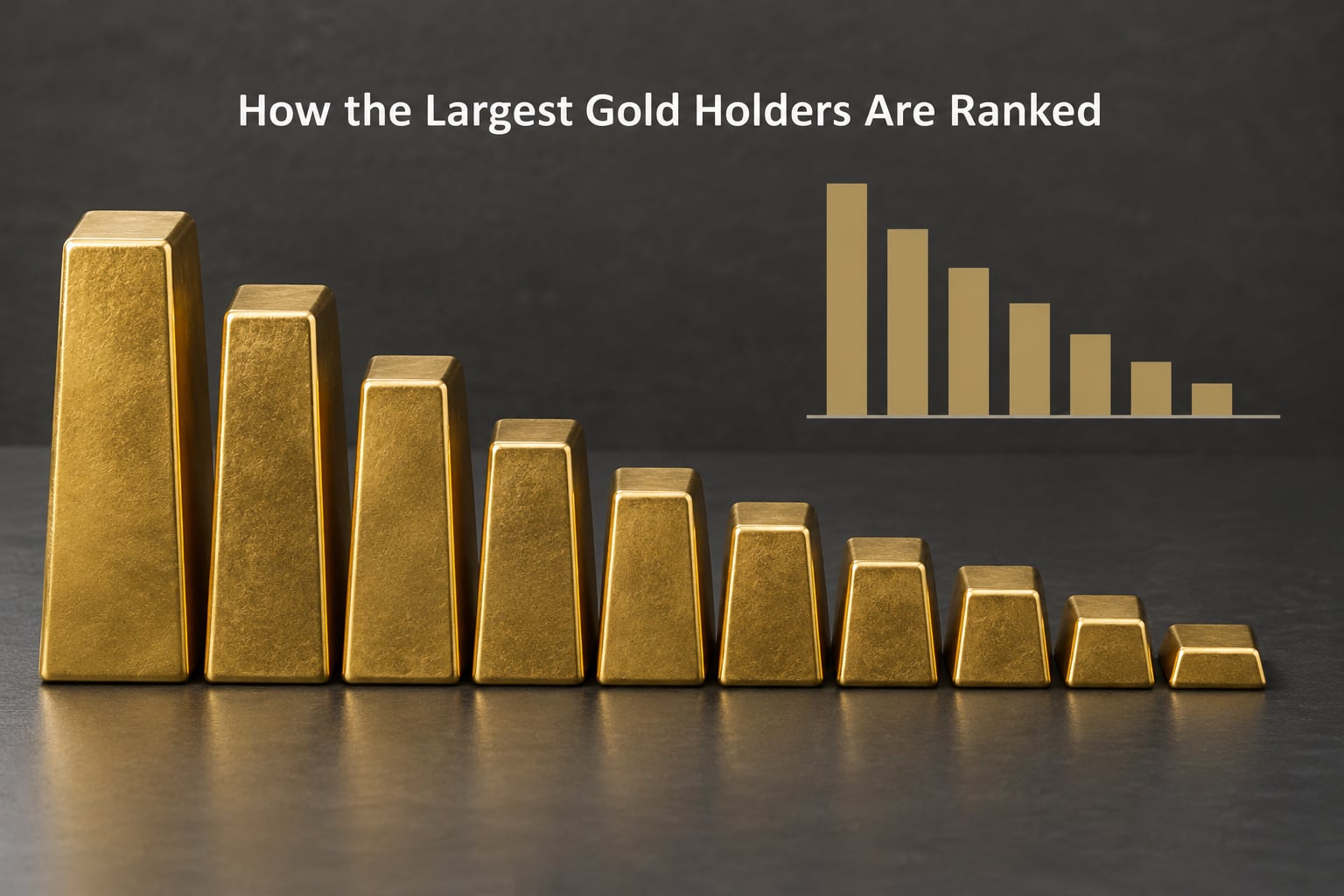
The ranking uses official monetary gold reported to the IMF, not estimated holdings and not gold in private hands. That choice matters in three places.
First, the International Monetary Fund sits third in the table and is not a country. Its holdings are pooled across member states, so leaving them in a list of national reserves confuses two different kinds of owner.
Second, reported and estimated figures diverge. China publishes its holdings but has stopped providing the detail analysts use to verify purchases, so many market participants treat its additions as estimates. Turkey illustrates the same issue from the other direction: reported holdings include roughly 242 tonnes held on behalf of commercial banks, which the World Gold Council strips out of its adjusted series. Quoting 772.5 tonnes and 530.6 tonnes for the same country is not an error, it is two different definitions.
Third, there is a lag. Country reports arrive with a delay of about two months, some central banks report late or revise previous figures, and the World Gold Council publishes on its own schedule. Any ranking screenshot without an as-of date is close to worthless.
Gold as a Share of Total Reserves Shows a Different Ranking
Share of reserves answers a different question from tonnage. A country with a small reserve base can hold a modest pile of gold and still depend on it heavily.
| Holder | Gold as a share of total reserves |
|---|---|
| Bolivia | 91.5% |
| Uzbekistan | 87.1% |
| United States | 81.3% |
| Germany | 80.8% |
| Kyrgyzstan | 79.5% |
| Portugal | 79.0% |
| France | 78.6% |
| Italy | 77.0% |
| Japan | 8.5% |
| China | 8.0% |
The spread is the story. The US, Germany, Italy and France keep gold at the heart of their reserve books. China and Japan hold enormous tonnage and lean on government bonds for most of their reserves, so they appear at the bottom of this table and the top of the previous one.
Why Countries and Institutions Hold Gold
Gold has no issuer, no counterparty and no credit rating. That single property explains almost every reason a central bank holds it, and the reasons sharpened considerably after 2022.
No counterparty risk. A government bond depends on the issuer paying you. A dollar deposit depends on the banking system and the jurisdiction you deposit it in. A gold bar in a domestic vault cannot be defaulted on by anyone, because there is no promise being broken.
Insulation from sanctions and asset freezes. When roughly 300 billion dollars of Russian central bank reserves were immobilised in 2022, the metal inside those reserves did not become available to Moscow. Gold held at home cannot be frozen by a foreign government. This is the argument most often heard in central bank discussions today.
Diversification. Gold moves differently from bonds and equities. It rarely correlates strongly with either, which is exactly what a reserve manager wants when everything else is selling off at once.
Crisis liquidity. Physical bullion can be moved or monetised without asking a market counterparty for permission, which is not true of other reserve assets in a stressed week.
Collateral and portfolio demand. Gold can back derivatives and margin obligations, and central banks are also buying it as part of ordinary reserve rebalancing and long-run diversification targets. The widely quoted benchmark floating around reserve committees is a gold share somewhere near 30 per cent, up from single digits a decade ago.
The buying data supports the story. Central banks added 1,082 tonnes in 2022, 1,051 tonnes in 2023, 1,092 tonnes in 2024 and 863 tonnes in 2025, against an average of roughly 473 tonnes a year across 2010 to 2021. Poland has added more than 409 tonnes and China more than 398 tonnes since the end of 2021, which makes them the biggest net purchasers even though neither sits near the top of the tonnage table.
That gap is worth pausing on. Holding the most gold and buying the most gold are different questions, and the second one tells you more about current intent. It also says nothing on its own about where the gold price goes next. A strategic stockpile is a hedge, not a forecast, and plenty of holders are not investors at all.
How Much of a Country’s Gold Is Actually Available?
Reported holdings are a statement of ownership, not a promise that every bar is sitting in the country or free to move. A good share of the world’s official gold is held abroad, leased, swapped or pledged as collateral.
In the United States, the question of who owns the gold confuses readers more than any other. The United States official gold holdings are reported as a US figure and the metal is physically held in US government facilities, with the Treasury holding title and the Federal Reserve acting as custodian through the Federal Reserve Bank of New York. Roughly 147.3 million troy ounces sit at Fort Knox, which is a little over half of Treasury gold, alongside about 54.1 million ounces at West Point and 43.9 million ounces in Denver, with the balance in New York.
Abroad, ownership and location diverge further. The Bank of England is one of the world’s two largest custodians, with holdings of roughly 400,000 bars for other countries’ account. Germany keeps about 51 per cent of its gold in Frankfurt, 37 per cent at the New York Fed and 12 per cent in London, which is why repatriation has become a recurring political topic there and in the Netherlands, where 122.5 tonnes came home, and in Poland, where 100 tonnes followed. India holds roughly 680 of its 880.5 tonnes onshore.
Two practical consequences. A government facing sanctions has less usable metal than its headline number implies if the bars sit in a foreign vault. And a country can own gold it has lent out, in which case the offsetting claim — a deposit or swap, not physical metal — is what keeps its accounts whole.
How Investors Can Read Gold Reserve Data
Before drawing a conclusion from any reserve figure, run it through this checklist. It takes about a minute and filters out most of the bad comparisons.
- Check the date. Official holdings update with a two-month lag, and annual snapshots are often a year out of date.
- Check the source. World Gold Council and IMF International Financial Statistics publish different series, and the World Gold Council adjusts some of them.
- Check the unit. Tonnes, million troy ounces and “million ounces” are all in circulation and are not the same number.
- Check the category. Official monetary gold, sovereign gold held outside the central bank, ETF assets and private bars are four separate buckets.
- Check the valuation. Tonnage is a stock; dollar value is that stock marked to the market price on the day. Only the tonnage tells you about buying and selling.
- Check reported against estimated. Where transparency is thin, say so rather than presenting a number as settled.
The dollar value of official holdings is worth watching on its own. Gold passed 4,000 US dollars per troy ounce in October 2025 and set a record of 5,595.47 dollars on 29 January 2026, and by 2026 the metal has moved above US Treasuries as the second-largest reserve asset held by central banks. Central banks now hold more gold than Treasuries in aggregate, which is a bigger structural shift than any individual country’s tonnage.
None of this makes gold a trade to chase. Reserve composition is a slow-moving macro signal about sanctions risk and monetary sovereignty, useful for context and poor as a timing tool. Prices and rules vary by country and change over time, so treat the ranking as a starting point and verify the current figures before acting on them.
Frequently Asked Questions
The United States holds the most official gold reserves at 8,133.5 tonnes, roughly two and a half times Germany’s 3,349.3 tonnes. Italy follows with 2,451.9 tonnes and France with 2,437.0 tonnes. The International Monetary Fund holds about 2,814 tonnes, which is larger than either European country but belongs to member states rather than to a single nation. Figures come from World Gold Council compilations of IMF reporting.
No. The US dollar is the world’s reserve currency and carries the largest official gold holding, but tonnage says nothing about currency strength on its own. Currency strength depends on growth, inflation, interest rates, external balances and how markets judge a country’s policy. A large gold reserve may support confidence in a currency, but it does not set its value. Gold share of reserves is the more telling metric, and there China and Japan rank near the bottom despite holding thousands of tonnes.
Usually, but not instantly and not always in the country. Bars held abroad by a foreign central bank can be blocked, delayed or immobilised by that government, as happened to Russian reserves in 2022. A significant share of official gold is also leased, swapped or pledged as collateral, so the truly free metal is smaller than the reported figure. Governments have increasingly repatriated gold to domestic vaults for exactly this reason, with the Netherlands, Poland and India all moving metal home.
Central banks hold the large majority of above-ground official gold. ETFs hold thousands of tonnes in aggregate and their holdings rise and fall with investor flows, but they remain a fraction of the roughly one fifth of all mined gold that official institutions control. Central banks bought 863 tonnes in 2025 while ETF flows turned negative in several quarters, which is why official-sector demand can outweigh private demand in a given year.
Valuation methods differ. Most central banks value gold at market prices, so their reported dollar figure rises and falls with the gold price even when no metal changes hands. The US Treasury is the outlier: it carries its gold at a statutory book value of 42.2222 US dollars per troy ounce fixed by law in 1973, which is why official US gold shows about 11 billion dollars on the books against roughly 1.05 trillion dollars at market prices.
Start with the World Gold Council’s Goldhub country tables, which compile IMF International Financial Statistics and include tonnes, dollar values and gold share of total reserves. The IMF’s own International Financial Statistics database carries the underlying country reports, and each central bank publishes an annual reserve disclosure. Remember the reporting lag of roughly two months and check whether a figure is reported or estimated before comparing it with another source.
What to Look at First
If you take one thing from this: the United States holds the most official gold reserves at 8,133.5 tonnes, and every other figure on the page needs a date and a category attached to it before it means anything.
Compare reported holdings from one reporting date against another rather than mixing sources, keep official monetary reserves separate from ETF assets and private bars, and check whether a tonnage is reported or estimated. Where a country’s value jumps without a tonnage change, you are looking at the gold price rather than a purchase.
And when a headline tells you a country has the “most gold”, check whether the journalist meant mined reserves in the ground. It is a different question, and the answer looks nothing like the table above.
Source: https://www.pgm-blog.com/what-are-gold-reserves-and-who-holds-the-most/
Anyone can join.
Anyone can contribute.
Anyone can become informed about their world.
"United We Stand" Click Here To Create Your Personal Citizen Journalist Account Today, Be Sure To Invite Your Friends.
Before It’s News® is a community of individuals who report on what’s going on around them, from all around the world. Anyone can join. Anyone can contribute. Anyone can become informed about their world. "United We Stand" Click Here To Create Your Personal Citizen Journalist Account Today, Be Sure To Invite Your Friends.
LION'S MANE PRODUCT
Try Our Lion’s Mane WHOLE MIND Nootropic Blend 60 Capsules
Mushrooms are having a moment. One fabulous fungus in particular, lion’s mane, may help improve memory, depression and anxiety symptoms. They are also an excellent source of nutrients that show promise as a therapy for dementia, and other neurodegenerative diseases. If you’re living with anxiety or depression, you may be curious about all the therapy options out there — including the natural ones.Our Lion’s Mane WHOLE MIND Nootropic Blend has been formulated to utilize the potency of Lion’s mane but also include the benefits of four other Highly Beneficial Mushrooms. Synergistically, they work together to Build your health through improving cognitive function and immunity regardless of your age. Our Nootropic not only improves your Cognitive Function and Activates your Immune System, but it benefits growth of Essential Gut Flora, further enhancing your Vitality.

Our Formula includes: Lion’s Mane Mushrooms which Increase Brain Power through nerve growth, lessen anxiety, reduce depression, and improve concentration. Its an excellent adaptogen, promotes sleep and improves immunity. Shiitake Mushrooms which Fight cancer cells and infectious disease, boost the immune system, promotes brain function, and serves as a source of B vitamins. Maitake Mushrooms which regulate blood sugar levels of diabetics, reduce hypertension and boosts the immune system. Reishi Mushrooms which Fight inflammation, liver disease, fatigue, tumor growth and cancer. They Improve skin disorders and soothes digestive problems, stomach ulcers and leaky gut syndrome. Chaga Mushrooms which have anti-aging effects, boost immune function, improve stamina and athletic performance, even act as a natural aphrodisiac, fighting diabetes and improving liver function. Try Our Lion’s Mane WHOLE MIND Nootropic Blend 60 Capsules Today. Be 100% Satisfied or Receive a Full Money Back Guarantee. Order Yours Today by Following This Link.


| Visits: | 1,833,886,241 |
| Stories: | 8,714,920 |
Whistler Blowers, Insiders

 God's Word - 2 Corinthians Chapter 10 (Jeff Osburn) |