

How to Focus During a Golf Round: A Masterclass in Mental Energy Management

Most golfers believe that learning how to focus during a golf round means maintaining a white-knuckle grip on their concentration for four straight hours. The reality is quite the opposite. Attempting to stay intensely “locked in” for every minute of a round is the fastest way to hit a mental wall by the 14th tee. True mastery doesn’t come from constant effort; it comes from the rhythmic ability to disengage and re-engage your attention at the right moments.
You likely recognize the frustration of a double bogey lingering in your mind for three holes, or the way your swing thoughts become a cluttered mess when the pressure mounts. It’s exhausting to fight your own brain while trying to navigate a difficult course. This masterclass will teach you the rhythmic focus system used by elite players to manage mental energy and maintain peak concentration from the first tee to the 18th green. We will break down the architecture of a repeatable reset routine and the psychological shifts required to achieve consistent performance and lower scores through better decision making.
- Understand that four hours of constant concentration is physiologically impossible. Learn to protect your mental energy by filtering out irrelevant environmental distractions.
- Master the “Focus Cycle” to learn how to focus during a golf round by alternating between high-intensity execution and periods of active mental disengagement.
- Shift your attention from internal swing mechanics to external targets. This transition allows your body to execute motor skills more naturally when under pressure.
- Utilize sensory grounding and box breathing drills to stabilize your internal state and reset your mindset immediately after a poor shot or distraction.
- Build a personal focus architecture using post-shot routines and a mental game scorecard to measure your concentration levels objectively across 18 holes.
Why Maintaining Focus for 18 Holes is a Physiological Challenge
Golf isn’t just a test of your swing; it’s a test of your brain’s ability to filter information. In the context of performance, focus is best defined as selective attention. This is the cognitive process of ignoring irrelevant stimuli, like the group on the next tee or a rustling leaf, while staying present with your target. Understanding the physiological challenge of this task is the first step toward improvement. Your brain is a metabolic organ. It consumes energy. When you try to force concentration for four hours, you aren’t just getting tired; you are depleting your focus battery.
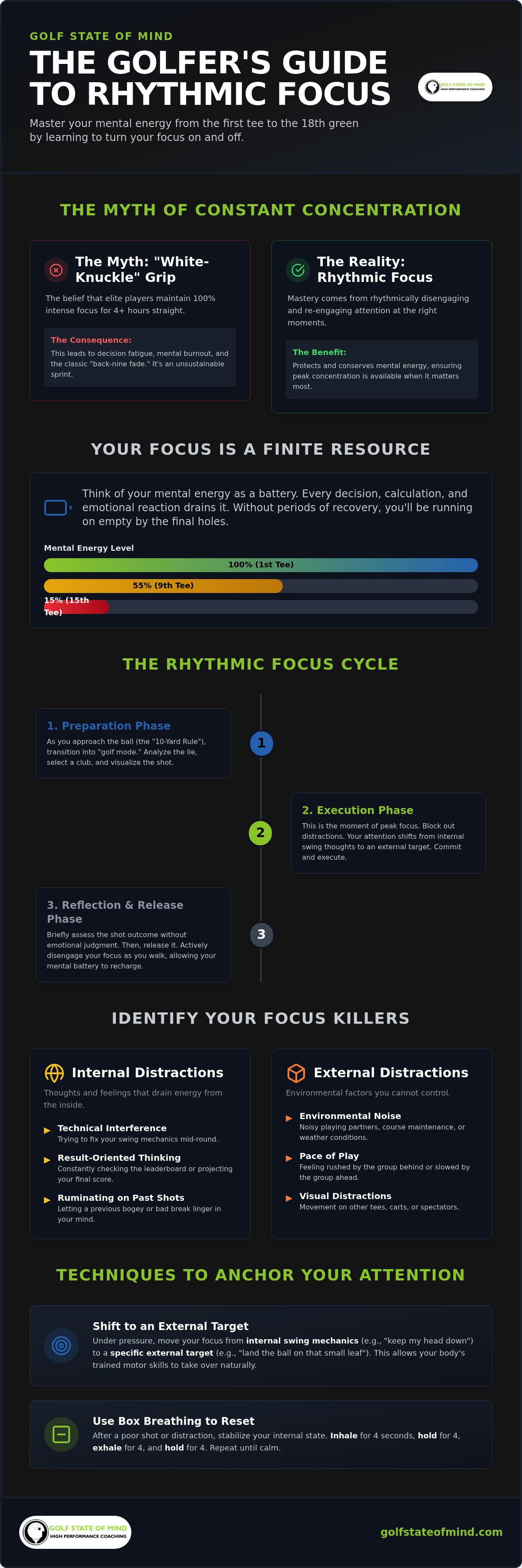
Think of your mental energy as a finite resource. Every time you calculate a yardage, read a green, or manage your frustration after a poor shot, you draw from that reserve. If you don’t manage these withdrawals, you’ll find yourself mentally bankrupt by the 15th hole. This is why many players suffer a “back-nine fade.” It’s rarely a lack of physical stamina. It’s a collapse of mental architecture. Much like the cognitive endurance required by professionals trained at Financial Modelling University, maintaining focus in golf requires a robust and well-managed internal system.
The Myth of Constant Concentration
Many golfers struggle with how to focus during a golf round because they believe elite players are “locked in” from the first drive to the final putt. This is a myth. Science suggests that directed attention is a finite resource. This concept is supported by Attention Restoration Theory, which explains that our ability to concentrate on a specific task wears out over time. If you try to maintain peak intensity for 18 holes, you will inevitably experience decision fatigue. This fatigue often manifests as poor club selection or a lack of commitment. You must learn to oscillate between a focused state during the shot and a diffuse, relaxed state between shots. Trying too hard often triggers the conscious mind to take over subconscious motor skills, which disrupts your natural rhythm.
Identifying Your Personal Focus Killers
To manage your mental energy, you must identify what drains it. Focus killers come in two forms. Internal distractions include overthinking swing mechanics or ruminating on a previous bogey. These thoughts create emotional leakage, where your frustration from the 4th hole saps the energy you need for the 12th. External distractions, such as slow play or difficult weather, are equally taxing if you allow them to penetrate your mental space. When you learn how to focus during a golf round, you learn to identify these leaks early.
Common focus killers include:
- Technical interference: Attempting to fix your swing mechanics mid-round.
- Result-oriented thinking: Checking the leaderboard or calculating your projected score.
- Environmental noise: Focusing on things you cannot control, like the pace of play or noisy playing partners.
Mastery begins when you realize focus is a resource to be spent wisely, not a switch to be left on indefinitely. By identifying these drains, you can begin to build a more resilient mental game.
The Rhythmic Focus Cycle: Turning Your Mind On and Off
Focus is not a static state. It’s a rhythmic cycle that moves between intense engagement and active recovery. If you attempt to maintain the same level of concentration while walking to your ball as you do while standing over a four-foot putt, you’ll deplete your mental reserves long before you reach the clubhouse. Mastery of the “Focus Cycle” involves three distinct phases: Preparation, Execution, and Reflection/Release. By compartmentalizing these moments, you protect your “concentration muscle” from fatigue. This rhythmic approach is a core pillar of how to focus during a golf round effectively.
A vital component of this system is the “10-Yard Rule.” This rule dictates that you do not allow your mind to enter “golf mode” until you are within 10 yards of your ball. Until that point, you remain in the Green Zone. Once you cross that invisible boundary, you transition into the Red Zone, where your focus intensifies for the upcoming shot. This clear separation prevents the mental “clutter” that occurs when you spend five minutes ruminating on a difficult lie while walking down the fairway. Utilizing Practical Techniques to Anchor Your Attention during these transitions ensures that your mind remains disciplined and ready for the task at hand.
Managing Your Mental Energy Tank
The space between shots is your primary opportunity for recovery. Use the walk to your ball to actively disengage from the game. Observe the landscape, engage in light conversation with your playing partners about topics unrelated to golf, or simply focus on the rhythm of your breathing. This isn’t “laziness” or a lack of seriousness; it’s a strategic withdrawal of effort. The Green Zone is the sanctuary for mental recovery, much like how a cool, comfortable home maintained by Ultra Air Heating and Cooling provides the physical sanctuary needed to recharge after a taxing round in the heat. When you allow your mind and body to rest in these states, you ensure that you have the capacity for high-intensity focus when it truly matters.
The Transition: Entering the Red Zone
As you approach your ball and cross the 10-yard threshold, you need a reliable signal to tell your brain it’s time to work. Use a physical trigger, such as putting on your glove or pulling a club from the bag, to initiate the transition. During this phase, narrow your visual field. Stop looking at the horizon and start looking at specific targets and flight paths. This shift from a broad to a narrow focus is essential for motor skill precision. Understanding how a structured pre-round golf routine prepares you for these transitions can be the difference between a fragmented performance and a cohesive one. To build this level of consistency into your own game, consider implementing the structured protocols found in the Ultimate Mental Game Training System.
External vs. Internal Focus: Where Your Eyes and Mind Should Be
To master how to focus during a golf round, you must understand the critical distinction between internal and external attention. Internal focus centers on your body mechanics, such as the position of your elbows or the rotation of your hips. External focus directs your mind toward the intended result, like the flight path of the ball or the specific target on the green. Research in motor learning suggests that focusing on the “what” (the target) rather than the “how” (the swing) allows your body to execute complex movements more fluidly. When you think about your muscles, you disrupt the automaticity of your swing. This interference is often what causes a swing to feel “stuck” or “unnatural” during a competitive round.
Elite performance often relies on the “Quiet Eye” concept. This is the final, steady gaze a player holds on the ball or target before beginning their motion. A stable eye leads to a stable mind. By anchoring your vision to a specific external point, you provide your brain with the precise spatial information it needs to succeed. This technique prevents your attention from drifting back to internal technical thoughts that often lead to “paralysis by analysis” under pressure. The longer and more stable this gaze is, the more likely you are to execute the shot with confidence and precision. It’s a silent anchor in the midst of internal noise.
The Science of Target Orientation
A clear mental image is the most effective way to anchor your focus. Instead of worrying about your take-away, visualize the ball’s apex and its landing spot. This creates a sensory blueprint that your subconscious can follow. Utilizing advanced golf visualization techniques helps you externalize your attention and maintain emotional stability. When your mind is occupied with a vivid picture of the shot, there is no room for doubt or mechanical over-correction. You aren’t just looking at the flag; you’re seeing the curve, the height, and the roll. This level of detail keeps the analytical brain occupied so the athletic brain can perform.
Silencing the Technical Demon
The golf course is a place for play, not practice. Save your technical adjustments for the driving range. During a round, you must replace “how to do it” thoughts with “what to do” intentions. If you find yourself overthinking your swing, use a mental scorecard to shift your perspective. Track how many shots you hit with a pure external focus rather than just counting your score. This shift in measurement reinforces the process over the result, which is a fundamental aspect of how to focus during a golf round without succumbing to technical interference. When you stop acting like a mechanic and start acting like an architect, your scores will naturally reflect that shift in mindset.
Practical Techniques to Anchor Your Attention
Mastering how to focus during a golf round requires more than just willpower; it requires a toolkit of sensory anchors. When your heart rate spikes after a missed putt or a wayward drive, your cognitive focus narrows into a state of reactive anxiety. To counteract this, use the 5-4-3-2-1 Grounding Drill. Identify five things you see on the course, four textures you can feel, three sounds, two scents, and one taste. This exercise forces your brain to exit the stress loop of the past and return to the physical present. It is a powerful way to interrupt the mental fatigue that often sets in during the middle of a round.
Box breathing is another essential tool for stabilizing your internal state. Inhale for four seconds, hold for four, exhale for four, and hold for four. This specific pattern improves heart rate variability, signaling to your nervous system that you are in control. To maintain your tempo during the swing, implement “Anchor Words.” Simple, rhythmic cues like “Smooth-Target” or “One-Two” occupy the conscious mind just enough to prevent mechanical interference. These words act as a linguistic shield, keeping your mind focused on tempo rather than the complex physics of the swing.
Breathing as a Mental Anchor
Deep diaphragmatic breathing is your most portable tool for emotional regulation. When you breathe from the belly rather than the chest, you stimulate the vagus nerve. This physiological shift lowers your heart rate and clears the mental fog caused by pressure. For a comprehensive guide on integrating these patterns into your game, explore these specific golf breathing techniques. Implement an “Exhale Trigger” as the final step before you address the ball. This long, slow breath acts as a mental delete button for any remaining doubt, leaving you with a quiet mind for execution.
The “Think Box” vs. “Play Box” Strategy
The most effective way to separate strategy from execution is to create a physical boundary on the turf. The “Think Box” is the area behind the ball where you analyze yardage, wind, and club selection. This is your workspace for logic and decision-making. Once you have made a committed choice, step across an imaginary line into the “Play Box.” You must never bring a single shred of doubt or a technical correction across that line. The Play Box is the zone of zero technical thought where you simply react to the target. If a distraction occurs while you are over the ball, step back into the Think Box and reset your process. You can refine this discipline by using the Ultimate Mental Game Training System to build a bulletproof routine for every shot.
Building Your Personal Focus Architecture
Building a resilient mental game requires more than just knowing a few drills; it requires a personal architecture that supports your mind through the inevitable highs and lows of 18 holes. While previous sections covered the mechanics of the focus cycle, this final step focuses on the structural support that keeps that cycle moving. A critical part of this is the post-shot routine. Its primary purpose is to release tension and file away the previous shot, whether good or bad, so you can return to the Green Zone with a clean slate. Without this release, your concentration will eventually buckle under the weight of accumulated frustration. When you understand how to focus during a golf round, you realize that your performance on the 18th hole is determined by how well you managed your energy on the previous 17.
Use a Mental Game Scorecard to objectively measure your concentration. Instead of just tracking strokes, give yourself a point for every shot where you successfully stayed in the Play Box and maintained an external focus. This shifts your attention back to the process, which is the only thing you can truly control. For those seeking a comprehensive blueprint to master these habits, the Ultimate Mental Game Training System provides the structured protocols necessary to turn these concepts into a permanent part of your game.
The 30-Minute Pre-Round Reset
Your focus begins long before you step onto the first tee. Use the 30 minutes before your round to prime your brain for stability. This isn’t the time for mechanical fixes or frantic swing adjustments on the range. It’s the time for a confidence booster to eliminate early-round jitters and settle your nervous system into a state of calm readiness. If you’re unsure where your specific mental leaks are, I encourage you to book a free 15-minute consultation for personalized focus mapping. Starting your round with a prepared mind is the most effective way to ensure you know how to focus during a golf round from the very first drive.
Long-term Focus Development
Focus is a skill that improves with intentional practice. You don’t just “have” focus; you build it through repetition and discipline. Integrating focus training into your range sessions ensures that your concentration is battle-tested before you reach the course. Engaging in golf performance coaching can help you identify hidden drains on your mental energy that you might not see yourself. Additionally, using mental game audios during your transit to the course can act as a mental warm-up. This practice ensures you arrive at the course with your mental architecture already in place, ready to perform with quiet strength and clarity.
Mastering the Internal Architecture of Your Game
True mastery of the sport requires you to shift your perspective from the physical swing to the mental process. You now understand that elite performance isn’t about constant intensity; it’s about the disciplined rhythm of engagement and recovery. By utilizing the Think Box and Play Box, and maintaining an external focus on your target, you protect your concentration from the fatigue that leads to back-nine fades. Learning how to focus during a golf round is a skill that requires as much practice as your putting, yet it offers the most sustainable path to lower scores and greater enjoyment on the course. For high-achieving entrepreneurs who want to bring this same level of elite focus to their business ventures, click here.
If you are ready to move beyond technical fixes and build a bulletproof mental game, it’s time to implement a proven system. Master your mental energy with The Ultimate Mental Game Training System. This program is used by professionals and high-level amateurs to create a step-by-step architecture for a “Quiet Mind.” It focuses specifically on the 90% of the game played between shots, giving you the tools to remain resilient under pressure. Trust in your process, stay committed to your routines, and watch as your internal stability transforms your external results.
Frequently Asked Questions How do I stop my mind from wandering between golf shots?
You stop your mind from wandering by giving it a specific “non-golf” task during the Green Zone between shots. Trying to force focus during the walk is counterproductive and leads to early fatigue. Instead, observe the textures of the trees or engage in light conversation with your partners. This active disengagement allows your mental battery to recharge so that you can re-engage with intensity when you reach your ball.
What is the ‘Quiet Eye’ technique in golf and how do I use it?
The ‘Quiet Eye’ is the final, steady fixation of your gaze on the ball or target immediately before the stroke begins. To use it, pick a specific dimple on the ball or a precise blade of grass and hold your gaze steady for two to three seconds. This stability in your vision creates a corresponding stability in your motor cortex, which reduces the interference of technical swing thoughts during execution.
How can I regain focus after a bad hole or a double bogey?
To regain focus after a double bogey, you must perform a structured post-shot routine to physically and mentally release the frustration. Use a physical anchor, like unstrapping your glove or cleaning your club, to signal that the hole is finished. Once that action is complete, the event is filed away. This prevents emotional leakage from draining the energy you need for the next tee shot.
Is it possible to focus too much during a golf round?
Yes, it is entirely possible to over-focus, which typically leads to mental exhaustion and “paralysis by analysis.” Effective strategies for how to focus during a golf round emphasize selective attention rather than constant intensity. If you try to maintain peak concentration for four hours, your brain will experience decision fatigue. This often results in a significant performance drop during the final four holes of the day.
What should I think about during my golf swing to stay focused?
Your mind should be occupied with a clear external intention rather than internal mechanical instructions. Replace thoughts about your elbow position or wrist hinge with a vivid mental image of the ball’s flight path. By focusing on the “what” instead of the “how,” you allow your athletic subconscious to execute the movement without the interference of your analytical conscious mind. This shift preserves your mental energy.
How does breathing help with concentration on the golf course?
Breathing helps with concentration by regulating your autonomic nervous system and lowering your heart rate. When you use box breathing or deep diaphragmatic exhales, you signal to your brain that you are in a safe, controlled state. This physiological shift prevents the “fight or flight” response from narrowing your focus too much, allowing you to maintain a calm, broad awareness of your strategy and environment.
Why do I lose focus on the last few holes of a round?
You lose focus on the final holes because your mental energy is a finite resource that has likely been depleted. If you haven’t practiced rhythmic disengagement throughout the day, your brain becomes “metabolically bankrupt.” This fatigue makes it difficult to process yardages or maintain emotional control. Managing your focus early in the round is the only way to ensure you have reserves left for the 18th green.
Can a pre-shot routine actually improve my focus?
A pre-shot routine is the most effective way to anchor your attention and signal the transition into the “Red Zone” of execution. It acts as a familiar psychological bridge that moves you from a relaxed state into a state of high-intensity focus. By repeating the same physical and mental steps, you create a sense of predictability that shields your mind from external distractions and internal pressure during the round.
The post How to Focus During a Golf Round: A Masterclass in Mental Energy Management appeared first on Instruction For The Mental Game of Golf.
Source: https://golfstateofmind.com/how-to-focus-during-a-golf-round-a-masterclass-in-mental-energy-management/
Anyone can join.
Anyone can contribute.
Anyone can become informed about their world.
"United We Stand" Click Here To Create Your Personal Citizen Journalist Account Today, Be Sure To Invite Your Friends.
Before It’s News® is a community of individuals who report on what’s going on around them, from all around the world. Anyone can join. Anyone can contribute. Anyone can become informed about their world. "United We Stand" Click Here To Create Your Personal Citizen Journalist Account Today, Be Sure To Invite Your Friends.
LION'S MANE PRODUCT
Try Our Lion’s Mane WHOLE MIND Nootropic Blend 60 Capsules
Mushrooms are having a moment. One fabulous fungus in particular, lion’s mane, may help improve memory, depression and anxiety symptoms. They are also an excellent source of nutrients that show promise as a therapy for dementia, and other neurodegenerative diseases. If you’re living with anxiety or depression, you may be curious about all the therapy options out there — including the natural ones.Our Lion’s Mane WHOLE MIND Nootropic Blend has been formulated to utilize the potency of Lion’s mane but also include the benefits of four other Highly Beneficial Mushrooms. Synergistically, they work together to Build your health through improving cognitive function and immunity regardless of your age. Our Nootropic not only improves your Cognitive Function and Activates your Immune System, but it benefits growth of Essential Gut Flora, further enhancing your Vitality.

Our Formula includes: Lion’s Mane Mushrooms which Increase Brain Power through nerve growth, lessen anxiety, reduce depression, and improve concentration. Its an excellent adaptogen, promotes sleep and improves immunity. Shiitake Mushrooms which Fight cancer cells and infectious disease, boost the immune system, promotes brain function, and serves as a source of B vitamins. Maitake Mushrooms which regulate blood sugar levels of diabetics, reduce hypertension and boosts the immune system. Reishi Mushrooms which Fight inflammation, liver disease, fatigue, tumor growth and cancer. They Improve skin disorders and soothes digestive problems, stomach ulcers and leaky gut syndrome. Chaga Mushrooms which have anti-aging effects, boost immune function, improve stamina and athletic performance, even act as a natural aphrodisiac, fighting diabetes and improving liver function. Try Our Lion’s Mane WHOLE MIND Nootropic Blend 60 Capsules Today. Be 100% Satisfied or Receive a Full Money Back Guarantee. Order Yours Today by Following This Link.


| Visits: | 1,830,185,959 |
| Stories: | 8,694,013 |
Whistler Blowers, Insiders

