

Can a Sports Psychologist Fix My Golf Game? What Helps

Your swing may not be the only thing shaping your score. The answer to “Can a sports psychologist fix my golf game?” is yes, in the sense that mental skills training can help you manage pressure, recover from mistakes, and make more consistent decisions. It won’t replace work on your swing, but it can help you use the skills you already have when a round gets tense.
You may also wonder whether you can learn golf psychology on your own. You can practise mental skills independently, but focused guidance can help you identify patterns that repeatedly disrupt your play and build a routine to address them.
This article explains how stress and breathing affect focus, how visualization and pre-shot routines support preparation, and how emotional regulation can help after a difficult shot. You’ll learn what mental game coaching can and can’t address, and how to decide whether a structured approach could help you play with greater composure.
- Notice how pressure changes your decisions and tempo, then use a deliberate relaxation technique before a demanding shot.
- Use breathing to reset your attention between shots instead of trying to stay intensely focused throughout the entire round.
- Build mental skills independently with consistent practice, and consider coaching when the same obstacles keep disrupting your play.
- Create a repeatable pre-shot routine that includes visualizing the shot and settling your attention before you swing.
- After a mistake, use a reset phrase to learn from the shot without carrying frustration into the next one.
1. How does stress impact golf performance at any age?
Stress can disrupt attention and decision-making, even when your swing feels dependable on the range. Picture a three-foot putt to win a flight: suddenly, the result feels important, and your attention may shift from pace and line to the fear of missing. Mental skills training helps golfers notice that shift and refocus on the shot in front of them.
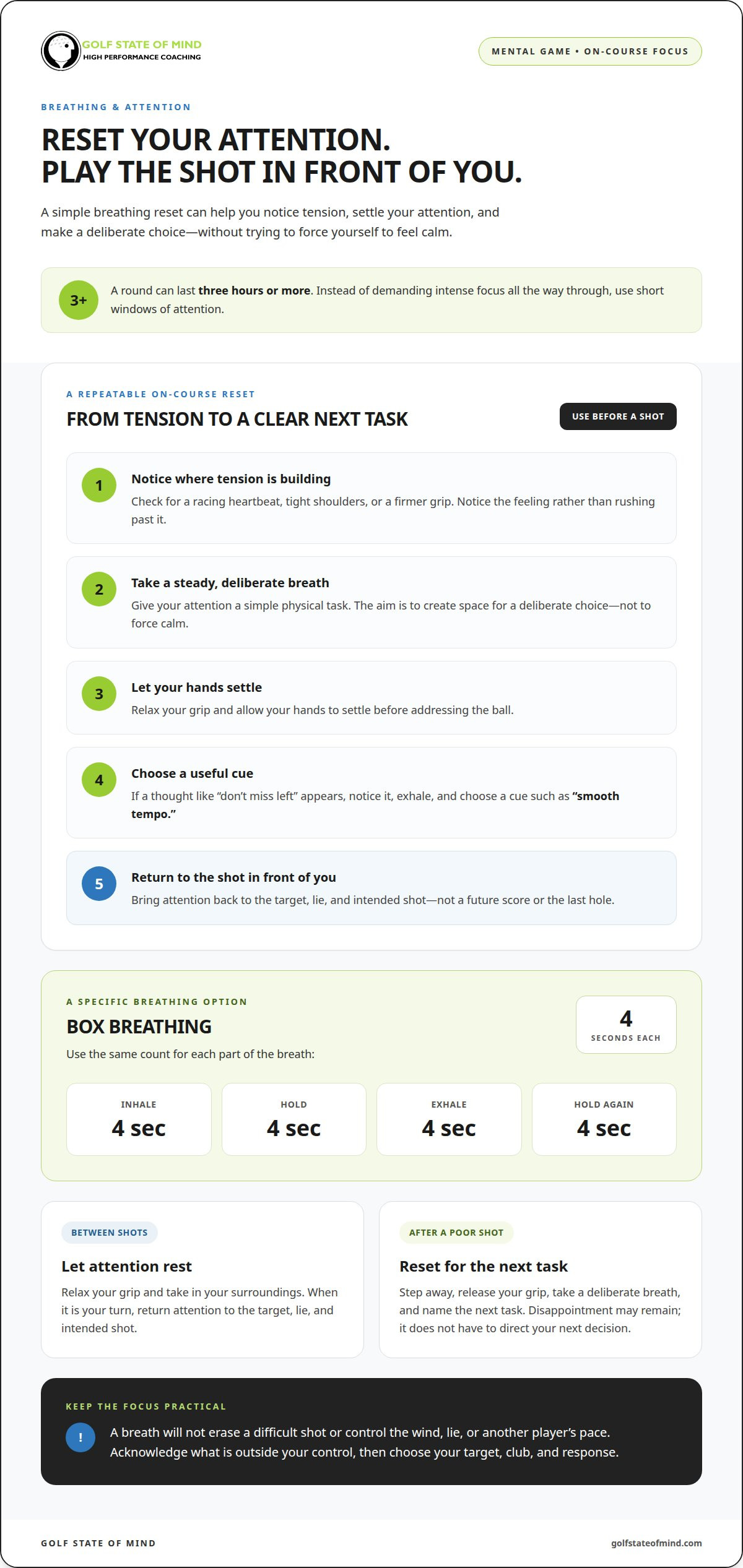
Sport psychology can help you prepare for pressure instead of treating it as a signal to rush. Practise relaxation techniques regularly, then use a simple reset before a demanding shot. Box breathing is one option: inhale for four seconds, hold for four, exhale for four, and hold again for four. A steady routine gives your attention a clear task when negative thoughts compete for it.
Range performance doesn’t always carry over to the course. On the range, golfers can repeat shots without the same score, waiting, or competitive pressure. To identify where your performance changes, compare scorecards with practice-session outcomes. Note the situation, intended target, club choice, and result. This can show whether a pattern involves decision-making, pressure, or execution, rather than relying on a broad judgment such as “I always play badly.”
Should you see a sports psychologist or a golf swing coach? Choose a sports psychologist when anxiety, self-doubt, or difficulty recovering from mistakes interferes with your decisions and routines. Choose a swing coach when the main issue is technique or ball striking. Mental coaching doesn’t teach swing mechanics. If both issues arise, each type of coaching addresses a different part of performance.
Perfectionism can turn a useful review into self-criticism. After missing a green, a golfer might replay the mistake and demand a flawless next shot, adding pressure to an already difficult decision. Replace that demand with a specific process goal, such as choosing a clear target and committing to the club. Track progress through scorecards and practice outcomes, not one perfect round.
A mental performance coaching process often takes 4-12 sessions. Work can identify recurring obstacles, select practical techniques, and apply them to real playing situations. The purpose is to make skills repeatable under pressure, not to promise a particular score. Sleep, nutrition, and exercise also support the concentration and resilience needed across a round.
How much does a sports psychologist for golf cost in the United States? The price depends on the case and is given after a quote request; factors include the coach, session format, and scope of support.
Sports psychology has limits: it doesn’t correct swing mechanics or eliminate every difficult shot. A technique can also become another source of pressure if you judge yourself for using it imperfectly. Treat mental skills as tools for decision-making and emotional recovery, then assess them through specific examples from practice and play.
2. How can breathing techniques improve focus on the course?
Anxiety can feel like a racing heartbeat, tight shoulders, or a suddenly firmer grip. For a golfer, that tension can make a smooth putting stroke feel unfamiliar. A controlled breath gives your attention a simple physical task before the next shot. Notice where tension is building, breathe steadily, then let your hands settle before addressing the ball. The aim isn’t to force calm, but to create space for a deliberate choice.
A round can last three hours or more, so maintaining intense concentration from the first tee to the final putt isn’t practical. Use focused attention in short windows. Between shots, relax your grip and take in your surroundings. When it’s your turn, return your attention to the target, lie, and intended shot. This rhythm supports consistency without demanding constant mental effort.
Breathing can also help you respond to thoughts without treating each one as an instruction. You can’t choose every thought that enters your awareness. If “don’t miss left” appears over the ball, notice the thought, exhale, and choose a useful cue such as “smooth tempo.” Then focus on the shot in front of you instead of projecting into a future score or replaying the last hole.
Some parts of golf remain outside your control: a gust of wind, an uneven lie, or another player’s pace. Trying to control them can fuel anxiety and distract you from the decision you can make. Separate the situation from your response. For example, acknowledge the wind, select a target and club, then commit to your routine. This supports emotional control without asking you to believe every shot will go perfectly.
Can a sports psychologist help with the yips or putting anxiety? Yes. Mental coaching can help you identify pressure patterns and practise ways to respond. With putting anxiety, that may mean noticing tension, taking a steady breath, and refocusing on the intended pace and line.
Use the same reset after a poor shot: step away, release your grip, take a deliberate breath, and name the next task. This won’t erase disappointment, but it can stop one result from directing your next decision. On a long golf course, that distinction matters. Your thoughts may wander, but you can repeatedly choose where your attention goes.
Practise these steps during ordinary rounds, not only during competitive moments. A structured mental game training system can help organize breathing, attention, and other mental techniques into a repeatable process.
3. Q: Can mental game coaching actually improve my golf scores?
Can a sports psychologist fix my golf game? Mental game coaching can help players manage patterns that interfere with decisions, confidence, and execution. Imagine hitting well on the range but struggling to break 90 on the course. Fear of failure, self-doubt, or attention that shifts after a mistake can change how you choose and commit to shots. Coaching helps identify those patterns and practise a response.
Self-guided practice can build useful mental frameworks. After a round, review one difficult moment without judging yourself: record what happened, what you felt, and what you’ll do next time. On the range, rehearse a simple sequence: set a clear target, picture the shot, choose a process cue, then assess the result. This makes mental practice a skill, rather than an instruction to “stay positive.”
Coaching adds structure when the same bad shots or reactions keep recurring. A practitioner can help connect a specific situation, such as missing a fairway, with the thoughts and decisions that follow. The next step is to choose a practical strategy, then apply it during practice and play. Training programs can also organize mental techniques into a repeatable routine, supporting players who prefer a guided framework.
How do you find a qualified sports psychologist who works with golfers? Look for a practitioner whose approach addresses golf-specific pressure, decisions, and recovery after mistakes. The work should connect mental strategies to situations you actually face, such as putting anxiety or protecting a lead, rather than treating confidence as a vague goal.
Confidence grows from preparation and familiarity with your game, not from expecting every shot to succeed. Visualization can help you rehearse a desired shot, while positive self-talk gives you a response when negative thoughts arise. After a difficult round, identify one area to improve and one decision you handled well. That balanced review builds resilience without tying your self-worth to a score.
Players can learn from elite golfers without assuming they never feel pressure. The useful lesson is the discipline of returning attention to the next task, accepting mistakes, and focusing on effort rather than outcome. A score of 100 doesn’t reduce a golfer’s worth, just as shooting 70 doesn’t increase it. Mental skills support performance; they don’t define the player.
So, can a sports psychologist fix my golf game if swing mechanics are also affecting my scores? Mental coaching can support your decisions and responses under pressure, but it doesn’t teach swing mechanics. Track scores alongside process measures, such as following your routine or recovering thoughtfully after an error. This helps you see whether mental practice is carrying over to the course.
4. Visualization and pre-shot routines
Visualization gives your mind a clear task before your body moves. Before a tee shot, picture the intended target, the ball’s flight, and where it should land. Make the image specific to the lie and shot you’ve chosen, rather than imagining a perfect result detached from the course. This brief rehearsal can help you commit to a decision instead of revising it over the ball.
Build a pre-shot routine from a few repeatable actions. First, assess the lie and select a target. Next, visualize the shot and take practice swings that match its intended rhythm. Then settle into position, focus on one useful cue, and begin your swing. Each step has a purpose: gather information, choose, rehearse, and execute. Keep the sequence familiar while adapting the club and target to the shot.
Consistency comes from repeating the same decision process, not performing identical movements in every situation. A wedge from a fairway and a recovery shot from rough require different choices. The routine can still follow the same order: assess, select, picture, rehearse, and play. One golfer may need a shorter rehearsal for a simple chip; another may need time to settle over a demanding tee shot.
One forum participant describes needing only 15-20 seconds of focus. Treat that as a reminder to keep the committed part of the routine brief, not as a universal timer. A lengthy rehearsal can invite extra thoughts: “What if I miss?” or “Should I change clubs?” If doubt appears, return to the target and chosen cue. Then start the swing without reopening the decision.
A post-shot routine helps stop a bad shot from shaping the next one. After a miss, describe what happened neutrally, such as “the ball finished short,” then decide whether there’s a useful lesson. Avoid replaying the swing as you walk to the next shot. Recognize frustration, release the result, and turn your attention to the new lie and target. This creates a clear boundary between shots.
Practise the full sequence during a round or on the range, including the post-shot reset. For example, choose a target for each practice ball, visualize its flight, and follow the same setup before swinging. Afterward, assess whether you followed the process, not just where the ball finished. Small wins, such as committing to a sensible target after a poor shot, reinforce a steady routine under competitive pressure.
5. Emotional regulation and experience under pressure
Pressure often narrows your attention to the last result or the score ahead. After an approach shot lands in a bunker, frustration can prompt a rushed recovery choice. Emotional regulation doesn’t mean suppressing disappointment. It means noticing the emotion, letting it pass without directing your next decision, and returning your attention to the task. That pause gives you a chance to choose a response instead of reacting automatically.
Use a simple reset after a bad shot. Name what happened without judgment, such as “the approach finished in the bunker.” Notice the feeling, then choose a short phrase that redirects attention: “Next shot, clear plan.” Practise that phrase after every bad shot for three weeks, including during ordinary rounds. Repetition makes the reset familiar before a competitive moment tests your composure.
Keep your next decision specific. From the bunker, identify the lie, select a realistic landing area, and choose a shot that fits your ability. Trying to erase the previous mistake can lead to an aggressive choice that ignores the situation. A process goal, such as committing to a safe landing spot, gives your attention something useful to do while emotions settle.
Composure also depends on how you interpret an outcome. A missed putt can feel like proof that your round is falling apart, but it’s still one result. Separate the fact from the story: the ball stopped short; “I always choke” is an interpretation. Replace that thought with a controllable action, such as reading the next putt carefully or choosing a clear target. This keeps one moment from defining the rest of your round.
Review emotional patterns after the round, not while preparing for the next shot. Recall one moment when pressure changed your choice, then identify the trigger and your response. For example, did a poor tee shot lead to anger, hurried club selection, or an attempt to recover too much at once? Choose one alternative response to practise next time. This turns experience into a useful adjustment instead of repeated self-criticism.
Mental training can help golfers build strategies for managing pressure, focusing under stress, and recovering from mistakes. If you want a structured way to practise emotional control, explore the mental game training system. Apply one skill at a time on the course, then assess whether it helped you make a considered next decision.
Golf State of Mind
Golf State of Mind helps golfers work on the mental patterns that can affect focus, confidence, and decisions under pressure. If you’re unsure whether self-guided training or individual support better fits your needs, its mental game resources offer different ways to approach that work. The Ultimate Mental Game Training System provides a structured training option, while 1:1 Mental Coaching focuses on your individual challenges. Golfers dealing with putting struggles can explore How to Cure the Yips, and Mental Game Audios offer another format for mental practice. These resources address the psychological side of golf, alongside the technical practice your game may require. Contact Golf State of Mind to discuss which mental game approach fits your goals.
Choose one mental skill for your next round
Progress starts with a deliberate choice, not a demand to transform your entire game at once. Before your next round, identify one recurring moment that unsettles you, then choose one response to practise. You might commit to a target after a poor shot or pause before acting on frustration. Keep the goal within your control and review it afterward. This gives your practice a clear direction beyond chasing a score.
If you’re asking whether a sports psychologist can fix your golf game, consider what you want to change first: your response under pressure, your confidence over a putt, or your ability to stay committed. Mental training can help you work on these patterns, while technical swing changes require technical instruction. Choose a structured approach that fits the challenge you’ve identified.
Explore a structured mental game training approach and begin building a steadier process for your next round. Give yourself room to practise, learn, and return to the course with intention.
Frequently Asked Questions Is golf psychology something you can learn on your own?
Yes, you can practise golf psychology independently by choosing one skill and applying it consistently. For example, after each round, note one difficult decision and write down an alternative response for next time. You can also set a process goal before practice, such as committing to a club choice. If the same pattern persists or feels hard to understand, guided coaching can help you examine it more closely.
Does experience make you better or worse under pressure?
Experience can help you recognize pressure, but it doesn’t automatically make you composed. A golfer who has faced a playoff before may know what tension feels like and still become distracted by the outcome. Use each pressured situation as information: identify what triggered the reaction, what you did next, and which response helped you stay engaged. Familiarity grows when you reflect on specific moments instead of judging the entire round.
How can breathing techniques improve focus on the course?
Breathing can give you a simple anchor when your attention drifts. During a pause before a shot, notice whether you’re holding your breath or tightening your jaw, then let your exhale become unhurried. Follow that with one concrete decision, such as selecting a landing area. If thoughts return, acknowledge them and repeat the breath-and-decision sequence. Practise on routine holes so the approach feels familiar when a putt matters.
How does stress impact golf performance at any age?
Stress can make a golfer focus on consequences instead of the next task. A junior worried about disappointing a parent, for example, may rush a shot; an experienced player may overthink a familiar club choice. In either case, identify the immediate task: read the lie, choose a target, or settle your stance. That’s more useful than telling yourself to stop feeling pressure.
Can mental game coaching actually improve my golf scores?
Mental game coaching can address habits that affect how you play, such as abandoning a strategy after one poor hole. It won’t change your swing mechanics, and a score alone can’t show which mental skill needs work. Track a specific behavior across rounds, such as whether you followed your intended strategy after a bogey. That record connects practice to decisions on the course and makes progress easier to evaluate.
How do I build confidence in golf?
Build confidence from evidence of preparation, not a promise that every shot will work. Before a round, recall a shot or decision you handled well and identify what you did to make it happen. Then choose a process goal for the day, such as selecting a target before stepping into the shot. Afterward, record whether you followed that goal. This creates a more dependable basis for confidence than one low score.
How do I manage frustration and anger on the golf course?
Start by noticing the first sign of frustration, such as a clenched grip or a hurried walk after a missed shot. Step away from the ball, name the feeling without judging yourself, and decide what the next shot requires. For example, a difficult lie calls for a realistic plan, not a recovery attempt driven by anger. Review what triggered the reaction after the round, when you can consider it calmly.
How does mental performance coaching work?
Mental performance coaching starts by identifying situations that disrupt your play, such as indecision, putting nerves, or difficulty resetting after errors. You and the coach can then focus on a relevant skill and apply it to examples from your golf. Between discussions, practice the selected strategy in suitable situations and reflect on how it affected your choices. Golf State of Mind offers 1:1 Mental Coaching for golfers seeking individualized support.
The post Can a Sports Psychologist Fix My Golf Game? What Helps appeared first on Instruction For The Mental Game of Golf.
Source: https://golfstateofmind.com/can-a-sports-psychologist-fix-my-golf-game-what-helps/
Anyone can join.
Anyone can contribute.
Anyone can become informed about their world.
"United We Stand" Click Here To Create Your Personal Citizen Journalist Account Today, Be Sure To Invite Your Friends.
Before It’s News® is a community of individuals who report on what’s going on around them, from all around the world. Anyone can join. Anyone can contribute. Anyone can become informed about their world. "United We Stand" Click Here To Create Your Personal Citizen Journalist Account Today, Be Sure To Invite Your Friends.
LION'S MANE PRODUCT
Try Our Lion’s Mane WHOLE MIND Nootropic Blend 60 Capsules
Mushrooms are having a moment. One fabulous fungus in particular, lion’s mane, may help improve memory, depression and anxiety symptoms. They are also an excellent source of nutrients that show promise as a therapy for dementia, and other neurodegenerative diseases. If you’re living with anxiety or depression, you may be curious about all the therapy options out there — including the natural ones.Our Lion’s Mane WHOLE MIND Nootropic Blend has been formulated to utilize the potency of Lion’s mane but also include the benefits of four other Highly Beneficial Mushrooms. Synergistically, they work together to Build your health through improving cognitive function and immunity regardless of your age. Our Nootropic not only improves your Cognitive Function and Activates your Immune System, but it benefits growth of Essential Gut Flora, further enhancing your Vitality.

Our Formula includes: Lion’s Mane Mushrooms which Increase Brain Power through nerve growth, lessen anxiety, reduce depression, and improve concentration. Its an excellent adaptogen, promotes sleep and improves immunity. Shiitake Mushrooms which Fight cancer cells and infectious disease, boost the immune system, promotes brain function, and serves as a source of B vitamins. Maitake Mushrooms which regulate blood sugar levels of diabetics, reduce hypertension and boosts the immune system. Reishi Mushrooms which Fight inflammation, liver disease, fatigue, tumor growth and cancer. They Improve skin disorders and soothes digestive problems, stomach ulcers and leaky gut syndrome. Chaga Mushrooms which have anti-aging effects, boost immune function, improve stamina and athletic performance, even act as a natural aphrodisiac, fighting diabetes and improving liver function. Try Our Lion’s Mane WHOLE MIND Nootropic Blend 60 Capsules Today. Be 100% Satisfied or Receive a Full Money Back Guarantee. Order Yours Today by Following This Link.


| Visits: | 1,837,462,155 |
| Stories: | 8,733,069 |
Whistler Blowers, Insiders

