

What Is a Bond Spread? A Simple Guide to Credit Risk in 2026

A bond spread is the difference in yield between two bonds, usually measured in basis points where 100 basis points equal 1%. If a corporate bond yields 5.5% and the U.S. Treasury of the same maturity yields 3.5%, the bond spread is 200 basis points. Investors read that gap as the extra return they demand for taking on credit, liquidity and risk that the Treasury does not carry.
It is a small idea that does a lot of work. The spread tells you what the market thinks about default odds, and it tells you how two bonds price relative to each other. Once you know how to read one, bond yields stop being isolated numbers and start telling you a story about risk.
The rest of this guide is general education about how spreads work. Market levels vary by country, by issuer and by month, and nothing here is a recommendation to buy or sell a security.
What Is a Bond Spread?
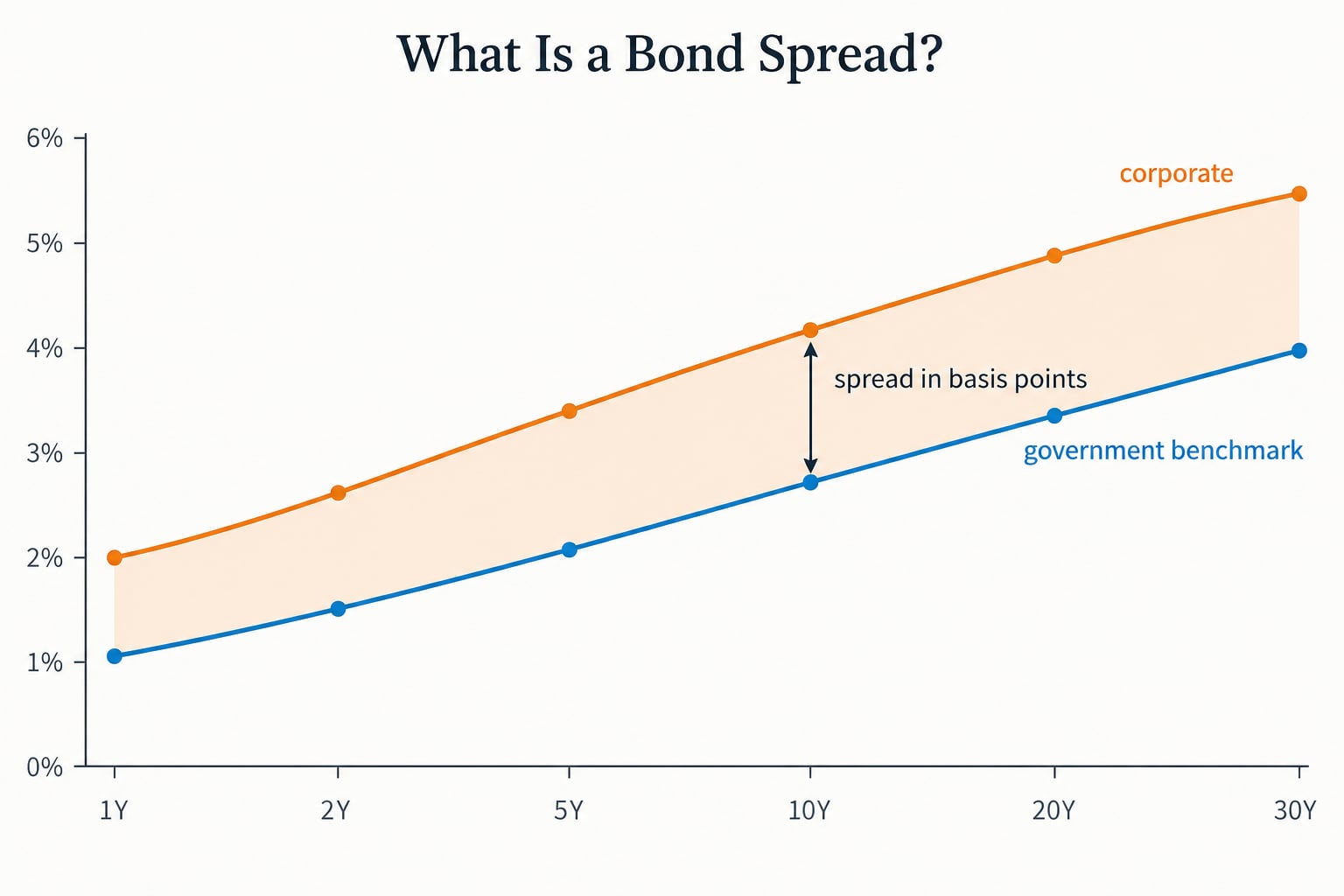
A spread compares the yield on the bond you care about with the yield on a reference bond that shares its risk profile in every way except one. That reference is the benchmark, and for most US credit work it is a US Treasury matched to the same maturity. The benchmark is close to risk-free, so the difference between it and your bond is the price of the risk you are taking.
How it works, in four steps: pick the bond, pick a maturity-matched Treasury, subtract the Treasury yield from the bond yield, and express the result in basis points. A 5.5% corporate bond against a 3.5% ten-year Treasury gives 2.0%, which is 200 basis points.
Why it matters: wider spreads mean lenders are charging more for the same maturity, which usually reflects higher perceived default risk, thinner liquidity, or both. Tighter spreads say the opposite. Spreads also move fast in a crisis, which makes them one of the cleanest real-time gauges of how stressed credit markets feel.
One caution about terminology. Searches for this head term return pages on credit spread option strategies, where a credit spread is a position that sells one strike and buys another. That has nothing to do with bond yields. A FAB spread, short for five against bond, is a Treasury futures-versus-bond arbitrage technique, also unrelated. Here, a bond spread always means a yield or price difference between two debt instruments.
How Do Investors Calculate a Bond Spread?
The arithmetic is short, and most of the work happens in choosing the benchmark. Practitioners calculate a yield spread like this:
- Pull the bond yield to maturity from the pricing screen.
- Pull the yield to maturity on the benchmark, matched as closely as possible to the bond’s remaining maturity.
- Subtract the benchmark yield from the bond yield.
- Convert the decimal result to basis points by multiplying by 100.
So a corporate bond at a 5.50% yield against a 4.25% Treasury of similar maturity gives 1.25%, or 125 basis points. The whole calculation fits in one line, which is why professionals fuss more about the inputs than the subtraction.
One basis point equals 0.01%. Keeping the conversion handy saves a lot of misreading.
| Spread | As a percentage | Plain reading |
|---|---|---|
| 10 bps | 0.10% | Near-identical risk pricing |
| 25 bps | 0.25% | A modest premium |
| 50 bps | 0.50% | Clear but ordinary compensation |
| 100 bps | 1.00% | One full percentage point of extra yield |
| 200 bps | 2.00% | Substantial risk premium |
| 500 bps | 5.00% | Stressed or lower-quality territory |
Two variants matter. A G-spread, or nominal spread, compares the bond’s yield with the yield on a specific Treasury issue of the same maturity. An I-spread, or interpolated spread, compares against a theoretical Treasury bond that has been interpolated onto the government yield curve, which avoids the gap you get when no exact maturity Treasury exists.
Some desks prefer a spread-to-duration measure instead. Rather than the raw spread, they divide by duration, so bonds with different maturities can be compared on a risk-adjusted basis. If you see a spread quoted alongside duration, that is usually what they mean.
A price spread is a different animal. Where a yield spread measures the gap in yields, a price spread measures the gap in the clean prices of two bonds. Yield spreads are what you will see almost everywhere in credit analysis.
What Are the Main Types of Bond Spreads?
Most of the named spreads you meet in textbooks are the same calculation with a different benchmark or a technical adjustment. This table is the one to come back to.
| Spread | Benchmark used | What it captures |
|---|---|---|
| Credit spread | Same-maturity Treasury | Extra yield for issuer default risk |
| G-spread (nominal) | A specific on-the-run Treasury | Simple yield gap, easy to read |
| I-spread (interpolated) | Theoretical interpolated Treasury | Yield gap without maturity mismatch |
| Z-spread | Swap curve | Yield gap net of embedded option cost |
| OAS (option-adjusted) | Swap curve | Spread after removing call, put and prepayment options |
| Swap spread | Swaps, measured against Treasuries | The gap between the swap and Treasury markets |
| Asset swap spread | Spread on the synthetic underlying | Price of converting a bond to floating rate |
| Term spread | Another maturity on the same Treasury curve | Curve slope, such as ten-year minus three-month |
| TED spread | Three-month funding rate vs three-month T-bill | Short-term funding stress, now quoted with SOFR |
G-spread, I-spread and Z-spread is the comparison people most often want, so it is worth stating plainly. G-spread uses one actual Treasury bond, which is simple but a little crude. I-spread uses a curve-fitted Treasury, which smooths out maturity mismatch. Z-spread moves the benchmark to the swap curve and then solves for the spread that reproduces the bond’s price, accounting for any embedded option. OAS goes furthest: it strips the bond back to an option-free cash flow stream and reports the spread left over, which is why it is the default measure for mortgage-backed securities and callable corporates.
Swap spreads sit at a different level entirely. They compare interest rate swaps with Treasuries, and they can go negative. The usual reasons are Treasury scarcity, where limited bond supply forces prices up and yields down, and balance-sheet and regulatory effects that make banks and insurers happy to hold Treasuries at almost any yield. When Treasuries get scarcer or more attractive to hold, their yields fall below swap rates and the swap spread turns negative.
An asset swap converts a fixed-rate bond into a synthetic floating-rate exposure. The spread on that conversion, quoted in basis points, is the asset swap spread. Investors watch it as a gauge of demand for the bond’s credit risk in its synthetic form.
Term spread and TED spread measure something else. The term spread is the slope of the yield curve, and a negative ten-year minus three-month reading has preceded most US recessions by roughly four to six quarters. The TED spread, once three-month LIBOR minus three-month T-bills, now uses SOFR, measures funding stress directly.
Why Does the Bond Spread Between Two Bonds Change?
Spreads move because the price of risk moves, not because the bonds themselves changed. Five forces do most of the work.
Credit quality and the credit cycle come first. When issuers report weaker earnings, ratings get downgraded or lenders get cautious, and the spread on a given issuer widens even if the Treasury yield is unchanged. The reverse happens late in a strong cycle, when spreads compress toward their tights and investors accept thinner compensation.
Rates and inflation expectations matter more than beginners expect. A bond’s yield has two engines: the risk-free rate and its spread. When Treasury yields fall in a recession scare, bond yields can rise even while spreads tighten, and vice versa. Keeping the two parts separate is the single most useful habit a new bond investor can build.
Liquidity matters as well. Spreads on obscure, thinly traded issues sit wider than spreads on benchmark bonds with the same credit quality, because the buyer needs compensation for the exit. Some of that gap is permanent and some of it closes on heavy trading days.
Supply and demand set the technical backdrop. Heavy new issuance from companies refinancing debt can pressure spreads wider in the short run, and a wave of fund inflows into high yield can pull them tighter regardless of news.
Finally there is risk appetite. Investors who expect a soft landing buy risk and compress spreads. Investors who expect a stumble sell it and widen spreads. This is the component that moves fastest and is hardest to forecast, which is why it gets its own label in market commentary.
How Do Credit Spreads Affect Investors?
Spreads and bond prices run in opposite directions, and duration tells you by how much. If a spread widens by 100 basis points while the Treasury yield is unchanged, a bond with a duration of six loses roughly 6% of its price. That is the mechanical reason a bond fund can fall even on a day when the Treasury rally pushes yields down.
Spreads also set the cost of borrowing for companies, which feeds back into the economy. Wider spreads raise interest expense, slow investment, and weigh on the same credit quality that produced the widening. Tight spreads do the reverse, which is one reason a long stretch of compressed spreads draws concern about late-cycle pricing.
Across markets, spread levels decide where income has historically been paid for risk. Historical anchors from Treasury comparisons put very high grade corporate spreads near one to two percentage points, and BBB credit around two to four percentage points or more. A bond offering less than comparable bonds is a signal about either its credit or its price, and reading which one is the whole job.
It also works across asset classes. Comparing municipal bonds with Treasuries or Treasuries with AAA corporates turns the yield curve into a menu of relative values, and comparing developed with emerging market sovereign spreads shows what country risk costs on any given day.
How Can Investors Use Bond Spreads in Practice?
Start with history, not with the absolute number. A spread only means something against its own range. Investment grade high yield spreads have often sat in the low hundreds of basis points in calm markets, with high yield option-adjusted spreads in the low-to-mid hundreds, and both pushed far wider in stress. The high yield index option-adjusted spread topped 2,000 basis points at its peak in late 2008 and ran above 1,000 basis points in March 2020. Those are anchors, not targets.
Then separate level from change, which is a distinction practitioners keep coming back to. A wide spread with a narrowing trend can be a market that has repriced the worst. A narrow spread with a widening trend can be a market that has not caught up yet. On r/CFA, learners hit this same question repeatedly: a wide spread is not automatically a bargain, because it may be the market’s current, correct opinion.
Check the benchmark before you check anything else. The same bond produces a different spread measured against Treasuries, against swaps, or against a sector index, and the choice is a real analytical decision rather than a formatting detail. State your benchmark whenever you quote a spread.
Know where the numbers come from. FRED carries the ICE BofA option-adjusted spread index series for US corporate, high yield, investment grade and emerging market debt, updated daily and free to browse. Bloomberg and FactSet screens carry the same option-adjusted spread field on individual bonds. The iShares HYG and JNK ETFs give you a liquid proxy for high yield and investment grade credit, so their price action tracks the spread story without you holding every bond.
Watch for the four beginner mistakes. Comparing spreads across mismatched maturities produces noise. Reading 200 bps as two percent of price loss rather than a yield gap misreads the number. Ignoring tax on municipal bonds hides the fact that a taxable-equivalent yield can be lower than the raw spread suggests. And comparing spread level to spread change as if they were the same signal will mislead you.
If you are studying this formally, the CFA fixed income curriculum treats G-spread, I-spread and Z-spread as the core progression, and it is genuinely the fastest way to get fluent in the vocabulary professionals use daily.
Frequently Asked Questions
A bond spread measures the difference in yield to maturity between two bonds, most often a corporate or municipal bond and a US Treasury of matching maturity. It is usually quoted in basis points, and 100 basis points equal 1%. The gap represents the extra return investors demand for taking on default risk, liquidity risk and the other risks that separate the two bonds. Narrow the pair to bonds that differ only in credit quality and the spread becomes a clean price of risk.
It depends entirely on context. A wider spread means investors are charging more to lend, which usually signals higher perceived default risk or thinner liquidity. For an existing bond holder that is bad news, because the price falls as the spread widens. For a new buyer, a wide spread is simply more compensation per unit of risk. The judgement depends on whether the market is correct about the risk, not on the direction of the move alone.
Basis points are the standard unit for spreads because the differences involved are small. One basis point equals 0.01%, so 100 basis points equal one percentage point and 1,000 basis points equal ten. To convert a spread expressed as a percentage, multiply by 100: a 2.0% spread is 200 basis points. The reverse conversion divides by 100. Many index series and pricing screens publish spreads in basis points by default.
A yield spread is the gap between the yields to maturity of two bonds, and it is the measure used almost everywhere in credit analysis. A price spread is the gap between the two bonds’ clean prices, expressed directly in currency. The two are related but not interchangeable, because a price difference depends on duration and on which bond is longer. When you see a spread quoted in yield terms on a trading screen, it is the yield spread.
Not on its own, but it carries information about default expectations. A common approximation treats the credit spread as expected loss, calculated as default probability multiplied by one minus the recovery rate. So a 200 basis point spread might be read as roughly a 3% chance of default with a 40% recovery, or a 2% chance with a 60% recovery. Spreads also reflect liquidity and sentiment, so they move for reasons that have nothing to do with imminent failure.
Rates and spreads are separate components of a bond’s yield, and they often move in opposite directions. If the economy weakens, investors buy Treasuries and yields fall, while credit spreads widen at the same time as risk appetite drops. A corporate bond’s yield can therefore rise even while its spread widens sharply, because the spread move outweighs the Treasury rally. For that reason, spread analysis is best read alongside the Treasury move, not in isolation.
What to Take Away
Pick one bond and one benchmark, subtract, convert to basis points, and check the number against its own history rather than against other spreads on the page. Then read the same bond on FRED or your pricing screen to see what the option-adjusted spread says, and compare it with the same sector a year ago. That single exercise does more for reading spreads than any definition can, because it forces you to name the benchmark every time.
Source: https://www.pgm-blog.com/what-is-a-bond-spread/
Anyone can join.
Anyone can contribute.
Anyone can become informed about their world.
"United We Stand" Click Here To Create Your Personal Citizen Journalist Account Today, Be Sure To Invite Your Friends.
Before It’s News® is a community of individuals who report on what’s going on around them, from all around the world. Anyone can join. Anyone can contribute. Anyone can become informed about their world. "United We Stand" Click Here To Create Your Personal Citizen Journalist Account Today, Be Sure To Invite Your Friends.
LION'S MANE PRODUCT
Try Our Lion’s Mane WHOLE MIND Nootropic Blend 60 Capsules
Mushrooms are having a moment. One fabulous fungus in particular, lion’s mane, may help improve memory, depression and anxiety symptoms. They are also an excellent source of nutrients that show promise as a therapy for dementia, and other neurodegenerative diseases. If you’re living with anxiety or depression, you may be curious about all the therapy options out there — including the natural ones.Our Lion’s Mane WHOLE MIND Nootropic Blend has been formulated to utilize the potency of Lion’s mane but also include the benefits of four other Highly Beneficial Mushrooms. Synergistically, they work together to Build your health through improving cognitive function and immunity regardless of your age. Our Nootropic not only improves your Cognitive Function and Activates your Immune System, but it benefits growth of Essential Gut Flora, further enhancing your Vitality.

Our Formula includes: Lion’s Mane Mushrooms which Increase Brain Power through nerve growth, lessen anxiety, reduce depression, and improve concentration. Its an excellent adaptogen, promotes sleep and improves immunity. Shiitake Mushrooms which Fight cancer cells and infectious disease, boost the immune system, promotes brain function, and serves as a source of B vitamins. Maitake Mushrooms which regulate blood sugar levels of diabetics, reduce hypertension and boosts the immune system. Reishi Mushrooms which Fight inflammation, liver disease, fatigue, tumor growth and cancer. They Improve skin disorders and soothes digestive problems, stomach ulcers and leaky gut syndrome. Chaga Mushrooms which have anti-aging effects, boost immune function, improve stamina and athletic performance, even act as a natural aphrodisiac, fighting diabetes and improving liver function. Try Our Lion’s Mane WHOLE MIND Nootropic Blend 60 Capsules Today. Be 100% Satisfied or Receive a Full Money Back Guarantee. Order Yours Today by Following This Link.


| Visits: | 1,833,910,285 |
| Stories: | 8,715,075 |
Whistler Blowers, Insiders

