

What Is the Ten Year Treasury Yield? A Simple Guide (2026)

The ten year treasury yield is the interest rate, quoted as a percentage, that the U.S. government pays on a Treasury note with ten years left to maturity. It closed at 5.28% on October 2, 2026, the highest level since 2002. Think of it as the market’s price for lending the federal government money for a decade.
That single number travels further than most people expect. It anchors mortgage rates, corporate bond spreads, the discount rate investors use to value equities, and the flow of international money into dollar assets. It is also the most misread number in personal finance, mostly because quote pages show a figure with no explanation attached.
Every yield figure in this guide is stamped with a date, and every one of them moves daily. Nothing here is investment advice — this is the mechanics, so you can read a yield headline without guessing.
What Is the Ten Year Treasury Yield?
The 10-year Treasury yield is an interest rate, not a price. The underlying security is a Treasury note, a piece of federal debt issued by the U.S. Department of the Treasury with a fixed maturity date ten years out. The Treasury pays interest twice a year based on the note’s coupon rate, and repays the face value at maturity.
The quoted yield you see on the news is slightly different from any single note’s coupon. It is a constant-maturity estimate, the yield a hypothetical 10-year bond would have if the Treasury issued one right now. The Treasury publishes that estimate every business day, and the Federal Reserve Bank of St. Louis tracks it as the FRED series DGS10.
- Issuer: U.S. Department of the Treasury
- Security: 10-year note, the standard on-the-run issue
- Coupon payments: Semi-annual, at a rate fixed when the note was issued
- Risk level: Very low, and treated as the risk-free benchmark rate in most models
- Backing: Full faith and credit of the U.S. government
- Tax treatment: Interest is taxable federally but exempt from state and local income tax
- Liquidity: Extremely high, one of the most traded securities in the world
Where the 10-year sits among Treasury securities
Treasury bills mature in a year or less and pay no coupon. Notes run from one to ten years and pay a coupon. Bonds run longer than ten years, up to thirty. Inflation-protected securities, or TIPS, adjust their principal with inflation. The 10-year note sits right in the middle, which is exactly why so many loans and models point at it.
Where the yield stands right now
These are the figures behind the current headlines, as of the October 2, 2026 close. Quote pages such as CNBC’s US10Y, FRED and Trading Economics publish them daily.
| Measure | Level | As of |
|---|---|---|
| 10-year Treasury yield | 5.28% | October 2, 2026 close |
| Previous close | 5.234% | October 1, 2026 |
| Open / day high / day low | 5.249% / 5.298% / 5.157% | October 2, 2026 |
| 52-week range | 3.92% to 5.35% | Trailing 12 months |
| One year ago | 4.10% | October 2025 |
| Long-run average | 4.26% | Multi-decade mean |
Read that table as context rather than a verdict. Today’s 5.28% is roughly a percentage point above the long-run average of 4.26% and well above the sub-4% levels that dominated the decade after the financial crisis. It is high by recent standards and unremarkable by long-run standards.
How Is the Ten Year Treasury Yield Calculated?
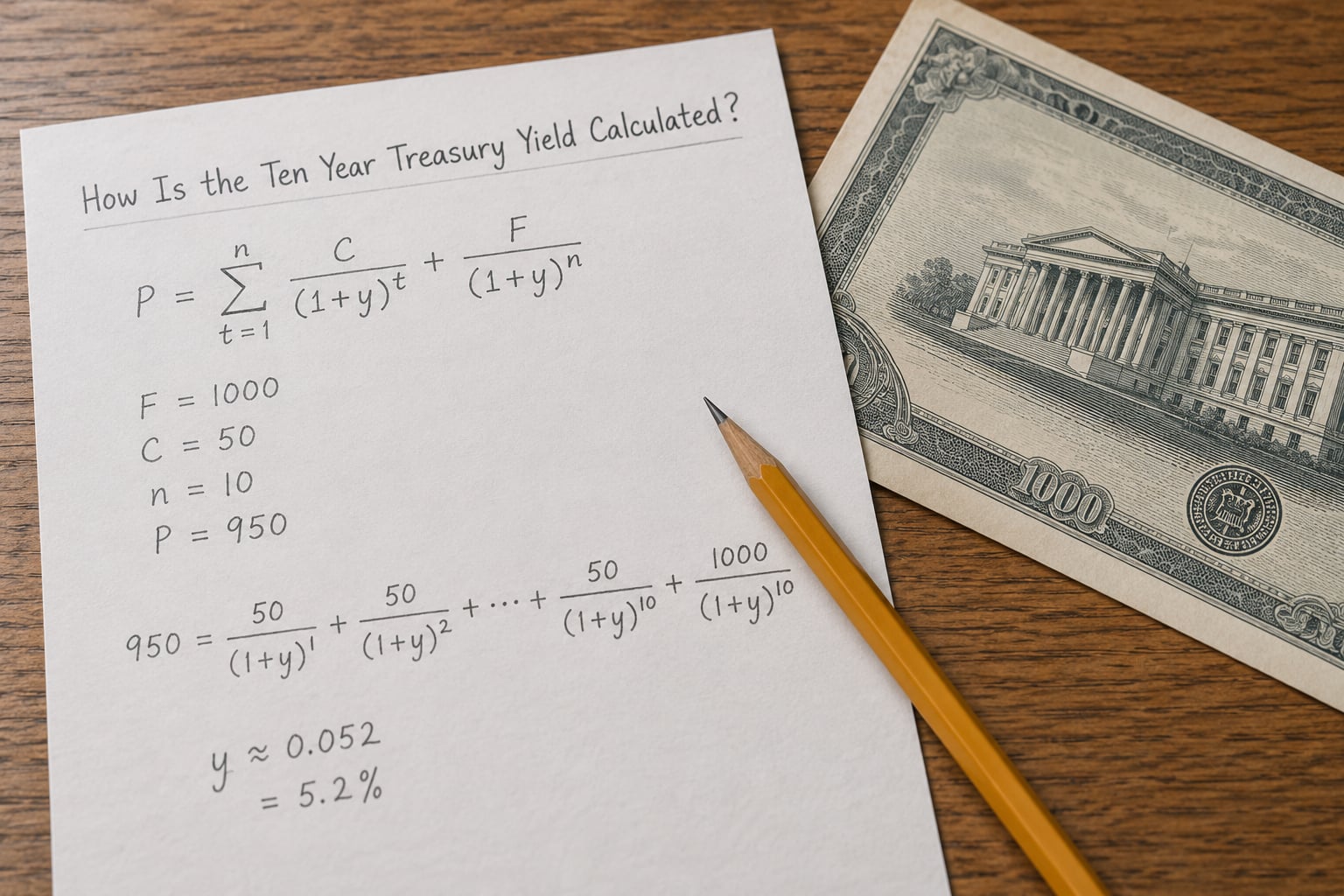
Yield to maturity is the single number that reconciles everything a bond does: the price you pay, the coupon you collect twice a year, the face value you receive at maturity, and the time you hold it. The formula looks intimidating. The intuition is simple: yield to maturity is the interest rate that makes the bond’s discounted cash flows equal today’s price.
A worked example
Imagine a note with a face value of 1,000 and a 3% coupon. It pays 30 every six months for ten years, then 1,000 back at maturity. That coupon rate is locked in when the note is issued and never changes. If you could buy it at exactly 1,000, your yield to maturity would be 3%.
Now the market moves. If that identical bond trades at 1,050, you paid 50 more than face value for the same cash flows, so the yield drops to roughly 2.86%. Push the price to 950 and the yield rises to roughly 3.16%. Same coupon, same maturity, opposite yield.
That is the whole relationship: price and yield move in opposite directions. It is why a bond you bought years ago can lose value today even though the government has never missed a payment.
How the market actually sets it
The Treasury does not set the yield you see. New 10-year notes are auctioned periodically to primary dealers, who bid on the security; competitive bids on price, translated back into yield, establish where the new issue opens in the secondary market, where everyone else trades. From there it is pure supply and demand, and the constant-maturity series interpolates a single number from that market.
Why a 4.625% coupon note trades near 95
A live example: the standard on-the-run note carries a 4.625% coupon and matures August 15, 2036. It was quoted around 95.06 out of 100 face value in early October 2026. The gap between its coupon and the market yield is not an error. It simply means buyers were paying less than face value for a fixed 4.625% income stream in a market where new ten-year money was yielding more than 5%.
Why Do Ten Year Treasury Yields Change?
Rates are a price, and like any price they move when expectations change. Five forces do most of the work.
- Federal Reserve policy expectations. The 10-year is forward-looking. Traders do not care where the federal funds rate sits today, only where it is expected to sit when the note matures. Cutting cycles can coexist with rising long yields.
- Inflation expectations. Bondholders are compensated for expected inflation. When price pressures look sticky over a decade, nominal yields climb.
- Economic data. Strong employment reports, retail sales and growth figures push yields up because they support higher future rates. Weak data does the reverse.
- Supply and demand. Federal deficits mean more debt to absorb, and quantitative tightening removes the Fed’s holdings from the market. Foreign demand for dollar assets pushes the other way.
- Safe-haven flows and risk sentiment. When markets get nervous, money moves into Treasuries and yields fall, sometimes sharply, regardless of what the Fed is doing.
The term premium question
Here is the puzzle that shows up constantly in reader discussions. The Fed has been cutting while long-term yields climbed, which looks contradictory until you separate the two things driving the ten-year. Expected short-term rates account for part of it. The rest is the term premium, the extra compensation investors demand for holding long-dated debt instead of rolling short-term bills.
When the term premium widens, long yields can rise while the Fed cuts. That is the current setup, and it is why “the Fed cut, so yields must fall” is wrong as a rule.
What happened on the way to 5%
The move through the 5% threshold was gradual rather than explosive. An intraday print of 5.14% on September 23, 2026 produced the first 5% reading since mid-2007. By the October 2 close the yield stood at 5.28%, up roughly 0.51 percentage points over the prior month and about 1.16 points higher than a year earlier.
How Do Investors Read a Ten Year Treasury Yield Quote? The percentage convention
A yield of 5.28% means 5.28 per 100 of face value per year. Movements are quoted in basis points, where one basis point is 0.01 percentage point. A move from 5.28% to 5.51% is 23 basis points, and news coverage treats that as a move worth explaining.
Why small moves hurt bond prices
A 10-year note has a duration somewhere around eight years, which means a 1% change in yield tends to move its price by roughly 8% in the opposite direction. So 25 basis points is not small for anyone holding these bonds. Duration is the reason long-maturity notes feel riskier than short ones even though the credit is identical.
Bid, ask and trading hours
Quotes come with a bid and an ask, the price at which dealers buy and sell, and the gap between them is small because the market is deep. U.S. Treasury trading runs roughly 8 a.m. to 5 p.m. Eastern, with price quotes in 32nds of a point, so 95.0625 means 95 and 2/32nds. Accrued interest is added separately between coupon dates.
Where to check it yourself
You do not need a broker account to follow this. TreasuryDirect publishes the daily par yield curve for every maturity. FRED’s DGS10 series gives you the same constant-maturity 10-year yield with a downloadable history. CNBC’s US10Y quote page shows live intraday levels. Readers on investing forums consistently treat TreasuryDirect and FRED as authoritative and discount undated figures from news fragments, which is a reasonable habit.
What Does a Higher or Lower Ten Year Yield Mean?
Direction matters, but so does cause. The same move in the 10-year can mean very different things depending on what is driving it.
When yields rise
Existing Treasury notes fall in price, which is painful for anyone who bought earlier at lower yields. Mortgage rates usually climb with them, though not one-for-one. Corporate borrowing costs rise as spreads are added on top of the Treasury rate, and the higher discount rate puts pressure on stock valuations, especially on companies whose value depends on profits far in the future.
Rising yields can also be read as a vote of confidence: if the economy is growing and inflation is contained, long rates should be higher. Forum readers who watch these threads often note the same thing. A steady climb alongside solid growth is a different signal from a sharp jump caused by doubts about debt sustainability.
When yields fall
Bonds rally, existing holders gain, and new buyers lock in lower income. Mortgages tend to follow down. Equities often rally as the discount rate eases and money rotates toward risk assets, and weaker-than-expected economic data is the usual explanation. Sharp, sudden falls during a market selloff point to safe-haven demand rather than optimism.
The yield curve and why its shape gets watched
The yield curve plots yields across maturities, and economists read the spread between short and long rates as a recession indicator. When short-term rates sit above long-term rates, the curve is inverted, meaning markets expect weaker growth ahead. That inversion ran from late 2022 into 2024, and it preceded a slowdown that arrived on schedule.
Historical extremes
No ranking explainer supplies these numbers, which is why they are worth keeping on file.
| Period | Approximate 10-year yield | Context |
|---|---|---|
| Early 1980s peak | About 15.2% | Inflation fighting and the Volcker era |
| Long-run average | 4.26% | Multi-decade mean |
| Pandemic-era trough | About 0.5% | Emergency policy cuts |
| One year ago | 4.10% | October 2025 |
| October 2, 2026 close | 5.28% | Highest since 2002 |
That range is the answer to whether today’s number is remarkable. It is high for the last five years and completely ordinary for the last forty.
How Does the Ten Year Treasury Yield Affect Portfolio Decisions?
None of this is a recommendation, and every saver’s situation differs. What the yield does is change the arithmetic available to you.
What you actually earn on a bond
The headline yield is nominal, and inflation eats into it. If inflation runs at 3% and you hold a note yielding 5.28%, the real return is a little over 2%. TIPS publish a breakeven rate, the gap between nominal and inflation-indexed yields, which is a forward-looking inflation gauge that many readers find more honest than headline comparisons.
Comparing bonds to other places to park cash
Savers weighing a Treasury against a certificate of deposit or a high-yield account should compare the after-tax number, since Treasury interest is federally taxable but exempt from state and local income tax. That exemption can move a comparison by a meaningful margin depending on where you live. Nobody should act on a rate quoted without noting its date.
Valuation pressure on dividend-paying equities
When the risk-free rate rises, the income a stock pays has to compete with a safer yield. Investors comparing a stock’s dividend yield against the 10-year are making exactly that comparison, which is why equity multiples tend to compress as the 10-year climbs.
Refinancing costs and portfolio ballast
Anyone with floating-rate debt or a maturing bond knows the mechanical effect: refinancing at a higher rate costs more. Holding Treasuries in the meantime still locks in a known yield, though selling before maturity means realizing whatever price the market offers on the day.
Precious metals and currency
Gold carries no yield, so higher real yields raise the opportunity cost of holding it, and a stronger dollar tends to dampen dollar-priced commodities. These are tendencies, not rules; geopolitics can move any of them on its own.
What readers actually do with this
Recurring threads in retail investing forums converge on a plain conclusion. People want to know whether a 5% level is genuinely attractive, and whether rising yields mean they should move money out of savings. The honest answer is that the number is one input among several: your time horizon, your tax situation, and whether you need the cash to stay liquid all matter more than any single yield print. Treat the 10-year yield as context, not a signal to act on.
Frequently Asked Questions
The 10-year Treasury yield is the annual interest rate implied by the price of U.S. government debt maturing in ten years. The Treasury issues 10-year notes with fixed semi-annual coupons, and the market trades them continuously. The quoted yield is a constant-maturity estimate, not a specific coupon, and it serves as the main risk-free benchmark for mortgages, corporate bonds and equity valuations.
Nobody can answer that from the yield alone. A 5.28% yield on October 2, 2026 is high relative to the 4.26% long-run average but normal over a forty-year view, and prices fall when yields rise. Locking in a known ten-year rate protects you if rates rise further, while waiting suits investors who expect yields to drift lower. Your time horizon and cash needs decide it, not a headline.
The 10-year yield peaked in the early 1980s at roughly 15.2%, during the inflation-fighting period of the early 1980s. At the other end it fell to about 0.5% during the pandemic-era emergency cuts. The long-run average sits near 4.26%, which makes the 5.28% close on October 2, 2026 high by recent standards but unremarkable historically.
Rising yields mean existing Treasury notes lose price, mortgage rates usually climb with them, and corporate borrowing gets more expensive. Higher discount rates also weigh on stock valuations, particularly for companies whose value sits far in the future. The cause still matters: a climb driven by strong growth reads differently from one driven by rising term premium or fiscal concerns.
Falling yields mean existing bond prices rise and new issues come with lower income, and mortgages generally follow. Markets often read lower long yields as softer growth expectations or as safe-haven demand during stress, since investors buy Treasuries when they want less risk. Bondholders already holding a note benefit directly through a higher price.
The 5% threshold was crossed gradually rather than in a single session. An intraday print of 5.14% on September 23, 2026 produced the first 5% reading since mid-2007, and by the October 2 close the yield reached 5.28%, up about 0.51 percentage points over a month and 1.16 points over a year. Long rates rose while the Fed was cutting, which points to a widening term premium rather than near-term policy expectations.
The federal funds rate is the overnight rate banks charge each other, set directly by the Federal Reserve and used as the main tool for monetary policy. The 10-year Treasury yield is a market rate for ten-year government debt and reflects expectations for future policy, inflation, growth and term premium over that whole span. The two can move in opposite directions, which confuses many readers.
Conclusion
The ten year treasury yield is the annual interest rate on U.S. government debt with ten years to maturity, quoted as a percentage and set by supply and demand in the secondary market. It closed at 5.28% on October 2, 2026, against a long-run average of 4.26%, which is high for this decade and ordinary for the last forty years.
Three things are worth doing before you react to the next headline. First, compare whatever number you are reading against the historical range, so a big move is not mistaken for an unprecedented one. Second, find out why it moved, since growth, inflation and fiscal pressure push the yield in the same direction but mean very different things. Third, remember that it is one signal about the price of money, not a buy or sell instruction for your own portfolio.
And stamp your figures with a date. TreasuryDirect and FRED are free, and a yield without a date is not information.
Source: https://www.pgm-blog.com/what-is-the-ten-year-treasury-yield/
Anyone can join.
Anyone can contribute.
Anyone can become informed about their world.
"United We Stand" Click Here To Create Your Personal Citizen Journalist Account Today, Be Sure To Invite Your Friends.
Before It’s News® is a community of individuals who report on what’s going on around them, from all around the world. Anyone can join. Anyone can contribute. Anyone can become informed about their world. "United We Stand" Click Here To Create Your Personal Citizen Journalist Account Today, Be Sure To Invite Your Friends.
LION'S MANE PRODUCT
Try Our Lion’s Mane WHOLE MIND Nootropic Blend 60 Capsules
Mushrooms are having a moment. One fabulous fungus in particular, lion’s mane, may help improve memory, depression and anxiety symptoms. They are also an excellent source of nutrients that show promise as a therapy for dementia, and other neurodegenerative diseases. If you’re living with anxiety or depression, you may be curious about all the therapy options out there — including the natural ones.Our Lion’s Mane WHOLE MIND Nootropic Blend has been formulated to utilize the potency of Lion’s mane but also include the benefits of four other Highly Beneficial Mushrooms. Synergistically, they work together to Build your health through improving cognitive function and immunity regardless of your age. Our Nootropic not only improves your Cognitive Function and Activates your Immune System, but it benefits growth of Essential Gut Flora, further enhancing your Vitality.

Our Formula includes: Lion’s Mane Mushrooms which Increase Brain Power through nerve growth, lessen anxiety, reduce depression, and improve concentration. Its an excellent adaptogen, promotes sleep and improves immunity. Shiitake Mushrooms which Fight cancer cells and infectious disease, boost the immune system, promotes brain function, and serves as a source of B vitamins. Maitake Mushrooms which regulate blood sugar levels of diabetics, reduce hypertension and boosts the immune system. Reishi Mushrooms which Fight inflammation, liver disease, fatigue, tumor growth and cancer. They Improve skin disorders and soothes digestive problems, stomach ulcers and leaky gut syndrome. Chaga Mushrooms which have anti-aging effects, boost immune function, improve stamina and athletic performance, even act as a natural aphrodisiac, fighting diabetes and improving liver function. Try Our Lion’s Mane WHOLE MIND Nootropic Blend 60 Capsules Today. Be 100% Satisfied or Receive a Full Money Back Guarantee. Order Yours Today by Following This Link.


| Visits: | 1,833,895,646 |
| Stories: | 8,715,030 |
Whistler Blowers, Insiders

