

What Is Hyperinflation and What Causes It? (October 2026)

Hyperinflation is a runaway rise in prices that pushes a country’s inflation rate above roughly 50% per month, and what causes it is nearly always the same thing: money created faster than the economy can produce goods and services, usually to fund a government that has lost access to ordinary borrowing. At that pace a currency stops working as a store of value. Cash gets spent the day it is earned because holding it overnight costs you.
Most people who search this question are not living through hyperinflation. They are trying to work out how far away it is, whether their savings are at risk, and whether the metal in their safe is worth anything. I’ll answer the definition first, then walk the causal chain step by step, then show what happened in the handful of episodes where this actually occurred.
How to Recognize Hyperinflation
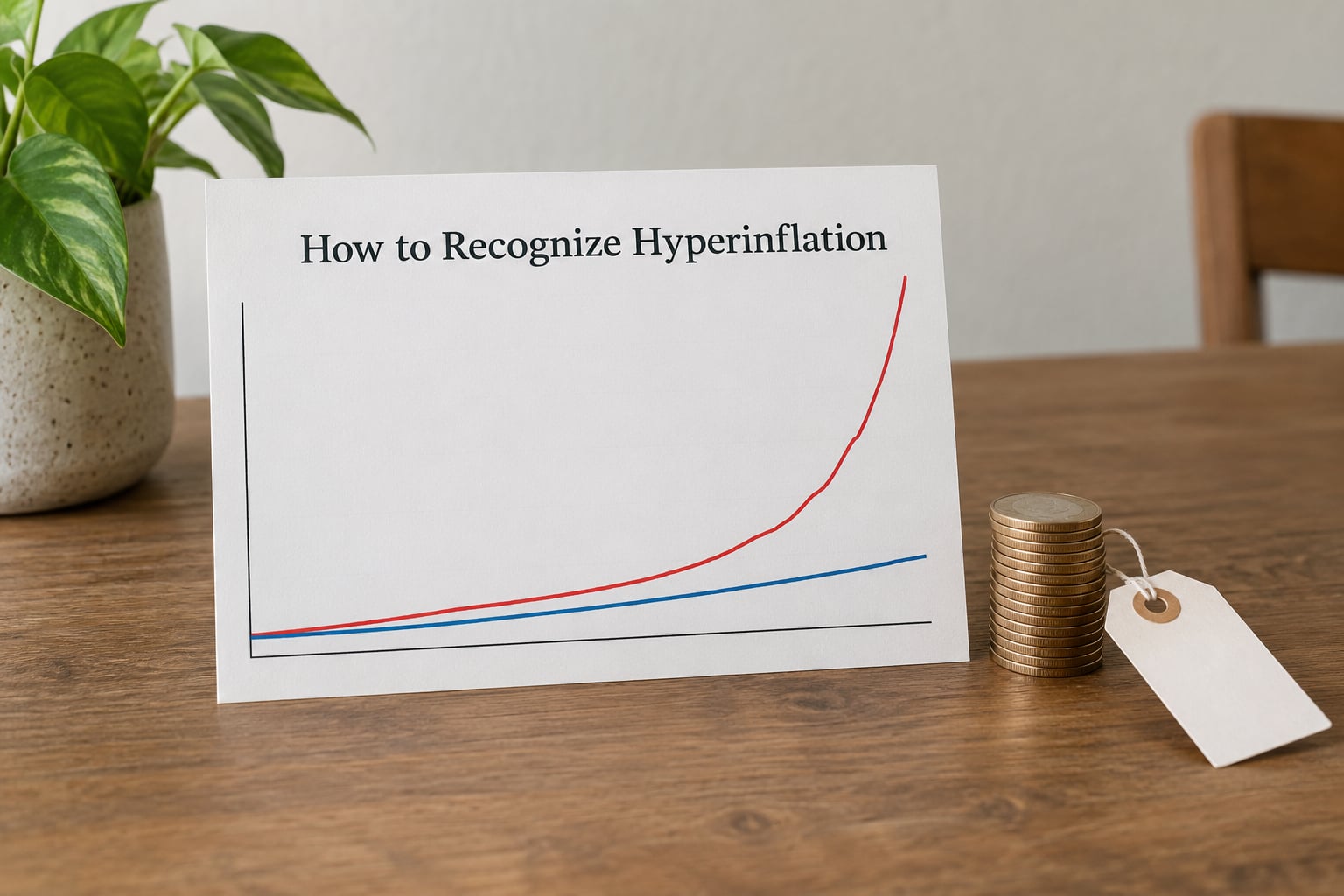
The definition everyone quotes comes from the economist Phillip Cagan, who studied seven episodes of extreme monetary instability in the 1950s. He defined hyperinflation as a rate of price change so extreme that it becomes socially and politically destabilizing, and used 50% per month as the practical threshold. That figure comes from compounding: prices rising 50% every month mean roughly 1,000% over a year, so money halves in purchasing power about every month and a half.
The 50% rule is a marker, not a law. Cagan’s own diagnosis also looked at how prices behaved, whether people had started demanding wages that reset constantly, and whether the currency was still being accepted at all. When a government pays workers in a currency that changes value by the hour, indexation takes over, and prices stop being quoted in a stable unit, something else has happened that a single threshold cannot capture.
What Is Hyperinflation and What Causes It?
Plainly: hyperinflation means money loses value faster than output grows, and the cause is an endless loop of new money chasing a fixed or shrinking supply of goods. Governments and central banks keep expanding the money supply to pay bills, wages, and debt, prices rise to chase it, people ask for more money to keep up, and the government prints more. Once nobody believes the currency will hold its value tomorrow, the currency stops being money in practice.
There is an important distinction to hold onto here. High inflation is bad, unpleasant, and sometimes politically dangerous. Hyperinflation is a different regime entirely, one where the ordinary machinery of saving, lending, and contracting stops functioning. A country can run 8% or 20% inflation for years without ever becoming a Weimar-style collapse, and treating those as the same thing is the most common mistake in this topic.
The Main Causes of Hyperinflation
Causes of hyperinflation tend to arrive in bundles rather than one at a time. The sequence below is roughly the order in which they appear, from the most common trigger to the ones that seal the outcome.
- Monetizing a large fiscal deficit. A government that cannot borrow or does not want to pay a higher rate simply instructs its central bank to create the money to cover the shortfall. Debt growth that outruns the tax base becomes money growth.
- Monetary expansion outrunning real output. If the money supply grows faster than the goods and services produced, each unit of currency buys less. Growth in the money supply without matching growth in real GDP is the mechanical core of the thing.
- War, civil conflict, or a collapse in government credibility. Wartime spending is a classic trigger. So is a political vacuum where nobody credible can make a fiscal decision, which removes the possibility of the eventual correction.
- Collapse of productive capacity or severe supply shocks. Destroyed agriculture, a broken export sector, or an embargo can leave a country printing money against a shrinking supply, which turns ordinary inflation into hyperinflation.
- Capital flight and a balance of payments crisis. When residents and foreigners pull money out, the central bank loses reserves. Defending an exchange rate with an empty reserve base forces more printing, which pushes more money out the door.
- Loss of confidence in the currency itself. The final stage rather than a starting cause. Once people switch to dollars, euros, gold, or barter, the domestic currency’s usefulness collapses and the spiral tightens on its own.
Notice what is missing from that list: high national debt on its own does not produce hyperinflation, and neither does printing on its own. The United States, Japan, and the United Kingdom ran large deficits and heavy money creation without hyperinflating, because they had independent central banks, deep domestic capital markets, and a currency the rest of the world wants to hold. Debt becomes dangerous when nobody believes it will ever be repaid and the central bank is politically prevented from raising rates.
How Hyperinflation Develops
The escalation is easier to understand as a sequence than as a definition. Each step feeds the next one, and by the time people can name what is happening, several steps have already run.
- Fiscal stress. Spending commitments exceed what tax revenue and borrowing can cover, for reasons ranging from war to a collapsing tax base.
- Reserve pressure. Foreign currency reserves fall as capital leaves, and the currency comes under attack in the market.
- Monetization. The central bank creates money to pay obligations and to defend the currency rate. The money supply accelerates.
- Currency depreciation. With more money chasing the same goods, the exchange rate falls and imports become brutally expensive.
- Accelerating prices. Import costs feed into domestic costs, and firms reprice constantly rather than annually. Menu costs become absurd: changing a price tag on a single item can eat a meaningful share of the shop’s margin.
- Wage indexation. Workers demand raises to keep pace, wages reset every payday, and firms raise prices again to cover the higher wage bill.
- Panic spending and capital flight. Wages are spent immediately. Savings are withdrawn. The bank deposit that took ten years to build is withdrawn in a single afternoon.
- Currency substitution. Households start holding dollars, euros, gold, or goods instead of the domestic currency, which drains the banking system of the deposits it depends on.
- Redenomination or dollarization. The government eventually abandons the currency, drops some zeros, adopts a hard currency, or accepts a currency board.
Each loop is faster than the last, which is why the final phase of a hyperinflation can compress years of ordinary damage into weeks. Surviving accounts from these episodes describe the same behavior everywhere: pay the bills the day you get paid, and hold no cash overnight.
Hyperinflation vs. High Inflation
The distinction that matters most is between a rate that is uncomfortable and a rate that changes how the economy behaves. Stagflation and deflation are worth separating too, since both get confused with hyperinflation.
| Condition | Typical pace | Usual cause | What the currency does | Effect on households |
|---|---|---|---|---|
| Ordinary inflation | Roughly 2-4% a year | Normal demand growth and modest monetary policy | Holds or drifts gently | Savings slowly lose purchasing power |
| High inflation | Often 10-30% a year | Large deficit spending, supply shocks, loose policy | Depreciates noticeably | Lenders lose to inflation; wage earners feel it in monthly costs |
| Stagflation | High rates with flat or falling output | Supply shock plus weak policy response | Usually under pressure but functioning | Few easy answers: jobs are scarce and prices are climbing at once |
| Hyperinflation | Above roughly 50% per month | Continuous monetization with collapsing confidence | Stops serving as a store of value; barter and hard currency take over | Cash savings erased in months, contracts and pensions break |
| Deflation | Persistent price declines | Demand collapse and excess capacity | Rises in real terms | Debt burdens grow and spending freezes |
Stagflation deserves its own note because it is the condition most people assume they are living in. It means inflation is running high while output is stagnant and unemployment is high. The uncomfortable part is that the usual cures for inflation, higher rates and lower spending, make the stagnation worse, which is why policymakers hesitate to use them.
Historical Examples of Hyperinflation
Five episodes are usually cited. The figures below are approximate because sources quote them inconsistently, and no two cases were identical in trigger, duration, or ending.
| Country | Period | Peak monthly rate (approx.) | Main trigger | How it ended |
|---|---|---|---|---|
| Weimar Germany | 1921-1923 | Figures cited range into astronomically large percentages per month by late 1923 | World War I reparations, fiscal weakness, passive resistance funded with newly issued currency | A new currency backed by land and industrial assets, plus a credible finance minister |
| Hungary | 1946 | Around 19,000% a month at the peak in 1946 | Post-war obligations and a large share of spending financed by money creation after the second world war | Currency reform in August 1946 at a punishing conversion rate |
| Zimbabwe | 2007-2008 | Roughly 80 billion% year-on-year by the final phase of the Zimbabwean dollar | A decade of war and military spending, a collapse in output, and an unsupported exchange rate | Abandonment of the Zimbabwean dollar and adoption of the US dollar and others |
| Yugoslavia | 1993 | Extremely high monthly rates for much of 1993 | Breakup of the federation, disrupted output, and financing of the conflict | Currency devaluation in 1994 followed by a rate stabilization program |
| Venezuela | 2016-2019 and later | Annual rates in the tens of thousands of percent at the worst point | Large fiscal deficit, heavy money creation, an exchange rate peg that broke, and falling oil output | Redenomination attempts and eventual widespread use of the US dollar |
Two details from the German episode stay with people who read it. A pension savings plan that had taken a working lifetime to accumulate bought a single cup of coffee. And in the payroll anecdote repeated across textbooks, workers were paid in wheelbarrows of banknotes because a single banknote was worth less than the cash needed to carry it.
Zimbabwe is the modern version. Deposits held in local currency were effectively wiped out by redenomination, and the banking system itself became a mechanism for losing money, since balances were converted at a rate that had already collapsed.
Warning Signs That Inflation May Become Hyperinflation
No list of signals is a prediction, and every one of them has produced false alarms. They are still useful, because in the episodes above they appeared in roughly this order.
- Prices that reset constantly. Shops repricing daily or weekly rather than annually, and menu costs rising so fast that they eat margins.
- A collapsing exchange rate. The currency losing double digits in a short period, and official rates diverging sharply from black market rates.
- Shortages and empty shelves. Import-dependent goods disappearing because foreign currency to buy them is unavailable.
- Negative real interest rates. Nominal deposit rates sitting well below the inflation rate, which is the signal that savers are being pushed out of the currency.
- Currency substitution. Prices quoted in dollars, wages negotiated to keep pace, and households holding foreign cash at home.
- Tightening capital controls. Rules restricting the purchase of foreign currency, which usually confirms the government already knows the pressure is severe.
- Loss of market access. Governments unable to borrow at a manageable rate, meaning the correction must come from money creation or default.
- Falling confidence in the numbers. Official statistics stopped being believed, which is usually late in the process rather than early.
Read together rather than individually, these are the markers to watch in your own country. A developed economy with an independent central bank, a deep domestic savings market, and foreign demand for its currency has a cushion most of the countries above did not have, which is why the consensus view is that the United States reaching true hyperinflation is unlikely.
What Hyperinflation Does to Money, Markets, and People
Cash savings are the first casualty, and they are the reason inflation is called a tax on the poor. A bank deposit is a promise to return a fixed quantity of money later; if prices rise 50% a month, that promise is worthless within two payment cycles. People living through high-inflation episodes describe the same pattern everywhere: spend the wage immediately, withdraw savings on the first sign of trouble, and convert into goods or a hard currency within days.
Banks fail next, and they fail for two reasons at once. Depositors rush to withdraw cash that the bank does not have, and the remaining assets are denominated in a currency worth less each week. Fixed-income investors suffer in a related way: government bonds can be adjusted for inflation, but most private contracts, pensions, and annuities are written in nominal terms and simply lose.
Real assets behave differently, and the table below reflects the historical pattern rather than a promise.
| Asset | Typical behaviour in a currency collapse | Caveat |
|---|---|---|
| Gold | Holds value in local currency terms and often rises sharply | Wholesale and physical markets can break down; spreads widen at the worst moment |
| Silver and other precious metals | Similar dynamic with more industrial demand noise | More volatile than gold and easier to manipulate at the retail level |
| Commodities and productive land | Price in dollars rises as currency falls, which cushions the local-currency value | Requires storage, insurance, and a way to sell when a market is open |
| Foreign currency held directly | Directly preserves purchasing power | Capital controls can make it illegal to hold or buy |
| Inflation-linked government bonds | Built to protect principal against measured inflation | Low real yields mean they may lag equities over long horizons |
| Diversified global stocks and bonds | The mainstream long-run answer from personal finance communities | Can fall hard in the first weeks of a crisis, before recovering |
There is a genuine argument between the precious metals crowd and the mainstream view, and it is worth naming rather than hiding. Gold people argue that a hard asset with no counterparty survives the failure of a fiat currency, which is historically true. Personal finance communities argue that a diversified worldwide portfolio of productive businesses has done the job over every long stretch where holding metal did not, and that precious metals belong in a satellite allocation, not a core one. Both are describing real evidence.
The wider damage is social and political. Fixed incomes collapse first, so retirees, pensioners, cash savers, and workers on short contracts carry the heaviest losses. Inequality widens. Businesses cannot plan, so investment stops. And historically, hyperinflation has been a reliable precursor of political extremism and unrest, which is a reminder that it rarely ends with a quiet policy adjustment.
Frequently Asked Questions
Economists commonly use a threshold of about 50% per month, from Phillip Cagan’s study of extreme monetary episodes. That rate compounds to roughly 1,000% in a year, so money halves in purchasing power about every month and a half. The number is a practical marker rather than a law: economists also look at how prices behave, whether wages are constantly reset, and whether the currency is still accepted in daily trade.
Almost always, but the mechanism matters. What produces hyperinflation is money creation that outruns the growth of real goods and services, usually to fund a deficit the government cannot borrow against. High debt on its own, or central bank asset purchases on their own, have not produced hyperinflation in countries with independent central banks and foreign demand for their currency. The trigger is expansion without a credible way to stop it.
It can be halted, but the cost is usually severe for whoever holds the currency. Episodes generally ended through abrupt stabilization, a fiscal and monetary overhaul, currency reform that imposed a large conversion loss on existing balances, or outright adoption of a foreign currency. Germany, Hungary, and Zimbabwe all ended their episodes this way. The longer an episode runs, the harder the stabilization becomes and the less of your savings survives it.
Gold has no issuing authority, so it cannot be devalued by a central bank, and in every episode above its local currency price rose sharply as the currency fell. Gold is also portable and recognizable, which matters when banks are failing and foreign currency is restricted. The catch is that physical gold markets thin out at the worst moments, spreads widen, and a portfolio built mostly on gold has no income and no growth. It works best as one part of a diversified position.
Judge your currency’s trajectory using the warning signs, not headlines: the exchange rate, the gap between nominal and real interest rates, and whether the government can still borrow at a sane rate. Then check what your holdings are actually denominated in. Cash and long-dated fixed-income investments are the most exposed. Adding a modest allocation to assets priced in a different currency or in hard assets, plus real assets you can actually hold and use, spreads the risk without pretending anything is guaranteed.
What to Watch First
Watch inflation, the currency, interest rates, and government credit together. Any one of them can look alarming on its own, and reacting to a single monthly print is how people talk themselves into a decision they then regret. Together they tell you whether a country is drifting toward the conditions described above.
The practical first step is unglamorous: check what your savings are denominated in and how much of your working life depends on that currency continuing to hold its value. Nothing on this page is individual financial advice, and no asset protects you in all circumstances, including the one where your government restricts the currency you thought you owned. Read more about the mechanisms, keep the reading going, and make the decision while it is still a decision.
Source: https://www.pgm-blog.com/what-is-hyperinflation-and-what-causes-it/
Anyone can join.
Anyone can contribute.
Anyone can become informed about their world.
"United We Stand" Click Here To Create Your Personal Citizen Journalist Account Today, Be Sure To Invite Your Friends.
Before It’s News® is a community of individuals who report on what’s going on around them, from all around the world. Anyone can join. Anyone can contribute. Anyone can become informed about their world. "United We Stand" Click Here To Create Your Personal Citizen Journalist Account Today, Be Sure To Invite Your Friends.
LION'S MANE PRODUCT
Try Our Lion’s Mane WHOLE MIND Nootropic Blend 60 Capsules
Mushrooms are having a moment. One fabulous fungus in particular, lion’s mane, may help improve memory, depression and anxiety symptoms. They are also an excellent source of nutrients that show promise as a therapy for dementia, and other neurodegenerative diseases. If you’re living with anxiety or depression, you may be curious about all the therapy options out there — including the natural ones.Our Lion’s Mane WHOLE MIND Nootropic Blend has been formulated to utilize the potency of Lion’s mane but also include the benefits of four other Highly Beneficial Mushrooms. Synergistically, they work together to Build your health through improving cognitive function and immunity regardless of your age. Our Nootropic not only improves your Cognitive Function and Activates your Immune System, but it benefits growth of Essential Gut Flora, further enhancing your Vitality.

Our Formula includes: Lion’s Mane Mushrooms which Increase Brain Power through nerve growth, lessen anxiety, reduce depression, and improve concentration. Its an excellent adaptogen, promotes sleep and improves immunity. Shiitake Mushrooms which Fight cancer cells and infectious disease, boost the immune system, promotes brain function, and serves as a source of B vitamins. Maitake Mushrooms which regulate blood sugar levels of diabetics, reduce hypertension and boosts the immune system. Reishi Mushrooms which Fight inflammation, liver disease, fatigue, tumor growth and cancer. They Improve skin disorders and soothes digestive problems, stomach ulcers and leaky gut syndrome. Chaga Mushrooms which have anti-aging effects, boost immune function, improve stamina and athletic performance, even act as a natural aphrodisiac, fighting diabetes and improving liver function. Try Our Lion’s Mane WHOLE MIND Nootropic Blend 60 Capsules Today. Be 100% Satisfied or Receive a Full Money Back Guarantee. Order Yours Today by Following This Link.


| Visits: | 1,833,895,646 |
| Stories: | 8,715,030 |
Whistler Blowers, Insiders

