
What Is Core Inflation and Why It Matters in Markets (2026)

Core inflation is the rate at which prices rise across the economy with volatile categories, food and energy, removed from the calculation. That gives a cleaner read on the underlying, long-run trend in the price level rather than the shock of the month.
It matters to anyone holding bonds, cash or metals because persistent price pressure is what forces a central bank to keep policy tight. That single mechanism reaches yields on savings accounts, mortgage rates, the price of gold and the real return on every paycheck.
What is core inflation and why does it matter, in short: it is the Fed’s preferred lens for deciding whether an inflation problem is real. Here are the points that carry the rest of this guide.
- It is a subtraction, not a separate survey. Agencies take a headline index and remove the food and energy components.
- It is smoother, not more accurate. The point is to filter noise, not to describe your household bill.
- The Fed does not target it. The 2 percent goal is stated in terms of headline PCE, which surprises a lot of readers.
- It is a trend read. One monthly print tells you very little; six consecutive releases tell you a lot.
What Is Core Inflation and Why It Matters
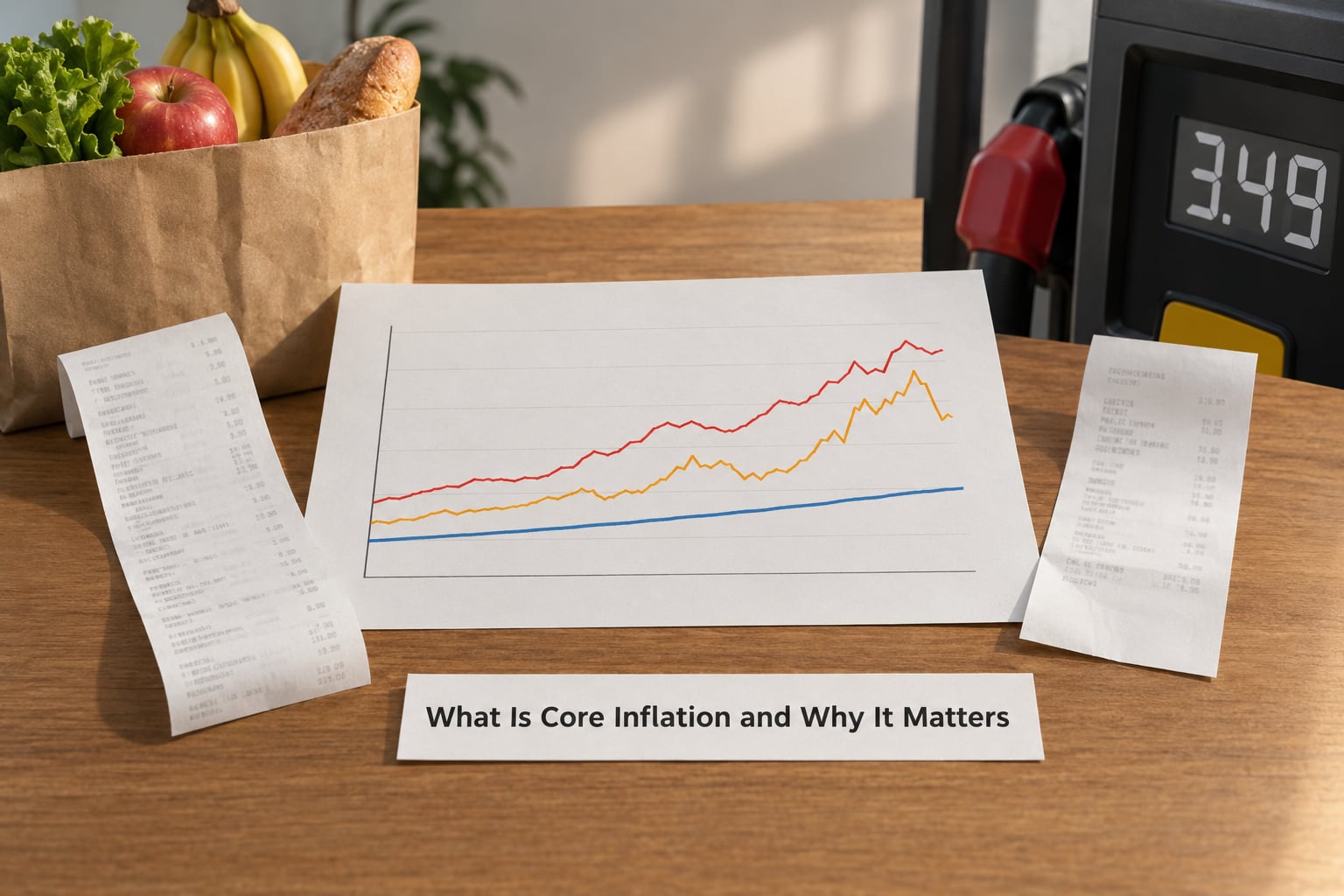
Strip out the two categories that move for reasons monetary policy cannot touch, and what remains is the part of inflation that demand, wages and expectations tend to drive. That is the whole idea behind the measure, and the idea dates back further than most people assume.
Economist Robert J. Gordon argued for a measure of the long-run price trend in 1975, and Otto Eckstein made a similar case in 1981. The argument was simple: a price series that reacts violently to a bad harvest or an oil embargo tells a central bank more about the weather and the futures market than about its own decisions.
The exclusion covers more than groceries and petrol. It reaches the full set of food and beverage categories and every energy component, including electricity and piped gas, not just motor fuel. Everything else in the basket stays in, including shelter, which is now the single heaviest weight in the US consumer basket.
Removing volatile categories does not make them unimportant to you. It makes them less useful as a gauge of policy. A household that spends a larger share of its budget on fuel and groceries will feel headline inflation more keenly than core, and that lived experience is not wrong, it is simply answering a different question.
What Does Core Inflation Include and Exclude?
This table compares headline inflation with core inflation category by category. The point to hold on to is that core is narrower, not different in kind.
| Category | Headline inflation | Core inflation |
|---|---|---|
| Food at home and away | Included | Excluded |
| Energy, including electricity and utility gas | Included | Excluded |
| Motor fuel | Included | Excluded |
| Shelter, rent and owners’ equivalent rent | Included | Included |
| Medical care | Included | Included |
| Apparel | Included | Included |
| Transportation services and parts | Included | Included, apart from fuel |
| Recreation, household goods and services | Included | Included |
One column worth pausing on is shelter. Because rent reweights slowly and new leases reset gradually, shelter inflation lags the rest of the economy by many months. When a spike in demand shows up in core services, part of what you are seeing is this lag working through, not a fresh burst of pricing power.
How Is Core Inflation Measured?
Neither index is a single price. Both are built by statistical agencies from thousands of individual price observations, and understanding the machinery explains most of the surprises readers find in a given month.
The Consumer Price Index, published by the Bureau of Labor Statistics, tracks out-of-pocket spending by urban consumers. The agency collects prices for a fixed basket of goods and services, reweighting the basket every two years, and each item carries a weight reflecting how much of the average budget it takes. Prices come from thousands of retailers, rental properties and service providers across the country.
The personal consumption expenditures price index, published by the Bureau of Economic Analysis, measures everything consumed in the economy, including spending that is paid on your behalf. A doctor’s visit illustrates the difference neatly: CPI counts what the patient pays out of pocket, while PCE counts the full amount billed across the patient, the insurer and the government. PCE updates its weights more frequently and handles substitution more smoothly, which is why it typically runs a little below CPI.
Core versions of both exist. Core CPI and core PCE are different numbers with different weights and different scopes, so treating them as interchangeable is a common mistake. The Fed works from PCE, and readers comparing news coverage to official statements should check which one is being quoted.
You can verify any figure yourself in minutes. The BLS posts its monthly CPI release with a plain-language summary at the top, the BEA publishes the PCE report with core and headline together, and the Federal Reserve’s FRED database carries the long series under the identifiers CPILFESL for core CPI and PCEPILFE for core PCE. No subscription needed.
What Is Core Inflation and Why Does It Matter?
Policymakers watch core because the categories inside it are the ones their instruments can actually influence. When a drought pushes olive oil prices up, cutting rates does nothing. When core services keep climbing, the implication is that demand is outrunning supply, and monetary policy has a lever for that.
A sustained core reading also says something about expectations. If people believe prices will keep rising faster, they demand higher wages and set higher prices, and a temporary shock becomes embedded in the price level. Breaking that loop early is cheaper than breaking it late, which is the practical case for tracking the measure.
The honest counterweight comes from the New York Fed, which studied core measures in the mid-2000s and found they were no better at forecasting future inflation than a simple moving average of the headline index. That finding has aged well, and it is the reason experienced analysts watch core alongside headline rather than instead of it.
How Do You Read a Core Inflation Report?
A core inflation report gives you several numbers, and they are not interchangeable. Knowing which one you are reading takes about ten seconds.
- Year-over-year. The most quoted figure, comparing this month’s index with the same month a year ago. Smooth, easy to understand, and slow to turn.
- Month-over-month. The change from the prior month. Noisy, but it is where turning points show up first.
- Annualized monthly. A single month’s move multiplied up to a yearly pace. Useful for spotting momentum, dangerous to quote as if it were a trend.
- Index level. The base is usually 1982-84 equals 100 for CPI. The level tells you the cumulative story since then; the rate tells you the pace.
- Revisions. The first months of data get revised. A number quoted in the first week of a release is provisional.
Seasonal adjustment deserves its own line. Agencies publish an adjusted series that smooths predictable patterns, such as heating fuel climbing in the first quarter, and an unadjusted series. Headlines almost always quote the adjusted number, which means genuine changes can get partly absorbed into the seasonal factors.
Within the release, look for the detail line called supercore inflation, which is core services excluding shelter. Officials quote it frequently because it strips out the slowest-moving component and gives a cleaner view of labour-intensive pricing. When core services is cooling but supercore is not, the story is usually about housing lag rather than about a new inflation impulse.
Finally, read a series rather than a print. One month inside the normal statistical noise tells you very little; the direction across six consecutive releases is the signal most worth acting on.
Why Is Core Inflation Not the Same as Headline Inflation?
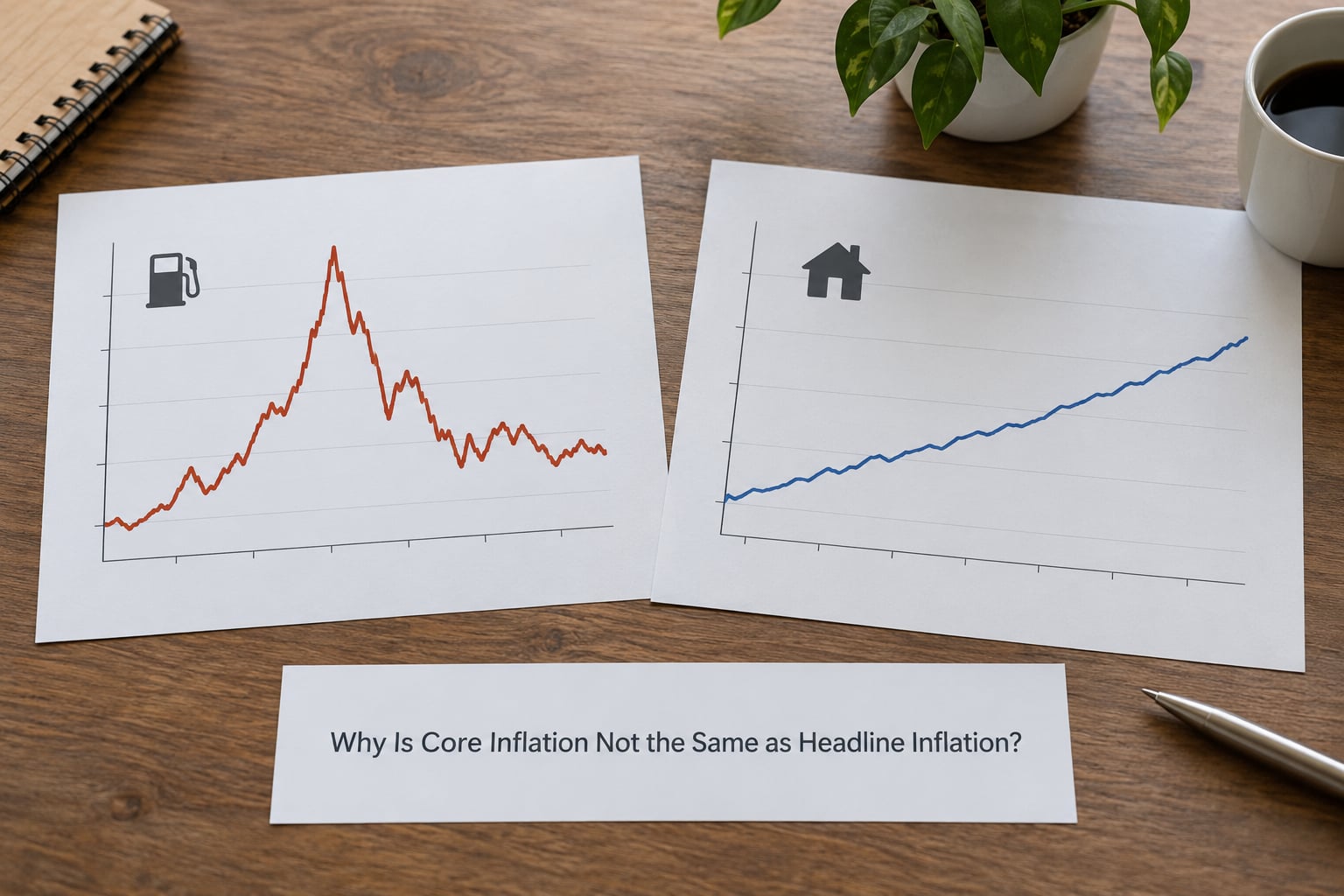
The two measures move in different directions for good reasons. Oil can double inside a quarter on a supply disruption, a shipping disruption or a decision by producers, and that flows straight into headline without touching the price of a haircut or a pair of shoes.
Food behaves similarly. A frost in one growing region, a harvest that came in early, or a run of grocery promotions in one month and shortages in the next all produce swings that have nothing to do with the state of the economy.
Tariff policy has added a subtler version of the same problem. When a duty raises the landed cost of imported goods, part of that increase enters core because the affected items are not food or energy. The result is core inflation that is partly a policy shock and partly a demand signal, and officials have to judge which is which before drawing conclusions from a single release.
That is also why the gap between the two measures can stay open for a while. If energy prices stay elevated at a new level, headline keeps printing higher than core indefinitely, because the level has reset even though the rate of change has not.
Why Does Core Inflation Matter for Interest Rates?
Here is the misconception worth correcting early: the Federal Reserve’s 2 percent goal is expressed in terms of headline PCE, not core. The Committee looks at core as evidence about the persistence and breadth of price pressure, but the target itself is a headline measure.
That distinction changes how you should read policy language. When officials say inflation is running above target, they mean the measure that includes food and energy. When they use core figures in speeches, they are describing the trend that would justify acting.
Rate decisions then feed through to borrowing costs in a fairly mechanical way. If persistent core pressure keeps policy restrictive, short-term rates stay higher, new fixed-rate debt is issued at higher yields, and adjustable-rate loans reset upward. Adjustable-rate mortgages and business credit lines reprice within months, while fixed-rate lending reprices as soon as longer yields move.
Real interest rates follow too. A nominal yield minus expected inflation gives the real return, and a core reading that stays firm keeps expected inflation firm, which keeps real yields positive. That is the arithmetic behind why savers earned more on short deposits during tight phases and bond prices fell.
A published reading is a measurement, not a forecast. Markets move on expectations, so a core number in line with consensus often produces little reaction while a surprise moves yields sharply. Watch where policy expectations sit, not just where the last print landed.
What Does Core Inflation Mean for Investors?
The practical translation runs through a handful of asset classes, and in every case the useful question is the same: does this reading suggest the pace of price growth is changing, or is it another print inside an existing trend?
Bonds. Rising core inflation erodes the real value of a fixed coupon and pushes yields higher, which lowers existing bond prices. The longer the duration, the more sensitive the price. Falling core inflation has the opposite effect and favours longer maturities, though the move is rarely straight.
Inflation-protected bonds. TIPS principal adjusts with the inflation index, and the market price reflects expected real rates. A firm core reading keeps real yields elevated, which is why TIPS can fall even while headline is falling.
Equities. Persistent price growth compresses margins for businesses that cannot pass costs on, and it keeps discount rates high, which weighs on valuations. Sectors with pricing power, such as commodity producers, have historically held up better in that environment than businesses with thin margins and long-duration cash flows.
Gold and mining shares. Gold tends to respond more to real yields and to confidence in the currency than to any single inflation print. Mining equities add operating leverage to the commodity price, so they carry equity risk on top of it. Neither is a substitute for holding the asset you actually want exposure to.
Industrial commodities. Copper, aluminium and similar metals respond to demand and supply cycles more than to consumer inflation. Crude oil and agricultural commodities track the very categories core excludes, which is the clearest illustration that inflation and commodity prices are different problems.
Currencies. Persistent inflation tends to weaken purchasing power over time, so markets adjust through interest rates rather than through the headline number itself. The relationship is a tendency, not a rule that holds in any single quarter.
None of this turns core inflation into a standalone trading signal. It is one input among growth, employment, credit conditions and the policy reaction function, and reading it alone will produce a lot of wrong turns.
What Are the Biggest Misunderstandings About Core Inflation?
The Fed targets core inflation. It does not. The longer-run goal of 2 percent is defined in headline PCE terms. Core is diagnostic, not the target.
Core tells you what inflation costs you personally. It does not. If half your budget goes to fuel and groceries, your experience tracks headline far more closely. That gap is often called felt inflation, and it is a real experience rather than an error in the data.
Core is always the better forecast. Not always. The New York Fed found core no better than a moving average of headline as a predictor, and the smooth appearance is partly a result of removing the very volatility that carries information about supply shocks.
Excluding food and energy means those prices do not matter. They matter enormously to households, to energy producers and to anyone modelling real purchasing power. The exclusion is about measurement, not about importance.
Core CPI and core PCE are the same thing. They use different baskets, different weights and different spending scopes, so they can diverge by a meaningful margin in any given month.
Underlying inflation and core inflation are interchangeable terms. Underlying is the broader idea. Core is one exclusion-based method for estimating it, alongside trimmed means, weighted medians and econometric models such as CPI-common.
Frequently Asked Questions
Headline inflation is the full year-over-year change in the consumer price index, including food and energy. Core inflation removes the food and energy components and measures the change in everything else. Headline is the measure of what households actually paid, while core is the smoother signal policymakers use to judge whether price pressure is persistent or driven by a temporary shock.
No. Core is less volatile, which makes it useful for reading a trend, but New York Fed research has found it no better than a simple moving average of headline at forecasting future inflation. For understanding what your household budget faces this month, headline is the more honest number. The two are most useful read together rather than one replacing the other.
Not at all. Excluding those categories is a measurement choice intended to filter out shocks a central bank cannot control, such as a bad harvest or an oil supply disruption. Food and energy still dominate the budget of many lower-income households, so their price swings shape lived experience far more than core does. Energy prices also drive profits and margins across the wider economy.
When core inflation stays firm, markets expect the central bank to keep policy restrictive for longer, which keeps short-term yields high and lowers the price of existing bonds, especially long-duration ones. Because bond income is fixed while prices rise, persistent core pressure also reduces the real return a fixed coupon delivers. Falling core inflation tends to push yields down and support longer maturities.
The indexes describe an average consumer, not your household. If your spending is weighted toward shelter, medical care or insurance, your experience tracks the core categories more closely. If it is weighted toward fuel, groceries or utilities, headline inflation is the better description. Location matters as well, since housing costs vary enormously between regions and indexes capture that only partially.
No. Core inflation is one input alongside growth, employment, credit conditions and the policy reaction function. Markets trade on expectations, so a reading in line with consensus usually moves little while a surprise moves yields sharply. Treat a core print as part of a trend confirmed across several releases, and check whether it agrees with headline before acting on it.
Conclusion
Core inflation is a filtered version of the price data, built to answer a narrower question than the one households ask: is price pressure persistent enough that policy needs to stay tight? It is useful for that, and misleading if treated as a description of your own costs or as a stand-alone signal.
Start by pulling core and headline from the same release and comparing them across at least six months rather than one. Then check whether policy expectations and the broader economy agree with what the trend is telling you. That is where core inflation does its job.
Source: https://www.pgm-blog.com/what-is-core-inflation-and-why-it-matters/
Anyone can join.
Anyone can contribute.
Anyone can become informed about their world.
"United We Stand" Click Here To Create Your Personal Citizen Journalist Account Today, Be Sure To Invite Your Friends.
Before It’s News® is a community of individuals who report on what’s going on around them, from all around the world. Anyone can join. Anyone can contribute. Anyone can become informed about their world. "United We Stand" Click Here To Create Your Personal Citizen Journalist Account Today, Be Sure To Invite Your Friends.
LION'S MANE PRODUCT
Try Our Lion’s Mane WHOLE MIND Nootropic Blend 60 Capsules
Mushrooms are having a moment. One fabulous fungus in particular, lion’s mane, may help improve memory, depression and anxiety symptoms. They are also an excellent source of nutrients that show promise as a therapy for dementia, and other neurodegenerative diseases. If you’re living with anxiety or depression, you may be curious about all the therapy options out there — including the natural ones.Our Lion’s Mane WHOLE MIND Nootropic Blend has been formulated to utilize the potency of Lion’s mane but also include the benefits of four other Highly Beneficial Mushrooms. Synergistically, they work together to Build your health through improving cognitive function and immunity regardless of your age. Our Nootropic not only improves your Cognitive Function and Activates your Immune System, but it benefits growth of Essential Gut Flora, further enhancing your Vitality.

Our Formula includes: Lion’s Mane Mushrooms which Increase Brain Power through nerve growth, lessen anxiety, reduce depression, and improve concentration. Its an excellent adaptogen, promotes sleep and improves immunity. Shiitake Mushrooms which Fight cancer cells and infectious disease, boost the immune system, promotes brain function, and serves as a source of B vitamins. Maitake Mushrooms which regulate blood sugar levels of diabetics, reduce hypertension and boosts the immune system. Reishi Mushrooms which Fight inflammation, liver disease, fatigue, tumor growth and cancer. They Improve skin disorders and soothes digestive problems, stomach ulcers and leaky gut syndrome. Chaga Mushrooms which have anti-aging effects, boost immune function, improve stamina and athletic performance, even act as a natural aphrodisiac, fighting diabetes and improving liver function. Try Our Lion’s Mane WHOLE MIND Nootropic Blend 60 Capsules Today. Be 100% Satisfied or Receive a Full Money Back Guarantee. Order Yours Today by Following This Link.


| Visits: | 1,833,882,533 |
| Stories: | 8,714,979 |
Whistler Blowers, Insiders