

What Is a Fiat Currency? A Plain Guide for Investors (October 2026)

A fiat currency is government-issued money that is not backed by a physical commodity like gold or silver. It holds value because a central bank and a government stand behind it, because taxes must be paid in it, and because enough people accept it as payment that everyone else has to as well.
That is the whole idea in one line. The rest of this guide unpacks what happens behind that line: where a fiat currency’s value actually comes from, how governments create it, why it can lose purchasing power, and what an everyday saver should watch for. Updated for 2026, because interest rates, inflation and the design of central bank balance sheets all move.
Key Takeaways on Fiat Currency
- No intrinsic value. A banknote is paper and cotton. Stripes, seals and portraits aside, there is no commodity inside it worth more than a few cents to produce.
- Backed by state authority. The issuer promises to accept it for settling debts and to honour its obligations in it, which is what the phrase “full faith and credit” means in practice.
- Legal tender. Law requires a seller of goods to take it for payment, within limits and in normal commercial conditions.
- Tax acceptability. Governments accept payment of their own obligations in their own currency. That single rule puts a permanent floor under demand.
- Public trust. Value is not printed on the note. It is held there by a collective belief that other people will keep accepting it tomorrow.
What Is a Fiat Currency in Simple Terms?
Fiat currency is money whose worth comes from a government decree rather than from an intrinsic commodity. A US dollar note, a euro coin or a Japanese yen banknote is not redeemable for gold at any official rate. Its value is established by the issuing authority, sustained by public acceptance, and limited only by how much of it exists and how much people are willing to hold.
The word comes straight from Latin: fiat means “let it be done” or “by decree”. It is a legal phrase, which tells you where the authority sits. A fiat currency exists because an institution with power to tax and to settle debts says it does.
The four pillars underneath that decree are worth keeping in mind, because they show up everywhere in the rest of this article:
- No intrinsic value. Nothing inside the note gives it worth on its own.
- Government decree. The state declares it money and accepts it for taxes and obligations.
- Legal tender status. Law obliges acceptance for debts and purchases, subject to limits.
- Public trust. Everyone’s willingness to hold and take it is what keeps it circulating at value.
Roughly 180 currencies circulate today and all but a handful of them are fiat in this sense. The US dollar, the euro, the British pound, the Japanese yen, the Australian dollar and the Canadian dollar are the largest examples by daily turnover. What makes them different from each other is scale, stability and how much international trade runs through them, not whether they are fiat.
How Fiat Money Gets Its Value
A currency has two kinds of value that are easy to confuse. Its face value is the number printed on it: the note says one dollar, and that is the accounting claim it represents. Its purchasing power is what that unit actually buys, and that figure moves every day without anyone reprinting a thing.
A twenty note stays a twenty note for its whole working life. Whether it buys a decent lunch or half of one depends on what has happened to the money supply, to wages, to energy and to what other currencies are doing. Nobody has to “devalue” a currency in the sense of altering its notes; most of the erosion happens quietly, month after month.
Four things hold up the exchange value, and they work together:
Legal tender status and the tax obligation
Legal tender law is the reason a seller has to take the note. In the United States, the Federal Reserve and the Treasury describe dollar banknotes as legal tender for all debts, public and private, and legal for the settlement of taxes.
Lawful money is a different and older idea. Under legal tender law, a creditor cannot force you to hand over gold to settle a debt, and cannot demand payment in gold if you offer the currency. Legal tender protects the payer. Lawful money rules were designed to protect the creditor who had been owed gold. Since the abandonment of redeemability, most advanced economies rely on legal tender rather than lawful money.
The ability to tax
This is the part that answers the most common question people ask about money: if there is nothing inside the note, what is holding it up? The answer is that you owe taxes to a government, that government denominates those taxes in its own currency, and you cannot settle them with anything else. That creates a floor under demand which no commodity ever managed.
Nobody holds dollars purely to admire them. They hold them because rent, payroll, tax and debts are priced in them, and because holding them is cheaper and simpler than holding gold in a vault.
Central bank support and the currency issuer’s backstop
A central bank exists to keep the currency usable. It supplies banknotes and coins on demand, stands ready to exchange foreign reserves for its own money, and uses policy rates to influence conditions in the economy. That backstop matters even though the currency is not convertible into gold. Central banks cannot promise a fixed metal price, but they can and do promise that the unit will still be accepted tomorrow.
Confidence and network effects
Value here is a shared belief reinforced by every transaction that clears. One person refusing dollars would be an oddity. Ten million people refusing them at once is a currency crisis, and no decree survives that. This is why central bank credibility and fiscal discipline show up directly in the exchange rate and in the inflation rate.
How Governments and Central Banks Create Fiat Money
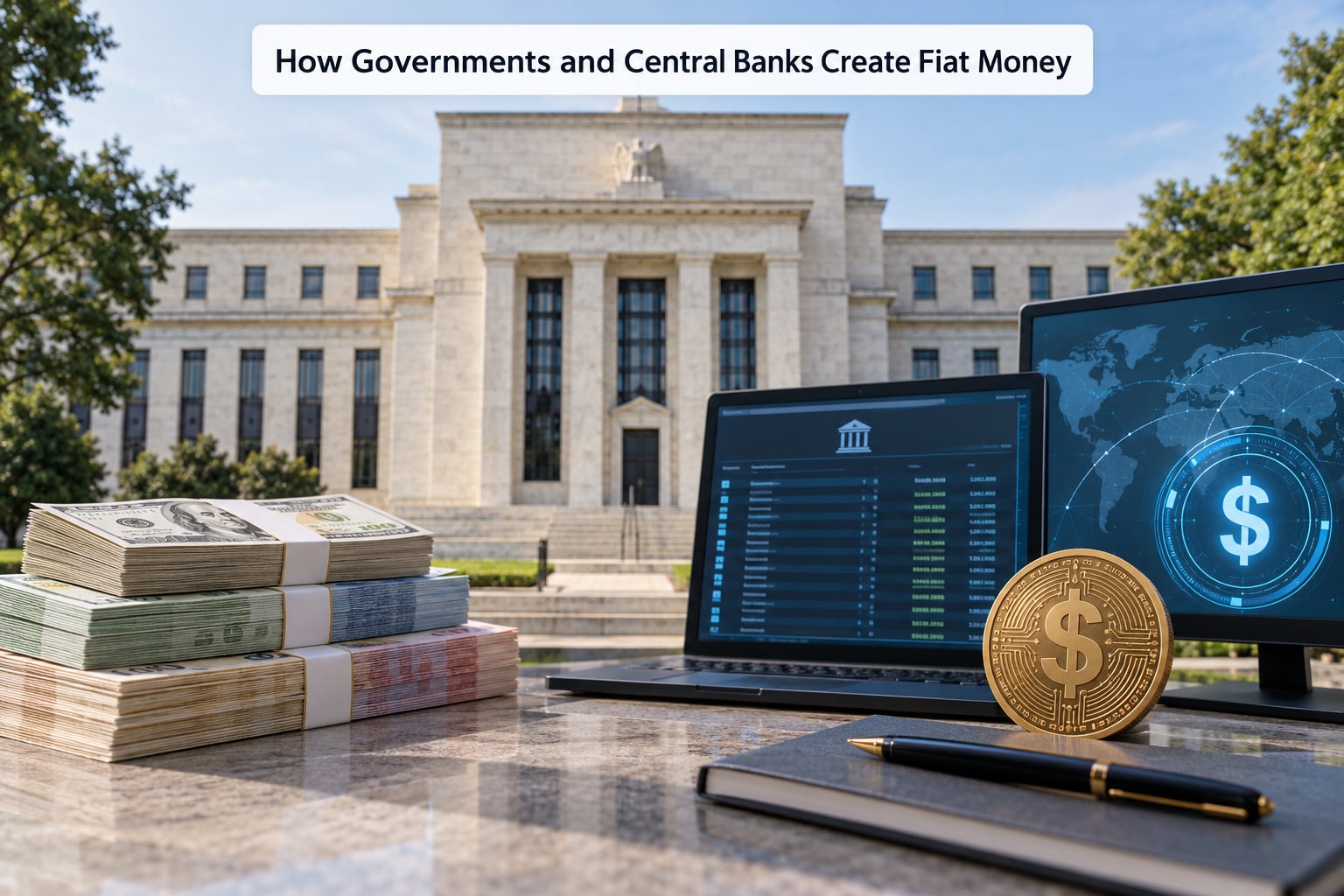
Most people assume a government prints money in a basement and ships it out. For the bulk of circulating money, that is the wrong mental model, and understanding why explains how central banks actually run policy.
When a bank approves a mortgage, it does not hand the borrower a stack of notes from a vault. It credits the borrower’s deposit account, creating a matching claim on itself. That new deposit is money, and it now exists because a private bank made a loan. Across an economy, the money supply expands through lending, secured by reserves the bank holds at a central bank. This is ordinary fractional reserve banking, and it has nothing to do with gold.
The central bank’s part is to set the conditions: what reserves count, what those reserves earn, and what it charges banks for overnight balances. Move that policy rate and you change how eager banks are to lend, which changes how fast money grows. It is a more indirect lever than printing sheets of paper, and a far more powerful one.
What Is a Fiat Currency, Precisely?
Technically, a fiat currency is a monetary unit whose acceptability and stability rest ultimately on state authority rather than on a promise to redeem a fixed quantity of a commodity. Three precise points follow from that. “Backed” in this context means backed by the issuing government’s capacity to tax and to meet its own obligations, not backed by a metal stockpile. Convertibility is a separate question that each currency answers for itself, and most now answer it as “no, not into gold.” And monetary, fiscal and political conditions all feed into the exchange value, not just monetary policy alone.
The parts of the supply, from smallest to largest
- Coins and notes in circulation. The visible fraction, a modest share of the total. Useful for transactions, irrelevant to how much money exists.
- Bank deposits. The overwhelming majority of circulating money, created mainly by commercial bank lending.
- Central bank reserves. Balances commercial banks hold at the central bank. They set the base on which deposits are created.
- Digital forms. A growing slice of payments and, in more economies each year, a central bank digital currency issued directly to the public.
When a government spends, it pays from an account at its central bank, and the money broadens in the banking system. The gap between the cost of producing a note and the value it carries is seigniorage, the issuer’s return for supplying money, and it is a real but small revenue line even for large economies.
Governments do not normally treat a money-printing press as a budget button. In most economies the state borrows in its own currency through bond markets, and the central bank is legally and politically separated from that decision. Where that separation is thin, or where a central bank ends up financing the deficit directly, the credibility damage shows up in the currency.
Fiat Currency vs. Commodity Money and Crypto
| Money type | Basis of value | Supply control | Government support | Main use | Main weakness |
|---|---|---|---|---|---|
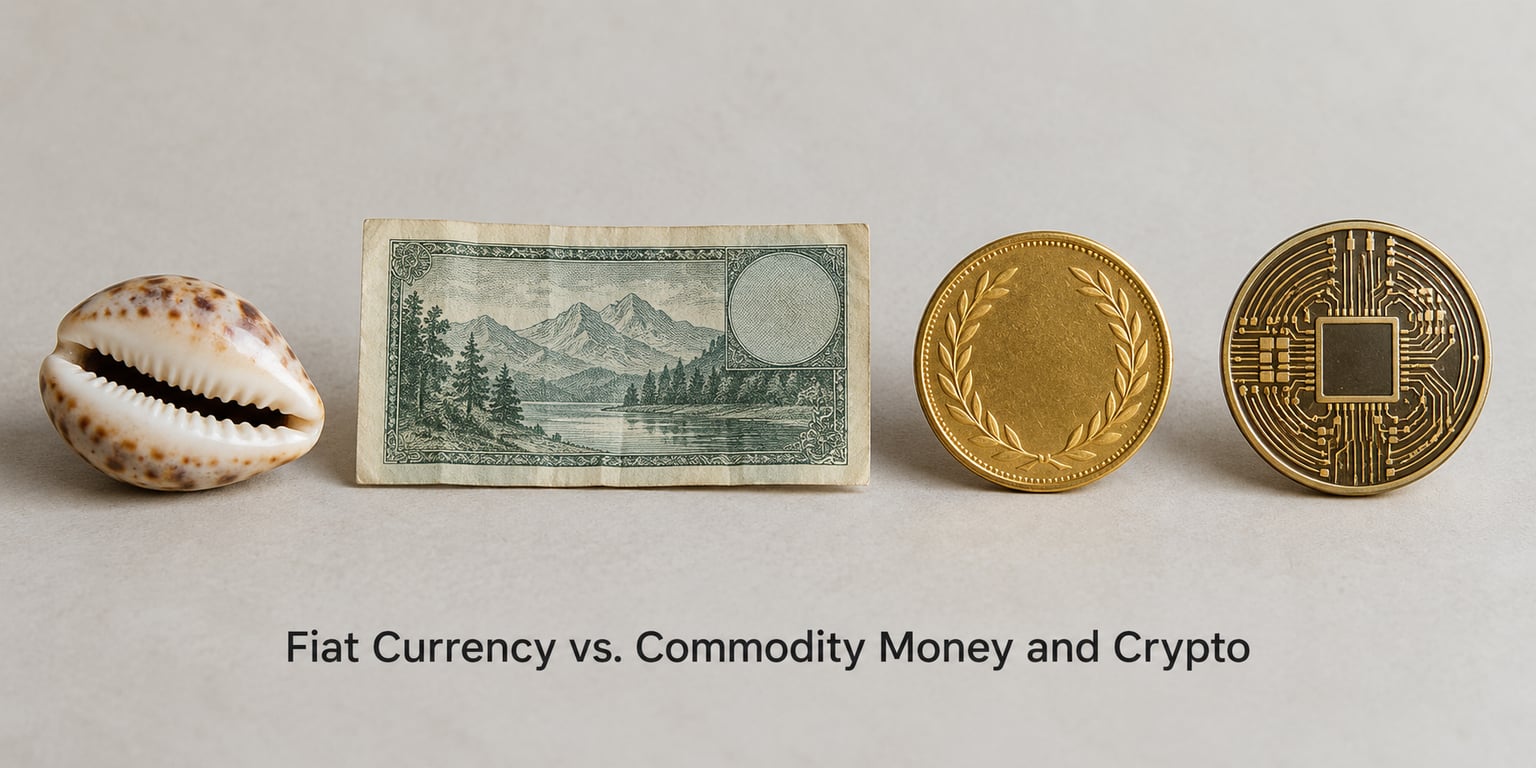
| Commodity money | The commodity itself: salt, shells, gold, salt cod, cacao | Limited by mining, harvest and trade | None, or minimal | Trade and savings | Heavy, divisible only in awkward ways, hard to scale |
| Representative money | A claim on a stored commodity | Limited by the amount held in reserve | Usually issued by a state bank | Large-value transactions | Breaks down when the issuer runs out of the commodity |
| Fiat currency | Government decree, tax demand and public confidence | Set by the central bank and the banking system | Full, and the defining feature | Everyday payments, savings, the unit of account | Loses purchasing power if supply outruns output |
| Commodity-linked tokens | A contractual claim on a commodity, or on one held by a custodian | Limited by the reserve actually held | Varies widely by jurisdiction | A transfer or savings wrapper around the metal | Counterparty and custody risk, thin liquidity in stress |
| Native crypto assets | Protocol rules, issuance limits and network adoption | Fixed or algorithmic, independent of any state | None in most countries | A speculative and settlement asset class | Runs on hope; many designs differ from each other entirely |
Commodity money gets its acceptance from the thing itself. A gold coin held in the right place is worth something to someone, whoever accepts it. Fiat inverts that: accept the note because of who issued it. Representative money sits in between, since it is fiat in form but commodity in substance, and it is the type that collapses most visibly when reserves run short.
On cryptocurrency, be careful with the category. Bitcoin is not a claim on gold and holds no intrinsic commodity value. Stablecoins are different again: some are backed one-for-one by dollars held in reserve, which makes them a claim on a fiat currency rather than a replacement for it. Stablecoins are, functionally, private fiat wrappers, not an alternative to it.
Why Fiat Currencies Can Lose Value
Fiat currency holds value because of scarcity and confidence, and both are adjustable by the issuer. That flexibility is the feature, and it is also the risk.
Inflation is a purchasing power problem
Inflation means the same money buys less over time. It is not the same as one price rising while others hold steady: a single shock that lifts fuel costs by 30% while wages and other prices are unchanged is a relative price change, not a sustained inflation. Inflation is the broad, continuing rise across the price level, measured by an index such as a consumer price index.
Hyperinflation is the extreme end, and the word is used loosely. A rough working definition is price increases of around 50% or more a month, sustained. Zimbabwe reached figures measured in tens of percent per day in the late 2000s, with the old currency redenominated and abandoned entirely. Weimar Germany in 1923 saw the mark lose extraordinary ground in a matter of months, with the price of basic staples climbing into the billions of marks. Hungary in 1946 is the standard reference case. None of these were caused by paper money existing; they were caused by money growing far faster than the goods and services available to buy.
The other ways value leaks
- Money growing faster than output. When the quantity of money expands persistently faster than real production, prices have to absorb the difference.
- Negative real interest rates. When nominal rates sit below inflation, cash balances and bond returns lose purchasing power even though the number in the account goes up.
- Exchange rate depreciation. Against currencies with more stable money, a currency can fall sharply, which shows up immediately when savings are spent abroad.
- Capital flight. When residents expect depreciation, they move savings out, which deepens the pressure.
- Falling confidence. A budget that can no longer be financed, or an institution seen as unable to act, raises the risk premium investors demand.
- External shocks. Commodity prices, sanctions, war and trade disruption move an exchange rate without any change in monetary policy.
Between countries, rates move on interest rate differentials, growth, trade balances and expectations as much as on policy decisions. Two currencies can move together for a month because of a single data release on the other side of the world.
Can a Government Print Too Much Fiat Money?
A government can create as much of its own currency as its institutions allow. What it cannot do is make the world keep accepting it. Several constraints bite long before a currency technically fails.
The most obvious one is inflation: buy too much with a currency and prices rise to match, which erodes the purchasing power of everyone holding it. The second is the exchange rate: sustained money creation pushes the currency down against others, which raises the local cost of imports and the local price of anything priced in dollars or euros. The third is bond market confidence: a government that must roll large debt in its own currency faces higher interest rates as soon as investors doubt the repayment path, and that cost feeds straight back into fiscal stress.
The question people most often ask is whether a country can simply declare its currency to be worth more overnight. It can declare anything, and the declaration changes nothing on its own. Revaluation only holds if counterparties accept it: trading partners, bond investors, importers and domestic households. Currency revaluations that have succeeded are the exceptions, and they generally carried large political costs.
Pegged currencies are the live demonstration of the limits. A currency pegged to the US dollar keeps a fixed exchange rate because the dollar, or the monetary system around it, is credible and deep. When confidence in the peg itself weakens, the defending authority runs out of reserves quickly. The currency is still fiat, still legal tender, still supported by decree; it simply loses the exchange value that the peg was providing.
What Fiat Currency Means for Savers and Investors
This section is general education about how a fiat system behaves, not individual financial advice. Rules, tax treatment and available products differ by country and change over time, and nothing here is a recommendation to buy or sell anything.
Think in real terms, not nominal terms
A deposit paying 4% while inflation runs at 5% loses purchasing power, even though the balance is higher every month. The number people notice going up and the number that matters to them going down are different numbers. Checking a yield against the current inflation rate is a small habit that prevents a lot of confusion.
Match your currency to your spending horizon
Money needed for expenses in a few months has no business sitting in an asset that swings against that currency. Longer-horizon money can tolerate more movement, because the holder is being paid for patience. The mistake is holding a short-term need in a long-term asset, or a long-term saving in a short-term instrument.
Know which risks you are actually taking
- Cash and deposits. Maximum liquidity and predictability, with purchasing power erosion as the price.
- Government bonds. The standard way to be paid for accepting currency risk and holding a fixed nominal amount.
- Equities. A claim on productive output rather than on the currency, which is why equities can hold up over long periods during inflationary stretches.
- Gold and other commodities. No issuer, no counterparty and no legal redemption promise, priced in real terms by global supply and demand. Gold has no yield, so it is a diversifier rather than an income holding.
- Overseas assets. A hedge or a source of return, but they add currency risk on top of market risk. Currency mismatched liabilities are the classic source of overseas investment pain.
Diversification only helps when the pieces behave differently in a given scenario. Holding several assets that all depend on the same currency and the same confidence in the same institution is one bet dressed up as four.
Behind that sits the slower-moving picture: fiscal position, central bank independence, debt sustainability and external balances. None of these move as fast as a price release, and all of them shape the long-run environment for every return measured in nominal currency. Watch them alongside the monthly data rather than instead of it.
Frequently Asked Questions
Yes. The US dollar is a fiat currency in the strict sense: it is not redeemable for gold or silver at any official rate. Its value rests on the full faith and credit of the United States government, on the requirement that taxes be paid in dollars, and on widespread public and international acceptance. The dollar is unusual only in size and reach. Most sovereign currencies that are not formally pegged behave the same way.
Nearly all of them. Around 180 currencies circulate today and the overwhelming majority are fiat, issued by a central bank or monetary authority and not convertible into a commodity. The partial exceptions are currencies held at a fixed exchange rate to a larger currency, such as the Bahraini dinar pegged to the US dollar, or the currencies of small states that share another country’s currency outright. Pegs change the exchange rate, not the underlying nature of the money.
Gold-backed money carried a promise: present the certificate and receive a defined weight of metal. Fiat money carries no such redemption promise, so its value depends on acceptance, tax demand and confidence rather than on a stockpile held somewhere. That difference matters most in a crisis. A gold standard protects the note holder against currency depreciation, but it also removes the central bank’s ability to expand the money supply in a recession, which is why most advanced economies left it behind.
A state issues its own currency mainly so that obligations denominated in it can be settled. Taxes, wages and public debt must be payable in something, and if the choice is left to other countries, the government hands over control of its money supply and its fiscal position to foreigners. Owning the currency also gives the central bank a working tool for monetary policy: setting rates, providing liquidity and expanding or contracting the money supply when the economy needs it.
Not in the near term, and the categories do not map neatly onto each other. Fiat currencies are recognised legal tender, collect taxes and fund public spending. Native crypto assets such as Bitcoin are recognised by almost no state and hold no claim on an issuer. Stablecoins backed by dollar reserves are closer to being claims on a fiat currency than replacements for it. What crypto does offer is a payment rail that moves without a central bank’s permission, which is genuinely useful for some users and invisible to most.
Conclusion
A fiat currency is money whose value is created by decree, kept alive by taxes and legal tender, and held up by public confidence. That is not a flaw so much as a design: it is why central banks can respond to recessions, why almost every currency in use today works this way, and why money is cheap to produce and easy to move.
The cost is that value is not guaranteed. Inflation, negative real rates and exchange rate moves are the price of that flexibility, and they show up quietly in your purchasing power rather than as a headline. Before making any financial decision, look at the inflation rate, the real return after it, and the currency risk in whatever you are holding.
Central bank digital currencies are the next step in the same story, a change in how the same fiat money reaches the public rather than a change in what backs it. Gold advocates and fiat proponents have argued about this for decades, and neither side has produced a clean win, so treat any confident answer on this subject with a little suspicion, including mine.
Source: https://www.pgm-blog.com/what-is-a-fiat-currency/
Anyone can join.
Anyone can contribute.
Anyone can become informed about their world.
"United We Stand" Click Here To Create Your Personal Citizen Journalist Account Today, Be Sure To Invite Your Friends.
Before It’s News® is a community of individuals who report on what’s going on around them, from all around the world. Anyone can join. Anyone can contribute. Anyone can become informed about their world. "United We Stand" Click Here To Create Your Personal Citizen Journalist Account Today, Be Sure To Invite Your Friends.
LION'S MANE PRODUCT
Try Our Lion’s Mane WHOLE MIND Nootropic Blend 60 Capsules
Mushrooms are having a moment. One fabulous fungus in particular, lion’s mane, may help improve memory, depression and anxiety symptoms. They are also an excellent source of nutrients that show promise as a therapy for dementia, and other neurodegenerative diseases. If you’re living with anxiety or depression, you may be curious about all the therapy options out there — including the natural ones.Our Lion’s Mane WHOLE MIND Nootropic Blend has been formulated to utilize the potency of Lion’s mane but also include the benefits of four other Highly Beneficial Mushrooms. Synergistically, they work together to Build your health through improving cognitive function and immunity regardless of your age. Our Nootropic not only improves your Cognitive Function and Activates your Immune System, but it benefits growth of Essential Gut Flora, further enhancing your Vitality.

Our Formula includes: Lion’s Mane Mushrooms which Increase Brain Power through nerve growth, lessen anxiety, reduce depression, and improve concentration. Its an excellent adaptogen, promotes sleep and improves immunity. Shiitake Mushrooms which Fight cancer cells and infectious disease, boost the immune system, promotes brain function, and serves as a source of B vitamins. Maitake Mushrooms which regulate blood sugar levels of diabetics, reduce hypertension and boosts the immune system. Reishi Mushrooms which Fight inflammation, liver disease, fatigue, tumor growth and cancer. They Improve skin disorders and soothes digestive problems, stomach ulcers and leaky gut syndrome. Chaga Mushrooms which have anti-aging effects, boost immune function, improve stamina and athletic performance, even act as a natural aphrodisiac, fighting diabetes and improving liver function. Try Our Lion’s Mane WHOLE MIND Nootropic Blend 60 Capsules Today. Be 100% Satisfied or Receive a Full Money Back Guarantee. Order Yours Today by Following This Link.


| Visits: | 1,833,882,533 |
| Stories: | 8,714,979 |
Whistler Blowers, Insiders

