

What Is the Bretton Woods System? (2026) Guide for Investors

The Bretton Woods system was the international monetary system agreed by 44 countries at a July 1944 conference in Bretton Woods, New Hampshire, in which every currency was pegged to the US dollar and the dollar was convertible to gold at a fixed 35 dollars per troy ounce. It held until the US suspended that gold convertibility on 15 August 1971.
If you invest in gold, currencies or commodities, this 1944 ruleset still shapes the world you trade in. Most explainers stop at the collapse, so the interesting part for investors — what the system left behind — usually goes unexamined.
What Is the Bretton Woods System?
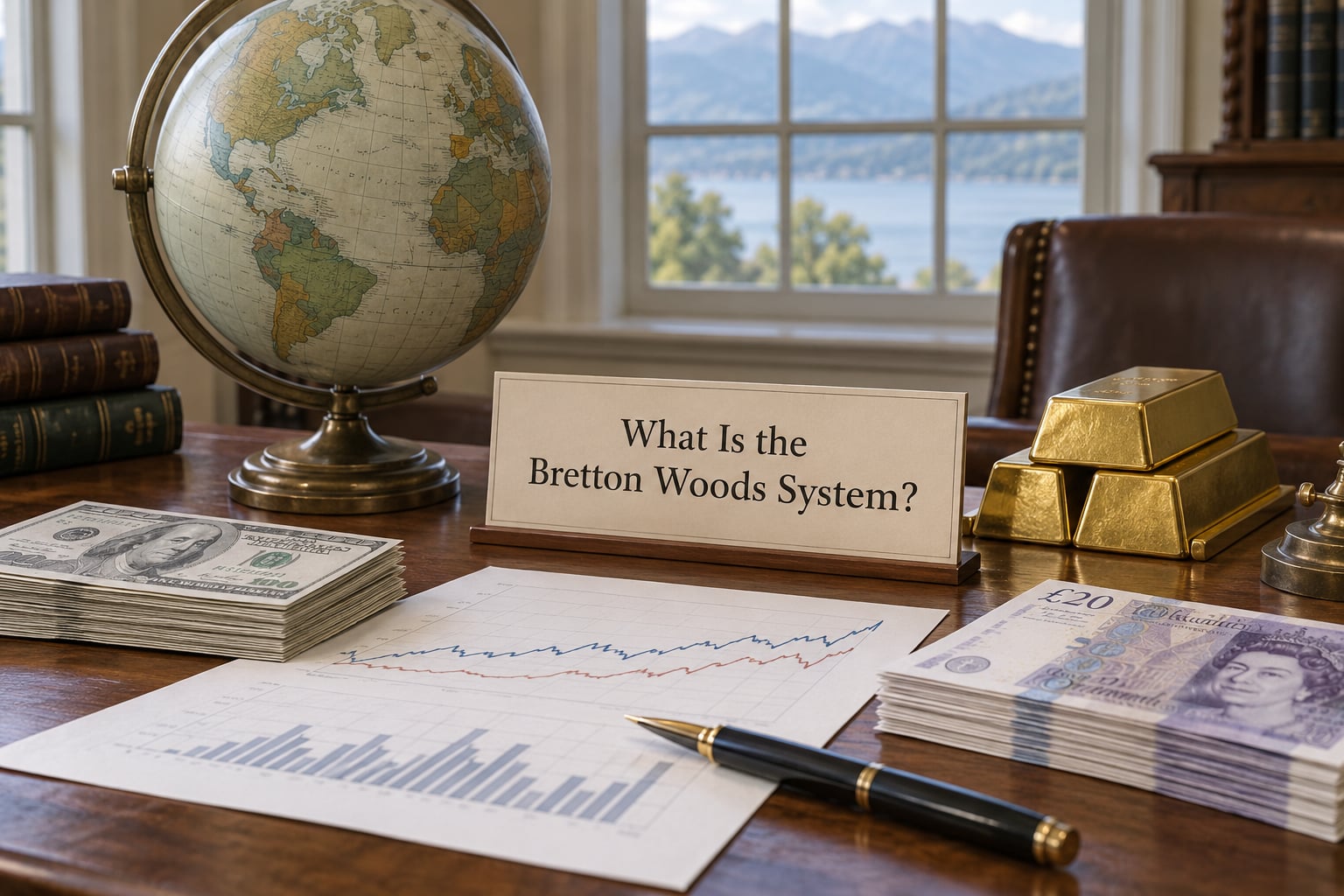
Bretton Woods was the post-World War II international monetary framework built around fixed exchange rates, the US dollar, and gold. Here is the whole thing in three lines:
- What it was: a fixed exchange rate system agreed by 44 countries in July 1944, designed to replace the gold standard after it collapsed in the 1930s.
- How the peg worked: every currency was pegged to the US dollar, and the dollar itself was convertible into gold at 35 dollars per troy ounce for foreign central banks.
- When and how it ended: President Richard Nixon closed the gold window on 15 August 1971, the Smithsonian Agreement failed to restore it in December 1971, and major currencies began floating in March 1973.
And the question that follows almost every search on this: what came after it? Floating exchange rates. Major currencies moved to a generalised float in March 1973, and the IMF’s charter was formally amended by the Jamaica Accords in 1976 to drop fixed par values and gold convertibility.
Two things people get wrong straight away. Bretton Woods was not a gold standard in the classic sense — under the old gold standard, money itself was gold, and each currency redeemed directly into it. Under Bretton Woods, only the dollar redeemed into gold, at a fixed price, and only for foreign central banks. Ordinary holders could not walk into a bank and swap dollars for bullion. And the system did not collapse in a single year; 1971 ended convertibility, 1973 ended the pegs, and 1976 ended the legal framework.
Why Was the Bretton Woods System Created?
The system was designed to fix a specific failure. The interwar gold standard had not produced stability — it produced competitive devaluations, trade wars and eventually deflation that deepened the Great Depression.
When countries ran short of gold, the old rules told them to deflate. Cut wages, cut prices, raise unemployment, and the trade deficit would close. Britain, France and the others did exactly that after 1931, and the result was a series of beggar-thy-neighbour attempts to export your way out of your own depression while choking off everyone else’s recovery.
Add the wreckage of the 1930s and the war economies, and the post-war position was dire. Industrial capacity and capital had been destroyed across Europe and Asia, trade routes and exchange markets had been broken up, and currencies were freely floating in a way that made cross-border planning impossible. By the time the 1944 conference met at the Mount Washington Hotel, there was no agreement on anything except that nobody wanted the 1930s back.
The US proposal, drafted largely by Harry Dexter White of the Treasury, did two clever things. It picked a reserve asset the country with most of the world’s gold and industrial capacity already had — the dollar — and it made the adjustment burden fall on surplus countries rather than deficit countries. Under the old gold standard, the country in deficit paid. Under Bretton Woods, Keynes’s preferred principle, the country in surplus gave up the money.
Keynes’s alternative, the bancor, would have been a supranational clearing unit that let surplus countries spend down balances and be pushed into importing when they ran up too large a surplus. It failed on one issue: voting power. The United States held most of the gold, and the US plan won.
How Did the Bretton Woods System Work?
The Bretton Woods system worked by having each country declare a fixed official value for its currency against the dollar, hold that value within a narrow band by buying or selling currency, and change it only rarely and only with approval.
The mechanics are worth walking through, because almost every explainer skips them and they answer most of the confused questions about what “pegged” meant.
- Declare a parity. Each currency had a par value set against the dollar. Sterling was fixed at 2.80 dollars per pound, the French franc at 4.6850 dollars, the yen at 0.2778 dollars. These were not market prices. They were declared, and maintained.
- Hold the band. Central banks had to keep market rates within one percent either side of parity, so sterling traded in a 2.772 to 2.828 dollar range. That narrow corridor was what made exchange rate risk manageable for businesses trading across borders.
- Intervene in the market. When pressure pushed sterling to the bottom of its band, the Bank of England bought pounds with dollars from its reserves; at the top it sold pounds and bought dollars. The pile of reserves, not the interest rate, was the shock absorber.
- Change parity only with approval. A par value could be adjusted by up to ten percent without asking anyone. Beyond ten percent, the currency had to show a “fundamental disequilibrium” — a term the agreement never defined, which is a large part of why the endgame was so murky — and get IMF consent.
- Recycle surpluses. Surplus countries were expected to spend their surpluses abroad. The dollar shortage of the late 1940s was partly a shortage of dollars overseas, and the Marshall Plan, announced in June 1947, was one of the ways the US pushed them out deliberately.
Central bankers hated parts of this. The policy trilemma says a country cannot have all three of a fixed exchange rate, free capital movement, and an independent monetary policy — pick two. Bretton Woods picked fixed rates and monetary autonomy, so capital was controlled.
The Role of the US Dollar and Gold
The dollar was the system’s anchor because it was the only currency with a defined gold price. Foreign central banks could convert dollars into gold at 35 dollars per troy ounce, and the United States held that gold at Fort Knox. Everything else in the system was a derivative of that single link.
That link did the work of stabilising trade and finance. American goods were effectively priced in gold, which meant import prices across the Western world stopped moving in a way that made exporting and long-term investment planning possible. It gave the dollar and Treasuries the standing that let the US borrow cheaply — the US paid less interest on its debt than other governments paid to US residents, a gap economists now call the exorbitant privilege.
It also kept private dollars and official dollars in the same place. Once private dollars could be held outside the banking system and earn interest, they would not automatically return to the Treasury to be exchanged for gold. The Eurodollar market, which grew through the 1960s, was exactly that: dollars parked in London, outside American reach, growing into a large share of international finance.
How Countries Managed Fixed Exchange Rates
Take a worked example. Say a country runs a large import bill, mostly machinery, and its currency comes under pressure as investors and importers sell it. The central bank sells dollar reserves and buys its own currency, pushing the rate back inside the band.
That works while reserves last. The moment the reserve stock gets thin, the defenders have three bad choices: borrow dollars from the IMF under conditions that usually mean tightening, raise interest rates enough to attract short-term capital, or devalue.
Sterling is the case everyone remembers. Defence spending abroad, weak export competitiveness, a 1967 devaluation that failed to stick left Britain with almost no gold or dollar reserves by 1971. Sterling’s band was revised up in November 1971 to 2.48 dollars, then collapsed the following month, and the pound was allowed to float — a decision that stuck. That move is generally treated as the moment fixed rates really started to die.
Who Built and Maintained the System?
Two institutions came out of Bretton Woods, and the conference itself is often confused with them. The conference met from 1 to 22 July 1944 with 730 delegates from 44 countries at the Mount Washington Hotel. The IMF Articles of Agreement were signed in December 1945, the Bretton Woods Agreements Act became US law on 31 July 1945, and the IMF began operations in March 1947. The World Bank, then the International Bank for Reconstruction and Development, was authorised with 10 billion dollars of capital.
The IMF’s job was liquidity, not charity. Members subscribed quotas — 25 percent in gold, 75 percent in their own currency — and drew emergency financing when a devaluation made their reserves unusable. The US held about one third of the total quota, which gave it a veto, and voting power was weighted by quota throughout.
That design is the source of the standard complaint about the system: whoever supplies the reserve asset sets the rules. The World Bank’s job was narrower, financing reconstruction and development loans, on the assumption that the new system would produce trade growth and make the borrowers eventually creditworthy.
Maintaining it was a job for national central banks, and they behaved differently depending on where they sat. Germany and Japan accumulated surpluses and were pushed by the US to loosen up. Countries in deficit were pushed the other way. The US itself, unusually, could ignore the pressure because it could print the currency everyone else was trying to hold.
Why Did the Bretton Woods System Collapse?
The collapse had one root cause and several accelerants. The root cause is usually called the Triffin dilemma, named for the economist Robert Triffin: the world needs a steady supply of dollars for trade and reserves, but every new dollar the US creates drains gold from Fort Knox. Supply the world, and the backing runs out. Restrain the supply, and trade stops.
The numbers make it concrete. Suppose the US holds 25 billion dollars of gold, which it roughly did around the system’s peak, and foreign central banks hold 30 billion dollars in claims. The promises exceed the metal. That gap is what turned a technical constraint into a political one, and it is why convertibility stopped being a promise and became a queue at a bank counter.
The pressures on top of it:
- US spending abroad. Vietnam, the Great Society, and a military footprint around the world pushed US current account deficits from near zero in the 1950s into persistent deficit in the 1960s. Every dollar spent abroad was a dollar that ended up in someone else’s reserves and available to convert.
- Domestic inflation. Vietnam spending plus the 1964–66 and 1968–69 expansions pushed US inflation toward 3 percent while Europe was under 2. The dollar was becoming the least credible currency in the system it anchored.
- The gold run. France converted its dollar holdings into gold aggressively through 1965 and 1967, and so did others. The gold pool that tried to hold the official price collapsed in March 1968, and the market was split into an official price for central banks and a much higher free-market price for everyone else.
- Speculation on a known end. Once the gap was public, holding dollars was a bet on a devaluation. Businesses priced that risk into contracts, and the two-tier market made the official rate increasingly fictional.
- Political choice. Nixon had to choose between defending 35 dollars an ounce and delivering on domestic growth. He chose growth. New York governor Nelson Rockefeller departed Camp David for London on 12 August 1971 to tell European central bankers not to expect an answer.
Nobody broke Bretton Woods in the sense of a dispute or a single decision. The structural contradiction did the work over roughly a decade, and the final break was the United States choosing domestic politics over an international commitment. If you want a name for the actor, it is Nixon on 15 August 1971, but the cause was arithmetic.
Key Dates From 1931 to 1976
| Date | What happened |
|---|---|
| 1931 | Sterling leaves gold, triggering the interwar breakdown of the gold standard |
| 1941 | Atlantic Charter sets out the post-war economic aims |
| July 1944 | Bretton Woods Conference, 44 countries, 730 delegates, Mount Washington Hotel |
| 1945 | IMF Articles of Agreement signed; Bretton Woods Agreements Act signed 31 July |
| 1947 | IMF operations begin in March; Marshall Plan announced in June |
| 1949 | Sterling devalued to 2.40 dollars, confirming the dollar as the pivot |
| 1968 | Gold pool collapses; two-tier gold market created in March |
| 15 August 1971 | Nixon suspends dollar-gold convertibility; the gold window closes |
| December 1971 | Smithsonian Agreement sets a new gold price and wider bands, then collapses |
| March 1973 | Major currencies move to generalised floating |
| 1973–74 | Oil price shock; oil priced in dollars, recycling through banks |
| 1976 | Jamaica Accords amend the IMF Articles to drop par values and gold convertibility |
That table resolves the date confusion that trips people up. 1944 is the agreement, 1945 is ratification, 1971 is the end of gold convertibility, 1973 is the end of the pegs, and 1976 is the end of the legal framework. All five are correct answers to different questions.
What Replaced Bretton Woods?
Floating exchange rates replaced Bretton Woods. After Nixon closed the gold window on 15 August 1971 and the Smithsonian Agreement failed within months, the major currencies moved to a generalised float in March 1973, and the Jamaica Accords in 1976 removed par values and gold convertibility from the IMF’s charter.
What replaced the rulebook was not a new rulebook. Since 1973 the system has been a managed float: central banks let rates move but intervene to smooth disorderly moves, and a currency is described as a dirty float when those interventions push the rate away from the market level in either direction. Today’s major currencies, the dollar included, are all dirty floats in that sense.
Coordination did not disappear. The G7, the IMF’s surveillance programme, and periodic summit commitments still try to keep currencies from disorderly moves, and the 1985 Plaza Accord and 1987 Louvre Accord are remembered as attempts at joint rate management. The G20 expanded that work after 2008.
The successor structure people argue about is the petrodollar. When oil prices rose sharply in 1973–74 and stayed high, the main commodity in world trade was priced in dollars, so surplus oil revenues were recycled into dollar assets through the banking system. That gave the dollar a structural demand that replaced the gold convertibility as the thing holding up its value. The first Gulf War, when oil was repriced and Saudi Arabia honoured the price rise to a degree that surprised markets, is usually cited as the moment that link broke.
Gold Standard vs Bretton Woods vs Today
| Feature | Gold standard | Bretton Woods (1944–1971) | Floating era (1973–today) |
|---|---|---|---|
| Reserve asset | Gold, and only gold | Gold, then the US dollar | No official reserve asset; national currency and Treasuries |
| What was pegged to gold | Every currency directly | Only the US dollar, at 35 dollars per troy ounce | Nothing |
| What other currencies were pegged to | Gold | The US dollar, within a plus or minus 1 percent band | Nothing; rates set by markets and central banks |
| Who could hold gold | Anyone with currency | Foreign central banks, via redemption windows | Anyone; free market price |
| How imbalances adjusted | Deflation in deficit countries | Surplus countries were expected to spend down surpluses; periodic realignments | Central banks intervene selectively; markets clear at market rates |
| Capital controls | Minimal in practice | Widespread; UK residents limited to 50 pounds of foreign currency a year | Mostly lifted from the 1980s onward |
| When it ended | Collapsed in stages from 1931; the Gold Bloc followed in 1936 | Convertibility suspended 15 August 1971, pegs ended 1973, closed legally 1976 | Ongoing |
The biggest difference in that table is the third row. Bretton Woods separated the reserve asset from the working currencies, which is why it lasted longer than the old gold standard and why it survived something the gold standard could not: a system in which the reserve asset is issued by the country running the largest deficits.
What Is the Bretton Woods Legacy for Investors?
The system is gone; its architecture is not. If you hold assets denominated in dollars, gold, oil or any major currency, the terms that Bretton Woods settled still shape what you are exposed to. This is general background on how the monetary system works, not investment advice.
Gold’s price behaviour changed permanently in 1971. Before August 1971 the official price was 35 dollars an ounce and the free-market price sat within an arm’s reach of it. After that, gold became a floating market price set by demand, inflation expectations and the dollar’s own direction. If you have watched gold rally through a period of dollar weakness, you are watching the open-ended version of what the closing of the gold window started. The 35 dollar figure still anchors every argument about whether gold is cheap, and it is useful as a long-run reference point rather than a target.
Currency risk became a real cost in portfolios. For most of 1945 to 1971 an investor in one major currency faced very little FX movement. From 1973 that volatility returned, and a currency allocation is now a decision rather than a side effect.
Central-bank policy runs through everything. In a fixed-rate world, policy was constrained by the peg. Today rates float, and the rate a central bank sets feeds straight into the currency. Watch the policy divergence between the Fed and the ECB or the Bank of Japan and the effect on the exchange rate is the main way currency moves get made.
Gold is held for reasons, not yield. A central bank that wants a reserve asset with no counterparty risk still holds bullion, and the composition of those holdings is a slow-moving signal about how those institutions read dollar risk. Individual investors use the same logic at a much smaller scale, which is why gold demand tends to firm up when real yields fall.
The dollar’s privilege is real but not permanent. The exorbitant privilege persists because the world needs a settlement currency with deep, liquid markets in it. The debate on the de-dollarisation side — the argument that dollar dominance is a policy choice rather than a law of nature, made repeatedly on financial forums and in academic commentary — points at the honest weakness: the reserve currency’s issuer is also the one printing the most of it. Whether the petrodollar holds into the 2030s is genuinely unresolved.
Terms from 1944 are still in your contracts. Special Drawing Rights, IMF conditionality, and the idea that a currency can be revalued are all Bretton Woods descendants. SDR allocations and IMF lending programs show up in central bank reserve discussions in 2026 just as they did in 1960s finance ministries.
Frequently Asked Questions
The Bretton Woods system was designed in July 1944 and took effect through the 1940s, with the IMF starting operations in March 1947. It ended in stages: Nixon suspended dollar-gold convertibility on 15 August 1971, major currencies moved to a generalised float in March 1973, and the Jamaica Accords in 1976 removed par values and gold convertibility from the IMF’s charter.
The official price was 35 US dollars per troy ounce. That price applied to redemptions by foreign central banks, not to the public, and it held from the system’s launch until 15 August 1971. It was set in 1934 and never changed, which meant the dollar’s gold value fell every year US inflation rose.
The United States held most of the world’s monetary gold and the largest share of industrial capacity, so the dollar was the asset other countries were most willing to hold. Every currency was pegged to it, and Treasuries and dollars were needed to settle trade, hold reserves and fund the US deficit, which gave the dollar a demand no other currency could match.
The structural cause is the Triffin dilemma: the world needs ever more dollars, but issuing them drains the gold backing those dollars rest on. On top of that came US spending on Vietnam and the welfare state, rising US inflation, France’s 1960s gold run, and the March 1968 collapse of the gold pool. Nixon chose domestic growth over defending 35 dollars an ounce.
Fixed, in the sense that mattered. Each currency had a par value against the dollar held within a one percent band by central bank intervention, and a par value could only change by more than ten percent with IMF approval. The floating era began only after March 1973, and a par value of more than ten percent generally signalled a fundamental disequilibrium in the balance of payments.
No, but its structure survives in altered form. The gold link, the par values and the fixed bands are gone, replaced by floating rates that central banks still manage and a dollar-centred settlement system built on oil pricing and Treasury debt. The IMF and the World Bank created at Bretton Woods are unchanged in function, and SDRs remain part of official reserve management.
Conclusion
Bretton Woods was a fixed exchange rate system built on the dollar and gold at 35 dollars an ounce, agreed by 44 countries in 1944 and broken in stages between 1971 and 1976. The first thing worth taking from it is that the arrangement is still with us in disguise: a major reserve currency, central-bank intervention, a continuing reference to gold, and exchange rates that are flexible but managed. For an investor, the practical version is to treat the dollar’s position, not gold’s 1971 price, as the variable that shapes the rest.
Source: https://www.pgm-blog.com/what-is-the-bretton-woods-system/
Anyone can join.
Anyone can contribute.
Anyone can become informed about their world.
"United We Stand" Click Here To Create Your Personal Citizen Journalist Account Today, Be Sure To Invite Your Friends.
Before It’s News® is a community of individuals who report on what’s going on around them, from all around the world. Anyone can join. Anyone can contribute. Anyone can become informed about their world. "United We Stand" Click Here To Create Your Personal Citizen Journalist Account Today, Be Sure To Invite Your Friends.
LION'S MANE PRODUCT
Try Our Lion’s Mane WHOLE MIND Nootropic Blend 60 Capsules
Mushrooms are having a moment. One fabulous fungus in particular, lion’s mane, may help improve memory, depression and anxiety symptoms. They are also an excellent source of nutrients that show promise as a therapy for dementia, and other neurodegenerative diseases. If you’re living with anxiety or depression, you may be curious about all the therapy options out there — including the natural ones.Our Lion’s Mane WHOLE MIND Nootropic Blend has been formulated to utilize the potency of Lion’s mane but also include the benefits of four other Highly Beneficial Mushrooms. Synergistically, they work together to Build your health through improving cognitive function and immunity regardless of your age. Our Nootropic not only improves your Cognitive Function and Activates your Immune System, but it benefits growth of Essential Gut Flora, further enhancing your Vitality.

Our Formula includes: Lion’s Mane Mushrooms which Increase Brain Power through nerve growth, lessen anxiety, reduce depression, and improve concentration. Its an excellent adaptogen, promotes sleep and improves immunity. Shiitake Mushrooms which Fight cancer cells and infectious disease, boost the immune system, promotes brain function, and serves as a source of B vitamins. Maitake Mushrooms which regulate blood sugar levels of diabetics, reduce hypertension and boosts the immune system. Reishi Mushrooms which Fight inflammation, liver disease, fatigue, tumor growth and cancer. They Improve skin disorders and soothes digestive problems, stomach ulcers and leaky gut syndrome. Chaga Mushrooms which have anti-aging effects, boost immune function, improve stamina and athletic performance, even act as a natural aphrodisiac, fighting diabetes and improving liver function. Try Our Lion’s Mane WHOLE MIND Nootropic Blend 60 Capsules Today. Be 100% Satisfied or Receive a Full Money Back Guarantee. Order Yours Today by Following This Link.


| Visits: | 1,833,882,533 |
| Stories: | 8,714,979 |
Whistler Blowers, Insiders

