

How Fed Rate Hikes Affect Gold: What Investors Must Know (2026)

Fed rate hikes usually pressure gold prices, because gold pays no interest and every hike raises the return you give up by holding it. That is the textbook answer, and it is directionally right most of the time. It is also incomplete, because gold has climbed through an entire hiking cycle since 2022 while the Fed was raising rates.
Written for readers who own bullion, gold ETFs or mining stocks and want to stop guessing at FOMC day. Everything here is general education about how markets work, not investment advice.
Gold is quoted in US dollars, the Federal Reserve sets the policy rate that anchors dollar interest rates, and the price of gold is the single most watched discount-rate-sensitive asset in the world. That combination makes the Fed the heaviest influence on gold, and it also makes gold the clearest place to see monetary policy at work.
Why Do Fed Rate Hikes Put Pressure on Gold?
A Fed rate hike tends to lower gold prices in the short run. Higher policy rates lift bond yields and borrowing costs across the economy, usually strengthen the dollar, and reduce the appeal of holding an asset that produces no income. Momentum traders and leveraged positions often sell at the same time, which makes the first reaction sharper than gold’s longer-term fundamentals justify.
Think of it as opportunity cost. A 10-year Treasury note pays you. A savings account pays you. So does a government money market fund. A gold bar sits in a drawer and returns nothing, so its value is entirely in the price you might sell it for later, and that price competes with whatever else your money could be earning.
Raise the alternative return and the bar gets harder to justify holding. Raise it a lot, repeatedly, and the case for owning something with no yield gets weaker every time.
Two caveats belong right next to that answer. First, this is a tendency, not a switch. Second, the effect depends on which real yields end up following, not on the policy rate alone. Gold has repeatedly broken the rule in 2026, and understanding why is more useful than memorising that it exists.
How Fed Rate Hikes Affect Gold Through Four Market Channels
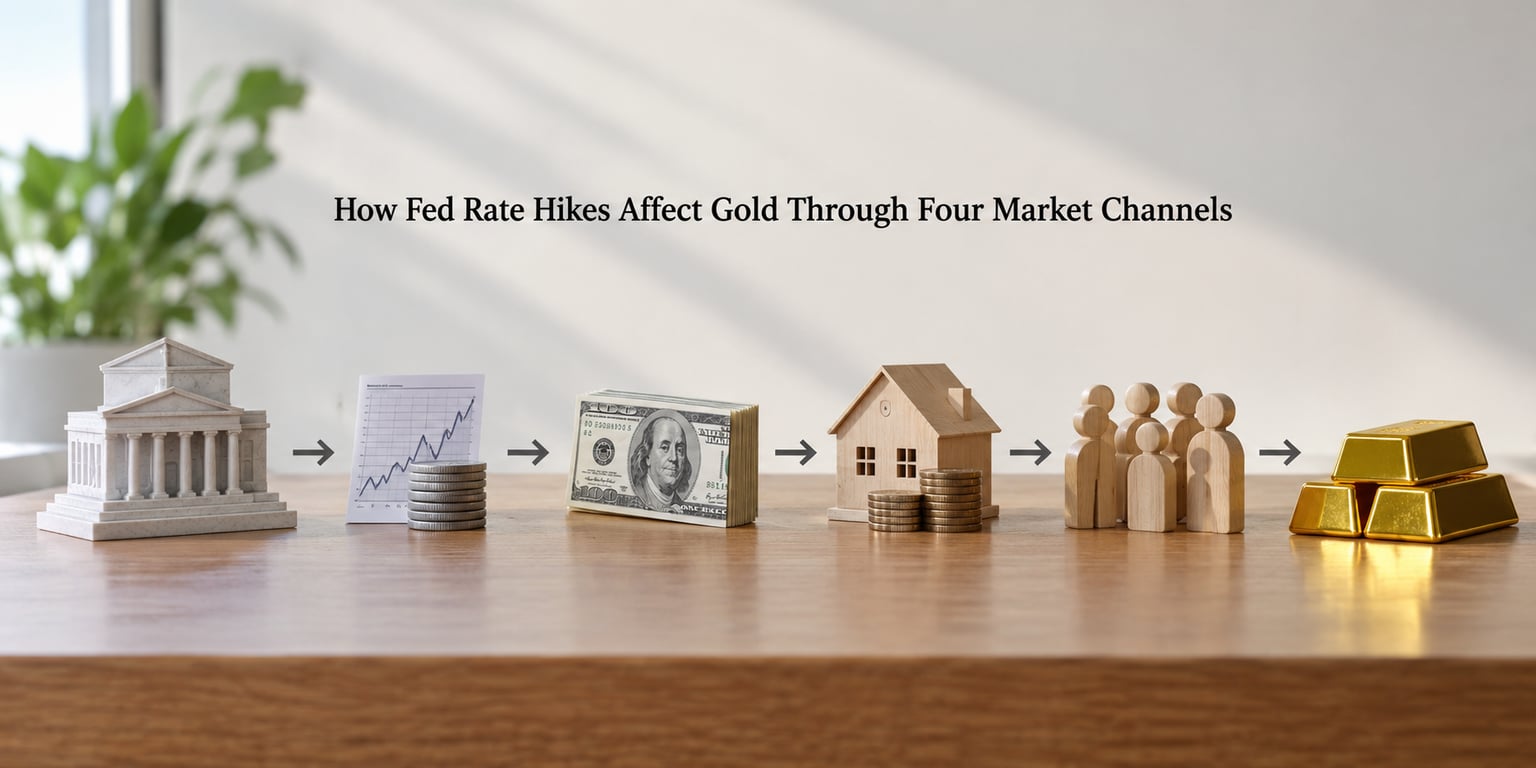
Every rate hike reaches gold along the same four paths. They run in a sensible order: first the opportunity cost of holding, then real yields, then the dollar, then the flows of actual money into and out of the metal.
Understanding how Fed rate hikes affect gold in 2026 means watching all four at once, because they rarely agree with each other.
How Fed Rate Hikes Affect Gold in the Short Run
The immediate reaction is usually mechanical. Investors who need cash sell their most liquid, most recognisable asset, and gold futures are among the most liquid things on the market. Leveraged positions get closed to meet margin calls, and a large forced sale pushes the price down regardless of fundamentals.
Currency effects amplify it. When US rates rise relative to rates elsewhere, dollar-denominated assets become more attractive to everyone, including foreign buyers. A European or Indian investor sees their local-currency cost of gold climb at the same moment as the dollar price of gold is falling, which makes for a bad two-way move.
Positioning can be crowded, and that cuts both ways. When too many traders are short gold into a meeting, a decision that is less hawkish than expected leaves them scrambling back in, and gold overshoots upward. That whiplash is not a broken model; it is a crowded one.
How Higher Real Yields Change Gold’s Appeal
Real interest rates are nominal yields adjusted for inflation. If a 10-year Treasury yields 4.2 percent and expected inflation over the same period runs 2.8 percent, the real yield is roughly 1.4 percent. That is the number to compare against holding gold, because it is the inflation-adjusted return on the safe alternative.
Now flip it. If yields fall to 3.0 percent while expected inflation holds at 2.8 percent, the real yield compresses to about 0.2 percent. Gold suddenly competes with a real return close to nothing, and the opportunity cost argument weakens sharply even though the Fed was still tightening in nominal terms.
The practical measure is the TIPS yield, the inflation-protected Treasury yield that strips expected inflation out by construction. Breakeven inflation, the gap between nominal and TIPS yields, tells you which half of the equation is doing the moving.
Gold can still rise while real yields rise, for three reasons: haven demand during a stress episode, buying from central banks that price policy risk differently, and expectations of future cuts already embedded in the curve. But over multi-month stretches, the real-yield relationship is the strongest statistical link in the whole complex.
How a Stronger US Dollar Influences Gold
Gold trades in dollars, so the dollar is embedded in the quote. When the dollar rises, gold becomes more expensive for buyers everywhere else. A German buyer who pays in euros sees a bigger bill for the same ounce, which reduces demand at the margin.
This is a pressure, not a rule. During a genuine crisis, dollars are bought in enormous volume, and gold often rises in dollar terms at the same time. If non-US buyers increase physical demand faster than the dollar strengthens, the currency effect is simply overwhelmed.
The relationship also runs through central bank reserves. Reserve managers buying tonnes of gold are not pricing a vacation in Frankfurt; they are looking at currency composition, sanctions risk and the long-run value of holding dollars.
Why Gold Rose Through the 2022 Hiking Cycle
The cleanest test of the rule is what actually happened. The Federal Reserve began raising rates in March 2022 and hiked aggressively for the better part of two years, and gold did not simply drift lower. It set fresh highs along the way, and in 2026 it continued to climb through and beyond the tightening cycle.
Four forces explain the disconnect. Central bank buying is the biggest: purchases ran near 91 tonnes a month against a pre-2022 average of about 17 tonnes, which is a structural change in who the marginal buyer is. Gold ETFs absorbed holdings steadily, so Western investor demand no longer collapses when yields rise the way it used to.
Fiscal and reserve-diversification concerns added a demand channel that has nothing to do with the Fed. And hedging demand rose as investors looked for something that does not depend on the credibility of a single institution’s monetary policy.
Goldman Sachs made the constructive case in September 2026, arguing that further hikes would slow rather than derail the rally. Separately, reporting from the September 2026 meeting shows how quickly both directions can appear: spot gold fell more than 1 percent on the decision day, while Comex front-month futures settled the session about 1.27 percent higher. Gold has repeatedly rallied on hawkish news too, which is exactly the whiplash that makes the textbook rule feel unreliable.
What Can Gold Do After the Fed Stops Hiking?
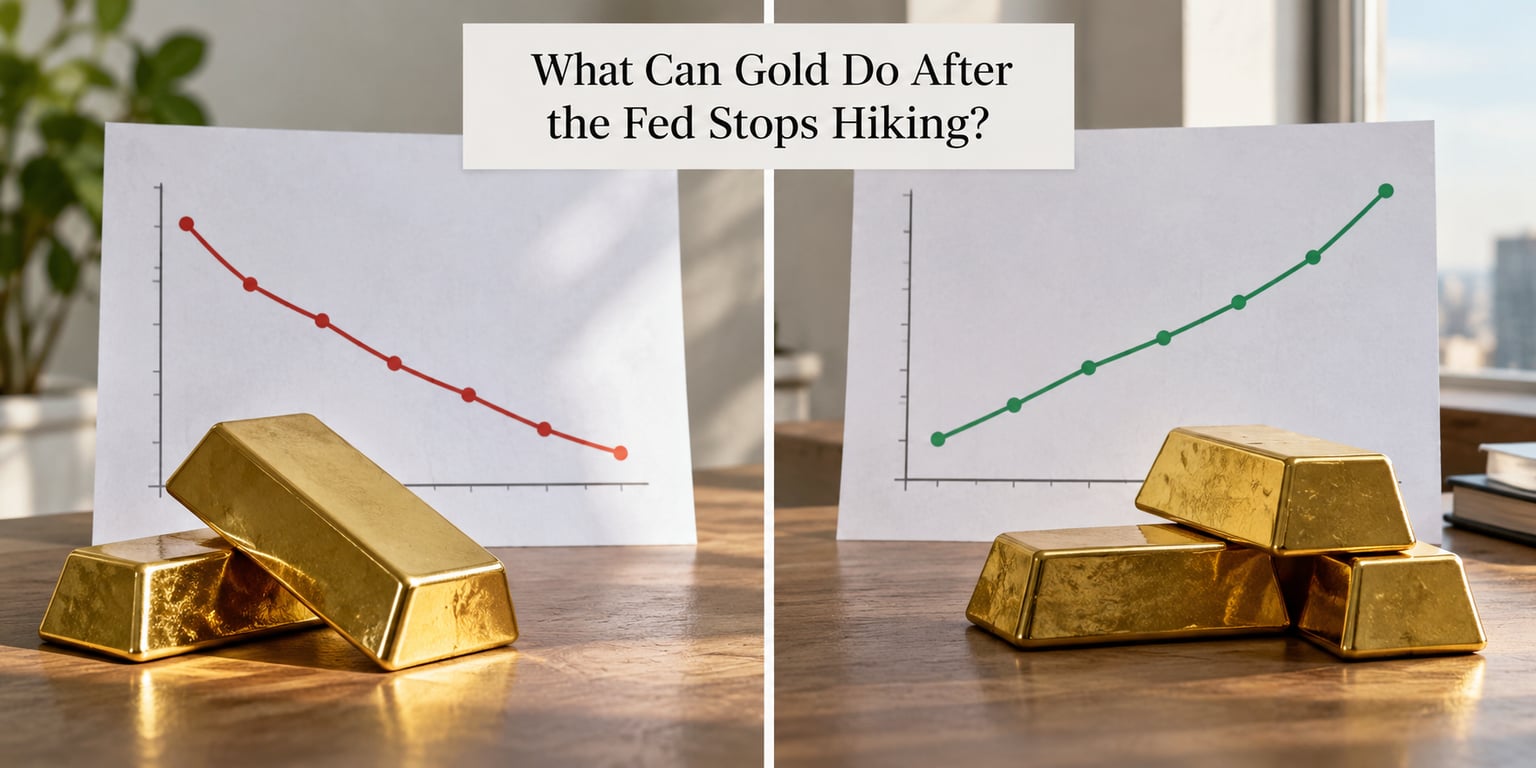
Ending the hiking cycle is not automatically good news for gold. Three quite different paths follow, and the difference between them is decided by what the Fed says about what comes next.
Gold rebounds. This is the soft-landing-plus-cuts path. Markets read the pause as the start of easing, real yields drift down, and the opportunity cost of holding gold shrinks. Safe-haven demand adds to it if growth is rolling over at the same time.
Gold stays firm. If the dollar and real yields stay elevated because inflation is sticky, gold can hold its level without much help from the rates channel. Central bank buying quietly does the supporting work here.
Gold keeps falling. If the Fed signals that the terminal rate is higher than expected and keeps tightening, or if a hawkish surprise lands against crowded positioning, tighter financial conditions can outweigh haven demand for a while.
The distinction that matters is between a pause that begins an easing cycle and a pause that is a pause. Forward guidance, the dot plot and the language around balance-sheet policy are what tell them apart, which is why the reaction to a meeting often matters more than the decision itself.
Fed Rate Hikes and Gold: What the Market May Already Be Pricing
Markets trade the gap between what was expected and what happened. A fully priced hike is a non-event, and a hike that surprises nobody can even produce a rally as short covering takes over. This is the point that separates readers who understand gold from readers who react to headlines.
Fed funds futures and fed funds rate odds published by CME Group are the tools for estimating what is priced in before a meeting. If the market has assigned a high probability to a 25 basis point move, that outcome changes nothing.
| Fed outcome | Typical pressure on gold | What to watch |
|---|---|---|
| Hawkish surprise | Downward, often sharp | Real yields, dollar index, open interest in futures |
| Hike fully priced in | Little reaction, sometimes a small rally | Positioning and the size of the move in yields |
| Dovish surprise or a cut | Upward | Whether real yields actually fall alongside the policy rate |
| Recession fears | Upward, often fast | Credit spreads, jobless claims, haven demand |
| Hawkish rhetoric plus stress elsewhere | Mixed or upward | Which force is stronger: rates or haven demand |
Note the caveat on the last row. Hawkish policy and a falling gold price only coexist cleanly when the rates channel is the stronger force. When financial stress dominates, gold can rise on the same news.
Which Economic Signals Should Investors Watch Next?
Rates alone will not tell you where gold goes next. Here is the monitoring list I would keep open, in rough order of how much noise each one adds.
Real Treasury yields. The TIPS yield is the single most useful series for judging opportunity cost. Sustained moves here line up with sustained moves in gold more often than the policy rate does.
The US dollar index. It tells you how much of the move is currency translation versus real demand. Gold rising while the dollar falls is a different signal from gold rising with it.
Inflation expectations. Breakeven inflation tells you whether rising nominal yields reflect higher real rates or higher inflation compensation. The first is bearish for gold, the second is much less so.
Payrolls and unemployment. These decide whether the Fed can keep tightening and whether a recession enters the picture. Softer labour data tends to pull real yields down.
Financial conditions. Credit spreads, lending standards and equity volatility all feed back into policy. Tight conditions raise the odds of the Fed backing off sooner than expected.
ETF flows and central bank purchases. These are the two channels that broke the historical relationship, and they are the two to watch if the textbook rule keeps failing. Persistent ETF inflows mean the marginal buyer is not rate-sensitive.
A bearish case gets stronger when real yields rise, the dollar firms, ETF flows reverse and central bank buying slows at the same time. That combination has not happened in a sustained way since 2022. It gets undermined when real yields fall, haven demand spikes, or official-sector buying holds steady regardless of what the Fed does.
Common Mistakes When Interpreting Gold’s Reaction to Fed Policy
Mistake one: treating a hike as permanently bearish. A single decision is a data point, not a verdict. Gold has rallied on hawkish news repeatedly since 2022, and the forum chatter about it reflects a real puzzle rather than bad luck.
Mistake two: assuming a pause guarantees a rally. If the Fed holds but signals more hikes, real yields can keep rising and gold can keep drifting lower. Watch the guidance and the dots, not the press release headline.
Mistake three: letting the dollar explain everything. The dollar is one channel. When gold rises through a hiking cycle, currency translation is not what is moving the price.
Mistake four: equating meeting-day reaction with cycle outlook. The move in the hour after a decision is positioning and liquidity. The trend across months is real yields and flows. Trading one and expecting the other is a common source of frustration.
A safer check before reacting: ask what real yields did, ask whether the move was already priced in, and ask who was forced to sell. Those three questions explain more moves than the headline does.
One limitation worth stating plainly. This is general education about monetary policy and market pricing. It is not individual investment advice, it cannot tell you whether your own portfolio is right, and rules and rates change over time. If you are making allocation decisions with real money, talk to a qualified professional who knows your situation.
Frequently Asked Questions
No. A hike raises the opportunity cost of holding gold, which usually pushes the price lower in the short run, but the relationship is a tendency rather than a law. Gold rallied through the entire 2022 hiking cycle as central bank buying ran near 91 tonnes a month. Real yields, the dollar and expected future policy matter more than any single decision.
A Treasury bond pays you interest, so a higher policy rate makes its return more attractive and its price can fall without making it a bad holding. Gold pays nothing at all, which means the entire case for owning it rests on future price appreciation or on its role as a diversifier. That difference is why gold reacts more sharply to rate expectations than most fixed income.
Because other channels can outweigh the rates channel. Central bank buying, steady gold ETF inflows, safe-haven demand during financial stress, and inflation running higher than nominal yields all support gold during a hiking cycle. Since 2022 official-sector purchases have run at several times the pre-2022 monthly average, which changed who the marginal buyer is.
It depends entirely on what follows the final hike. If markets expect cuts, real yields tend to fall and gold can recover. If the Fed signals a higher terminal rate and keeps conditions tight, gold can stay under pressure or fall further. A pause on its own carries no direction, so the guidance and the projected rate path matter more than the pause itself.
Mostly, but not always. A physically backed gold ETF tracks the metal closely after its expense ratio, and its flows are one reason gold held up during the hiking cycle. Mining shares and royalty companies are equities, so they move further than the metal in both directions and add company, cost and jurisdiction risk to the same underlying price.
Conclusion: Start With Real Yields and the Dollar
Fed rate hikes tend to pressure gold by raising the cost of holding an asset that pays nothing, but the effect runs through real yields, dollar strength and investor flows rather than the policy rate alone. Gold climbing through a full hiking cycle is the proof that the rule has limits.
So do one thing first. If you keep asking how Fed rate hikes affect gold, start by checking what real Treasury yields did, what the dollar did, and whether the move was already priced in. Those three checks explain more gold price moves than the decision itself, and they are the difference between reading the market and guessing at it.
This is general education about how monetary policy reaches gold prices, not individual investment advice.
Source: https://www.pgm-blog.com/how-fed-rate-hikes-affect-gold/
Anyone can join.
Anyone can contribute.
Anyone can become informed about their world.
"United We Stand" Click Here To Create Your Personal Citizen Journalist Account Today, Be Sure To Invite Your Friends.
Before It’s News® is a community of individuals who report on what’s going on around them, from all around the world. Anyone can join. Anyone can contribute. Anyone can become informed about their world. "United We Stand" Click Here To Create Your Personal Citizen Journalist Account Today, Be Sure To Invite Your Friends.
LION'S MANE PRODUCT
Try Our Lion’s Mane WHOLE MIND Nootropic Blend 60 Capsules
Mushrooms are having a moment. One fabulous fungus in particular, lion’s mane, may help improve memory, depression and anxiety symptoms. They are also an excellent source of nutrients that show promise as a therapy for dementia, and other neurodegenerative diseases. If you’re living with anxiety or depression, you may be curious about all the therapy options out there — including the natural ones.Our Lion’s Mane WHOLE MIND Nootropic Blend has been formulated to utilize the potency of Lion’s mane but also include the benefits of four other Highly Beneficial Mushrooms. Synergistically, they work together to Build your health through improving cognitive function and immunity regardless of your age. Our Nootropic not only improves your Cognitive Function and Activates your Immune System, but it benefits growth of Essential Gut Flora, further enhancing your Vitality.

Our Formula includes: Lion’s Mane Mushrooms which Increase Brain Power through nerve growth, lessen anxiety, reduce depression, and improve concentration. Its an excellent adaptogen, promotes sleep and improves immunity. Shiitake Mushrooms which Fight cancer cells and infectious disease, boost the immune system, promotes brain function, and serves as a source of B vitamins. Maitake Mushrooms which regulate blood sugar levels of diabetics, reduce hypertension and boosts the immune system. Reishi Mushrooms which Fight inflammation, liver disease, fatigue, tumor growth and cancer. They Improve skin disorders and soothes digestive problems, stomach ulcers and leaky gut syndrome. Chaga Mushrooms which have anti-aging effects, boost immune function, improve stamina and athletic performance, even act as a natural aphrodisiac, fighting diabetes and improving liver function. Try Our Lion’s Mane WHOLE MIND Nootropic Blend 60 Capsules Today. Be 100% Satisfied or Receive a Full Money Back Guarantee. Order Yours Today by Following This Link.


| Visits: | 1,833,882,533 |
| Stories: | 8,714,979 |
Whistler Blowers, Insiders

