

How Quantitative Easing Works: A Plain-English Guide (October 2026)

Quantitative easing works like this: a central bank creates money electronically, uses it to buy government bonds or mortgage-backed securities from banks and investment funds, and in doing so pushes bond prices up and interest rates down. That is the entire mechanism. Everything else — the stimulus, the currency weakness, the rally in equities and gold — is a second-order effect that flows from those two moves.
Central banks reach for it only when ordinary rate cuts run out of room. Once the overnight policy rate is near zero and cutting it further would push yields into negative territory, there is very little left to do with conventional tools. Asset purchases are what remains.
The rest of this guide walks through the mechanics step by step, shows where the new money actually lands, and covers what investors should watch when the program is running or when it is being unwound.
What Is Quantitative Easing?

Quantitative easing is an unconventional monetary policy tool in which a central bank buys large quantities of government bonds and other securities to push bond prices up, push their yields down, and make borrowing cheaper across the economy.
Here is the plain-English version. Normal monetary policy works by adjusting the price of overnight money. A central bank pushes its policy rate up or down and banks follow. Quantitative easing works one level further out: instead of changing the price of borrowing overnight, it goes into the market and buys the debt itself, taking a chunk of the supply out of private hands.
Three things define it:
- The central bank announces a purchase target, either a fixed dollar amount or an open-ended commitment to buy a set monthly pace until conditions improve.
- The purchases are funded by creating reserves electronically. No physical cash is involved at any point.
- The intent is to lower longer-term yields, because policy rates alone were no longer enough to stimulate borrowing and spending.
The Bank of England, the European Central Bank, the Bank of Japan and the Swiss National Bank have all used variations of it, which tells you it is not an American quirk but a standard tool whenever the zero lower bound binds.
How Quantitative Easing Works Step by Step
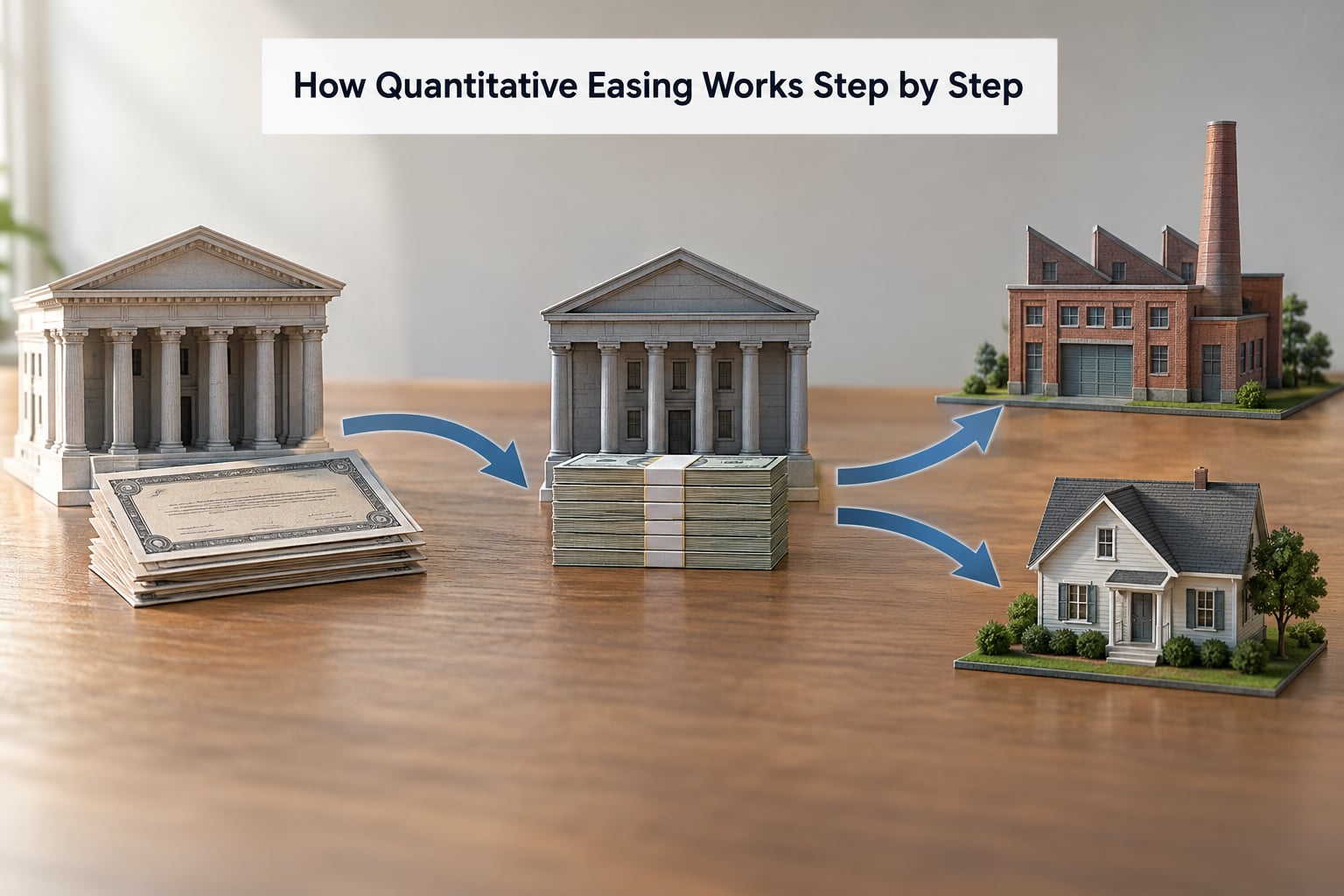
- The central bank announces a purchase target. This might be a fixed amount, a monthly cap, or an open-ended commitment tied to economic conditions.
- It creates reserves to pay for the purchases. These are digital entries credited to banks at the central bank. Nothing is printed.
- It buys bonds through primary dealers. Dealers are firms authorised to trade directly with the central bank. They aggregate sellers and deliver the securities.
- Sellers receive payment instead of reserves. A bank seller gets credited in its reserve account; a non-bank seller gets a deposit in a commercial bank.
- Bond prices rise and yields fall. Extra demand for a fixed supply of debt pushes prices up, and since yield and price move in opposite directions, yields drop.
- Lower yields feed through to borrowing costs. Mortgage rates, corporate bond yields and some consumer rates trend down with the wider market, sometimes with a lag.
- Cheaper money is meant to turn into spending. Households borrow and consume, companies borrow to invest, and savers rebalance into riskier assets seeking better returns.
That last step is where the argument starts, because it is the only step that depends on human behaviour. The first six happen mechanically. The seventh is a hope.
How quantitative easing works when the seller is a bank versus a fund
This is the detail almost every explainer skips, and it is the one that trips up readers trying to work out where the money goes.
When a commercial bank sells bonds to the central bank, the payment lands as reserves in that bank’s own account at the central bank. When a pension fund or money market fund sells, the payment lands as a deposit in whichever bank holds that fund’s account. Either way reserves are created. The difference is who can use them.
Only banks can lend reserves out, because only banks can create deposits against them. A pension fund sitting on a bigger deposit will typically shift the money into equities, bonds, gold or foreign currency. That purchasing pressure is one reason asset prices tend to firm up during a program.
It also explains a puzzle that shook confidence in the stimulus story. After QE1, reserves piled up and bank lending fell for years. Banks were not sitting on reserves for lack of money to lend; they were constrained by capital requirements, weak credit demand and low profitability. More reserves did not automatically mean more loans.
What Assets Do Central Banks Buy?
The core programme is nearly always government debt, but several other assets have appeared in practice, each with a different purpose and a different set of risks.
| Asset | Purpose | Main risk |
|---|---|---|
| Government bonds | Lower the risk-free benchmark that mortgages, corporate debt and loans are priced against | Large holdings concentrate duration risk on the central bank’s own balance sheet |
| Mortgage-backed securities | Remove mortgage debt from private hands and support the housing market directly | Prepayment behaviour is hard to forecast, so the average maturity on the book can shift quickly |
| Covered bonds | Widen the pool of safe assets available for private balance sheets | Adds complexity and requires careful collateral management |
| Corporate bonds and asset-backed securities | Credit risk moves onto the public balance sheet rather than vanishing | |
| Commercial bills | Provide a short-term safe asset during a market funding squeeze | Very short duration, so limited effect on long-term borrowing costs |
Choosing mortgage-backed securities rather than Treasuries says the central bank wants mortgages cheaper. Choosing corporate debt says it wants a specific credit channel reopened. The asset is the policy statement.
Why Does Buying Bonds Lower Interest Rates?
Bond prices and yields move in opposite directions, and that single fact explains most of what quantitative easing does.
A bond pays a fixed coupon until maturity plus the face value at the end. If you buy it above face value, your effective return falls. So if new buyers start paying more for the same bond, its yield drops without anything about the coupon changing.
When a central bank becomes a large, price-insensitive buyer, it bids up the price of what it wants and absorbs the supply everyone else wants to sell. That is the portfolio rebalancing channel: funds and banks that sold bonds now hold fewer of them and must move into other assets to meet their targets, which spreads buying pressure further.
From there the pass-through runs outward. Mortgage lenders price off Treasury and mortgage-backed securities, so their rates fall. Corporate issuers refinance when the cost of new debt drops, so interest expense eases. Savers face a lower return on safe deposits, which is the point for the policy but a problem for anyone living on that income.
The transmission is not instant and not one-to-one. Yields on ten-year debt can rise during a purchase programme if investors expect future inflation or future bond issuance to climb. Markets read the whole path of policy, not just the current action.
How Does Quantitative Easing Affect the Economy?
Quantitative easing is a plumbing operation with several outlets. Understanding which outlet is open explains why the same programme produces different results in different decades.
- Borrowing costs. The intended channel and the best documented. Yield-based borrowing costs fall across the economy.
- Bank reserves and lending. Reserves grow, but lending responds only when capital rules, credit demand and risk appetite allow it.
- Portfolio rebalancing. Sellers chase returns elsewhere, supporting equities, credit and gold.
- Confidence and wealth effects. Higher asset prices make households feel richer and businesses more willing to spend, though the evidence for the size of this effect varies.
- Exchange rates. Lower yields at home make domestic assets less attractive to foreign investors, which tends to weaken the currency on the way down.
- Expectations. Forward guidance is usually paired with purchases so markets understand how long the accommodation is expected to last.
- Deflation prevention. In a weak economy, the goal may simply be stopping a downward spiral in prices rather than forcing growth.
One clarification is worth making early, because it comes up constantly: quantitative easing expands the monetary base reliably, but the money supply responds only if the public is willing to hold the resulting deposits. Reserve growth and deposit growth are two different things.
Where the money shows up in the money supply tiers
| Tier | What it includes | How QE affects it |
|---|---|---|
| M0 | Physical currency held by the public and in bank vaults | Largely unaffected; QE creates no cash |
| M1 | M0 plus checkable deposits and other highly liquid balances | Rises when bank sellers receive reserve balances that boost deposit capacity |
| M2 | M1 plus small-denomination time deposits and retail money market funds | Can expand as lower rates push savers into fund accounts |
| M3 | M2 plus institutional money market funds and deposits held abroad | Often the fastest-growing tier when funds rotate out of government debt |
| M4 | M3 plus comparable deposits held in other jurisdictions | Widest measure, least responsive to a single country’s programme |
Nobody tracks M4 outside academic work. But the table shows why a huge balance sheet expansion does not automatically produce a proportionally huge M2, and why the inflation question depends on money demand rather than the central bank’s intentions.
What Happens to Equities, Currencies, Gold, and Commodities?
Bonds get the direct effect. Everything else reacts to the conditions bond buying creates: lower real yields, weaker confidence in the currency, and money searching for yield somewhere other than a bank account.
Equities. Lower discount rates raise the present value of future earnings, and excess cash pushes investors into equities for yield. This has been the most reliable market-side effect, though a programme launched during a genuine credit crisis can be overwhelmed by the crisis itself.
Government bonds. Yields on the targeted maturities usually fall, while term premiums can compress so investors accept less extra return for holding long-dated debt. If markets believe the central bank will eventually sell, long yields can rise during the programme.
Currencies. This is where the devaluation question comes from. When policy rates fall while rates elsewhere stay higher, capital tends to rotate toward higher-yielding currencies, which pushes the domestic currency weaker. That helps exporters and importers of raw materials, and it raises the local price of anything priced in dollars. It is a real effect, though rarely the stated goal.
Gold. Gold pays no interest, so its opportunity cost falls when real yields fall. Central bank demand for gold often rises alongside programme purchases, which adds a second source of support. The caution is instructive: during the third round of Fed purchases gold spent long stretches declining, because the drive behind the programme was disinflationary rather than inflationary. Rate direction mattered more than the purchases themselves.
Industrial commodities. These respond mostly to growth expectations. If quantitative easing revives demand, metals and energy follow. If it merely holds down yields in a slump, they may not rally at all.
The honest summary: these are tendencies, not rules. Portfolio rebalancing is real, but so is the 2013 taper tantrum, when the mere suggestion of slower purchases pushed long yields sharply higher and emerging-market currencies fell.
Can Quantitative Easing Cause Inflation?
Yes, it can. Whether it does depends on spare capacity and on whether households and firms want to hold the money that gets created.
The inflation channel runs through reserves to bank lending to deposits to spending. If banks are already holding far more reserves than they can use, and nobody wants to borrow, the extra reserves sit idle and prices stay flat. That is the most plausible reading of the long period of low inflation that followed the large balance sheet expansions of the 2010s.
When the economy instead has unused labour and factories and tight supply, the same reserves support spending that pushes prices up. Central banks in that situation normally pair purchases with a commitment to keep rates low until inflation moves back toward target, which deliberately lengthens the route from reserves to spending.
Two other points on this. Expectations matter: if households believe the central bank will reverse course quickly, they treat the money as temporary and spend it immediately. And supply shocks complicate everything, since an expensive energy market produces inflation that rate cuts cannot fix and that asset purchases do not cause.
What Are the Limits and Risks of Quantitative Easing?
- Weak transmission. Reserves pile up without lending growth, so the intended stimulus never arrives.
- Distorted bond pricing. The scarcity of safe assets compresses term premiums and makes long-term rates harder to read as a signal of economic conditions.
- Asset-price inflation rather than consumer inflation. Financial assets can rise sharply while wages and consumer prices stay flat, which worsens inequality for anyone without portfolio exposure.
- Reduced price discovery. Heavy central bank presence makes it harder for investors to see where the market clearing rate actually sits.
- Bad allocation. Capital pulled toward assets with central bank bids may drift into lower-quality credits.
- Financial repression. Keeping yields low indefinitely caps the return savers can earn and pushes pension funds toward riskier assets to meet their obligations.
- Unwinding is hard. Selling securities back into the market is far more disruptive than buying them, which is why balance sheet reduction is usually slow and heavily telegraphed.
- Loss of credibility. If markets doubt that purchases will be reversed when inflation returns, the credibility of the inflation target suffers, and expectations can unmoor on their own.
The recurring criticism is simpler than any of these: the central bank took an asset that was already bought and sold, tried to buy it back later at a loss-making pace, and may now be stuck holding it.
How Investors Can Track Quantitative Easing
You do not need access to anything unusual. Almost everything worth following is published weekly.
- Balance-sheet size and pace. The weekly H.4.1 release from the central bank shows total assets and the change in holdings week by week.
- Purchase caps and reinvestment policy. The monthly cap and whether matured securities are reinvested tell you the direction of travel.
- Yield curve. Watch the segment being targeted. A falling ten-year yield during purchases suggests the programme is transmitting; a rising one suggests markets expect more supply or more inflation.
- Real yields. Inflation-protected bond yields matter more for gold and for equity valuations than nominal yields do.
- Credit spreads. Narrowing spreads mean the credit channel is open. Widening spreads mean it is not.
- Currency reaction. A programme paired with falling short rates tends to pressure the domestic currency.
The reverse gear: how quantitative easing works in reverse
Quantitative tightening, or QT, is the same machinery pointed the other way. Securities mature and are allowed to run off the balance sheet without reinvestment, or the central bank sells them into the market. Reserves drain, the balance sheet shrinks and liquidity tightens.
The effect is gentler when it is slow, which is why most tightening programmes have used monthly caps and long runoff schedules. The risk is a funding-market accident, the kind of events that have appeared each time a central bank pushed too far and too fast.
The direction matters more than the size. Assets rally hardest when the expected path changes, which is why announcements move markets far more than the monthly totals do.
Frequently Asked Questions
No. Printing money increases the physical cash in circulation. Quantitative easing creates reserves electronically and swaps them for securities, so the amount of cash never changes. It also buys an existing asset rather than funding new spending, because the central bank pays the going market price. Calling it printing confuses the mechanism with the money supply, which only grows if banks and the public decide to hold and spend the deposits that get created.
No. Inflation depends on spare capacity and on whether anyone wants to borrow and spend the new reserves. When the economy has unused labour and idle factories, extra money can push prices up. When banks sit on abundant reserves and credit demand is weak, the reserves simply stay idle, which is the most common reading of the low-inflation years that followed the large balance sheet expansions of the 2010s.
Three mechanisms. Lower bond yields reduce the discount rate applied to future earnings, which lifts valuations. Cash that came from selling bonds to the central bank needs reinvesting, and equities are a natural destination. Third, lower policy rates reduce the appeal of cash and deposits, pushing some savings into higher-returning assets. The effect is not automatic: a programme launched during an acute credit crisis can be swamped by the crisis.
Yes, and all of them have. Programmes end because economic conditions met the target, because inflation returned, or because a new policy framework replaced the old one. The end usually comes in stages, with monthly purchase caps lowered and then stopped, followed by reinvestment changes. Because selling is disruptive, most central banks shrink the balance sheet by letting securities mature rather than dumping them into the market.
Rate cuts change the price of overnight borrowing and are the primary tool. Quantitative easing removes securities from private hands and expands the central bank’s balance sheet. In practice the two are almost never separated. When the policy rate is near zero, rate cuts have little room left, so the central bank shifts its effort to the quantity of assets it absorbs. Expectations of the future rate path usually matter more to markets than the current action.
Prices go up and yields go down, because yield and price move in opposite directions for any fixed-coupon bond. The effect is strongest in the maturities and sectors being purchased, since that is where the central bank’s demand is concentrated. Long yields do not always follow: they can rise if investors expect inflation to lift future rates, or if they fear the central bank will eventually have to sell a large holding back into the market.
Conclusion: What to Watch First
Quantitative easing works by creating electronic reserves to buy securities, which lifts bond prices, lowers yields and loosens financial conditions. The first six steps of that chain are mechanical; only the final step depends on people choosing to borrow and spend.
If you want a short list to follow, start with four things: the size and pace of purchases, the yield curve in the maturities being targeted, real yields rather than headline rates, and credit spreads as a check on whether the credit channel is actually open. Track those and the rest of the debate mostly takes care of itself.
Source: https://www.pgm-blog.com/how-quantitative-easing-works/
Anyone can join.
Anyone can contribute.
Anyone can become informed about their world.
"United We Stand" Click Here To Create Your Personal Citizen Journalist Account Today, Be Sure To Invite Your Friends.
Before It’s News® is a community of individuals who report on what’s going on around them, from all around the world. Anyone can join. Anyone can contribute. Anyone can become informed about their world. "United We Stand" Click Here To Create Your Personal Citizen Journalist Account Today, Be Sure To Invite Your Friends.
LION'S MANE PRODUCT
Try Our Lion’s Mane WHOLE MIND Nootropic Blend 60 Capsules
Mushrooms are having a moment. One fabulous fungus in particular, lion’s mane, may help improve memory, depression and anxiety symptoms. They are also an excellent source of nutrients that show promise as a therapy for dementia, and other neurodegenerative diseases. If you’re living with anxiety or depression, you may be curious about all the therapy options out there — including the natural ones.Our Lion’s Mane WHOLE MIND Nootropic Blend has been formulated to utilize the potency of Lion’s mane but also include the benefits of four other Highly Beneficial Mushrooms. Synergistically, they work together to Build your health through improving cognitive function and immunity regardless of your age. Our Nootropic not only improves your Cognitive Function and Activates your Immune System, but it benefits growth of Essential Gut Flora, further enhancing your Vitality.

Our Formula includes: Lion’s Mane Mushrooms which Increase Brain Power through nerve growth, lessen anxiety, reduce depression, and improve concentration. Its an excellent adaptogen, promotes sleep and improves immunity. Shiitake Mushrooms which Fight cancer cells and infectious disease, boost the immune system, promotes brain function, and serves as a source of B vitamins. Maitake Mushrooms which regulate blood sugar levels of diabetics, reduce hypertension and boosts the immune system. Reishi Mushrooms which Fight inflammation, liver disease, fatigue, tumor growth and cancer. They Improve skin disorders and soothes digestive problems, stomach ulcers and leaky gut syndrome. Chaga Mushrooms which have anti-aging effects, boost immune function, improve stamina and athletic performance, even act as a natural aphrodisiac, fighting diabetes and improving liver function. Try Our Lion’s Mane WHOLE MIND Nootropic Blend 60 Capsules Today. Be 100% Satisfied or Receive a Full Money Back Guarantee. Order Yours Today by Following This Link.


| Visits: | 1,833,882,533 |
| Stories: | 8,714,979 |
Whistler Blowers, Insiders

