

What Is Quantitative Tightening? A Simple Guide (October 2026)

Quantitative tightening is the process a central bank uses to shrink its balance sheet, mainly by letting bonds it holds mature without reinvesting the proceeds, which drains reserves from the banking system and slows money growth. It is the reverse of quantitative easing, and it supports a central bank’s effort to bring inflation back to target.
That definition covers the mechanics, but not the intuition. Think of a central bank as a warehouse that buys up bonds, and QT as a decision to stop refilling the shelves. Nobody sets fire to the building. The pile just declines, quietly, month after month, and the effect ripples out to mortgage rates, equity valuations, the dollar and gold.
For US readers the Federal Reserve is the central bank that matters most, and it ran a QT programme from October 2017 to September 2019, then again from June 2022 until it stopped runoff in late 2025. Below is how the process works, why it is not the same thing as a rate hike, and what to watch on the central bank’s balance sheet now.
What Is Quantitative Tightening?
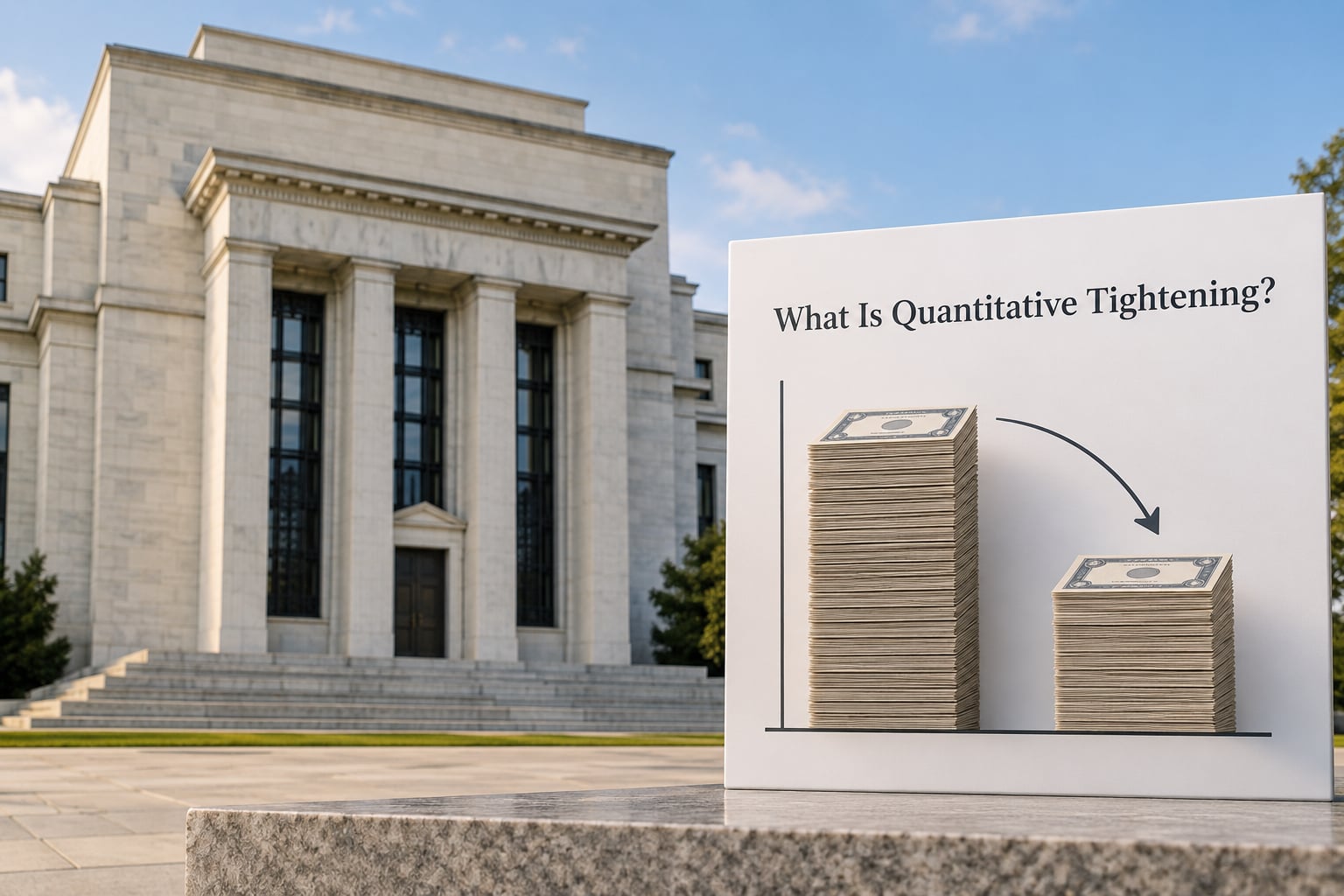
A central bank’s balance sheet is a record of what it owns and what it owes. On the asset side sit the securities it bought: Treasury bills, Treasury notes, and mortgage-backed securities. On the liability side sit the credits it created to pay for them: bank reserves, the cash in circulation, and the reverse repo facility.
When a central bank buys a bond, it creates reserves to pay for it and its balance sheet grows. Every asset has a matching liability. Quantitative tightening is the deliberate reversal of that: let holdings run off or sell them, and both sides of the ledger shrink together. Federal Reserve assets peaked close to 9 trillion dollars in early 2022 after the pandemic asset purchases, and the subsequent runoff has taken roughly 2 trillion dollars off that total.
Here is the policy in compact form:
| Element | Quantitative tightening | Typical market objective | What investors tend to watch |
|---|---|---|---|
| Direction | Balance sheet shrinking | Tighter financial conditions and inflation credibility | Reserves, yields, liquidity-sensitive assets |
| Main mechanism | No reinvestment of maturing principal, plus active sales | Drain reserves without relying on rate policy | FOMC statements and reinvestment announcements |
| Instrument affected | Central bank asset holdings | Bank balance-sheet capacity | Treasury General Account, money market rates |
| Relationship to rates | Separate from the policy rate, though often paired with it | Signal that policy will stay tight | Federal funds rate path and yield curve shape |
The language gets confusing because central banks, journalists and retail platforms all use shorthand. A few terms worth knowing before going further:
- Runoff means letting securities mature and letting the cash drain away rather than buying replacements.
- Reinvestment is the practice of using maturing principal to buy more of the same type of security. Saying QT begins on a date usually means reinvestment stops on that date.
- SOMA is the System Open Market Account, the Fed’s portfolio of securities held on behalf of the Open Market Committee.
- Reserves are balances commercial banks hold at the central bank. They are the plumbing that settles payments between banks.
- Reverse repo facility (RRP) is a tool money funds and banks use to park cash at the Fed for short periods, earning an administered rate.
- Ample reserves describes a regime in which the central bank holds the balance sheet still and manages the level rather than the size, steering short-term rates with its administered rates.
How Does Quantitative Tightening Work?
There are only three mechanisms, and understanding the cash flow is the part most explainers skip. When a Treasury security held in SOMA reaches maturity, the Treasury pays the principal by crediting the Fed’s account at the Treasury. The Fed’s holdings fall by that amount and its asset side shrinks.
On the other side, the payment moves the Fed’s own reserve balances down: the central bank debits its account and the recipient’s bank receives fewer credits at the central bank. Commercially, it looks like one bank settling with another. No cash leaves the banking system as physical notes. The Fed simply declines to refill reserves by buying a replacement bond.
So the mechanics, in order:
- Stop reinvesting maturing principal. The central bank lets holdings run off rather than replacing them. This is the passive route and the dominant one in practice.
- Let the resulting drain reach reserves. Because every sale or maturity is matched by a debit to reserve balances, banking system liquidity shrinks by the same amount over time.
- Actively sell securities. To speed things up, a central bank can sell holdings outright, including mortgage-backed securities. This is faster, noisier and rarely used at a large scale because it pushes supply into private hands.
The Fed also applies caps. Between 2017 and 2019 it allowed holdings to decline gradually rather than by a fixed sum each month. From June 2022 it set a monthly cap on Treasury redemptions and a separate cap on MBS principal repayments above a small reinvestment threshold, so most MBS principal was returned to private investors while only a slice went back into new mortgages.
A simple illustration of how the flow changes over time. Suppose the central bank holds 1 trillion dollars of Treasuries, with a mix of short bills and long notes. Long notes rarely mature, so early months show a modest decline. As the bill share rolls off, the monthly redemptions rise, and the balance falls faster simply because more securities are maturing, not because policy changed.
| Phase | Portfolio mix shifting | Monthly runoff | Reserves |
|---|---|---|---|
| Early | Long notes dominate, few maturities | Modest, predictable | Drifting down gradually |
| Middle | Bill share increases as older paper matures | Rises as bills roll off | Falling faster |
| Late | Short-dated paper makes up most holdings | Lumpy, harder to forecast | Approaching the ample threshold |
The practical consequence is that QT is hard to time. Markets cannot know a month in advance how much will mature, so month-to-month balance sheet moves look noisy even when the policy stance is unchanged. What matters is the trend.
Why Do Central Banks Tighten Their Balance Sheets?
There are four reasons, and they rarely all point the same way.
Inflation credibility. Printing money does not mechanically raise consumer prices, but a very large asset purchase programme is easy to read as an endorsement of easy money. Running the portfolio back down restores the credibility of the inflation target and makes it harder to argue that the target has been abandoned.
Post-crisis normalisation. The pandemic purchases were an emergency response to a market seizure. A central bank that never reduced its holdings would be operating crisis tools indefinitely. QT is the scheduled exit.
Lower interest expense. The Fed pays banks interest on reserves and the Treasury pays coupons on the securities the Fed holds. When the balance sheet is large and policy rates are high, those remittances to the Treasury shrink sharply, which critics call financial repression. A smaller book means a smaller bill, and it transfers less income from the public to the banking system.
Making future room. A smaller balance sheet gives a central bank more capacity to respond to a downturn later. This is the argument that has moved to the centre of the debate as QT ends and questions about future easing return.
None of this requires the policy rate to move. QT and the federal funds target range are separate tools, and history shows them paired in several combinations: QT running while rates were being cut after the 2019 repo crisis, and QT running while the funds rate sat still or moved only slightly in the later stages of the 2022 to 2025 episode. Balance sheet policy is a slow background process. Rate policy is the sharp instrument.
How Does QT Differ From Quantitative Easing?
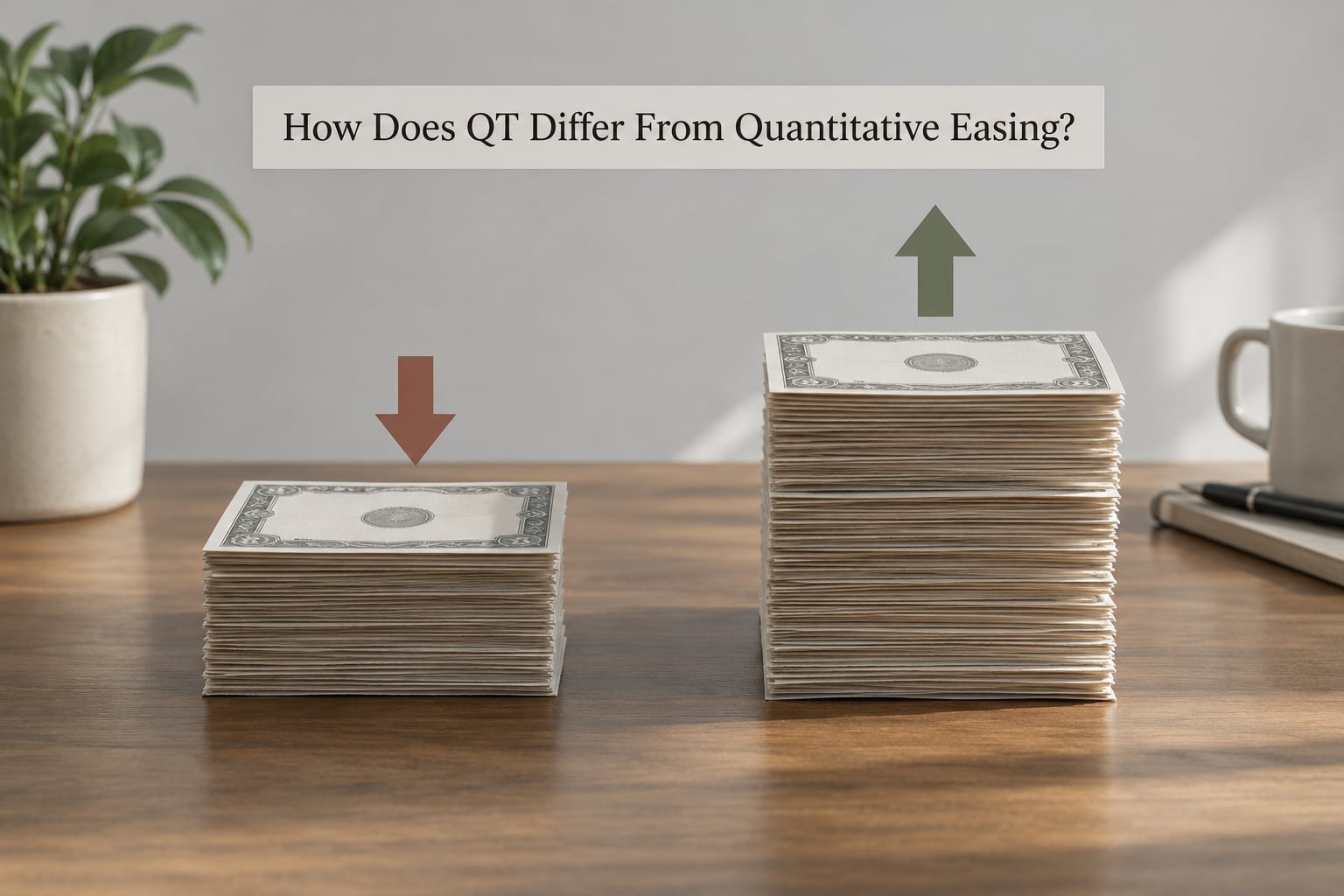
Quantitative easing buys assets to lower long-term borrowing costs and expand liquidity. QT does the opposite. The two are mirror images, but they are not symmetrical in practice, and the differences matter.
| Dimension | Quantitative easing | Quantitative tightening |
|---|---|---|
| Direction of purchases | Buying Treasuries, agency debt, sometimes corporate paper | No reinvestment, and sometimes outright selling |
| Balance sheet | Grows | Shrinks |
| Reserve balances | Rise | Fall |
| Typical market context | Recession risk, deflation fear, market stress | Inflation above target, growth above potential |
| Typical effect on long yields | Pushes yields down | Leaves upward pressure, though often modest |
| Currency tendency | Often a weaker dollar on relative-growth grounds | Often firmer, though the rate path usually dominates |
| Speed | Announced in large tranches over months | Bleeds out over years through maturities |
Why is quantitative tightening slower and less visible than a rate hike?
A quarter-point rate move happens on a scheduled date, gets a statement, an explanation and a market reaction within minutes. QT has no date at which it obviously happens. The central bank announces caps and reinvestment policy, and then the balance sheet declines by whatever happens to mature.
That difference explains the common complaint that QT was quietly tightening markets for years. It was. The mechanism is gradual, so no single data release announces it, and the effect shows up in the background: a slow reserve drain, a slightly higher term premium, and a market that is marginally less liquid than it was a year earlier. Macro-literate readers on r/EconomyCharts generally describe QT the same way, as a passive drain rather than a shock.
It also explains why the size of the two programmes is hard to compare. A crisis QE can add several trillion dollars in a matter of months because purchases are discretionary and large. QT has no equivalent valve, because the central bank cannot decide to sell more; it can only decline to replace what matures, or sell on purpose.
What Does Quantitative Tightening Mean for Investors?
Two things matter here, and keeping them apart prevents most mistakes: what QT does mechanically, and how markets feel about it. The mechanics are slow and fairly predictable. The reaction is fast, noisy and frequently wrong.
Government bond yields and the yield curve
The direct channel is the longest-dated yields, through the term premium. When the central bank is the marginal buyer of a large share of duration, its retreat removes a bid, and the extra yield investors demand to hold that duration tends to rise. The effect is usually gradual and is easily swamped by shifts in growth expectations or inflation prints.
Short rates are governed mostly by the policy rate and by administered rates such as interest on reserves. QT does very little to them mechanically. If short-term funding rates start moving oddly during runoff, the usual suspects are the Treasury General Account rebuilding its balance, money market funds leaving the reverse repo facility, or reserves drifting below what banks consider comfortable.
Borrowing costs for households and companies
Mortgage and corporate rates track the long end more than the funds rate, so a persistent QT period tends to sit alongside a higher cost of borrowing even when the central bank is cutting. Adjustable-rate mortgages reset off short-term rates, which is why borrowers on a variable loan can see payments fall while fixed-rate borrowers do not.
Bank reserves and lending
Reserves fall mechanically as the balance sheet runs off. Whether that matters for credit depends on where they land relative to banks’ needs, and the 2019 episode is the cautionary example. In September 2019, a squeeze in the overnight repo market appeared and the Fed stepped in with short-term operations to relieve it. QT was formally paused soon after.
The lesson institutions drew was that an ample-reserves floor is a policy choice, not a given, and that discovering it by accident is expensive. That reasoning, more than any single data point, explains why the Fed now prefers to hold the balance sheet roughly steady and steer short rates with administered rates.
The dollar
The mechanical effect of QT on the dollar is weak and easy to overstate. Rates matter far more: when a central bank holds its policy rate higher than others’, capital tends to flow toward its currency. Any dollar effect from QT mostly works through the term premium and through the signal that policymakers are prepared to keep tightening financial conditions.
Equities and other risk assets
Risk assets dislike tight liquidity in principle, because valuations are discounted at higher rates and because market depth depends on balance sheet capacity somewhere in the system. In practice, the relationship is noisy. Broad equity indexes have often gone nowhere or risen while QT ran, because earnings growth, inflation data and the rate path move prices far more than a gradual reserve drain.
Sectors that rely on cheap, long-duration funding have felt it more than others. Anything that depends on abundant liquidity or carries heavy borrowing tends to be more sensitive to QT than the index average.
Gold and other precious metals
Gold is where most of the guesswork lives, and readers on this site should treat it with care. There is no mechanical channel from QT to the gold price. Gold does not earn an administered rate and it is not collateral in the repo market that tightened in 2019.
The argument for QT supporting gold is a real-terms argument. Withdrawing liquidity and tightening financial conditions tends to raise the appeal of a finite, non-yielding store of value, and QT is one of the few ways a central bank expresses a tightening bias while its policy rate is falling. The counterargument is that QT has historically accompanied rising real yields, which is headwind for gold, and that the reserve drain matters less for it than the dollar and the real rate.
My own read is that the term premium and the dollar do most of the work, and QT matters mainly as background. Readers who trade the metals should watch real yields and the dollar index first, then treat QT announcements as context rather than as a trigger. The same caution applies to silver and the platinum group metals, which are more industrial and more sensitive to growth expectations than to reserve policy.
Industrial commodities
Commodities are mostly a growth story. A QT period that accompanies strong demand tends to see firm commodity prices even as liquidity tightens. A QT period that runs alongside a slowdown is a different matter, and it is worth separating the two before drawing conclusions about the policy itself.
Is Quantitative Tightening the Same as Raising Interest Rates?
No. A rate hike changes the price of very short-term central bank funds. QT changes the size and composition of a portfolio of long-dated securities. They act on different parts of the yield curve, through different plumbing, and markets can move sharply on one while ignoring the other.
The distinction matters most in three situations. When a central bank is cutting rates while still running QT, the two are visibly pulling in opposite directions and the curve tends to steepen. When a central bank stops reinvesting but holds the policy rate, QT becomes a slow background tightening that most rate-focused commentary ignores. And when reserves approach scarcity, the funding market can tighten even with the policy rate unchanged, which is the unusual case that made 2019 instructive.
A third thing gets confused with both: the reserve requirement ratio, the fraction of certain deposits banks must hold at the central bank. That is a regulatory rule, and it has not been an active policy lever in the United States for decades. Shrinking the balance sheet is not the same as lowering or raising reserve requirements, and a central bank can do one while leaving the other alone.
Bond tapering is a fourth term worth separating. Tapering refers to slowing the pace of asset purchases before ending them. It is a reduction in the rate of expansion, not a contraction, so tapering sits on the QE side of the line.
How Can Investors Monitor Quantitative Tightening?
Everything worth tracking is public and published on a schedule. Here is the checklist I would work through.
- Read the balance sheet itself. The Fed releases the H.4.1 every Thursday, covering total assets, securities holdings, reserve balances, the reverse repo facility and the Treasury General Account. Other central banks publish equivalents.
- Track the trend, not the weekly change. Weekly prints swing for accounting reasons. Use a three-month or six-month change to see the policy signal.
- Watch for reinvestment announcements. Changes in monthly caps, MBS reinvestment thresholds or outright sale plans arrive in FOMC statements and implementation notes before they show up in data.
- Check where reserves sit. Reserve balances against the Treasury General Account and the reverse repo facility tell you what is actually draining. When reserves fall and the general account rebuilds, short rates can drift upward without any policy change.
- Follow short-term funding spreads. Repos, commercial paper and the spread between overnight rates and interest on reserves give early warnings that the system feels tighter.
- Watch the curve and term premia. If long yields are rising while the funds rate is flat, the term premium is doing the work, and that is where QT usually shows up.
- Read the communication, not just the headline. The language around balance sheet normalization versus maintaining an ample-reserves regime matters, and so do the minutes.
Frequently Asked Questions
It is a central bank deliberately shrinking its balance sheet, usually by letting Treasury and mortgage-backed securities mature without buying replacements, and sometimes by selling holdings outright. The effect is a gradual drain on bank reserves and slower money growth. Central banks use it to tighten financial conditions and support credibility around their inflation target after a period of asset purchases.
Not directly. QT changes how much the central bank holds and therefore how much liquidity sits in the banking system. The policy rate is set separately, and a central bank can run QT while cutting or holding rates steady. Any effect on rates works through the term premium and funding conditions rather than through the central bank repricing overnight funds.
QE buys securities to expand the balance sheet, raise reserves and push long-term yields down, usually during weakness or crisis. QT does the reverse: it shrinks the portfolio, drains reserves and tends to leave upward pressure on long yields. QE is discretionary and fast because purchases can be sized freely, while QT is usually passive runoff that bleeds out over years.
When a central bank holds a large share of outstanding bonds, it is part of the marginal bid. Letting that bid fade, or selling into the market, means private investors must absorb more supply and usually demand a higher term premium. That shows up most in long-dated yields. Short rates are anchored to the policy rate and administered rates, so they respond far less.
Watch the weekly H.4.1 release, which shows total assets, securities held outright, reserve balances, the reverse repo facility and the Treasury General Account. A sustained decline in assets and reserves, alongside FOMC language about caps and reinvestment thresholds, is the clearest evidence. Compare three-month and six-month changes rather than single weeks.
Conclusion
Quantitative tightening is a central bank letting its bond portfolio shrink, mostly by declining to reinvest maturing principal, so that reserves drift down and financial conditions tighten a little. It is not a rate hike, it is not the same as quantitative easing, and it is slower and harder to read than either.
As of 2026, the Federal Reserve has stopped runoff and shifted to a holding pattern that aims to keep bank reserves ample, so the era of automatic monthly balance sheet shrinkage is over for now. Watch five things: the reinvestment policy in FOMC statements, the weekly H.4.1 numbers, where reserves sit relative to the Treasury General Account and the reverse repo facility, the policy rate path, and what the long end of the Treasury curve is doing. For gold and silver, add real yields and the dollar to that list, because they do more of the work than balance sheet policy does.
Source: https://www.pgm-blog.com/what-is-quantitative-tightening/
Anyone can join.
Anyone can contribute.
Anyone can become informed about their world.
"United We Stand" Click Here To Create Your Personal Citizen Journalist Account Today, Be Sure To Invite Your Friends.
Before It’s News® is a community of individuals who report on what’s going on around them, from all around the world. Anyone can join. Anyone can contribute. Anyone can become informed about their world. "United We Stand" Click Here To Create Your Personal Citizen Journalist Account Today, Be Sure To Invite Your Friends.
LION'S MANE PRODUCT
Try Our Lion’s Mane WHOLE MIND Nootropic Blend 60 Capsules
Mushrooms are having a moment. One fabulous fungus in particular, lion’s mane, may help improve memory, depression and anxiety symptoms. They are also an excellent source of nutrients that show promise as a therapy for dementia, and other neurodegenerative diseases. If you’re living with anxiety or depression, you may be curious about all the therapy options out there — including the natural ones.Our Lion’s Mane WHOLE MIND Nootropic Blend has been formulated to utilize the potency of Lion’s mane but also include the benefits of four other Highly Beneficial Mushrooms. Synergistically, they work together to Build your health through improving cognitive function and immunity regardless of your age. Our Nootropic not only improves your Cognitive Function and Activates your Immune System, but it benefits growth of Essential Gut Flora, further enhancing your Vitality.

Our Formula includes: Lion’s Mane Mushrooms which Increase Brain Power through nerve growth, lessen anxiety, reduce depression, and improve concentration. Its an excellent adaptogen, promotes sleep and improves immunity. Shiitake Mushrooms which Fight cancer cells and infectious disease, boost the immune system, promotes brain function, and serves as a source of B vitamins. Maitake Mushrooms which regulate blood sugar levels of diabetics, reduce hypertension and boosts the immune system. Reishi Mushrooms which Fight inflammation, liver disease, fatigue, tumor growth and cancer. They Improve skin disorders and soothes digestive problems, stomach ulcers and leaky gut syndrome. Chaga Mushrooms which have anti-aging effects, boost immune function, improve stamina and athletic performance, even act as a natural aphrodisiac, fighting diabetes and improving liver function. Try Our Lion’s Mane WHOLE MIND Nootropic Blend 60 Capsules Today. Be 100% Satisfied or Receive a Full Money Back Guarantee. Order Yours Today by Following This Link.


| Visits: | 1,833,882,533 |
| Stories: | 8,714,979 |
Whistler Blowers, Insiders

